WHAT?
I have decided to work with oil paints, partly because I need to learn more about them, and partly because I sometimes have to break off work suddenly in my role as full-time carer, and oils stay wet whereas acrylics dry up on me.
To begin with I have two sets of brushes and paints, one upstairs in the attic and one downstairs. I appreciate I shall need to mix them at some point.
SO WHAT?
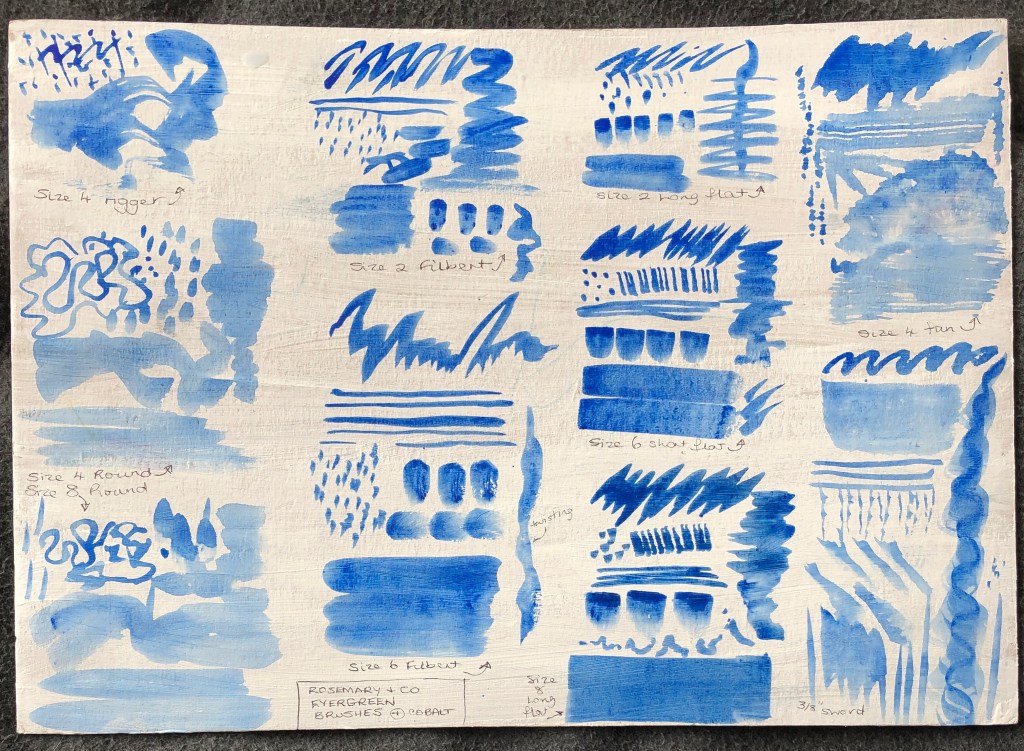
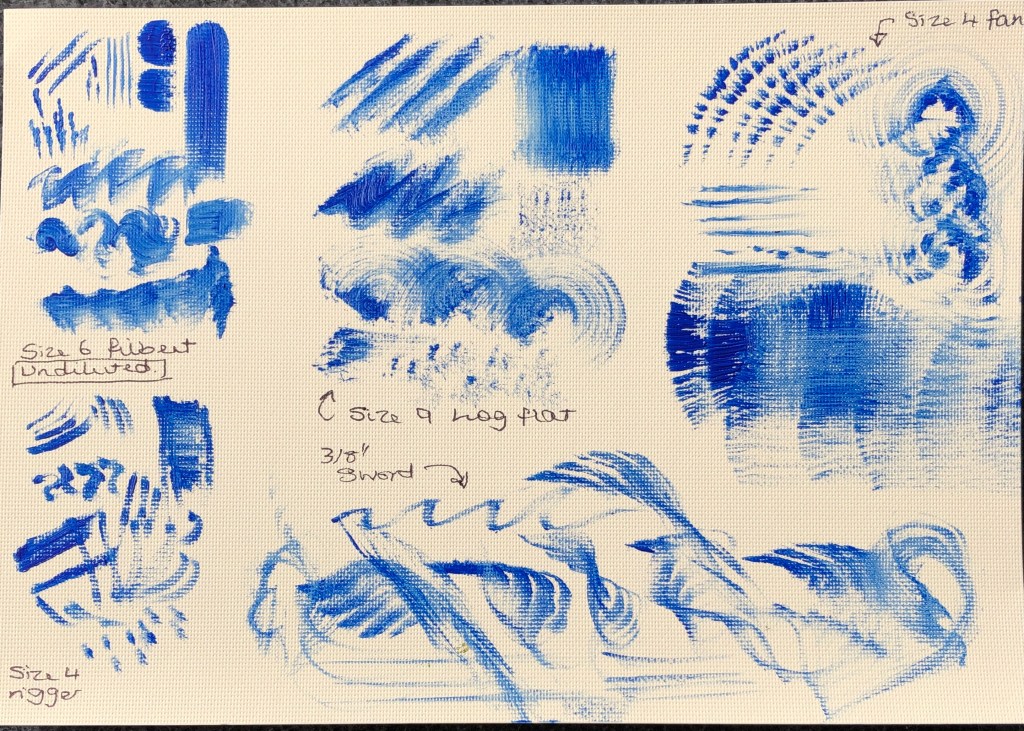
I made a range of marks with my upstairs paints, which are Cobra water-mixable oils, and my brushes, which are a set of alla prima brushes from Rosemary & Co, quite soft bristles. I worked on a bit of cardboard which had previously been coated back and front with gesso. My paint was diluted (with water) and I found that it ran overmuch on this surface and made some marks indistinct, so I did a few more with undiluted paint on oil-prepared paper:
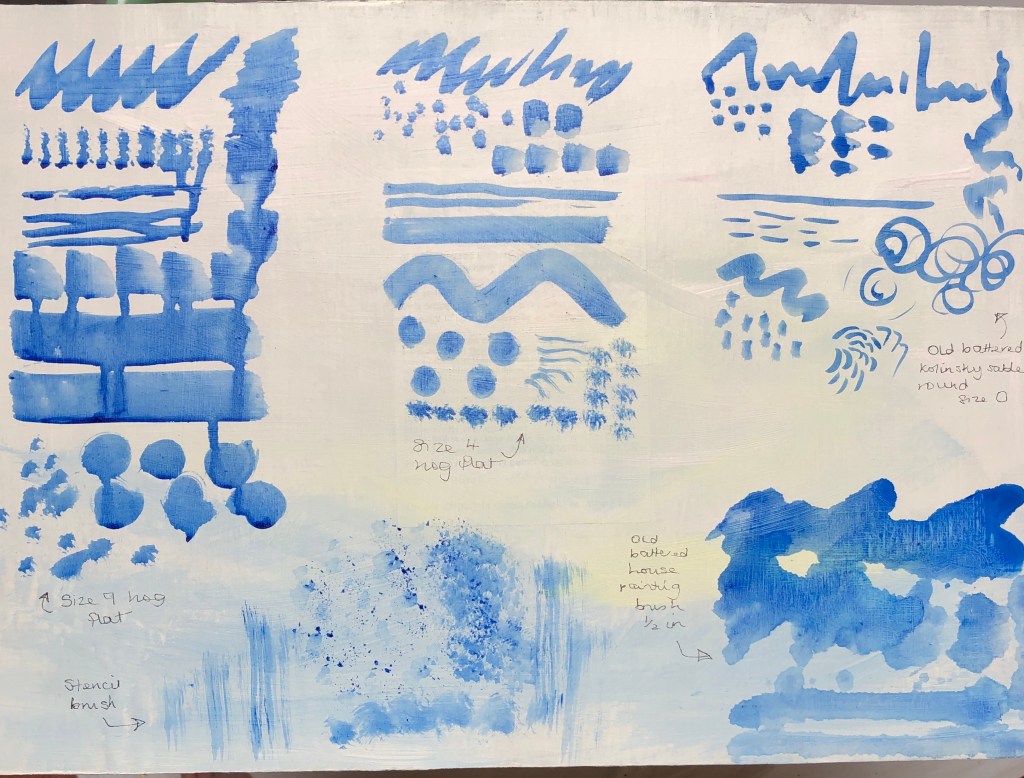
I also tried my downstairs set, mainly bristle flats, rounds and filberts, using Jackson’s oil colours, just slightly diluted with Zest-It, on oil-prepared paper:

I found that:
- Most brushes were capable of a range of marks
- The flats give a slightly crisper, cleaner edge
- The sword and the fan allow for special effects
- The numbers on the brushes seem peculiar to the range – for example, a size 10 in one range is much bigger than a size 12 in another
- Possibly one gets what one pays for – for example, my more expensive hog flat gave a crisper, better defined mark, and was much easier to clean at the end, than my cheap brush.
Next I painted a landscape from memory, a much loved (and much-drawn) section of riverbank on the River Tavy just down the road from our house.
I used my Cobra water-mixable oils (burnt umber and ultramarine for the darks, cobalt blue and lemon yellow for the greens) and three brushes:
- A size 8 flat for the trees and bank
- A sword for the tree roots in the bank (also drawn into with the solid end of the brush for highlights), and parts of the water
- A fan for the foliage and parts of the water.
I worked onto prepared oil paper, size A4. In my memory, the sunlight shone from behind and to the right of the trees:

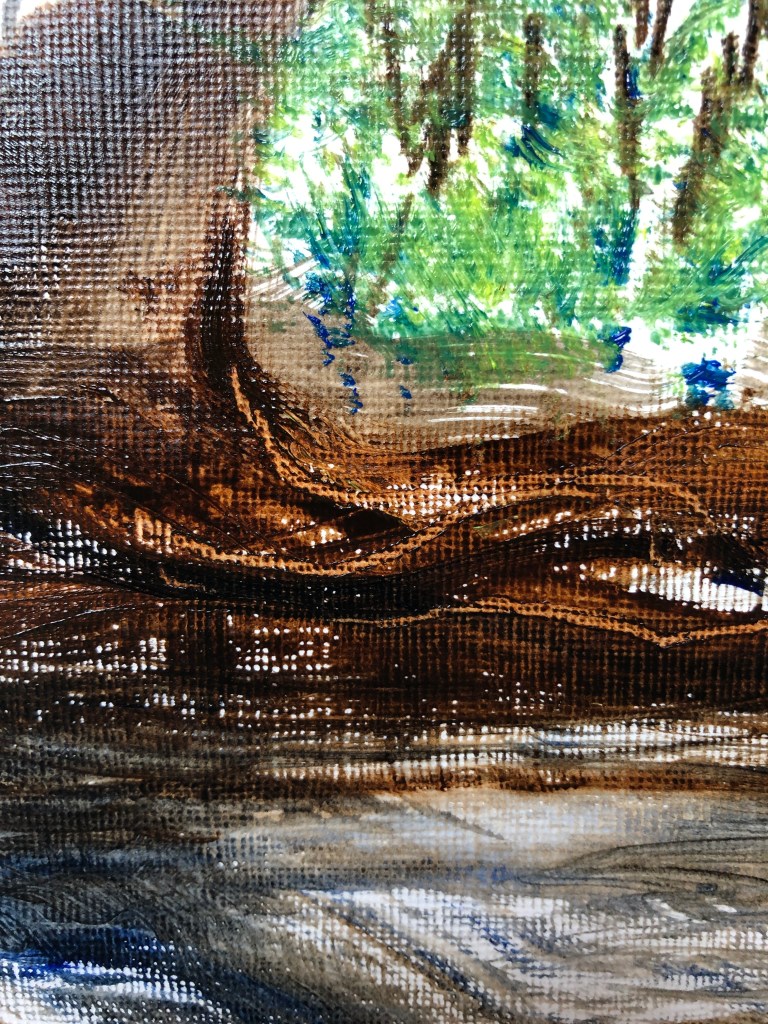

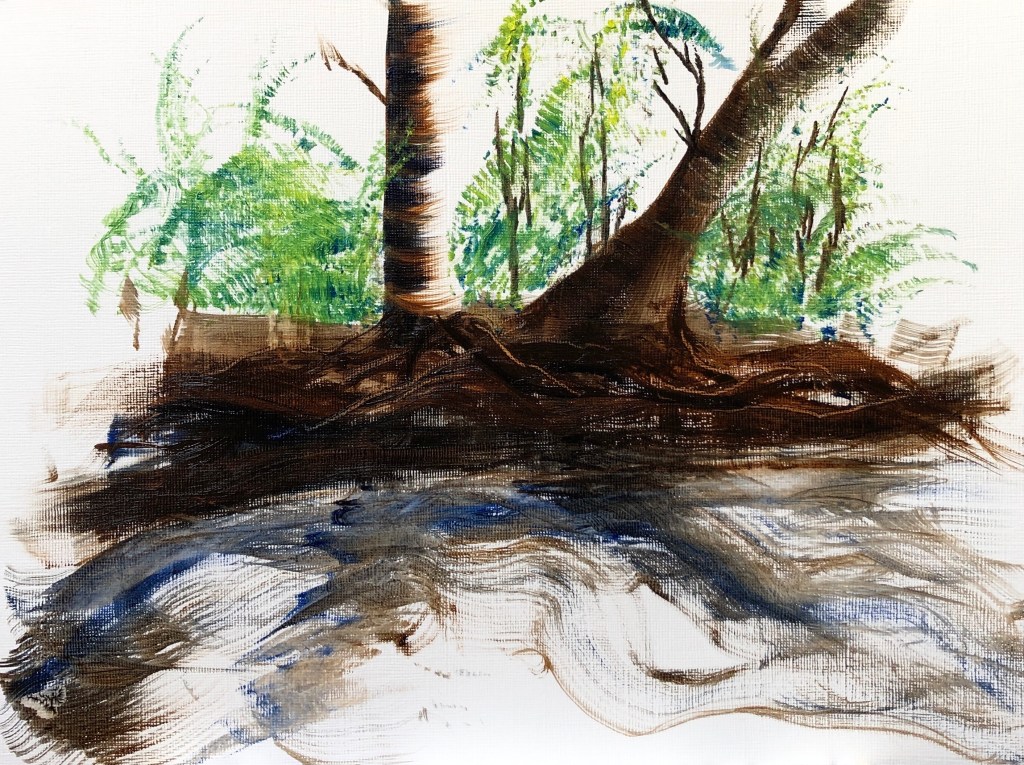
I really enjoyed the precision of the flat and the dragging marks possible with it. I was a bit “jabby” with the fan but I can see that, with practice, it has potential to be useful for layers of foliage, and also for colour mixing on the surface (I picked up bits of separate yellow and blue). The sword also has promise for those narrow-wide-narrow flowing marks, a bit like italic script, but I need to work more at learning how to handle it for less random effects.
Finally, I set up an apple on a white sheet of paper to explore using my large size 8 Winsor & Newton hog filbert. The lamp was directly overhead but I was sitting in a conservatory and, even though it was a very overcast and rainy day, there were multiple shadows. I made a quick biro sketch in my sketchbook, then set to work painting on oil-prepared paper using Jackson’s oils diluted with Zest-It. My small palette consisted of crimson, yellow ochre and ultramarine violet.
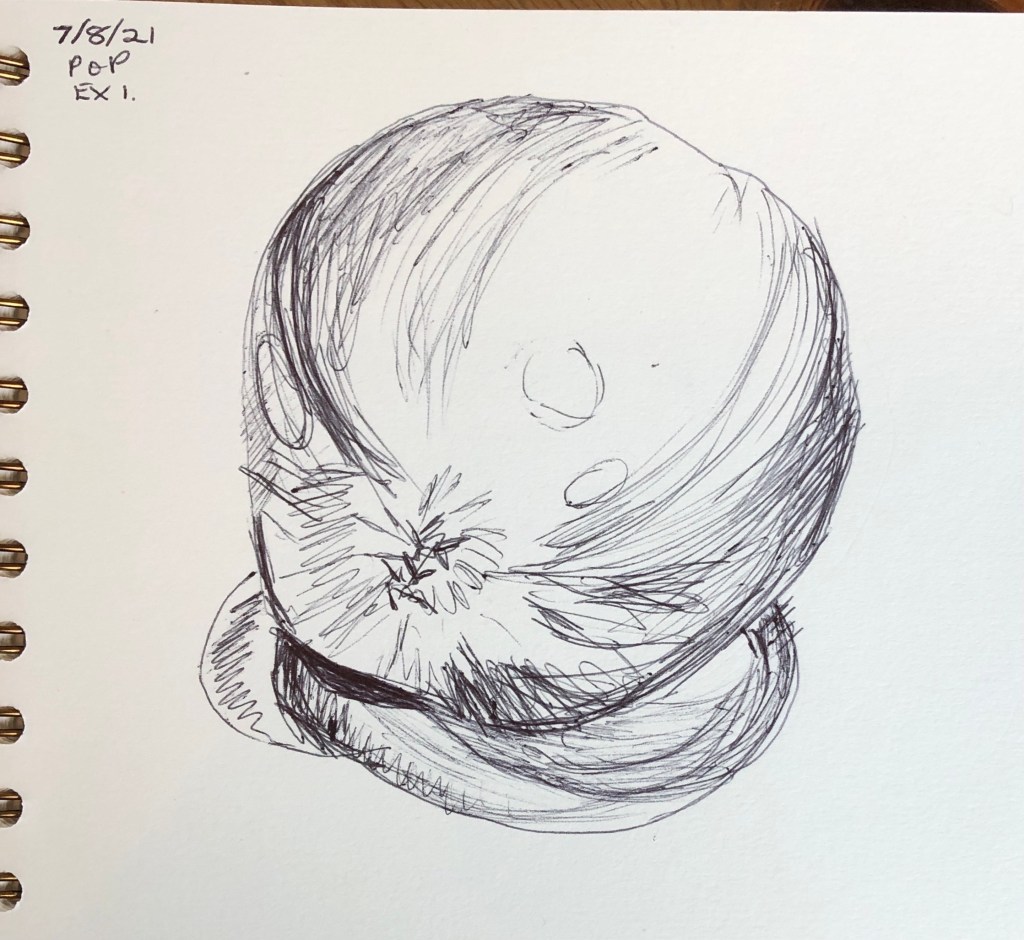
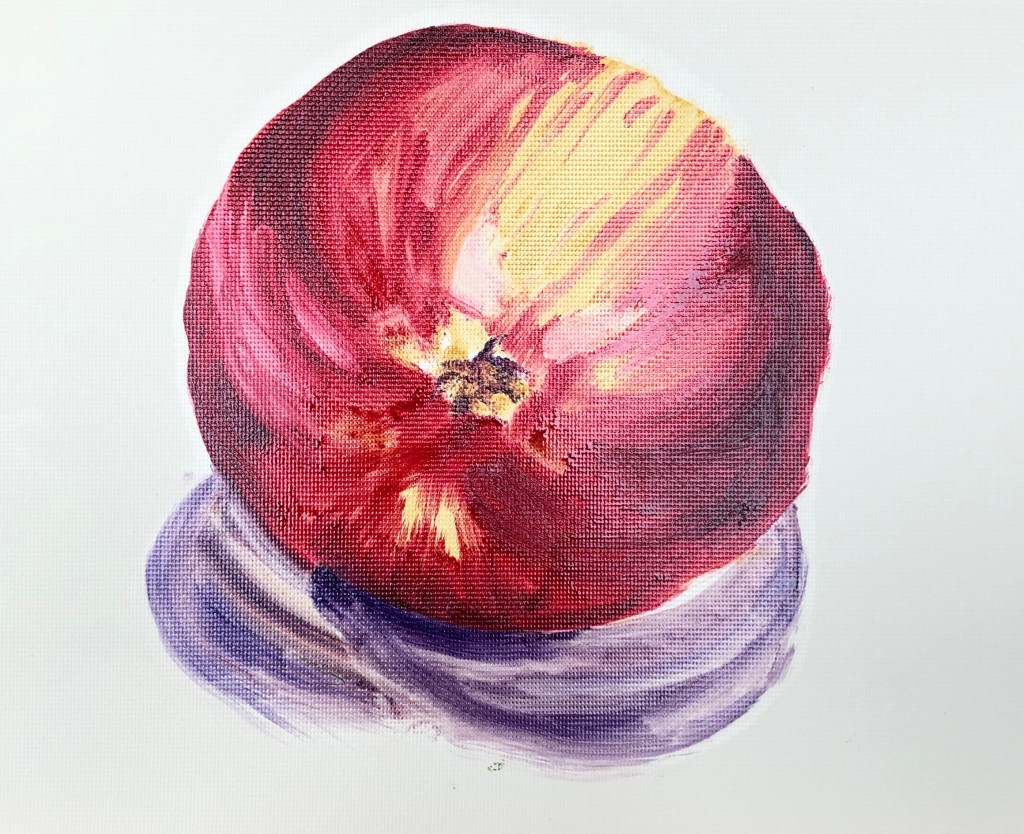
I discovered two main things:
- Getting a clean edge with the filbert was not easy – my apple has become quite distorted in my efforts to tidy up the edges!
- The paint that is carried along by the brush as one makes a stroke gets “dumped” at the end when you take the brush off the paper – to be considered carefully.
NOW WHAT?
The exercise immediately sent me back to a book I had recently acquired: Auping, M, Elderfield, J & Sontag, S (1995), Howard Hodgkin Paintings, Thames & Hudson Ltd, London. Close scrutiny of his later works allowed me to pick out many of the marks I had made in the first part of the exercise and to “work backwards” through his paintings to identify how he had constructed them.
This also reminded me of a remark made by my previous tutor: “A brushstroke has a beginning, a middle and an end”. I could identify this in Hodgkin’s paintings. In my landscape, I could see that the most effective marks were those where I had thought about the beginning and end (having previously been someone who just “goes for” a painting, and ends up with a lot of unresolved middles as a result). The beginnings and ends of the strokes became clearer to me as very different beasts when painting the apple with the large filbert.
So, my way forward: don’t just go for it, stop and think about all parts of each stroke. Should be quite meditative if I can pull it off.

 Sue J's blog