Painting 1 (UPM); Experimenting with acrylics and retarder

WHAT?

I bought a set of Liquitex muted colours in the Jackson’s sale; also, separately, had bought a bottle of acrylic retarder (Golden) after watching a video on the difference between solvent, retarder, flow enhancer and surfactant – and I wanted to experiment with both of them.

SO WHAT?

I played around on a sheet of A3 mixed media paper using brushes (mainly a soft half-inch flat) and a round-ended palette knife. I only used a small amount of paint each time and added a blob of the retarder which I mixed into the paint on the palette using a cocktail stick.

I had started amassing material for a forthcoming workshop by Hayley Lock (OCA tutor) on H Bosch’s “Garden of Earthly Delights”, and had found a book on plants ordered by colour (Dr R Bayton and R Sneesby, 2019, RHS Colour Companion. Octopus Publishing Group Ltd, London) which I used as a prompt, without copying any images in detail – some were stylised and, by the end, some were invented.

NOW WHAT?

  • Loved the colours; it said on the box that the idea was to mix them with white to make pastel colours, but I’m not a great lover of pastel colours so I wanted to use them “raw”. Favourites were turquoise (which I love anyway) and the grey, which has a strong mauve element to it. To be used again!
  • Not sure how much retarding the retarder did, I used the paint pretty quickly as I’d only poured small amounts; certainly any scraps left unused on the palette after, say, 10 min were fairly dry. More experimenting needed.

Painting 1 (UPM); Review of Part Two

General comments about curation and collections:

As well as working through the notes and painting a wide variety of collections, my understanding of this aspect of this Part has been greatly extended by:

  • Zoom workshop with Cheryl Huntbach (see blog post) which covered the generation of a mass of work by Jo Whittle from a particular stimulus, and then the curation of this mass of work into a coherent exhibition by David Orme; from this I shared the excitement of creation from an explosion of ideas based upon a site, and also thought, probably for the first time, of the skill of the curator as the “explainer” or interpreter of that work to the viewer.
  • Zoom workshops with Bryan Eccleshall (see blog post) in which I both took a part in the act of curation, and also observed how others, faced with a disparate selection of artworks, had tackled the question of how to present them to the viewer.
  • Zoom workshop with Sarah Jaffrey (see blog post), where we had the discussion about how what each person (with their differing experience, knowledge and ideas) brings to a work/group of works will be enough to make it unique.

Review against assessment criteria:

  • Demonstration of visual skills: Materials, techniques, observational skills, visual awareness, design and compositional skills.

My assignment in Part 1 was founded upon continuous line drawing; I have done less in this Part as I have been so taken up in exploring different media, and have often painted a rough “underdrawing” before working into it, or else been bold and just gone straight in. My main drawing work has been 

  • in response to the feedback from assignment 1
  • Life drawing (sadly now suspended in lockdown)
  • In response to the drawing workshop from Sarah Jaffrey, where I am continuing with continuous line drawing (not blind) in response to existing works and then drawing into them to add tone – e.g. 

I have been selective so far in the collections I have painted, often cropping a large collection or choosing small bits within it to make something which was:

  • Coherent within itself
  • Interesting colour-wise, e.g. harmonious as in the poppy seed heads, or vibrant as in the bowls, which were basically the primary colours, or made use of complementary colours, as in the clarinet parts
  • Manageable

I have worked on a wide range of supports (paper, various packaging materials, board, cork, metal, leather, china and toilet paper being some that spring to mind), and also used a variety of painting media (ink – Indian, Chinese and acrylic, watercolour, tea, acrylics, varnish, egg tempera, oils and enamels). One learns more with every painting, and I am beginning to feel able to make more informed choices about my materials depending on the task in hand – but much more experimentation and refining of technique is needed.

  • Quality of outcome: Content, application of knowledge, presentation of work in a coherent manner, discernment, conceptualisation of thoughts, communication of ideas.

It has been interesting to look back at the collections I have chosen to paint; some I photographed but had no interest in painting, e.g. the socks (clothes don’t “grab” me at all), and other things like the books I thought would be one of my first choices (I am an obsessive bookworm) – and yet I haven’t picked them. So my choices haven’t just been about me and the portrayal of my personality through my collections (see initial research blog post).

I seem to have chosen a mix of:

  • Collections which I knew I would find tricky to paint – e.g. the clarinet parts (I chose a stick to paint them with as I knew this would make me be loose and gestural and not get bogged down in detail)
  • Collections which “matched” their support or materials, e.g. the eggs on the eggbox in egg tempera, the cutlery on the china plate in enamel, the tubes of paint in oils – i.e. they told some sort of story
  • Collections which I found visually pleasing, either because of colour or form e.g. the china bowls and the pots and kettle; the feathers; the bottles of ink, painted  in enamels and in oils, both of which have brought out their inherent shine.


Demonstration of creativity: Imagination, experimentation, invention, development of a personal voice.

I haven’t kept a specific sketchbook for this Part – most of the work has been hands-on and experimental (for me!), and so my thoughts have been amassed in my learning log.

Part 1 felt like a unified whole to me; Part 2 has felt more disparate as there were so many things to get into – unusual materials was one, collections another, curation and all the online workshop stuff yet another, and then trying to follow through on the feedback from assignment 1… So I feel as if I’ve learned bits about a million different things, all of which I’d like to take forward somehow if only there were more of me/an infinite amount of time (bit like the big bang theory…the actual theory, not the series).

I’ve pulled out my learning/action points (my “Now What?s”) right through the Part, and tried to draw some threads together in preparation for my assignment (see separate blog post); I’ll reflect on them and try to bring out some of the key bits of learning as at least a jumping off point for a conversation with my tutor.

Context: Reflection, research, critical thinking (learning logs and essay).

I have looked at a range of artists, both contemporary and historic. I have had a go at working in the style of several (see research blog post), and have picked some, e.g  Raqib Shaw, to study in more detail, researching his technique and having a go at painting using his methods. 

I have found that my painting style varies between the meticulous (like Shaw) and the  wild and expressive (like Hambling – and Auerbach to a lesser extent). My tutor recommended that I look, among other artists, at Laura Lancaster, which I have; she uses big strokes (painting much larger than I can anyway, as I have a very small attic studio), and says that she is able to work so loosely because of the amount of preparatory drawing she has done which has really familiarised her with her subject.  I think there’s a lesson for me here – I have an issue with tone and colour, and I think much more preparatory drawing would enable me to continue with my loose style (which I enjoy) without getting the tone wrong (which frustrates me).


Painting 1 (UPM) Part 2: Review of all “Now what”s since last feedback, to identify progress and further action

WHAT?

These are all the development points I have identified in this Part:

30.9.20 (Cheryl Huntbach group Zoom)

These videos and the discussion really chimed with me because:

  • Of where I am in my studies, i.e. Painting 1 Part 2 – looking at collections and also at painting on more unusual materials e.g. copper – it has been motivating and also inspiring to see what is possible
  • Looking forwards to another Zoom group meeting this weekend with OCA Tutor Bryan Eccleshall entitled “Contamination/Curation” – I have a little bit more insight into curation now, not really having considered it before
  • Listening to Jo and David and their bubbling excitement when presented with this commission with all the myriad possibilities it presented to them artistically was hugely inspiring – I felt a bit like that after having visited the “Cranach the Elder” exhibition at Compton Verney earlier this year, so keen to build what I had seen into my work. It’s like being given a big box of new toys. It’s an emotion to hold onto and try to apply to tasks which don’t immediately appeal – find a way in and around the task to find an aspect that does grab the interest.

Research into collections and unusual materials

Magnificent Obsessions

Tried to keep loose but directional marks and overlaid layers – gouache is really good for letting you do this quickly.

Likes:

  • Some of the brushmarks, especially where I’ve managed to get the right weight and feathery-ness (usually brush quite dry, but not always)

To improve:

  • Also some of the brushstrokes! – where I’ve got the brush too wet and then picked up too much paint, marks rather clunky.

Lisa Milroy:

I have learned that:

  • Painting with long-handled brushes is something I am going to have to work hard to get good at – my right arm (because of my previously broken shoulder) doesn’t have the freedom of movement, and my left hand/arm is just not used to wielding paintbrushes (although fine with charcoal!) and will need some training up.
  • I enjoyed the loose mark-making possible with the oils, got really into the zone, and this is something I want to do more of.

Tabitha Moses:

I have learned that:

  • a collection can be of quotes around an idea or situation – it doesn’t have to be of actual objects
  • there is huge scope for investigation of a concept, eg. the effectiveness of a support as a threshold 

Paul Westcombe:

I have learned….

  • I’m potentially going to struggle with the “off-piste” aspects of this Part – it’s not apparently in my nature…or rather, it feels a bit like the sort of thing I would have done with the children back when I was teaching, and therefore not proper “Art”. Guess I need to loosen up a bit and let go – I did enjoy the eggs, so it can be done.

Cathay Lomax/Ali Sharma:

I have learned:

  • Making up doodly out-of-my-head images is not a strength, I am better at painting “something” defined – my foliage and flowers are more folk art than fantastical Raqib Shaw.
  • I should not dismiss supports other than paper/board/canvas as too difficult to try painting on.

Julian Walker:

  • This whole “grid” mentality is interesting…I am a very organised person and it is second nature to me to arrange things tidily in grids…..so the making of grids from collections of things is going to be my ideal…..but on the other hand, I am rather an impatient painter, and am aware that I can be a bit “right, done that, what’s next?”. Painting a few things as a collection in a grid should be fine (e.g. the paint tubes and bottles in the Lisa Milroy section, above)…but will I become a bit frustrated with a bigger collection in one picture? I thought back to the 20-piece work I did for Assignment 1, but my interest was maintained throughout that by the fact that each individual picture was very different. Self-knowledge can sometimes be an unsettling thing….

David Dipre:

  • I’m gradually getting into the idea of painting on non-traditional supports – am starting to look around my studio and think “Hmm….wonder what it would be like to paint on that…..”
  • I have been trying to make paintings being decisive and economic following my feedback from Assignment 1. “Decisive” is going well and I am feeling bolder about making bold marks. “Economic” is going less well, for two reasons:
    • In trying to loosen up my mark-making I have got into a “go for it”  trance-like mode, when I’m in the moment and almost instinctive rather than thoughtful – it all has to happen now
    • I’m aware of the above and I have tried to make myself pause, step back and take note, when I’ve completed the image if not before – but when I’ve done so I’ve found a “decisive” mark which I don’t like, and am then in a dilemma as to whether to let it stand as honest and authentic, or sort it out, which is when I fall to tweaking and fiddling and trying to wipe bits out and the thing becomes a bit of a mess and decidedly un-economic.

    Not quite sure how to sort this out…more practice…?

Lee Edwards:

  • Well, painting as small as this certainly makes for decisive and economic mark making!
  • The enamel paint has a solid opacity to it which I find pleasing – it’s a bit like liquid gouache or runny acrylic. I have bought a small and quite random selection of matt, gloss and metallic finishes, so will be interested to play more and see if I can tell the difference once the Zest-It cleaner arrives. 
  • The paint is quite smelly which might prove an issue for me personally due to my asthma; however, I have been attracted to the enamel paint pictures by Raqib Shaw who does get some very vibrant effects, and I hope to be able to achieve something working towards his style (if much less detailed and intricate!). 

Some collections of my own

I’m looking forward to using some of these images in the exercises , as well as the collections discussed in my research blog (especially the “bottles of ink” and the “things to paint”). I might choose to rearrange some, or to select a few from each collection, depending on the task; and obviously, with an arranged collection, you have more control over the background.

I’ve tried to pick a favourite collection from the selection above, purely as an image, and I can’t – although the one I’m most looking forward to having a go at painting is the parts of a clarinet (probably the most fiddly, so I’m going to go with a lot of implication to avoid tying myself in knots).

Following up on action points from Assignment 1 feedback

Zorn palette; Frank Auerbach portrait:

I learned a lot there!

  • If you’re going to paint solely from a drawing, then get the drawing right!!
  • And then, trust your drawing – I can see bits where I haven’t (e.g. the darkness of the hair on the left)
  • If a painting’s going wrong, trust your gut to put it right, but DON’T FIDDLE
  • I have been decisive in places, but I’ve not always been economic
  • The Zorn palette definitely works for portraits
  • I am better at being decisive with my left hand because I have to concentrate on each mark as I worry I lack the control over a long handled brush; when I’m unsure of what I’m painting, I kept catching myself reverting to the right hand and moving the hand nearer the ferrule, and that’s where I fiddled.

More experiments with unusual materials and supports

I’m pleased to find I’m beginning to enjoy and embrace the experimental. 

I’d like to try more of the following:

  • When using thick paint, apply it with tools other than brushes – maybe more credit card marks, also palette knives.
  • I’m interested in Raqib Shaw’s method of working and would like to play around more with the enamel paints.

After doing the above experiments, I had a good go at cleaning my palettes. The acrylic one wasn’t too bad as I’d kept it in one of those “stay-damp” boxes, but getting the partially-dried oil off the other, glass, palette was a bit of a nightmare; so I’ve learned that thrift is OK to a point, but I would be better thinking about how much I’m actually going to need before I squeeze paint from a tube.

More work on formative feedback from Assignment 1

Maggi Hambling work:

I have found that:

  • Mindful of some tonal inaccuracies/omissions in my earlier Frank Auerbach drawing which translated into corresponding inaccuracies in tone in the painting, I have learned to think more about this issue – which I did find easier here when drawing with ink.
  • If I want to do much more work with acrylic I need a whole lot more practice at dealing with the speed at which it dries, which took me aback a little. I could cover up my errors when they were “within” the image easily enough, but I wasn’t quite sure what to do about errors I had made right on the edges, which seemed to dry in seconds before I could wipe them off.

Exercise 2.1

Household paint:

  • This is definitely something I would repeat – for the enjoyment of being able to “dollop” paint with a thickish brush and a knife, and also for the feel of the paint and the little bit of extra texture it provides, which would be appropriate to certain types of subject matter – I think it really worked here
  • The exercise has made me reflect on the issues of form and background. I struggled to make a really dark dark (best I could achieve is blue, then red, then blue – but the paint is opaque so it’s difficult to get a dark by building layers). As a result the painting is possibly a little flat. I wondered then about introducing a dark background so that this would bring the crockery forward and stop it floating.  However, I’ve propped it up on a shelf and been living with it for a day or so, and the contrast between the board background and the chalky paint makes the crockery stand out separately anyway (hard to see on a photo, clearer in actuality, the paint sort of shimmers above the card), so I decided to stop where I was. I know it’s only a practice piece on a bit of bent board, but I rather like it!

Tea:

This experiment, and the previous one, is really bringing home to me the importance of having a decent range of tones to work with; or rather, to taking the time before you start to understand the range which you have, particularly if it is small, and making sure you are clear about your middle tone – I think I have used my darkest tone as a mid tone and then been frustrated that I had nowhere to go with it.

Humbrol enamel and acrylic liner:

  • Interestingly, form and background have come to prominence again as consideration here. Even without indicating shadows, the half-finished one looks more realistic (perhaps because it matches the white background of the photo); adding the blue background has, to me, turned the picture into a more fantastical image where form is not required or necessarily desired.
  • I really enjoy using these enamel paints (a sucker for shiny things), even though following Shaw’s method is quite time-consuming – it leads to work of a jewel-like quality.  I should like to experiment more with these paints to see what other effects can be achieved when they are used more freely.

Zoom workshops with Dr. Bryan Eccleshall – Contamination/curation

I learned a huge amount over these two sessions and the intervening work. Four big takeaways:

  • I have never considered curation before, but this is an aspect of an exhibition I shall pay attention to in future
  • First time I have collaborated with a group like this – it’s not so scary; you have to let go of any niggles about lack of contribution from some members and assume they have life/work issues which prevent them; be positive and affirmative
  • Doing things because they look good is a good enough reason
  • You have to have confidence that your work will survive in the world

Exercise 2.3

I began the 3D work back with my research with some despondency, thinking it felt rather like messing around and was somewhat of a waste of time when I needed to be getting on to the serious stuff. However I’ve discovered, particularly with the recent trompe l’oeil plate piece and my egg box of eggs (which formed a key part of a collaborative exhibition pitch – see blog post on Contamination/Curation) that it can (a) be fun, and (b) lead to an eye-catching finished piece.

Exercise 2.2

  • I had really enjoyed using ink and a stick in Drawing 1, so it felt good to revisit this.
  • I am not sure whether this has ended up being a line drawing or a line painting and, indeed, exactly what the difference is.
  • Nevertheless, I feel the outcome has a vibrant, shimmering quality and I hope that any clarinettists out there would recognise it.
  • I am not sure how I would improve it – I could have spent more time wearing the end of the twig down to a more reliable point to make for a slightly more controlled image, but I think the very roughness and unpredictably is the key (pardon pun) to the success of the image – the whole point of a clarinet is that it works off a varying column of vibrating air, and I think I’ve got the outside vibrating as well as the inside.

Zoom drawing workshop with Sarah Jaffrey

  • This talk reinforced the idea that there’s nothing new under the sun, but it’s what you do with/change/combine/interpret what’s in front of you that makes your work different from everyone else’s.
  • I’d like to do more drawing from existing paintings, something I haven’t done much of hitherto, to try and build my visual vocabulary.

Exercise 4

Household paint on egg tempera:

  • I enjoy the freedom of working loosely with this paint – it has a nice feel.
  • I also really enjoyed using the palette knife, both to apply and drag paint, and to cut through the layers to make marks; clearly a huge range of marks is possible, and I am only at the start of my explorations of its use.
  • The chalky finish of this paint does still make the image quite flat, but I find it is open to tonal tweaking by overlaying with ink.

Ink on acrylic:

  • I managed to rescue the image around the bits of tone (both light and dark) which I had managed to establish before my painting implement died on me – but in so doing, it has become more of a drawing, although I am confusing myself by worrying about this distinction between drawing and painting.
  • Again this was an experimental piece in a “I wonder what would happen if….” frame of mind – it wasn’t a success, but I don’t think that matters particularly – experimentation is good for the soul
  • I do think that, having made the decision to commit to moving into pen, I could have worked harder at establishing a better tonal contrast between the poppy heads and the background (I confess I’d lost interest in it a bit by then)

Acrylic on varnish/general:

Looking back over the paintings I’ve done in this Exercise, I’ve dealt with the issue of tone with varying degrees of success; I think it’s still something I need to work at mastering, and need to have at the forefront of my mind when tackling my assignment.

Painting on a metal/mirrored surface

I have found that:

  • I really like working with oils because of the feel of them and the way I can move them around
  • I have developed quite a loose style, with a lot of my colour mixing taking place on the picture surface, but must retain an awareness of tone, and not become confused between tone and colour
  • I also really enjoyed working on the aluminium surface – something I think I should like to pursue in the next unit
  • I am going to retain this palette layout for a while and see how well it works for me. I wonder if I need to slow down a little to make the most of the palette as a tool, rather than just something to hold the paint temporarily.

SO WHAT & NOW WHAT?

Reading back over this list and reviewing Part 2 so far has allowed me to group learning into three categories:

Things which have been tackled and are developing (but always needing more…):

  • Getting around tasks which don’t immediately appeal by finding a way to “get in from another angle”
  • Loosening up and being up for experimenting
  • Managing my impatience as a painter by managing my subject matter
  • Favourite media: oil paint, household chalk paint and enamel paint.
  • Favourite ground: egg tempera, ink
  • Favourite tools: sticks and knives
  • Favourite support: metal
  • Becoming aware of curation and your work as art out in the world

Issues which keep coming up and need more work:

  • Quality of mark making and brush strokes
  • “Decisive and economic”
  • Palette organisation and where to mix colours
  • Tone generally, but in particular:
    • Adding tone to drawing
    • Possible confusion of tone and colour in painting
    • Understanding the tonal range available
  • Controlling my style – should I? How do I develop it?

Things which appealed at the time but which I appear to have mentally parked:

  • A collection as being of quotes or ideas to investigate a subject – rather than just a load of actual “stuff”

Painting 1 (UPM); Part 2; Painting on metal surfaces

WHAT?

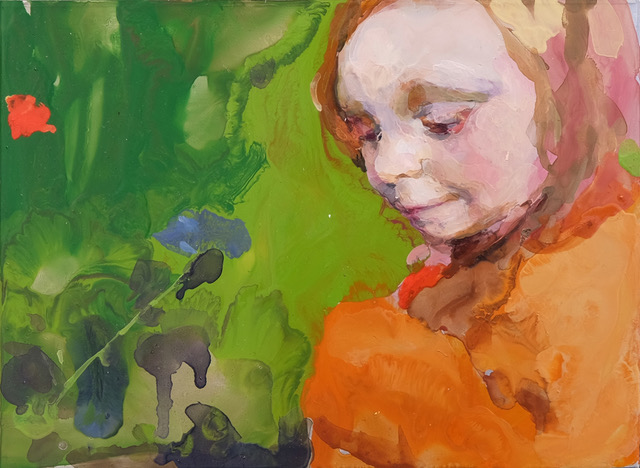
I have seen one small painting on copper by Lucien Freud at Pallant House this year, and also watched a video online of Jo Whittle’s work on copper as part of a group session with Cheryl Huntbach (see separate blog post). The reflective nature of the metal certainly does seem to bring a luminescence to the work.

I looked at the other artists who work on metal (referred to in the course notes), and was particularly interested in Geraldine Swayne, who often works in a smaller format on metal, e.g.

Son of a Musician Looking at a Flower,

2020

Enamel on aluminium

17 x 22 cm

Charlie Smith London (Gallery)

I particularly enjoyed her fluid use of the paint and her mixture of loose marks and occasional fine detail which create an effective image.

I wanted to have a go myself, looking particularly at the following:

  • I wanted to use oil paint and work loosely
  • I wanted to try and be organised in my use of my palette, particularly having watched the video recommended to me by my tutor in my feedback from Assignment 1 

SO WHAT?

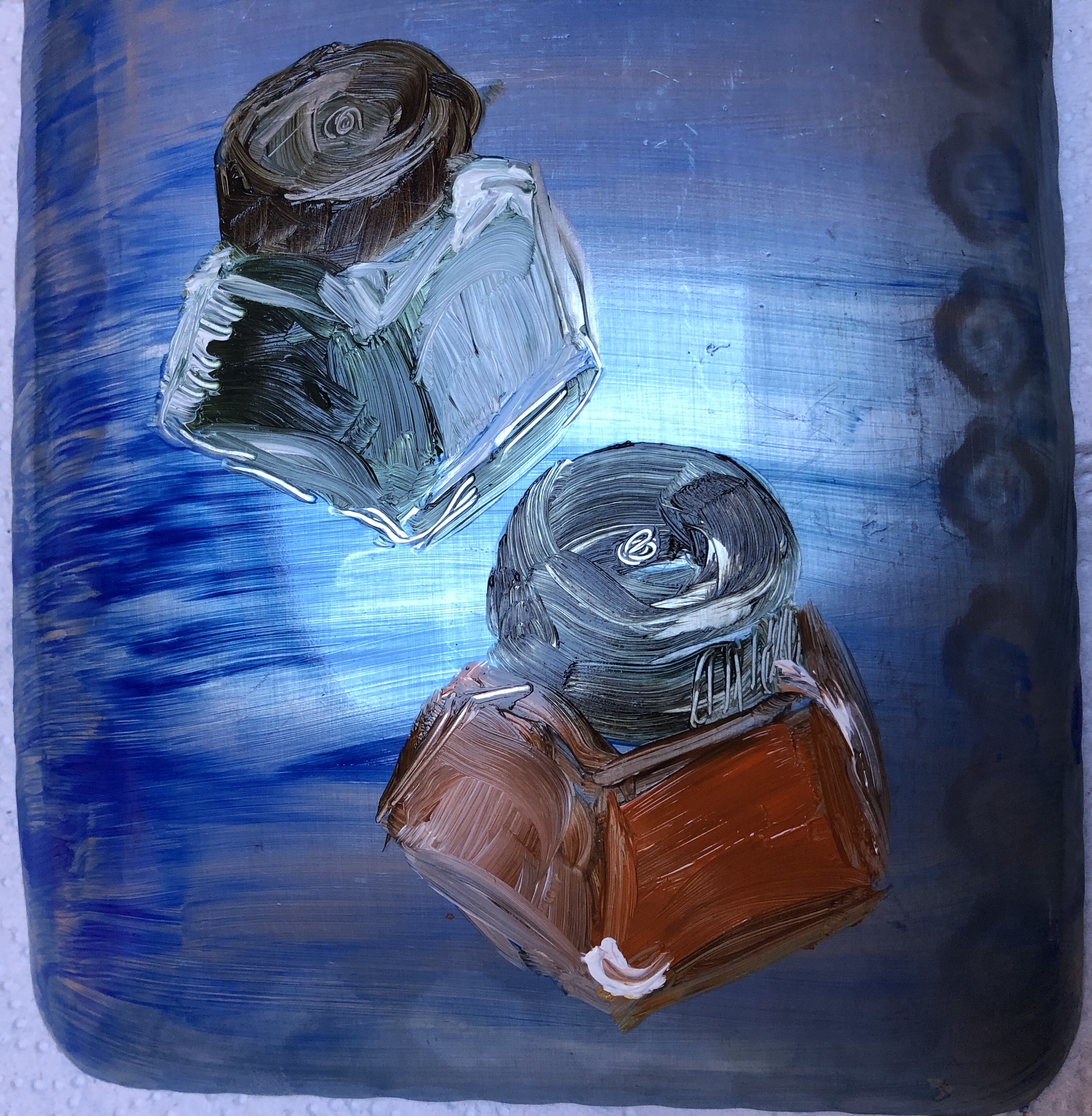
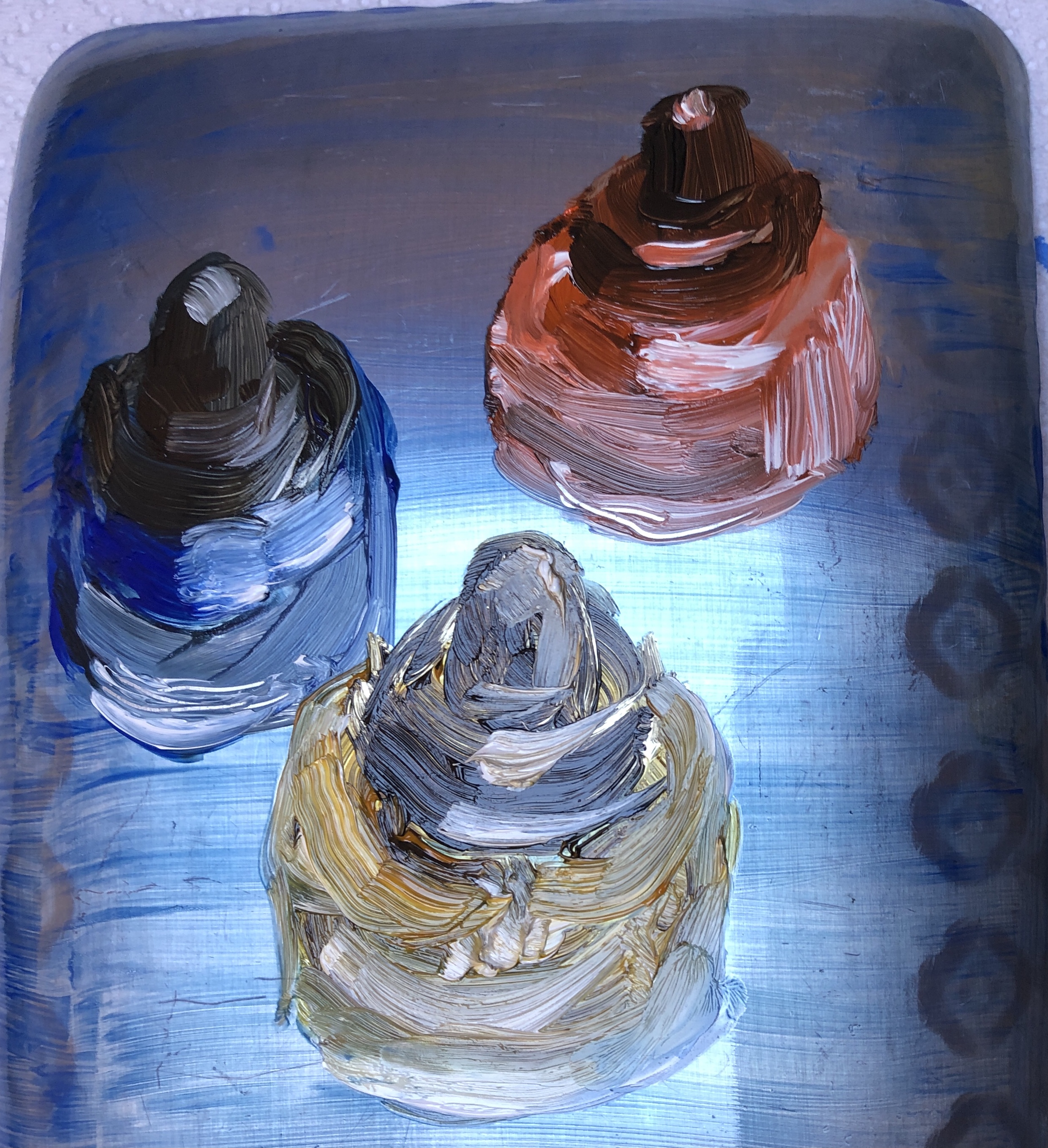
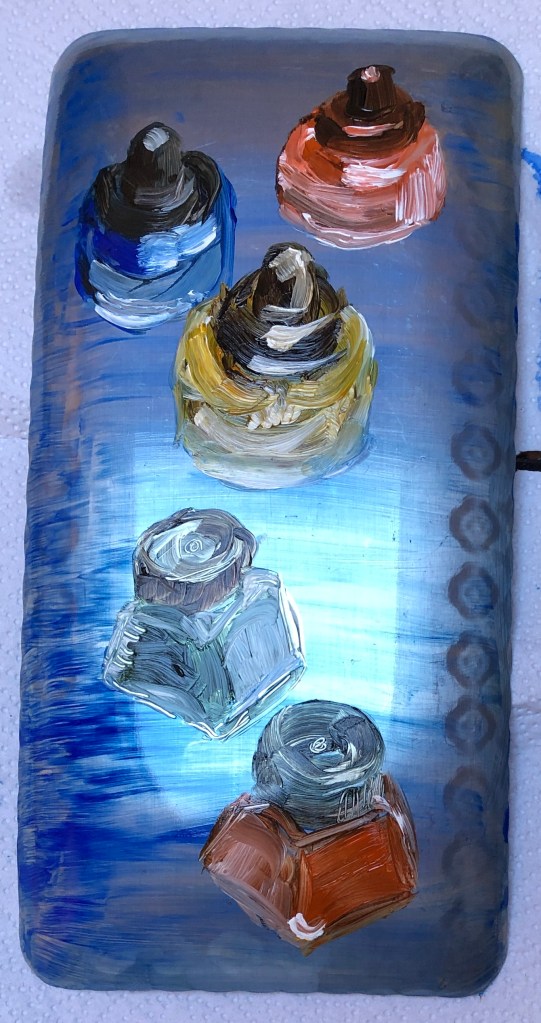
I found an old aluminium serving dish (using the back so that we could still use the dish as intended if needed). I also used Cobra water mixable oils (titanium white, Indian yellow, vermillion, cobalt blue and burnt umber) a few drops of water mixable linseed oil and flat brushes in sizes 2 and 8. I laid my palette out as suggested (blue, red and yellow in a triangle with white behind the blue and burnt umber behind the red).

I made a small collection of bottles of ink laid out on my glass art table as my subject matter. I laid down a very thin layer of linseed oil over the whole surface, and then worked into this some dilute cobalt blue as a background.

Then I began to paint in the ink bottles to the wet surface. I found that very dilute paint tended to run (the dish being convex) so I used fairly undiluted paint to build up the image, trying to use directional gestures and minimising the number of strokes. It was helpful to have a system on my palette; I do paint quite quickly, so being able to go straight to a colour is a bonus – although once I started to mix on the palette, especially making a near-black from blue and brown, I found that things became a little more random. Also, when clearing up a dribble with my finger, I uncovered the metal, which reminded me that this was an option – so I made more highlights by scratching out little bits of colour with the wrong end of the brush.

The outcome isn’t a great work of art, and will probably take weeks to dry because of the oil base (an experiment) – but I had great fun.

NOW WHAT?

I have found that:

  • I really like working with oils because of the feel of them and the way I can move them around
  • I have developed quite a loose style, with a lot of my colour mixing taking place on the picture surface, but must retain an awareness of tone, and not become confused between tone and colour
  • I also really enjoyed working on the aluminium surface – something I think I should like to pursue in the next unit
  • I am going to retain this palette layout for a while and see how well it works for me. I wonder if I need to slow down a little to make the most of the palette as a tool, rather than just something to hold the paint temporarily.

Painting 1 (UPM); Part 2; Exercise 4 – Painting on a painted surface

EXPERIMENT 1

WHAT?

I wanted to pick up on some things I had said I wanted to look at more:

  • Using the household paint again (I have red, yellow, blue and white), this time with a dark background to see if I could establish tone better;
  • Use a palette knife to paint with.

SO WHAT?

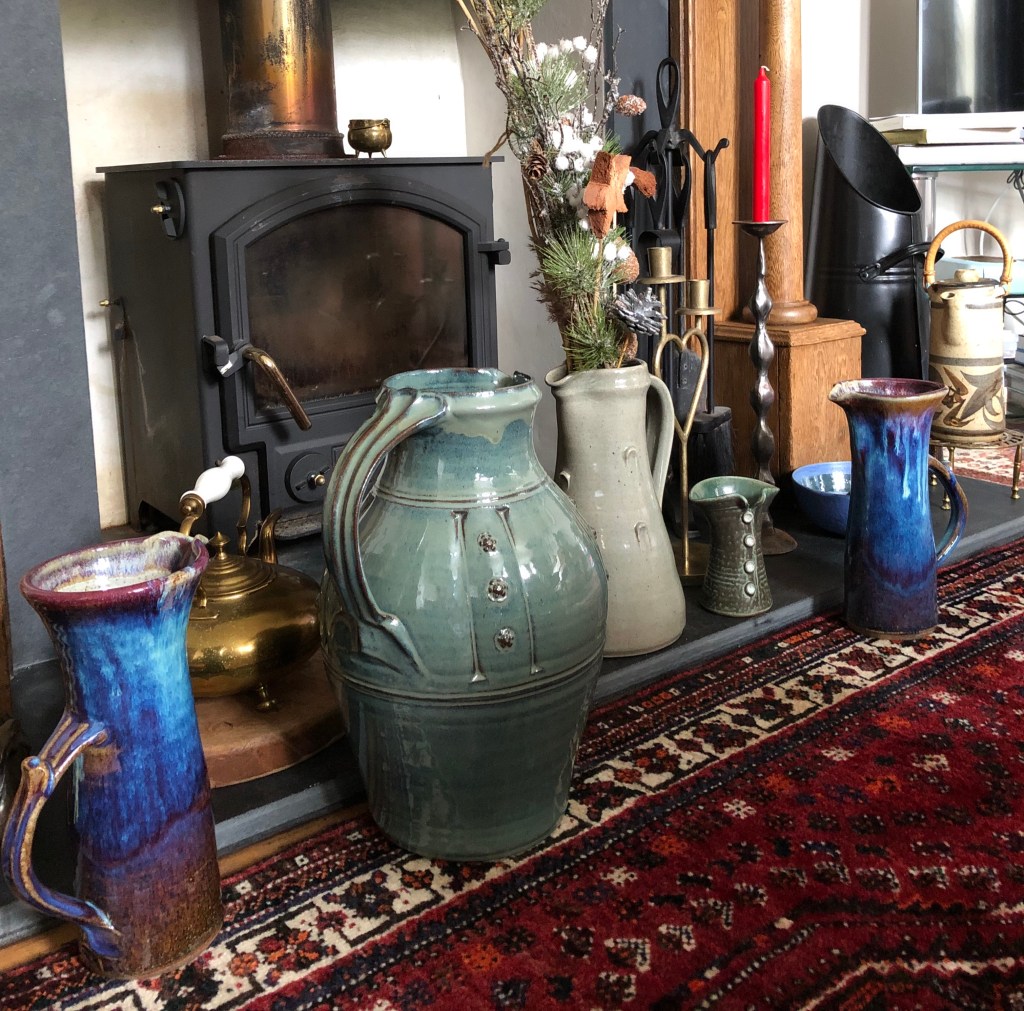
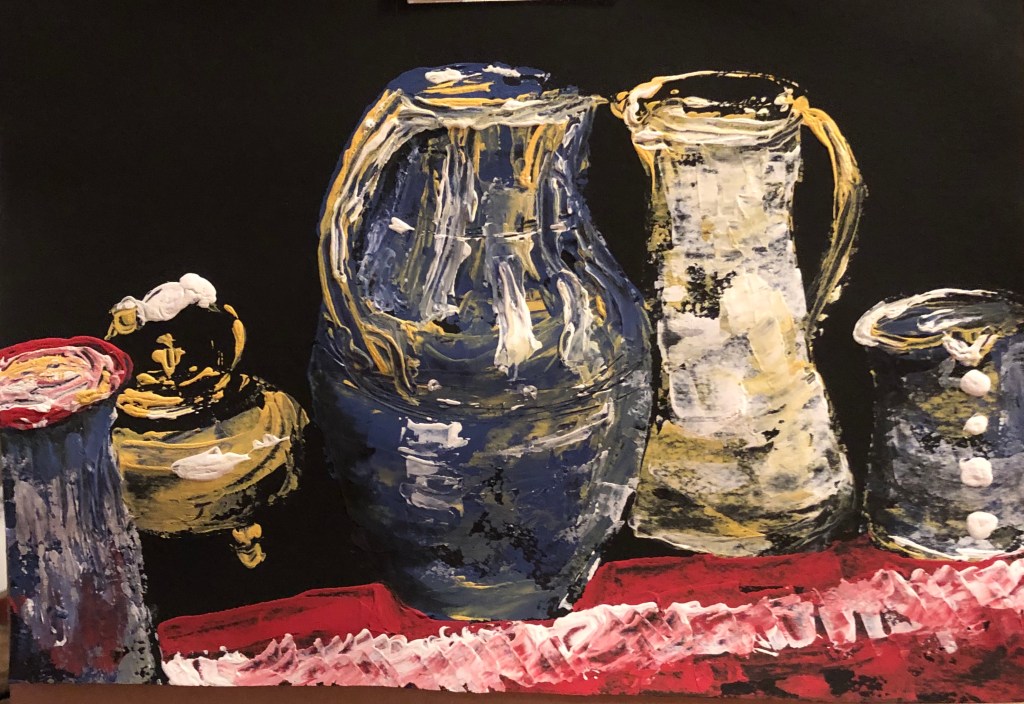
I prepared the paper with black egg tempera, which was the best medium I found in Part 1 for getting a strong, even matte background. The collection I chose was the pots and kettles by the woodburner. 

I didn’t want to have detail in the background, intending all the focus to be on the pots and kettle. I began with the largest pot, placing that in the centre of the page, and then worked outwards. I tried to keep the number of strokes as low as possible, overlaying and “cutting in” different colours. The most difficult thing I found was to get the horizontal curved strokes crossed with the lines of light which went downwards, without it looking like a grid. My technique gradually improved, and I am most pleased with the kettle, which really does consist of a small number of strokes and is quite impressionistic. I tried to drag paint away from areas which were too light to expose the black background as my dark tone; this worked where the paint was still wet, but it dries pretty quickly, especially where thin, and so I experimented by overpainting with a mix of black and blue ink (which I had left over from the clarinet painting) to re-establish a few darks where needed, particularly the left side of the big and small pots. My husband suggested it was painted in the style of Maggi Hambling! – whose work I have been looking at quite a bit recently.

NOW WHAT?

  • I enjoy the freedom of working loosely with this paint – it has a nice feel.
  • I also really enjoyed using the palette knife, both to apply and drag paint, and to cut through the layers to make marks; clearly a huge range of marks is possible, and I am only at the start of my explorations of its use.
  • The chalky finish of this paint does still make the image quite flat, but I find it is open to tonal tweaking by overlaying with ink.

*******************************************************************

EXPERIMENT 2

WHAT?

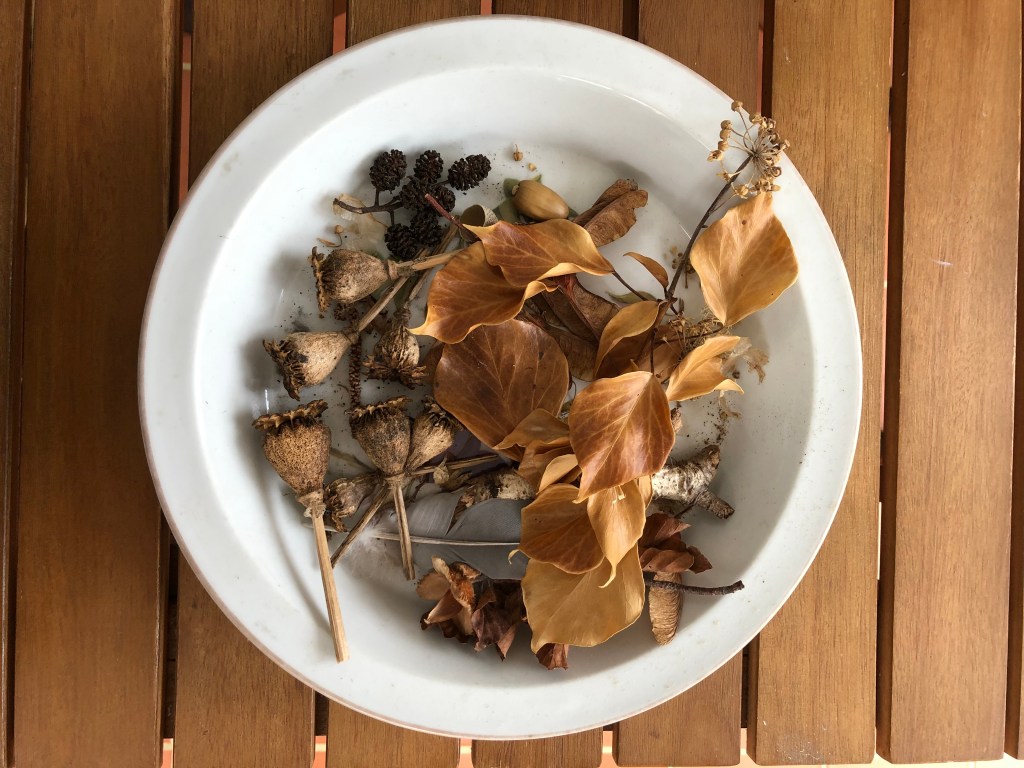
I wanted to paint part of my collection of “natural bits picked up outside”; specifically the dried poppy heads. 

SO WHAT?

In the collection was an old stumpy feather which had escaped my pristine feather collection, so I decided to paint with that. The dish edges are white but inside it actually has a yellow design painted on it, so I laid down a thin ground of primary yellow acrylic to reflect this. Once this was dry I drew with the feather and the primary yellow/tabac ink mix left over from the ground of the clarinet painting.

My intention was to build up layers of tone, and it went well at first, using the stem for lines and the other end as a brush to spread and pull the ink in a feathery way (obviously). However, my stem soon began to collapse and go rather mushy and bendy. I took a break to let everything dry, and picked up a book of drawings by Piranesi (Sarah Vowles (2020), “Piranesi drawings; visions of antiquity”. The British Museum/Thames and Hudson, London), who often draws with ink into a brown wash. So I decided to rescue the painting by doing the same, using a black waterproof drawing pen – even though I suppose I have now turned the work from a drawing into a painting .. hmm..

NOW WHAT?

  • I managed to rescue the image around the bits of tone (both light and dark) which I had managed to establish before my painting implement died on me – but in so doing, it has become more of a drawing, although I am confusing myself by worrying about this distinction between drawing and painting.
  • Again this was an experimental piece in a “I wonder what would happen if….” frame of mind – it wasn’t a success, but I don’t think that matters particularly – experimentation is good for the soul
  • I do think that, having made the decision to commit to moving into pen, I could have worked harder at establishing a better tonal contrast between the poppy heads and the background (I confess I’d lost interest in it a bit by then)

***********************************************************************

EXPERIMENT 3

WHAT?

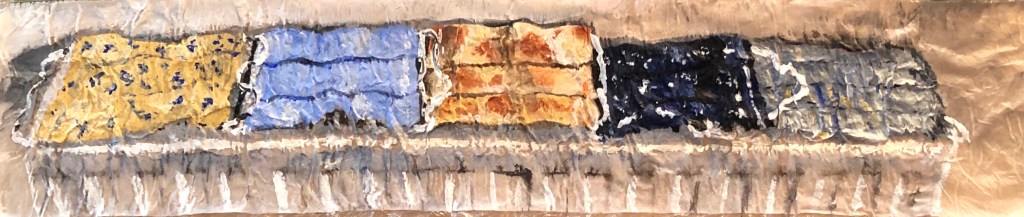
My husband found a video on BBC Scotland yesterday (30.10.20) of an interview with Scottish artist Caroline Gormley. She had thought about the start of the first lockdown when toilet paper became a precious commodity, and so she decided to paint on it using oil paint; I think she said that so far she has done about 90 paintings, one per sheet, on a roll. I have been trying to avoid coronavirus references – my art is my escape from it – but I had photographed a row of masks drying on a radiator as one of my collections, so decided to try and paint this on toilet paper.

SO WHAT?

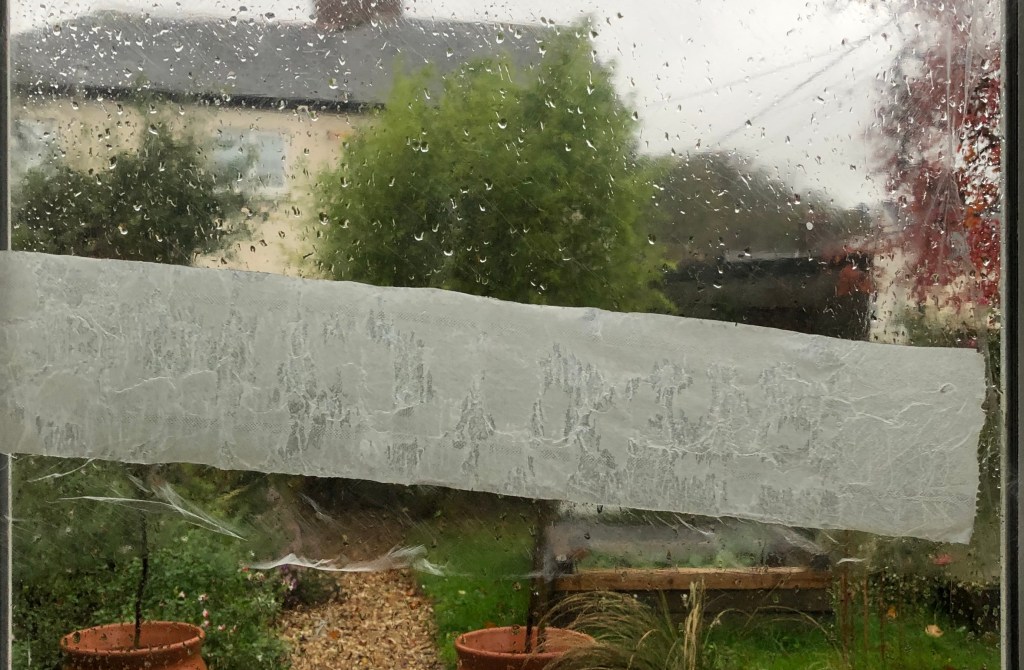
 I investigated our toilet paper, but clearly Caroline’s is better quality than mine, which was fairly thin and easily torn as soon as paint was applied. I decided to use two coats of acrylic varnish for my ground to try and strengthen the paper – it was hard to apply evenly, so the result was best described as wrinkly and crusty! On the plus side it made the paper much more robust; added to which, I had laid it on a sheet of cling film so that it could dry flat, and it seems to have stuck itself to the cling film – so, uber-robust now!

In Part 1 when I experimented with painting on a varnished ground, I used acrylic paint; I knew this worked, so used it here. I chose black, white, ultramarine blue, yellow ochre and burnt sienna. I tinkered with applying it with a palette knife, but the paint preferred the knife to the varnished surface, so I soon gave this up and turned to a size 4 round and a rigger. The photo was taken under a window so the image was quite flat and tone was not easy to establish, making itself apparent more in the radiator than the masks. Mark-making still wasn’t easy and I had to put some effort into getting the paint into the nooks and crannies….but ended up with what I hope is a recognisable image of a collection of masks drying on a radiator.

NOW WHAT?

Looking back over the paintings I’ve done in this Exercise, I’ve dealt with the issue of tone with varying degrees of success; I think it’s still something I need to work at mastering, and need to have at the forefront of my mind when tackling my assignment.

Painting 1 (UPM); Part 2; Large scale line painting

WHAT?

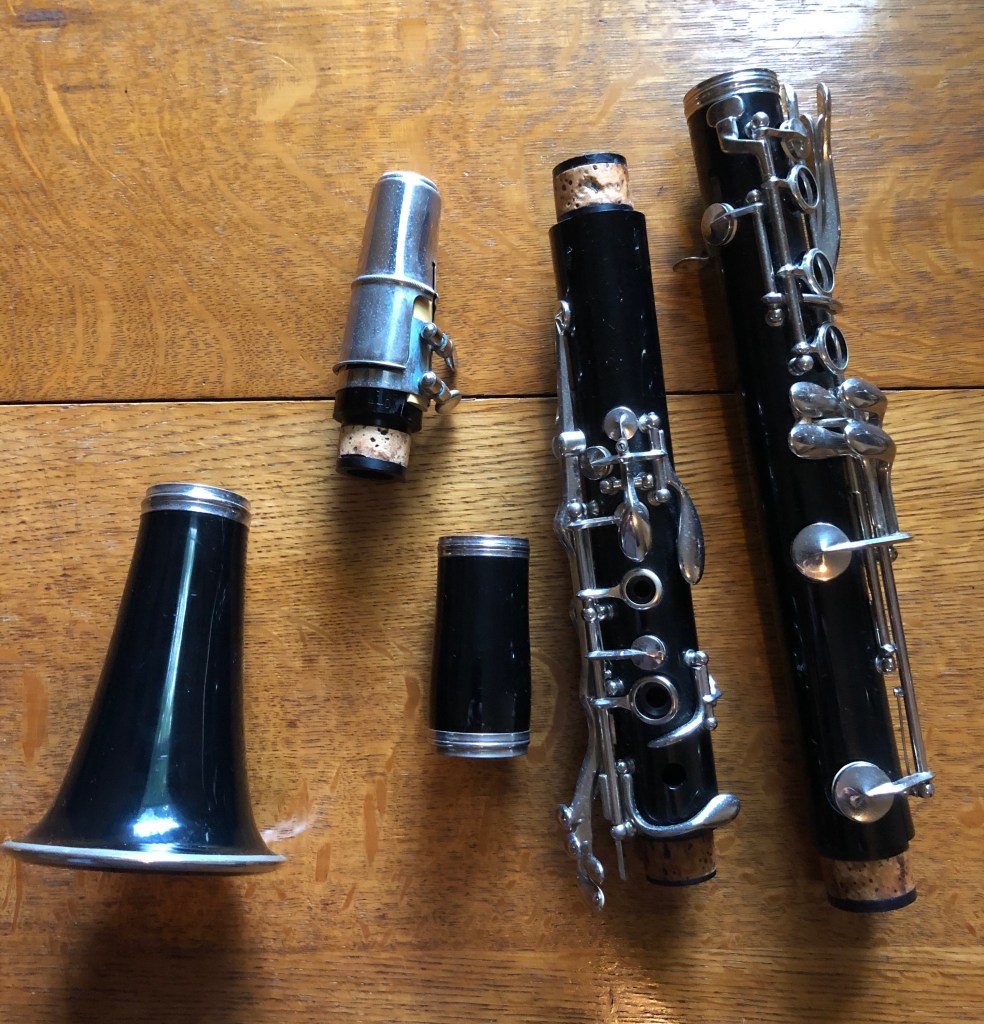
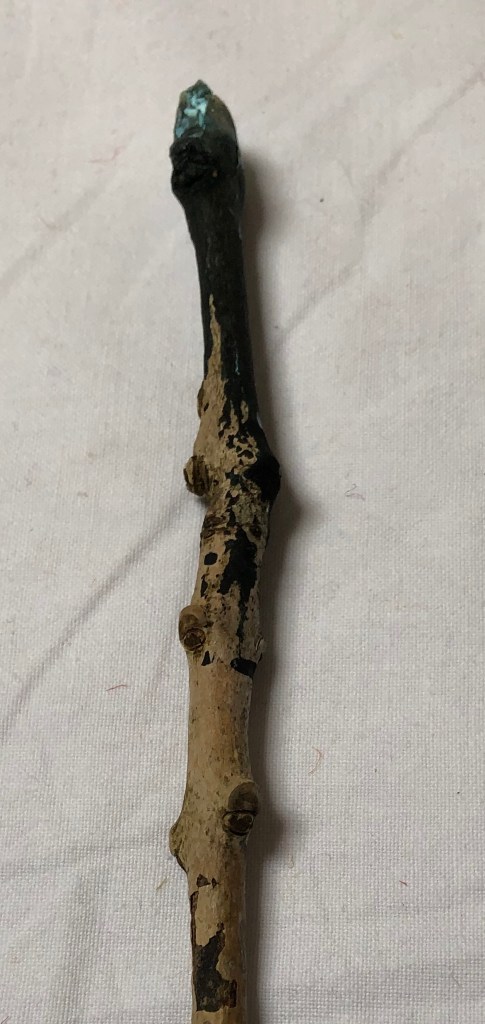
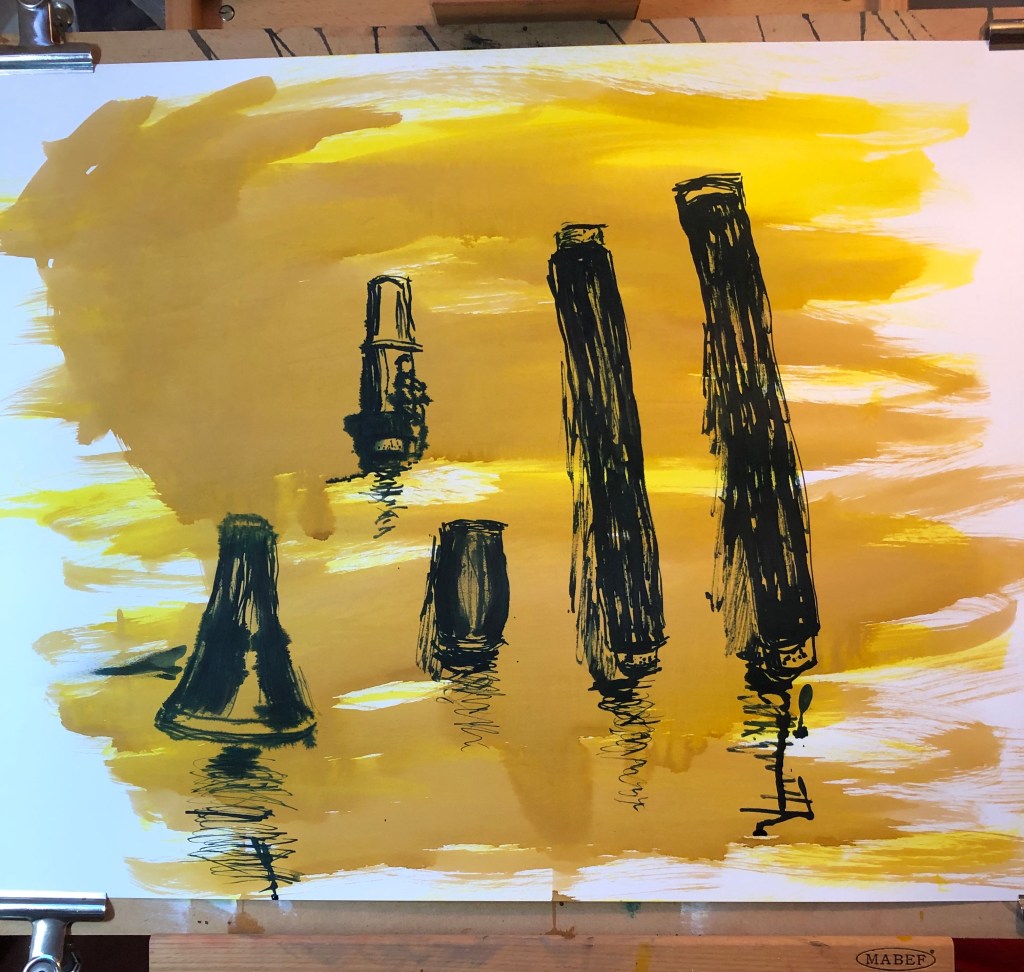
Using undiluted inks and undiluted white acrylic applied with an ash twig onto A1 hot pressed watercolour paper, I chose my collection of clarinet parts for this exercise.

SO WHAT?

The brief suggested that the background could be left blank if desired but I wanted the wooden table surface indicated. For this I applied a very loose wash of Colorex Primary Yellow ink, then added a bit of Colorex Tabac ink in a loosewash.

I began the line painting into the ink wash while it was still damp.  I used the broken end of an ash twig which allowed for thick lines, thin lines and all points in between, but it was rather hit and miss as to what you actually got at any point. I wanted to draw in the body of the pieces first and then add all the keys when that had dried. The body looked black but with a bluish tinge, so I used a mixture of black Indian ink with a dash of Colorex China blue ink. I worked quickly from left to right, and the difference can be seen when I reached the right as the background was virtually dry by then and so the lines were much sharper.

Once that was all completely dry, I began to add the lines for the metal keys. These were a kind of metallic silvery-blue so I dithered about colour choice, but decided to start with plain undiluted white acrylic. This is actually not easy to apply with  twig as it tends to bobble and clump round the sides of the stick, but I persevered and was rewarded with a great effect – the blue from the black-blue ink mix, even though completely dry, began to show through – presumably released by the inherent wetness of the acrylic? Or scratched up by the rough stick? Who knows – anyway, it was exactly the colour I wanted, as I had hoped that the blue would stand out against the slightly orangey background as a complementary colour. A combination of the roughness of the stick and the clumpiness of the paint made accuracy difficult, and I settled for gestural marks and indications of key position rather than anything detailed.


NOW WHAT?

  • I had really enjoyed using ink and a stick in Drawing 1, so it felt good to revisit this.
  • I am not sure whether this has ended up being a line drawing or a line painting and, indeed, exactly what the difference is.
  • Nevertheless, I feel the outcome has a vibrant, shimmering quality and I hope that any clarinettists out there would recognise it.
  • I am not sure how I would improve it – I could have spent more time wearing the end of the twig down to a more reliable point to make for a slightly more controlled image, but I think the very roughness and unpredictably is the key (pardon pun) to the success of the image – the whole point of a clarinet is that it works off a varying column of vibrating air, and I think I’ve got the outside vibrating as well as the inside.

Painting 1 (UPM); Part 2; Exercise 2.3 – Painting on a 3D surface

WHAT?

I have already experimented with 3D surfaces in my research work at the start of this section (see earlier blog post) – for example, painting on a handbag in acrylic paint and ink, and also oils; painting on a cork in enamels; painting on an eggbox in egg tempera; painting on a cardboard roll in watercolour.

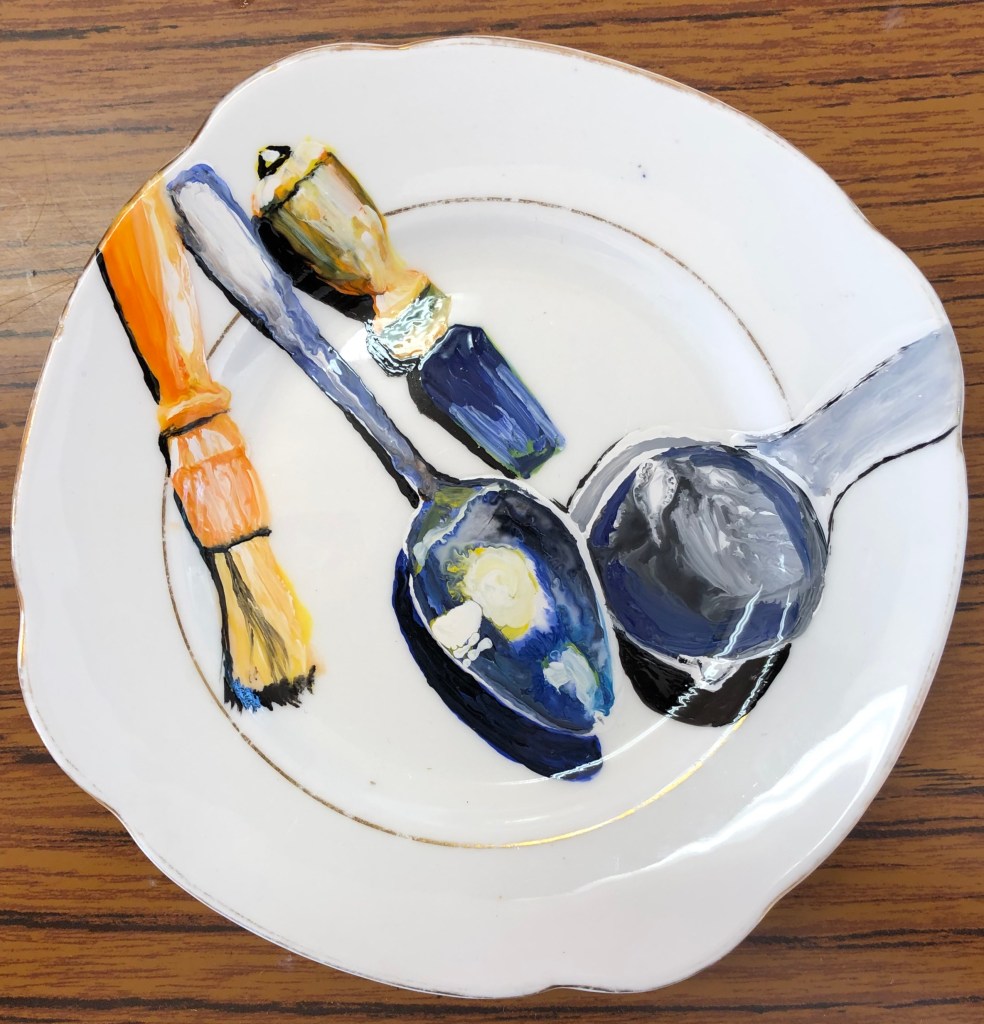
For this exercise I wanted to try painting with enamel again but loosely without an acrylic liner (see recent blog post), so I found a bone china side-plate to use as a support.

SO WHAT?

I selected a part of my collection of items from the cutlery drawer, going for a trompe l’oeil effect, as if things were being used and had just been placed temporarily on the plate to save making the work surface dirty. I couldn’t draw it out first so just went for it, beginning each item with white enamel and building up layers on top of that, without waiting for anything to dry. Whereas the paints are tricky to mix, you can get some interesting layer-mixing, e.g. on the wooden handle of the cheese knife. I also tried dropping some Zest-It solvent into the bowl of the spoon and then put colours into that, which has created some loose spreading effects. The hardest thing to paint was actually the tea strainer, which looks a bit unrecognisable, but I think the others are clear and I have mainly managed the curves of the plate well.

NOW WHAT?

I began the 3D work back with my research with some despondency, thinking it felt rather like messing around and was somewhat of a waste of time when I needed to be getting on to the serious stuff. However I’ve discovered, particularly with the recent trompe l’oeil plate piece and my egg box of eggs (which formed a key part of a collaborative exhibition pitch – see blog post on Contamination/Curation) that it can (a) be fun, and (b) lead to an eye-catching finished piece.

Painting 1; Part 2; Exercise 2.1 – Unusual painting media

EXPERIMENT 1

WHAT?

Household paint (Annie Sloan) on a piece of packing card from an Amazon parcel.

SO WHAT?

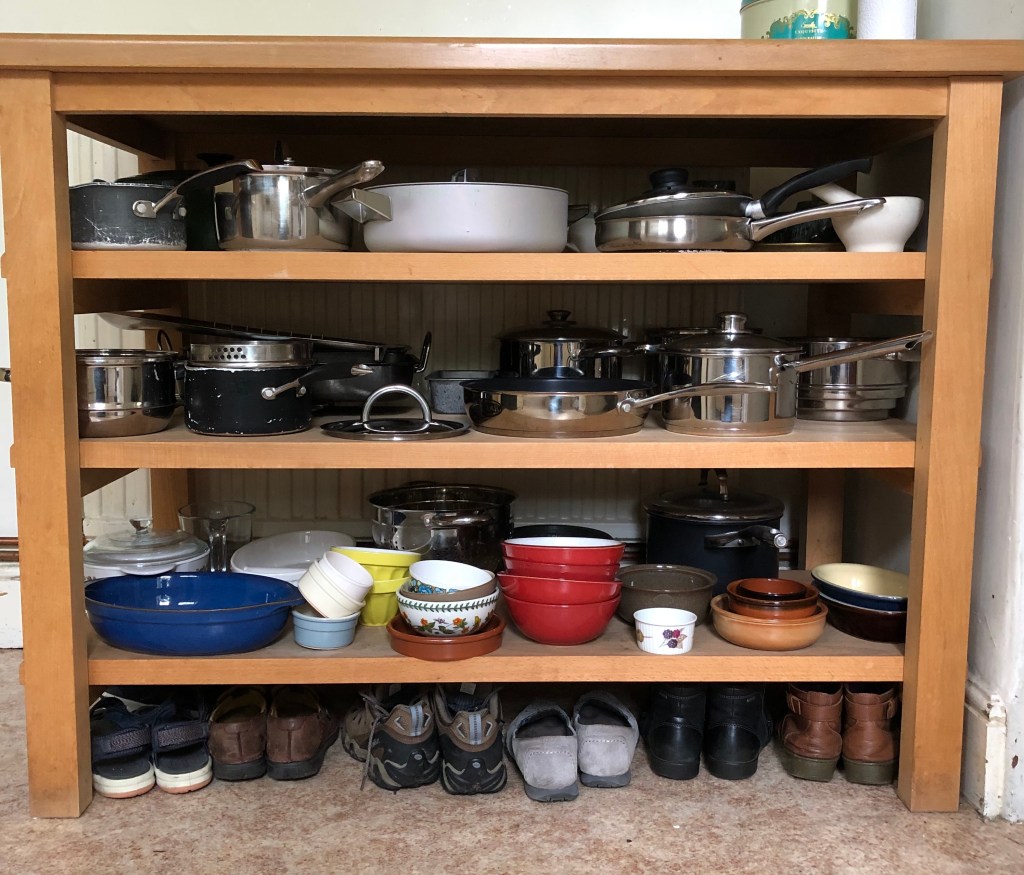
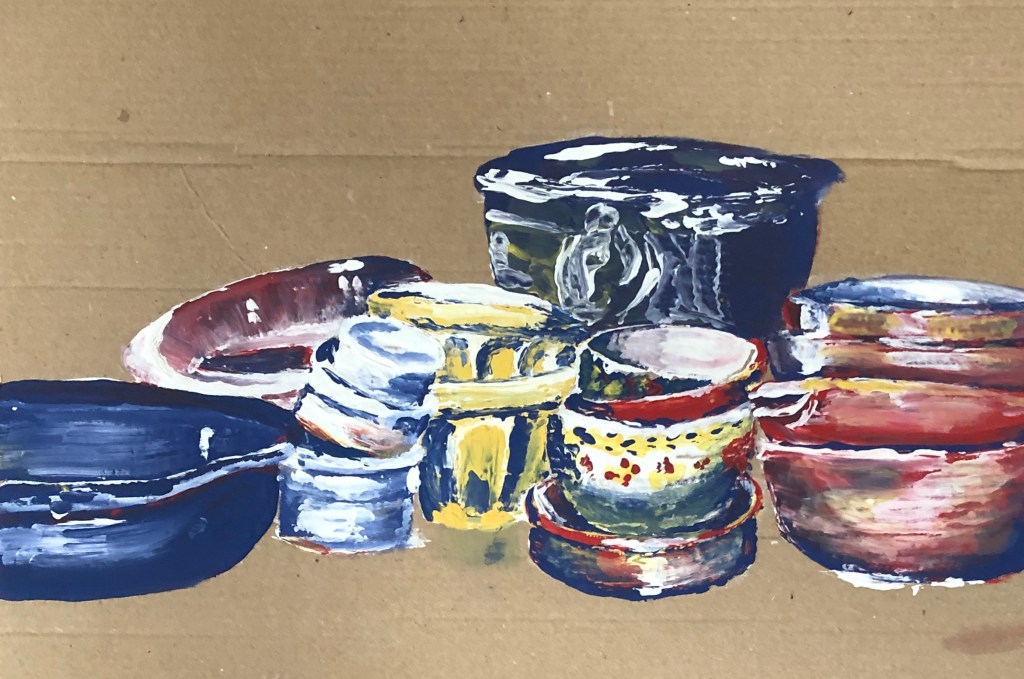
I had four small tins of her chalk paint – Napoleonic Blue, Old White, Emperor’s Silk (a crimsony red) and Tilton (bit like Naples yellow). I chose a detail from the bottom shelf of this picture, left-hand end; the collection of china and pottery bowls with the metal colander behind. I thought the slightly clay-y nature of the paint would be good for depicting clay-y products.

I started off working with a size 6 bristle filbert; however, I was using an ordinary round-ended cutlery knife to get the lids off the paint tins, and I soon found that this knife was actually as good/better at applying the paint to achieve smooth surfaces and thin lines –  so ended up using a combination of both tools, with a bit of fingertip thrown in.

Because I was using nice, gloopy, non-”expensive art” paint and a rough bit of bendy and corrugated-in-places card, I had enormous fun slapping the paint on, getting myself in a fine mess in the process. All colour mixing took place on the painting surface and that generally seemed to work fine – my only issue was my inability to mix a real “dark” for the dark shadows. I thought I’d let it all dry and then consider putting in the dark darks with an ink wash….but in the end, I liked its raw quality, so left it as it is.

NOW WHAT?

  • This is definitely something I would repeat – for the enjoyment of being able to “dollop” paint with a thickish brush and a knife, and also for the feel of the paint and the little bit of extra texture it provides, which would be appropriate to certain types of subject matter – I think it really worked here
  • The exercise has made me reflect on the issues of form and background. I struggled to make a really dark dark (best I could achieve is blue, then red, then blue – but the paint is opaque so it’s difficult to get a dark by building layers). As a result the painting is possibly a little flat. I wondered then about introducing a dark background so that this would bring the crockery forward and stop it floating.  However, I’ve propped it up on a shelf and been living with it for a day or so, and the contrast between the board background and the chalky paint makes the crockery stand out separately anyway (hard to see on a photo, clearer in actuality, the paint sort of shimmers above the card), so I decided to stop where I was. I know it’s only a practice piece on a bit of bent board, but I rather like it!

***************************************************************

EXPERIMENT 2

WHAT?

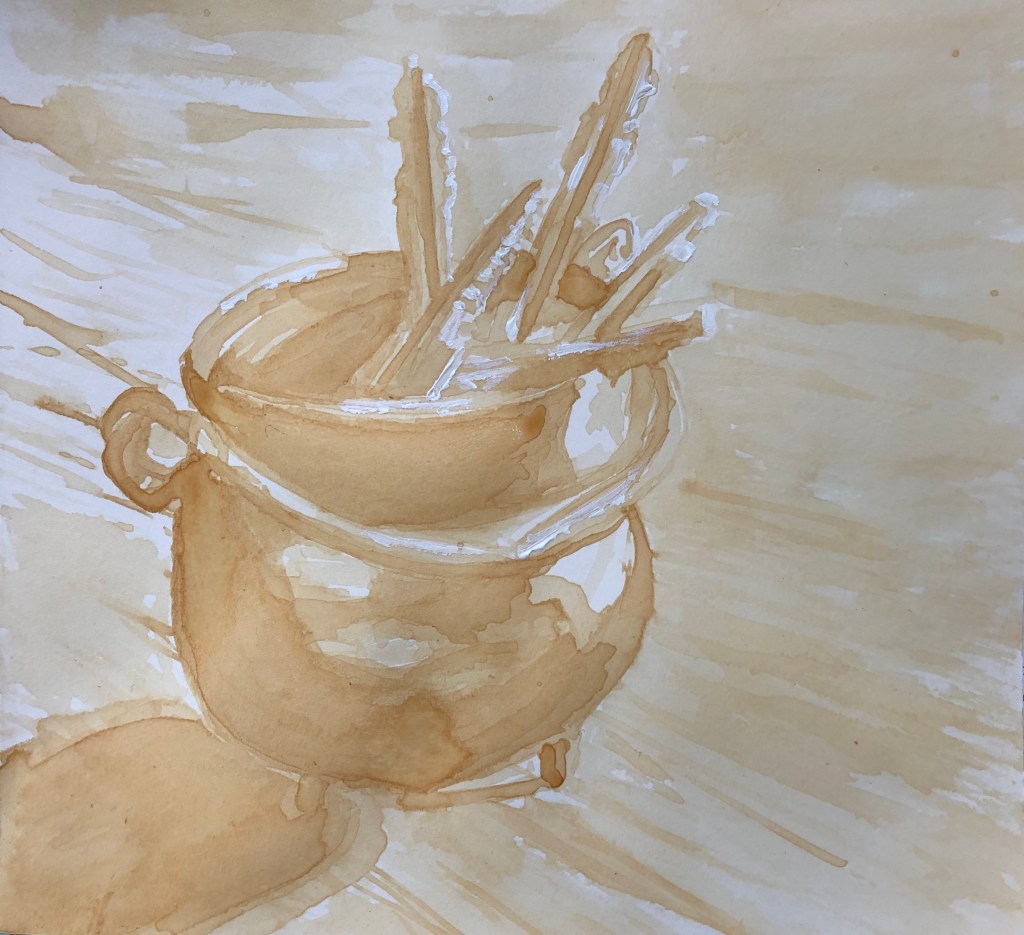
Tea (substituted for coffee) on a square of off-white cartridge paper (approx 18 x 18cm), with a few highlights in white acrylic.

SO WHAT?

I had a go at painting a collection of keys in a pot on a wooden table, using a size 3 rigger, with this photograph as reference material.

Even having prepared my medium with 3 tea bags in a small quantity of water and leaving it to steep for three days, I realised as soon as I applied the first brushstroke that this was going to need to be built up in several layers as the marks were fairly faint. I had chosen a light creamy support as I thought that might help bring out the warmth of the original, but I’m not sure it has helped, the tea is quite an acidic brown. In the end, finding myself a bit confused by the colours, I made my reference image monotone on my iPad and worked from that, finding it easier to pick out the tones. 

After many layers, which had to be left to dry each time otherwise the tea just pooled in the cockles of the paper, I seemed to be struggling to get any darker, so I decided to use a few dabs of white acrylic to pull out the highlights on the keys, the rim edges and the top of the handle.

Not the most satisfying painting I’ve done….

NOW WHAT?

This experiment, and the previous one, is really bringing home to me the importance of having a decent range of tones to work with; or rather, to taking the time before you start to understand the range which you have, particularly if it is small, and making sure you are clear about your middle tone – I think I have used my darkest tone as a mid tone and then been frustrated that I had nowhere to go with it.

******************************************************************

EXPERIMENT 3

WHAT?

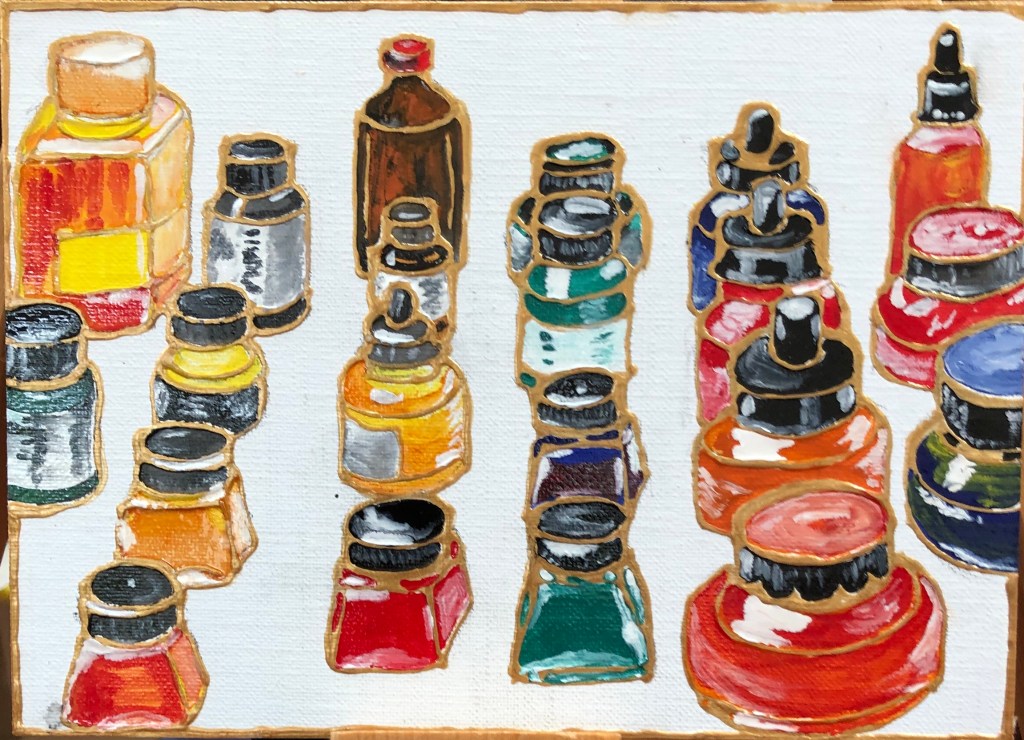
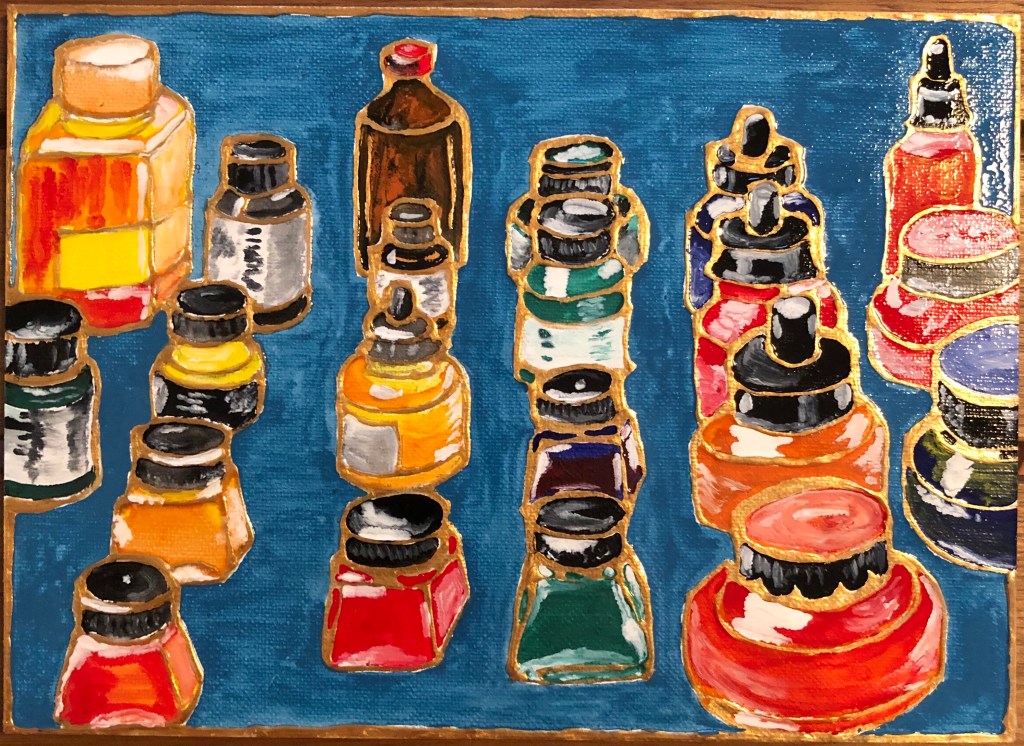
Humbrol enamel paint, plus some Zest-It solvent, and gold acrylic liner, on white prepared board, 18 x 13 cm.

SO WHAT?

Consequent upon my previous experiment with enamel paint on a CD inspired by the work of Raqib Shaw (see earlier blog post), I decided to try to apply his method to my collection of ink bottles. I used this photograph as reference. 

I worked quite small as I find the method quite time-consuming since the work is detailed. I did a pencil sketch onto the board, then drew over it in gold acrylic liner squeezed from a tube. When this was dry, I applied the enamel paint using a small craft brush. I did the bottles first, experimenting with dilution of the paint with Zest-It; however I found the most “bottle-y” effect was achieved with the paint fairly neat and thick. 

I took a photo when all the bottles were painted and debated whether to paint in the background at all (having learned this time to put an acrylic liner boundary round the edge of the board); however, having chickened out of adding a background in the household paint picture (see above), I thought I should go for it here. I went for a Raqib-style turquoise gloss background, but this time applied it in equal measure with the solvent and, although not perfect, this has served to lessen the prominence of the brushstrokes which I found tricky in the CD painting. The whole thing has a rather design-like quality so I decided not to worry about adding shadows – I was OK with it being basically flat but shiny!

It’s quite hard to photograph as, wherever I put it, the light reflects off it somewhere.

NOW WHAT?

  • Interestingly, form and background have come to prominence again as consideration here. Even without indicating shadows, the half-finished one looks more realistic (perhaps because it matches the white background of the photo); adding the blue background has, to me, turned the picture into a more fantastical image where form is not required or necessarily desired.
  • I really enjoy using these enamel paints (a sucker for shiny things), even though following Shaw’s method is quite time-consuming – it leads to work of a jewel-like quality.  I should like to experiment more with these paints to see what other effects can be achieved when they are used more freely.

Painting 1; Part 2; More work on formative feedback from Assignment 1

WHAT?

I wanted to:

  • look at some drawings by Maggi Hambling
  • make some drawings in her style
  • Make a painting from one of the drawings

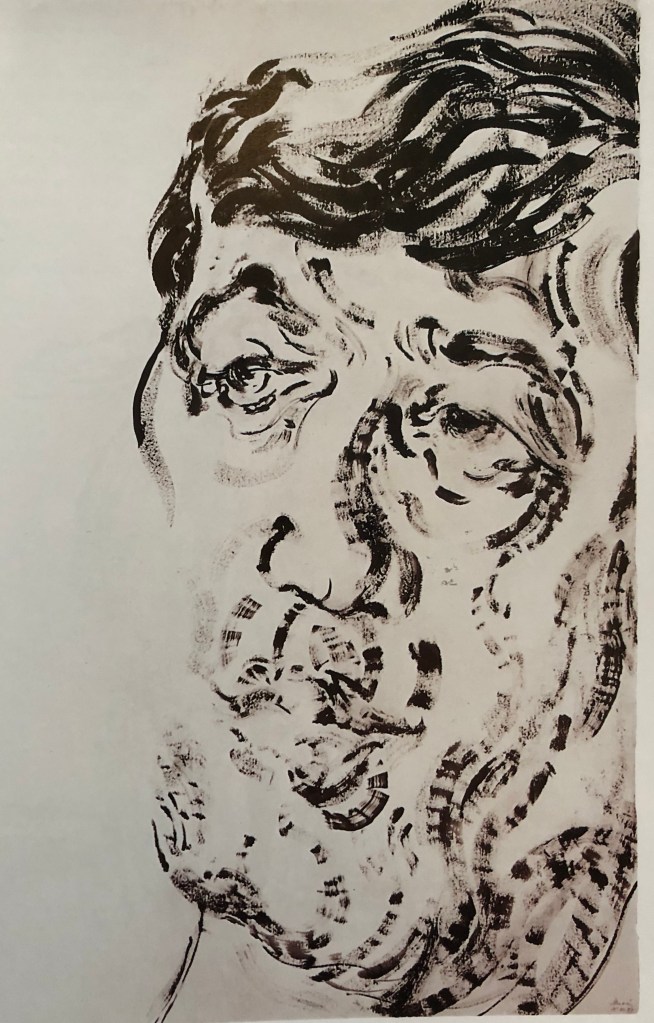
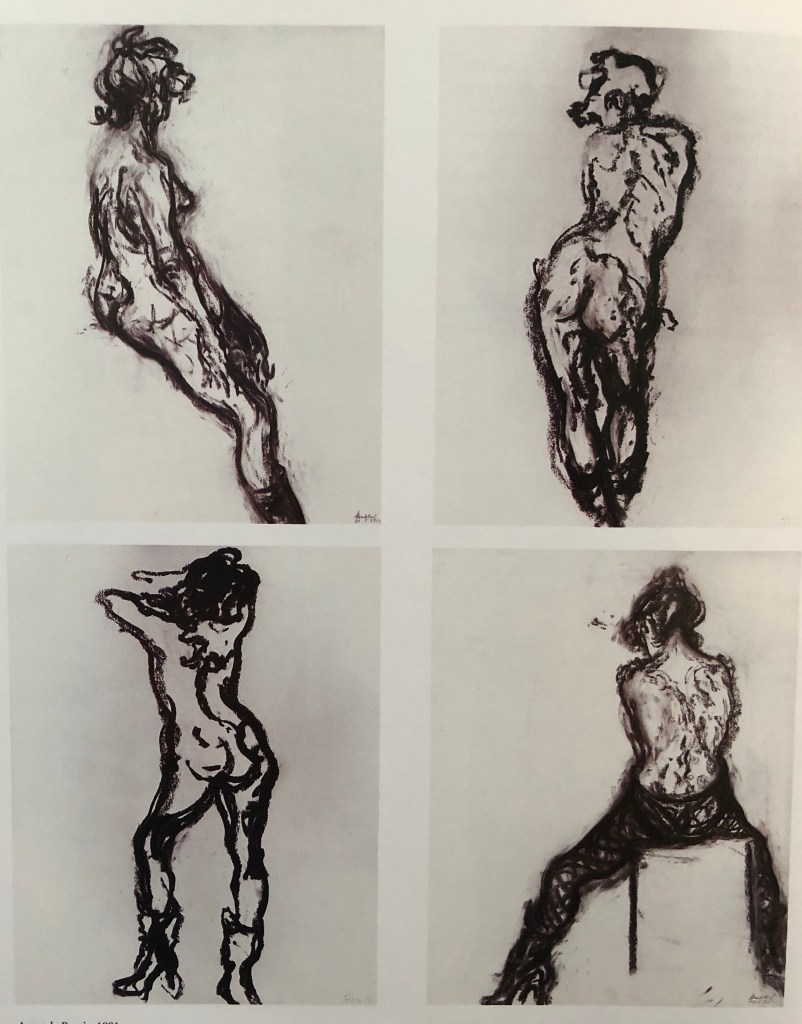
I had a good browse through Andrew Lambirth’s 2006 book “Maggi Hambling The Works and conversations with Andrew Lambirth”, Unicorn Press, London. Maggi has a very free drawing style, as can be seen in:

“Large Head of Stephen”

1993

Ink on paper

152.4 x 101.6 cm

And…

Amanda Barrie”

1991

Four studies from life

Charcoal on paper

Each 60.7 x 48.3 cm

I was particularly interested in the way she seems to drag a partially dried brush in her ink drawing of Stephen Fry to get her wider-yet-lighter lines. She made this drawing (among others) in preparation for painting a portrait of Fry.

SO WHAT?

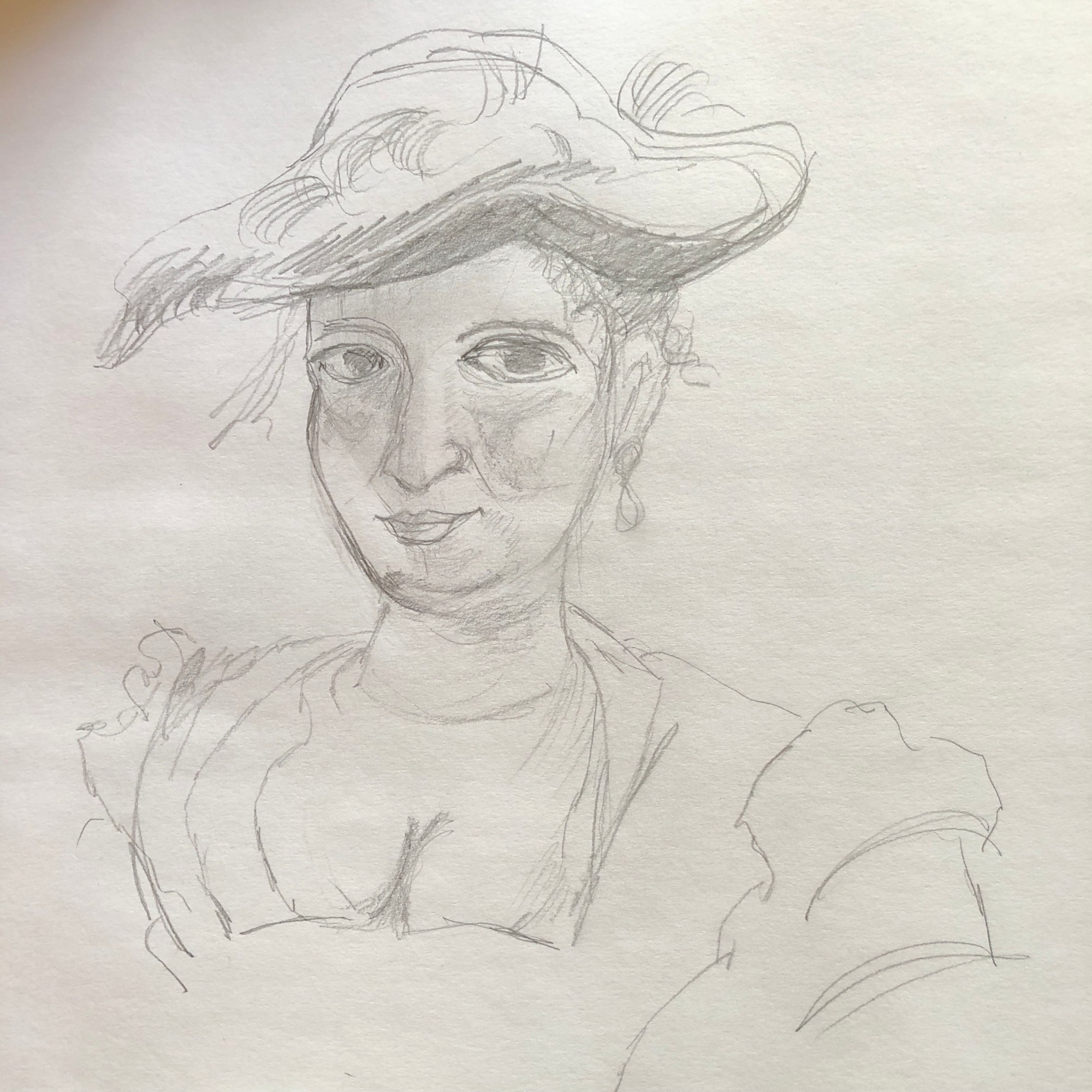
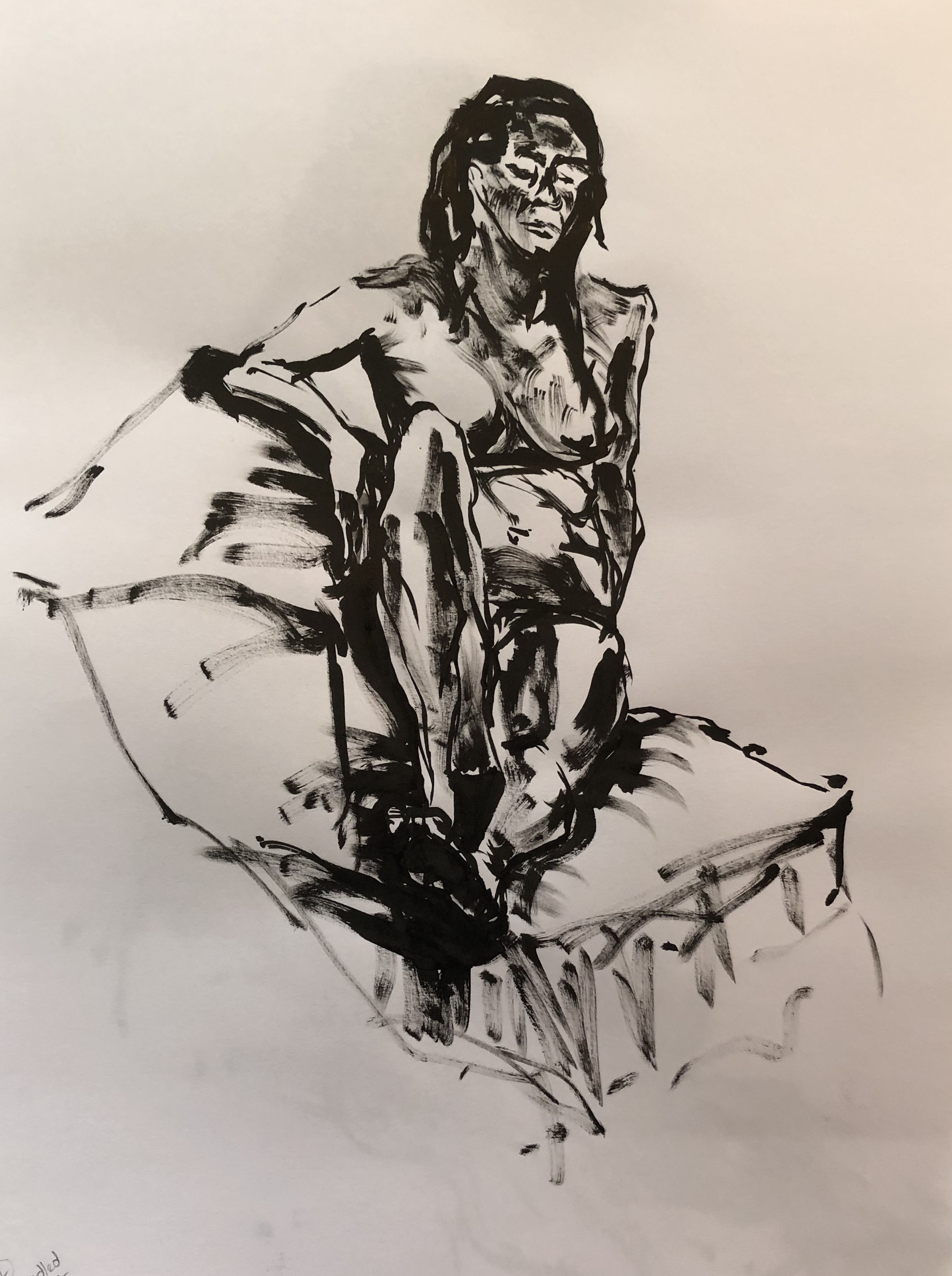
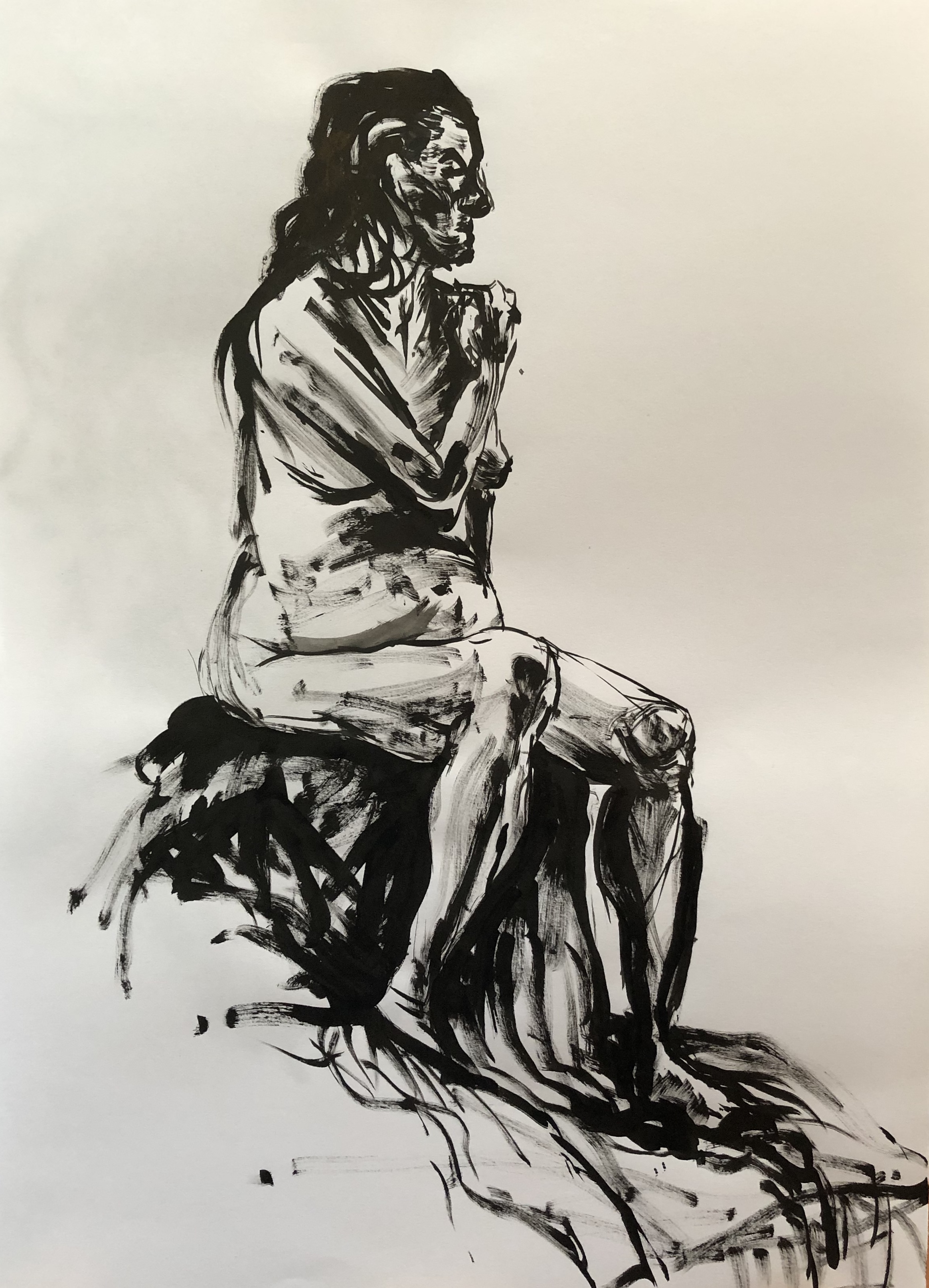
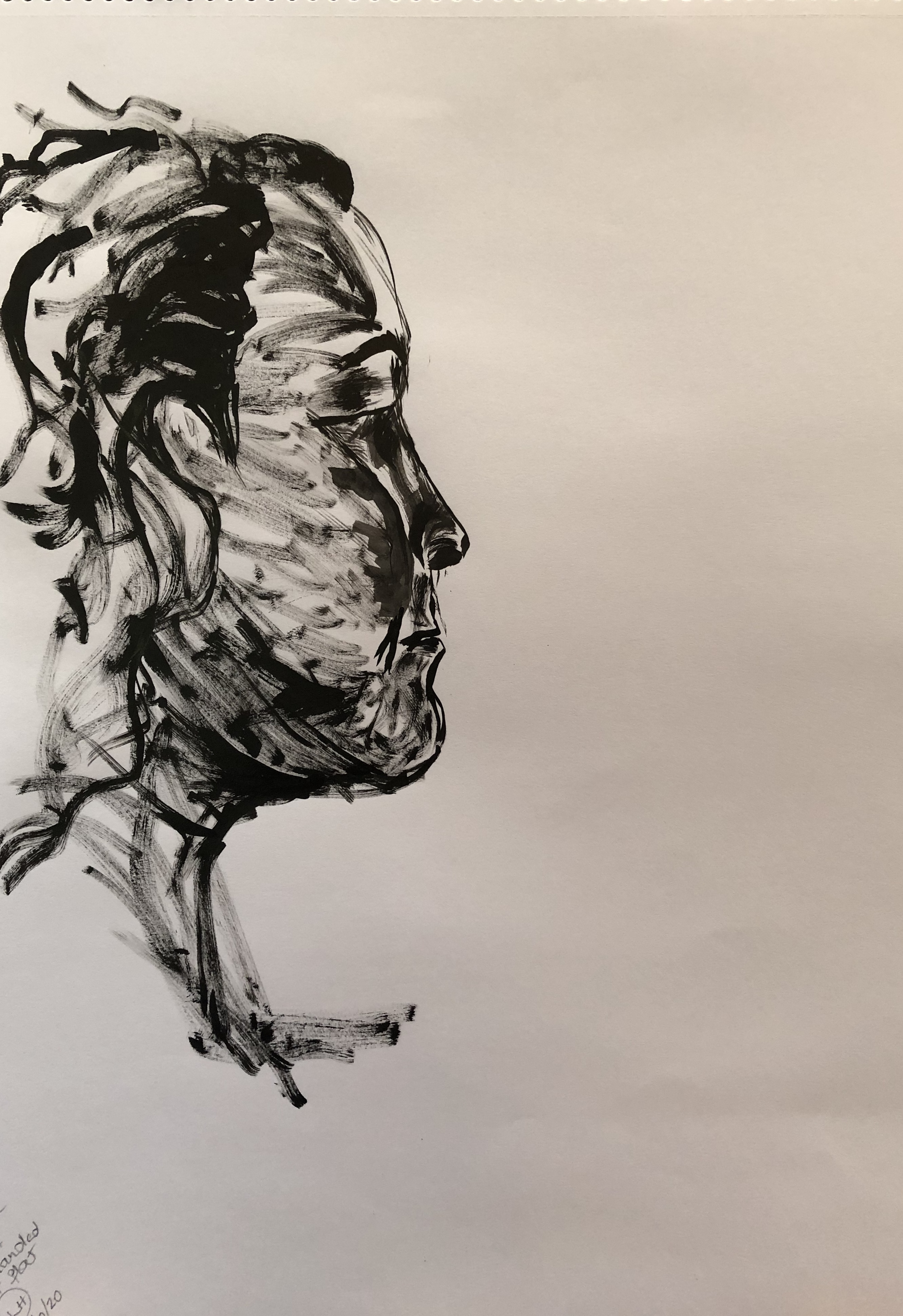
I decided to work in Chinese black ink and a long-handled size 4 short bright throughout a life drawing class, trying to replicate Maggi’s free style of mark making, hoping that one would be clear enough to paint from. I also tried to use my left (non-dominant hand) throughout to try and improve my facility with a brush with that hand.

Some results as follows:

I feel my brush strokes have mainly been decisive (and Maggi is, if nothing else, a great role model for decisive mark making), and I soon got the hang of her dry-brush drag for lighter marks. 

I fell into the trap of being uneconomic at first – so hard in a life drawing group when someone says “10 minutes left for this pose” – so you think you have to add something to your drawing in that time) – so decided to use some extra time from the second long pose to try a drawing of the model’s face, which I knew I hadn’t got right in the main figure drawing. The face was quite shadowed but with key areas lit up by a lamp.

I decided to use this drawing of just the head to take forward to a painting.

I had two things to try out in this painting: a tube of Jackson’s “Scorched Earth” black acrylic (supposed to be made from the ash of Iraqi fields burned by the militia), and a long handled sword liner brush.

I laid down a quick background on a piece of gessoed board, using loose strokes with  flat brush and the black Scorched Earth acrylic mixed roughly with some titanium white Cryla acrylic. This dried in minutes, and I did the whole of the rest of the painting using the sword liner (and my left hand).

I worked quickly, marking in the lightest areas with plain white and the darkest with undiluted black. Then it was a question of filling in the mid tones. The sword liner was great for the wavy, expressive lines (as per Maggi), although I did struggle a bit with accuracy of detail. 

I think the outcome is dramatic, although I think I lost some definition of marks in my mid tone areas as a result of just the fun of playing with the sword liner, and also have lost some of the character of the original – this feels more like a generic person than a particular woman.

On the plus side, I have managed to retain some of Maggi’s freedom of mark making.

NOW WHAT?

I have found that:

  • Mindful of some tonal inaccuracies/omissions in my earlier Frank Auerbach drawing which translated into corresponding inaccuracies in tone in the painting, I have learned to think more about this issue – which I did find easier here when drawing with ink.
  • If I want to do much more work with acrylic I need a whole lot more practice at dealing with the speed at which it dries, which took me aback a little. I could cover up my errors when they were “within” the image easily enough, but I wasn’t quite sure what to do about errors I had made right on the edges, which seemed to dry in seconds before I could wipe them off.

Painting 1; Part 2; More experiments with unusual materials and supports

WHAT?

Turning out a cupboard, found an old box of unused CD ROM blanks which seemed ripe for experimentation as a support – I wanted to find out what materials the surface would accept.

AND…

I have been reading more about Raqib Shaw’s work with enamel paint, and wanted to see if I could replicate his method.

AND…

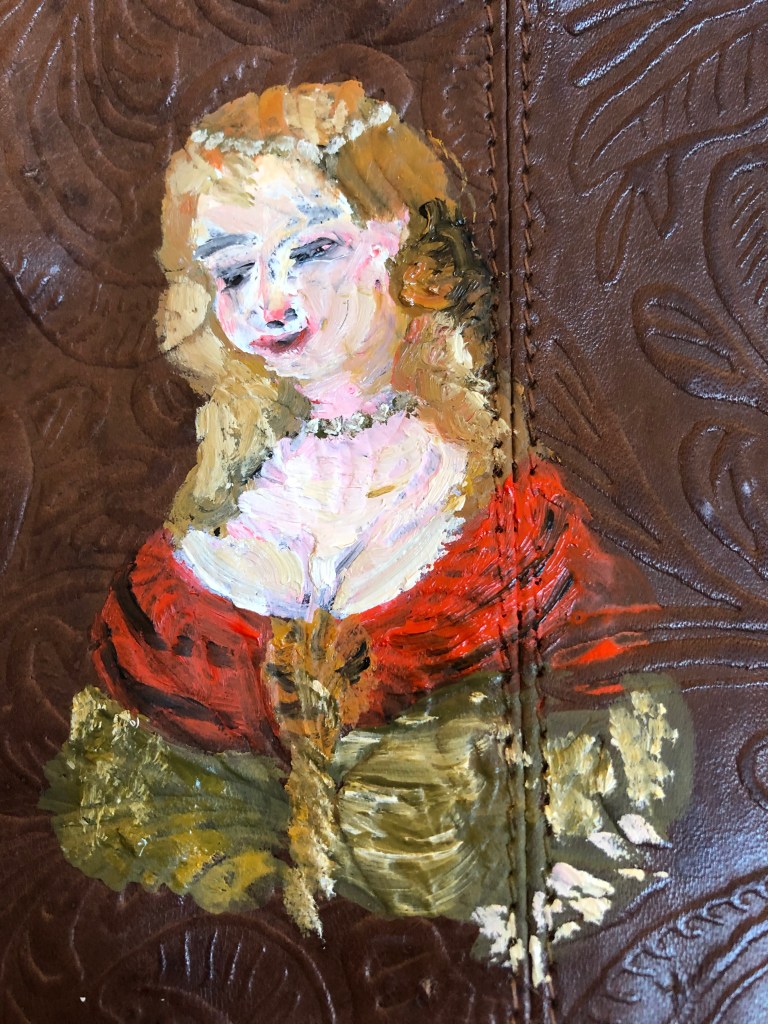
We have been away for a few days to Dunster in North Somerset. There is a National Trust Castle there which we visited, and I was very struck with the “Leather room” – a room completely hung with what initially looked like tapestries telling the story of Anthony and Cleopatra, but they turned out to be paintings on large leather panels done with oil paint in the late seventeenth century – sections of the painting were done separately and then the panels are joined and hung. These are rare in this country and came originally from the Netherlands where (according to the room steward), this was a very popular and widespread technique. Who knew? Need to have a go…..

SO WHAT?

CD ROMs:

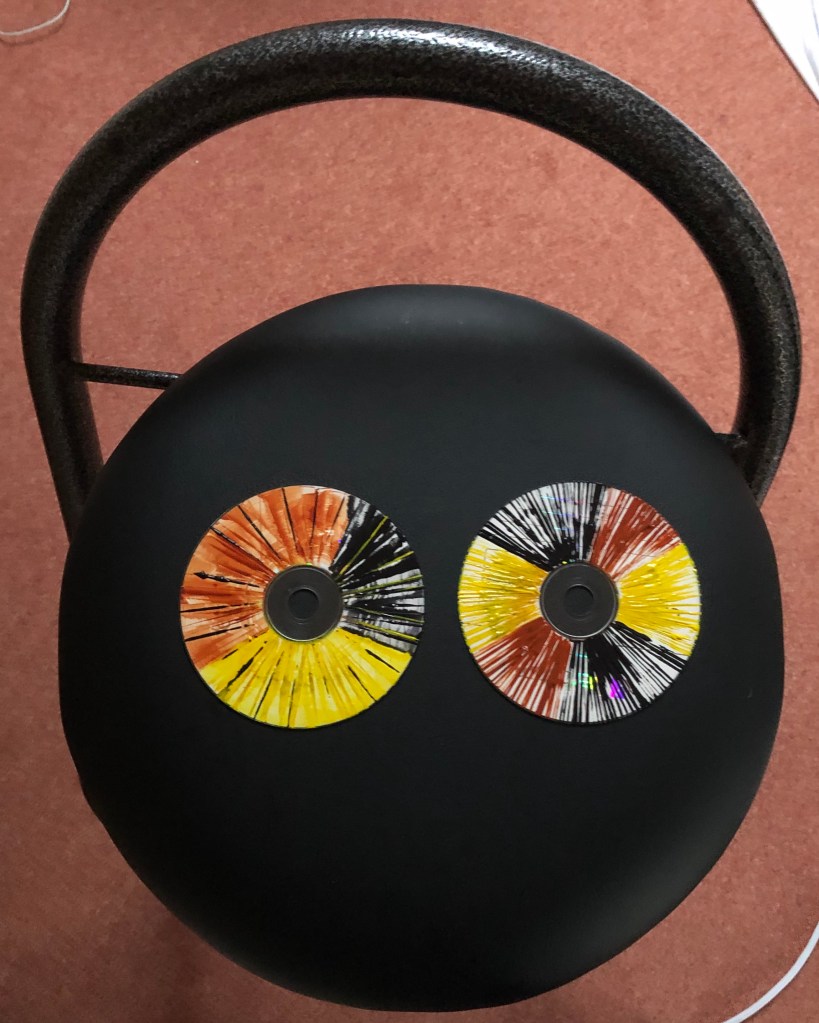
Acrylic paint seems to stick to most things, and this proved to be the case with the CD surface. I had some dollops of paint left over from a Zorn palette painting, so experimented to see what marks I could make by applying the paint thickly with the edge of a credit card – fun, satisfying, something to experiment with more on a bigger surface (I got a bit caught up turning my CDs into a pair of unmatched eyes for a stool “bug”).

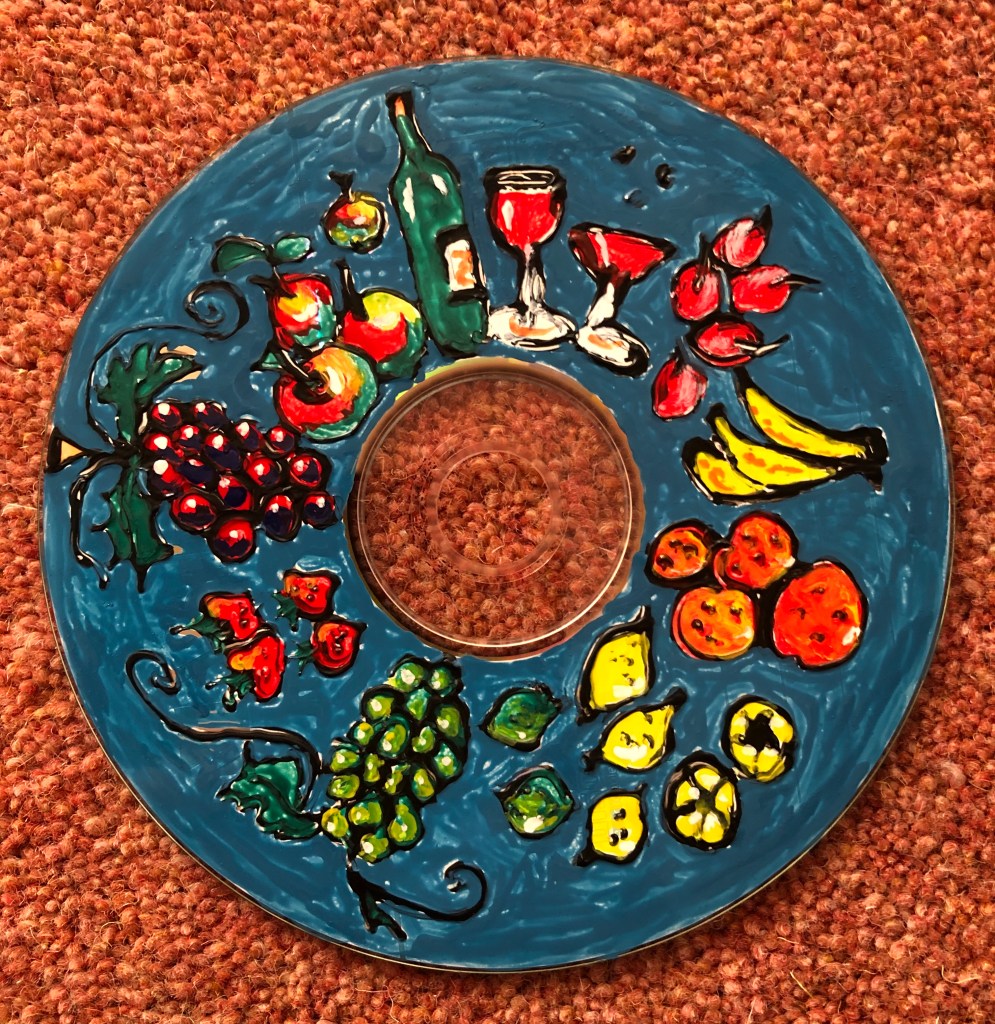
Next, I had been reading about Raqib Shaw’s method of working with enamel paint in Patrick Elliott (2018) “Raqib Shaw; Reinventing the Old Masters”, National Galleries of Scotland, Edinburgh  – apparently he does elaborate preparatory drawings, projects them onto his support, draws out the design using an acrylic liner, then fills in the areas cordoned off by the liner with the enamel paint; he comments that the paints don’t mix terribly well, but he uses porcupine quills to sort of swirl them together within a little drawn cell.

This example is a detail from his “Self-portrait as an Opium Smoker (A Midsummer Night’s Dream), 2016, acrylic liner and enamel on birch wood, 102 x 133cm, Private collection.

Lots of Shaw’s paintings contain cornucopia-type areas of food and drink, so I drew freehand some fruit and wine around the CD using a black glass paint liner – a technique in itself as you have to maintain exactly the right pressure on the tube as you’re drawing so you don’t get blobs or bald patches. Once it had dried, I painted into the drawings then added a blue background, a favourite colour of Shaw’s. I am using Humbrol enamel paints – the colours are vibrant, they don’t mix brilliantly (as Shaw commented) but you can overlay them a bit and blend edges with the tip of a brush. The paint adheres to the CD surface, although you do get a few skiddy areas if you don’t dry the Zest-It cleaner off the brush well. Only disappointment was the background, which I could not seem to apply evenly; I think Shaw drops the paint into the cells and lets it spread, which I wasn’t able to do here as I hadn’t applied liner to the outside of my CD…thus proving that shortcuts don’t always work.

…and finally, the oil on leather experiment:

Tried using up some water-mixable oils from a Zorn palette I had made a few days ago – they were still malleable, although admittedly a little clumpy in places. I used a size 4 round brush onto the back of the handbag I’d used to experiment with acrylics (see Research blog post). I worked from a postcard of the Dunster Anthony and Cleopatra leather paintings, just trying to get head and shoulders of one of the figures (the image shown here is a detail).

The oil paint was not as easy to apply to the surface as the acrylics; when I used it slightly diluted with water it slid all over the place, so I tried to keep it as “neat” as I could, and even so it felt as if it were moving about a little whenever I tried to build up layers – so it’s ended up fairly pasted on!

I’m not sure how much of my difficulty was caused by the fact that my paint had already started the drying process, and how much was caused by using water-mixable oils (which I prefer because of my asthma) – obviously leather is treated to repel water, and I wonder if I would have had a different experience with completely oil-based paint. Also, there is the possibility that the bag is not actual leather but a faux substitute, so might not react the same. Again, there is the possibility that the Dunster paintings had some sort of ground applied (gesso or similar) to help the paint “take”, although this wasn’t apparent and wasn’t mentioned by the chap who described the process to me. Finally, I wonder if I should have tried using a smaller brush – but it took a bit of oomph to “push” the paint onto the leather and get it to stay there – so possibly, rather than using a smaller round, I would have been better off using a bristle brush and going for impression rather than detail.

NOW WHAT?

I’m pleased to find I’m beginning to enjoy and embrace the experimental. 

I’d like to try more of the following:

  • When using thick paint, apply it with tools other than brushes – maybe more credit card marks, also palette knives.
  • I’m interested in Raqib Shaw’s method of working and would like to play around more with the enamel paints.

After doing the above experiments, I had a good go at cleaning my palettes. The acrylic one wasn’t too bad as I’d kept it in one of those “stay-damp” boxes, but getting the partially-dried oil off the other, glass, palette was a bit of a nightmare; so I’ve learned that thrift is OK to a point, but I would be better thinking about how much I’m actually going to need before I squeeze paint from a tube.