Demonstration of visual skills: Materials, techniques, observational skills, visual awareness, design and compositional skills.
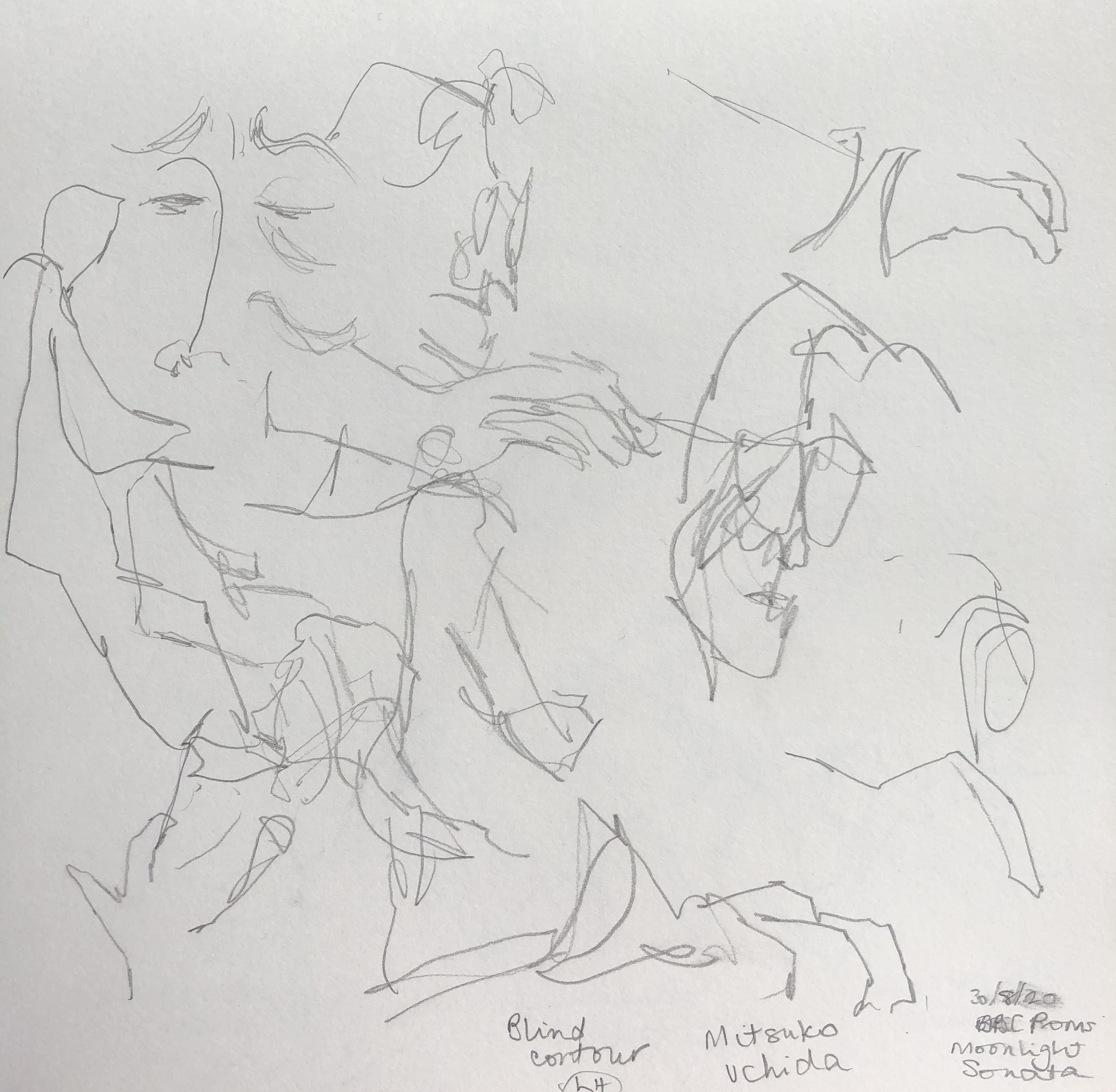
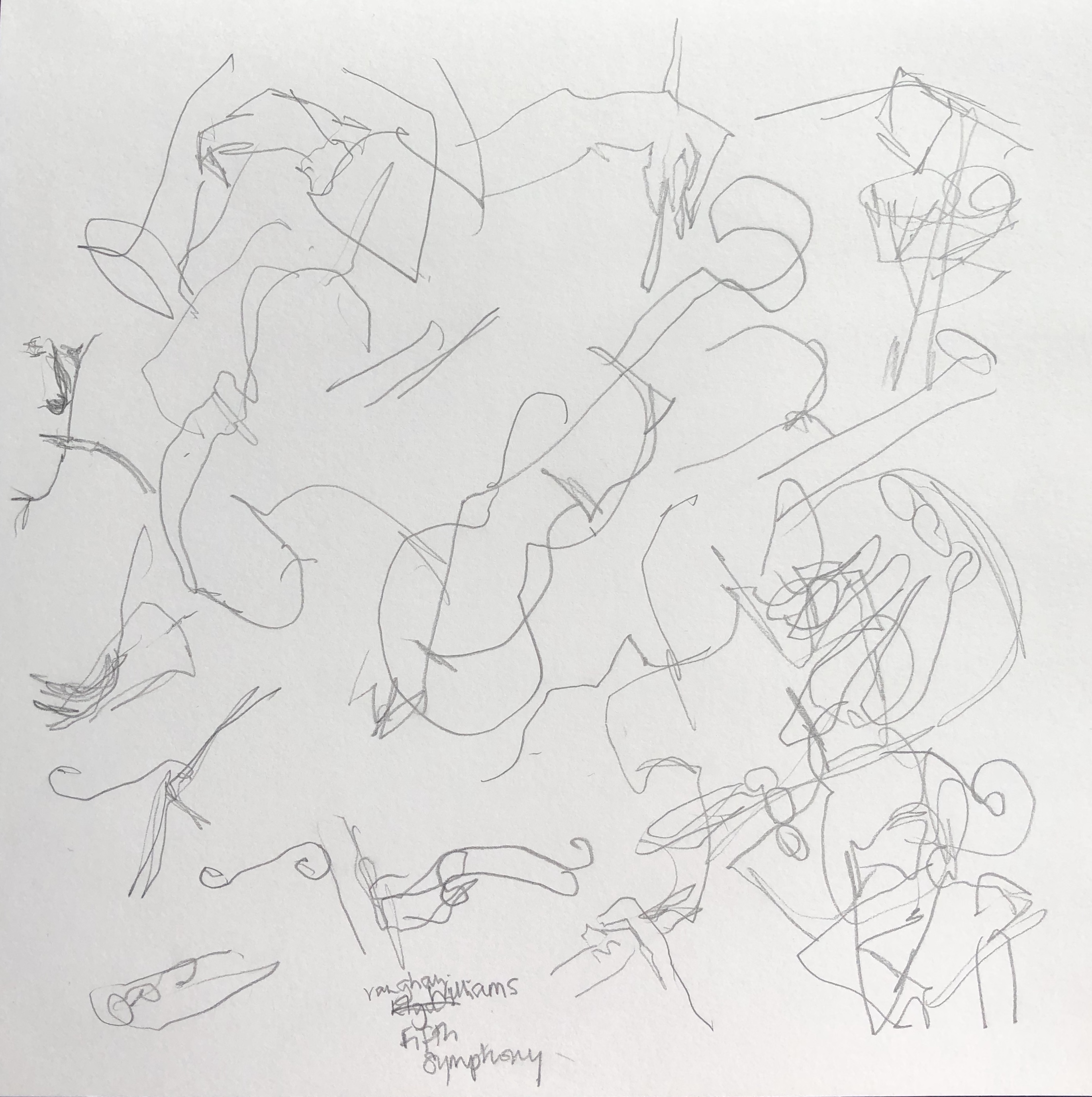
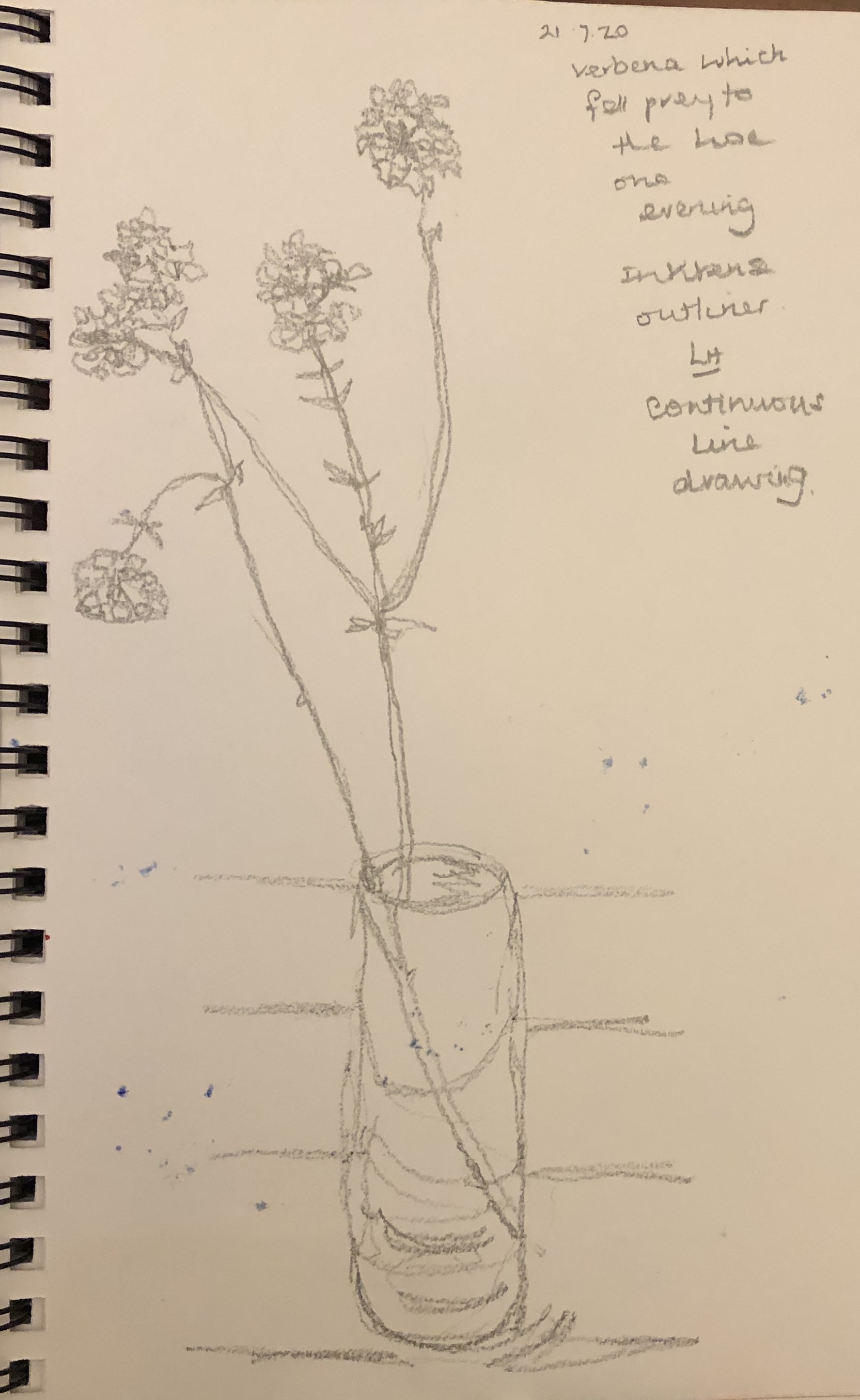
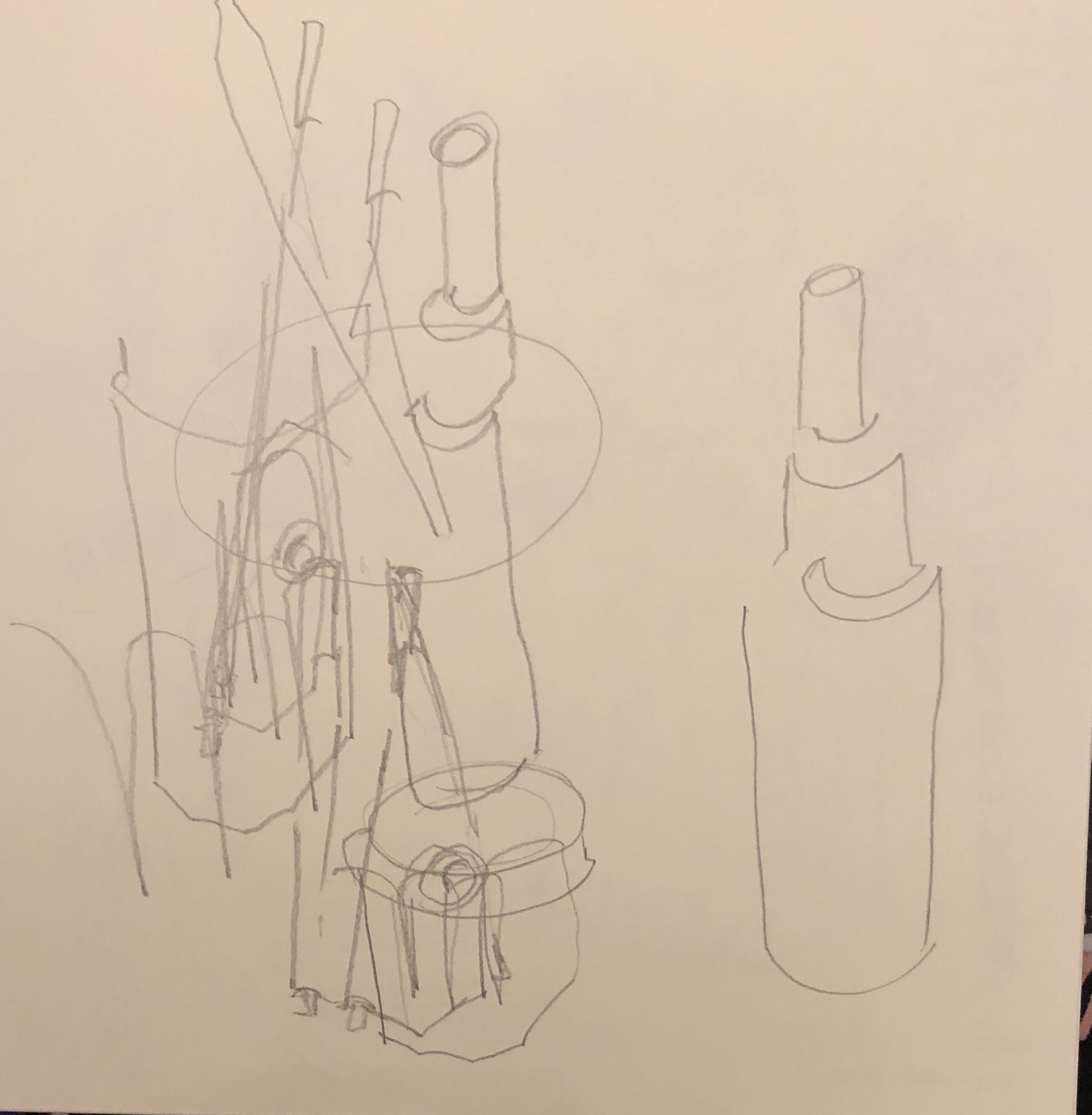
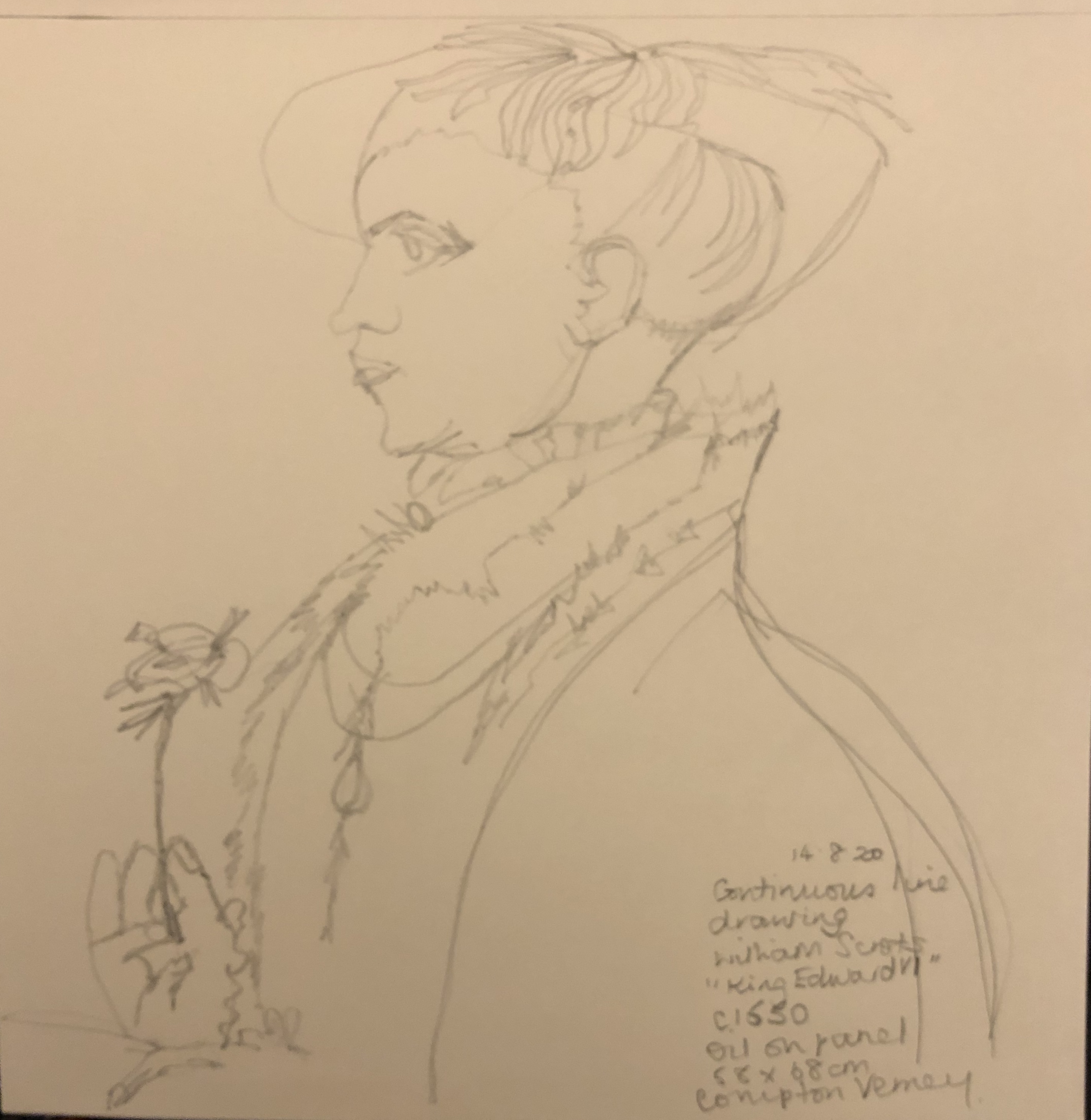
I have been using continuous line drawing (often blind, sometimes not) regularly through this section as a way to hone my observational skills (see some sketchbook examples below), and of course, it was one of the key determinants in my composition selection for my assignment pieces (see video of the supporting work for my assignment). I have found the course notes, together with information online and in books, helpful in using the different media, and have been introduced to all the most common media in the course of the various exercises; I picked an unfamiliar medium, egg tempera, to work with for my assignment piece so that I could explore its properties and capabilities.
Quality of outcome: Content, application of knowledge, presentation of work in a coherent manner, discernment, conceptualisation of thoughts, communication of ideas
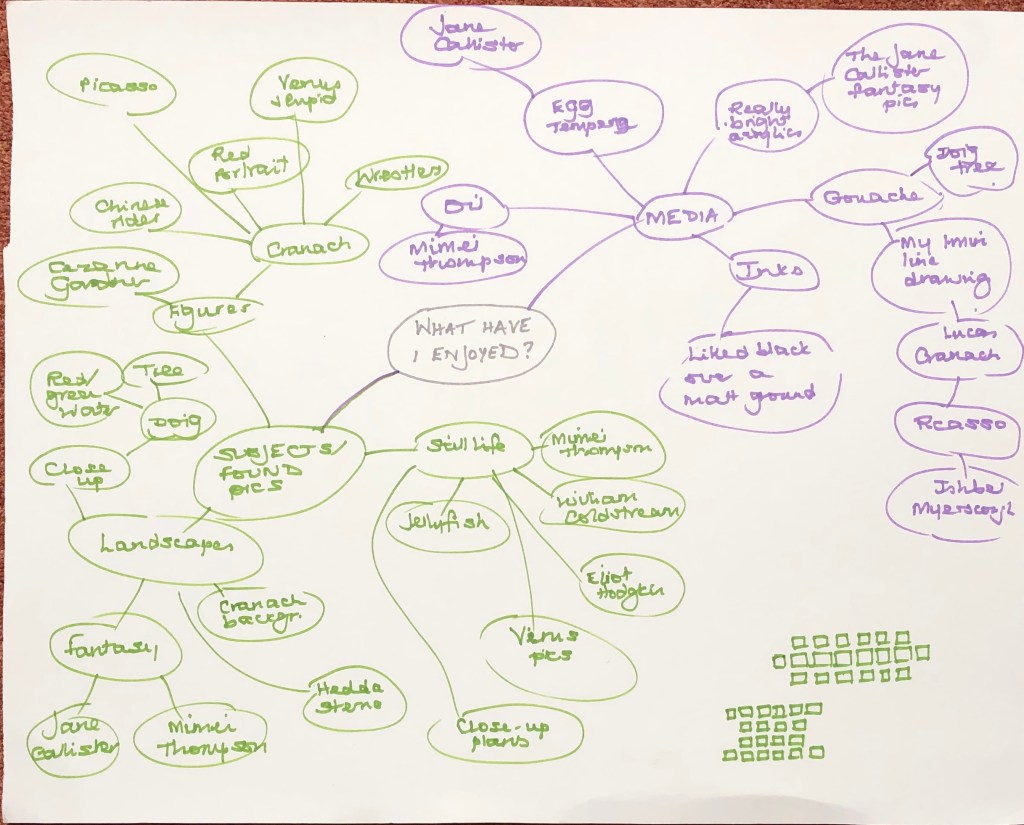
I am interested in people and the depiction of people; the former is a lifelong interest, the latter only developed since tackling Part 4 of Drawing 1, where I had to get over my fear of portraying people and get on with it – only to find, to my surprise, that I finally understood why so many artists have devoted themselves to portraiture and life drawing – I have found it compelling, even though I have had a massive amount to learn. I feel I am playing catch-up with this aspect of my art now, which is why I chose to investigate the work of various artists whose work depicting figures and faces I had collected as found images for this Part and for my assignment. I hope that my series of characters holds together as a single work as well as individual pieces, and shows my enthusiasm for the breadth of this aspect of art, and the wide variety of my research and reading. I tried listing and mind-mapping my way towards the decisions about the assignment – at the moment I am finding this writing down a useful tool just to express some basic thoughts for my subconscious to swill around until it eventually throws a finished idea out.
Demonstration of creativity: Imagination, experimentation, invention, development of a personal voice.
I found my sketchbook work invaluable when planning out the paintings for my assignment (see sketchbook video) – sometimes I had picked a found image and knew exactly what I wanted to do with it; but much more frequently I used my sketchbook to experiment with my found image, using blind continuous drawing, thumbnails and tonal drawings, in order to make decisions about image, ground and composition, sometimes discovering that what I had thought I was going to do turned out to be superseded by a much better idea.
• Context: Reflection, research, critical thinking (learning logs and essay).
I have used found images and looked at artists’ work from 700AD to the present day during the course of this Part, both in my research work and in particular for my assignment piece. I have greatly enjoyed depiction of the human form, but I am not wedded to this (not wanting to write myself out of still life, landscape and abstraction just yet) and, although I have tinkered and experimented with a wide range of styles, I do not yet feel that my own voice is emerging (apart from a fondness for bright, vibrant colours, apparently). All of the styles I have tried have been appealing on some level, although part of this is just the excitement of doing something unfamiliar.
I have enjoyed the challenge of working small. Thinking about both ends of the scale is not something I have grappled with too much before, and in Drawing 1 the drive was always to get bigger and more expressive – so the requirement to work small and in quantity in this Part has been fun. It is actually very convenient – you can set it up anywhere, almost no space is needed, and finish a piece quite quickly which gives a satisfactory sense of achievement (until you calculate how many more pieces are still needed to complete the work). Having said this, when I came to Part 5 of Drawing 1, I was very attracted to tessellated images such as those of John Virtue and Tyga Helme – so this was not a completely new thing to me. However, having been pushed by the end of Drawing 1 up to A1 and beyond, I am finding myself hankering to flex my muscles on something larger than 6 x6 in, even if just for a little while.
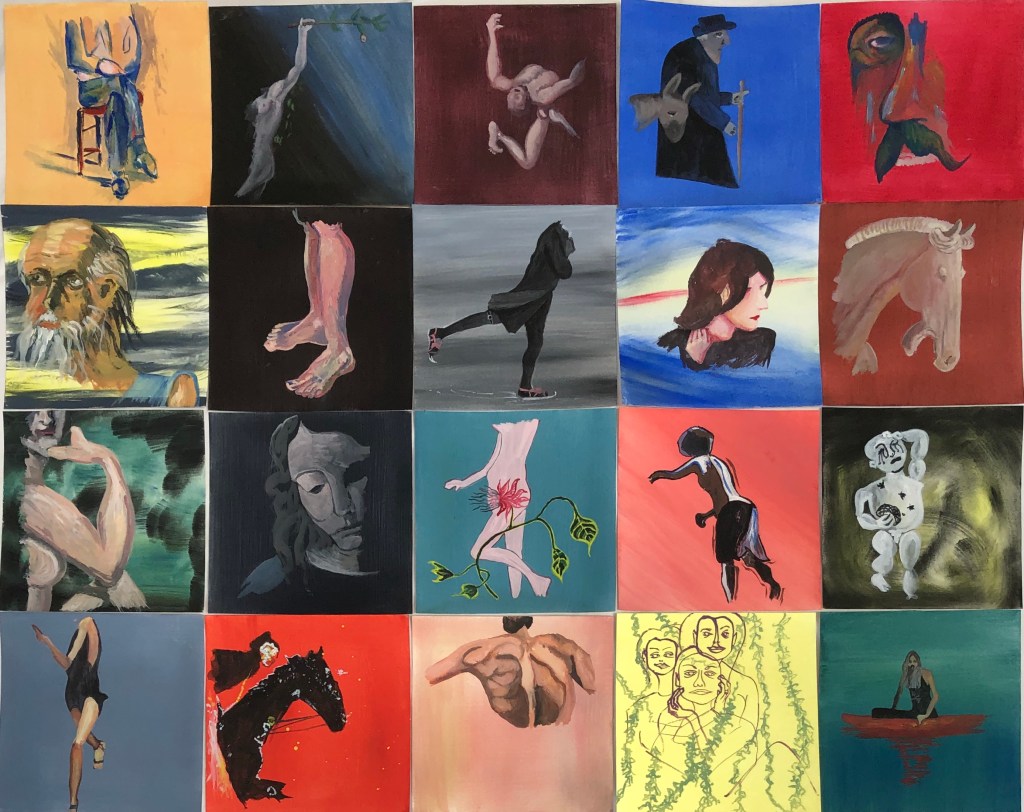
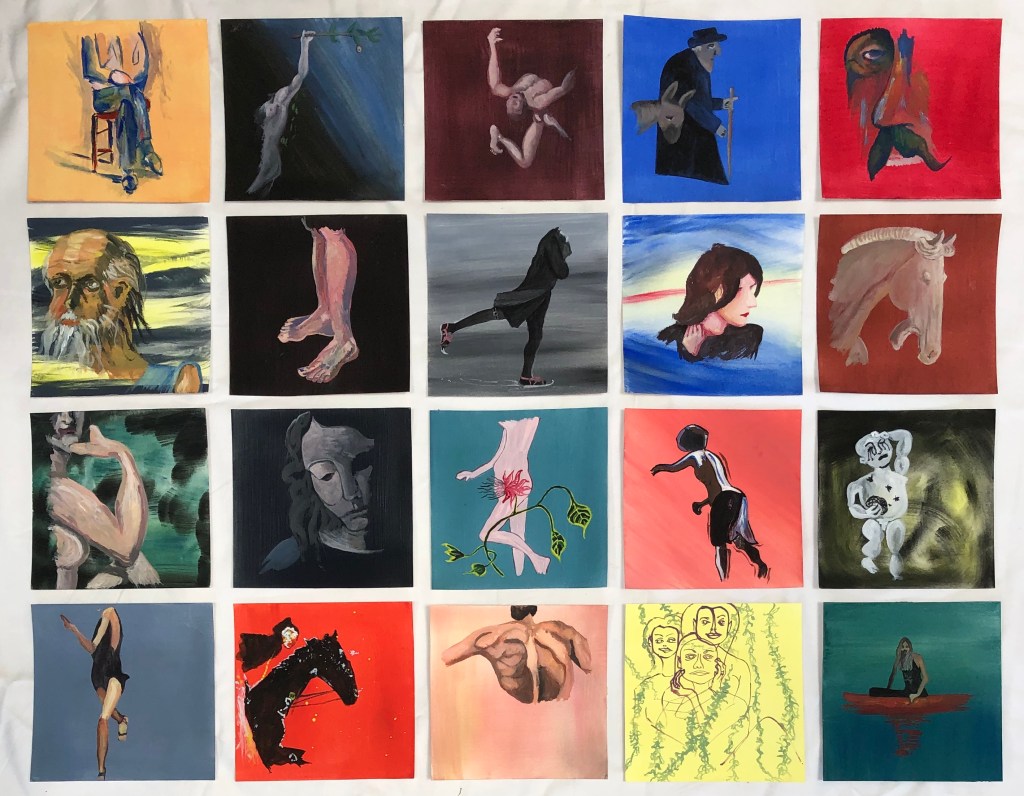
I spent a good while trying to decide the subject matter of my series of 20 paintings:
looking through a collection of found images I had started making at the start of this unit
making a mind map of material which had interested me throughout this part
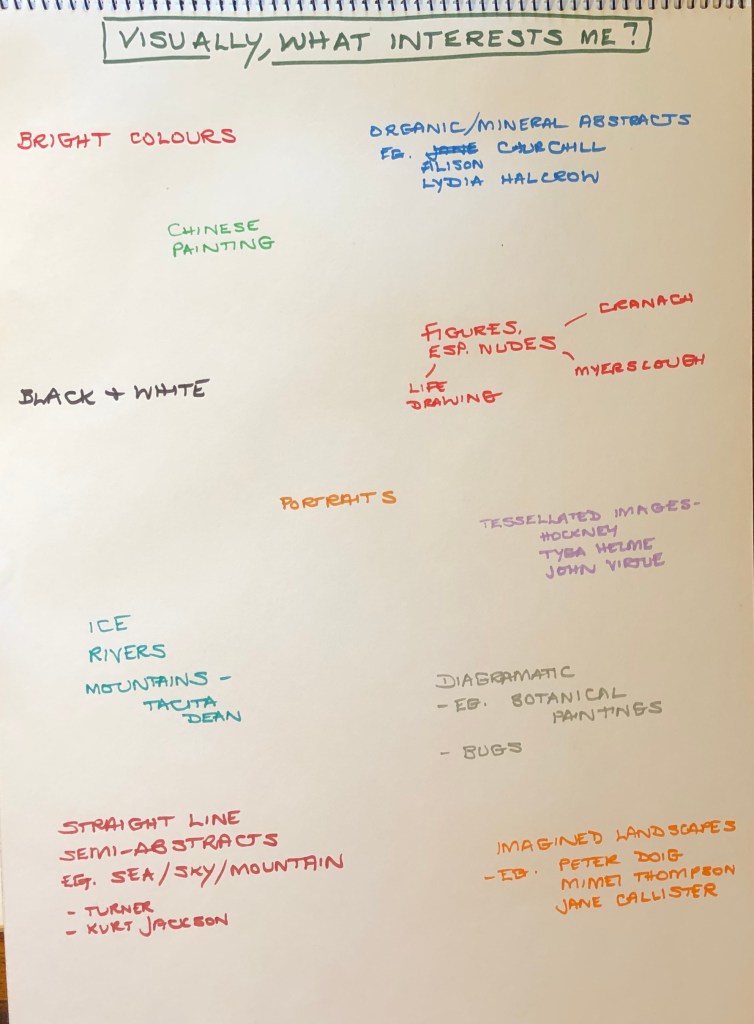
making a list of subject matter I was drawn to
looking at the series of work by the artists recommended in the materials – of these I was most drawn to Roxy Walsh – I looked at her series called “The Lady Watercolourist at Home” (see www.roxywalsh.com), where each painting was the same size and in watercolour, but the subject matter differed in each.
Reflecting on my (alarmingly wide) range of “likes”, I thought back to a series of work by Viv Owens, an artist recommended to me during Drawing 1 by my then tutor, Rachel Forster – this series was a set of images of portraits drawn on square paper and arranged in a grid, and set me looking for found images of people (see Vivowen.wordpress.com).
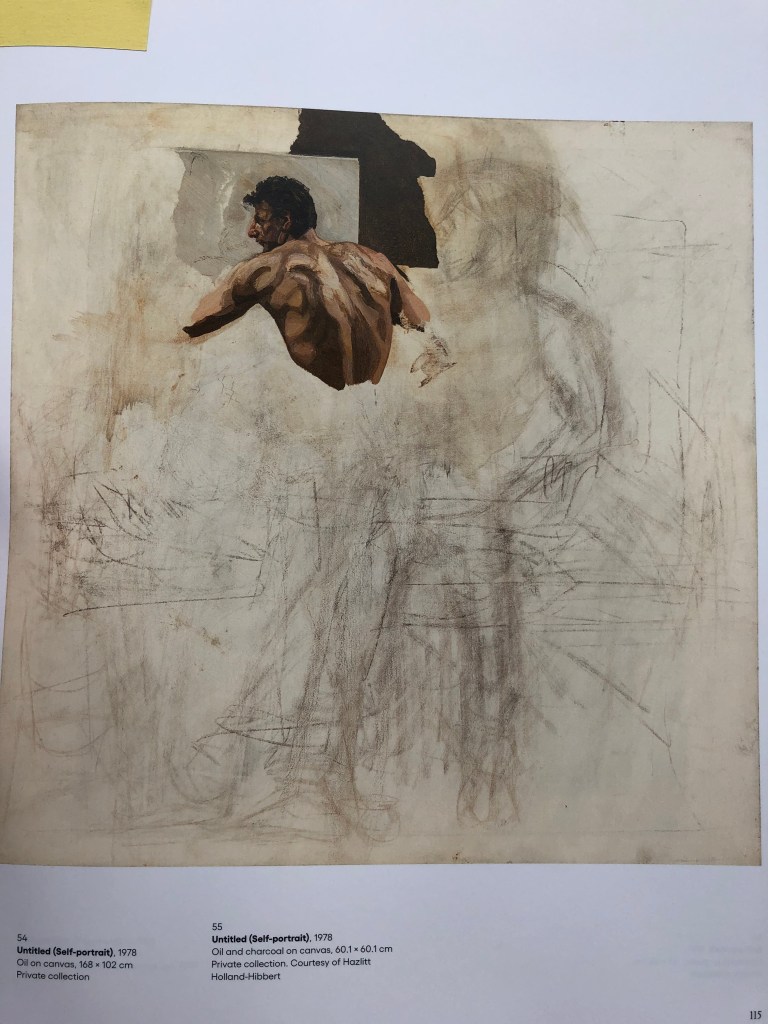
I decided to create a series of images of people I had encountered during this Part. One found image I selected – Lucian Freud’s “Untitled (Self-portrait)”, 1978, oil and charcoal on canvas, 60.1 x 60.1 cm, private collection – I had seen at the Royal Academy exhibition in January 2020, and it is striking because the majority of the canvas is blank (with evidence of an underpainting which has been covered) and only part of the figure, fully formed, looms out of this blankness. This made me decide to do something similar and only use part of the figure each time.
In Exercise 3 I enjoyed just painting lines and feeling their quality, so I decided to identify which “bit” of my figure to do each time by doing a set of blind continuous pencil drawings and choosing the part with the lines I liked drawing best. My sketchbook of pencil drawings, scale thumbnails, notes and ink tonal drawings can be seen in a separate video.
Now to choose my medium and ground. I had liked the depth of colour I found in the egg tempera work in earlier exercises, as well as its texture, so I decided to use this for both ground and medium. I had a Sennelier set of five tubes – ultramarine blue, alizarin crimson, lemon yellow, titanium white and ivory black – and it was my hope that using this restricted palette would help to unite the pieces into a series. For each painting I wetted the paper and then laid the ground colour on thickly and sweepingly with a fan brush (my favourite part), and then worked up the images in layers and small brushstrokes using a size 2 rigger and a size 6 round sable.
My aims were to:
Create a series which felt coherent
Learn about the use of egg tempera, a relatively new medium to me
Learn a little about other artists’ painting styles by replicating some of their work (without getting hung up on making exact copies)
SO WHAT?
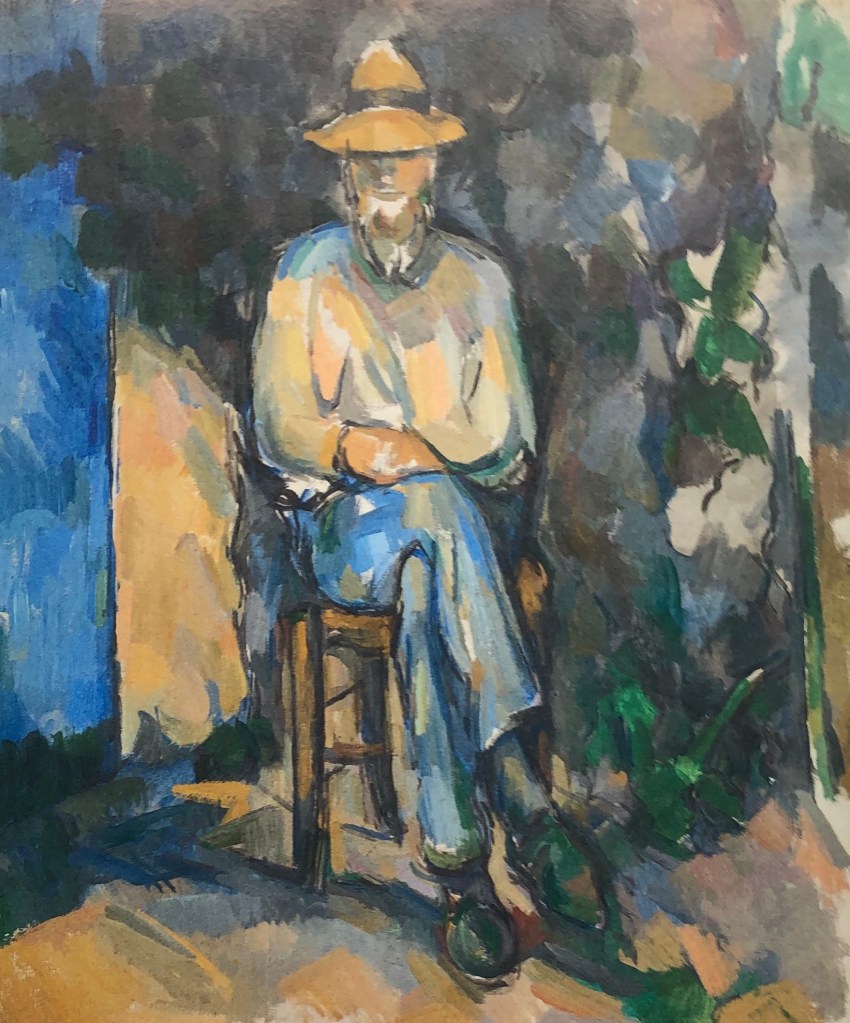
IMAGE 1
Paul Cezanne
“The Gardener Vallier”
C. 1906
Oil on canvas
65.4 x 54.9 cm
Tate
Cezanne is a favourite of mine – I like his loose areas of colour and his colour choices – here, attracted by the blue/orange. The section I chose was because of the sweeping lines of the legs.
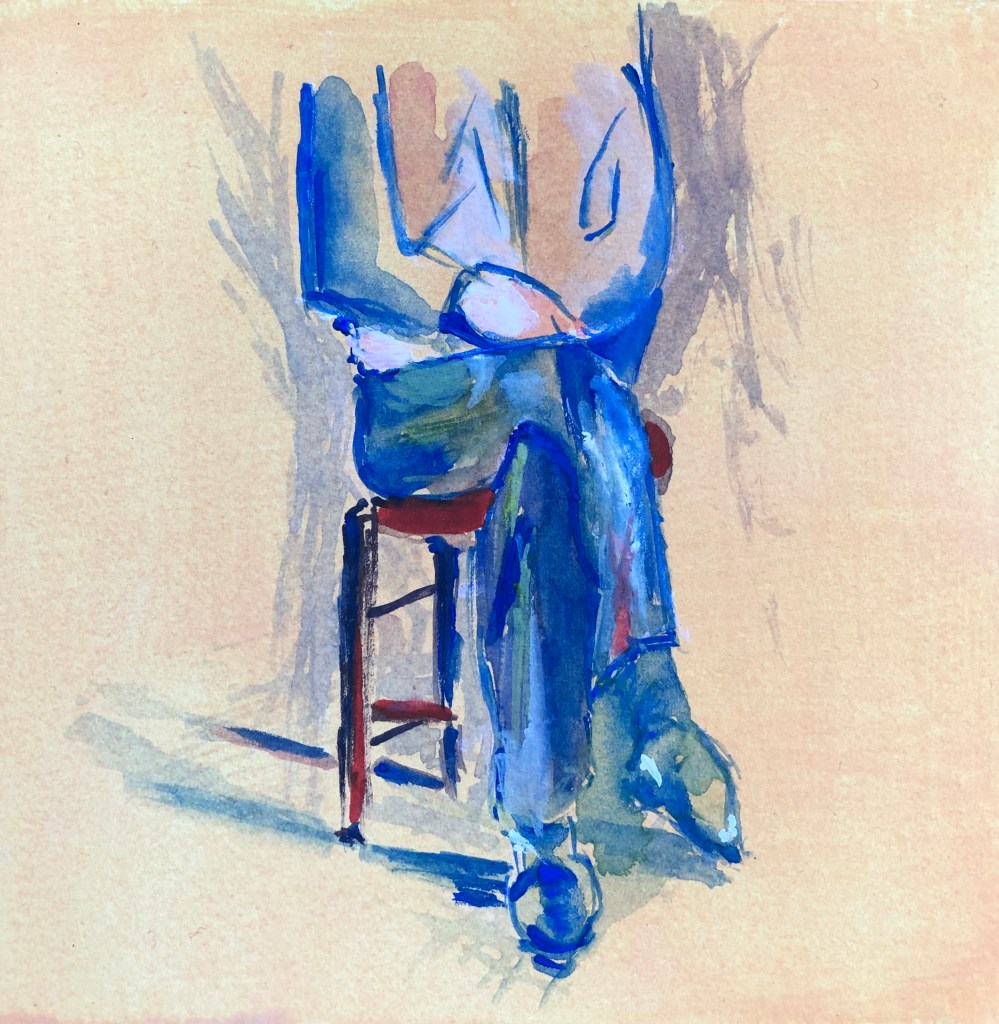
This is my version.
The background is actually more vibrant than it appears in the photograph – a chalky yellowy-orange very like the gardener’s jumper in the original; I think the camera has seen the chalk but not the yellow!
I liked the contrast between the straight lines of the chair and the curves of the legs. I omitted most other background, as it is my intention that the focus of all the paintings will be on the figure.
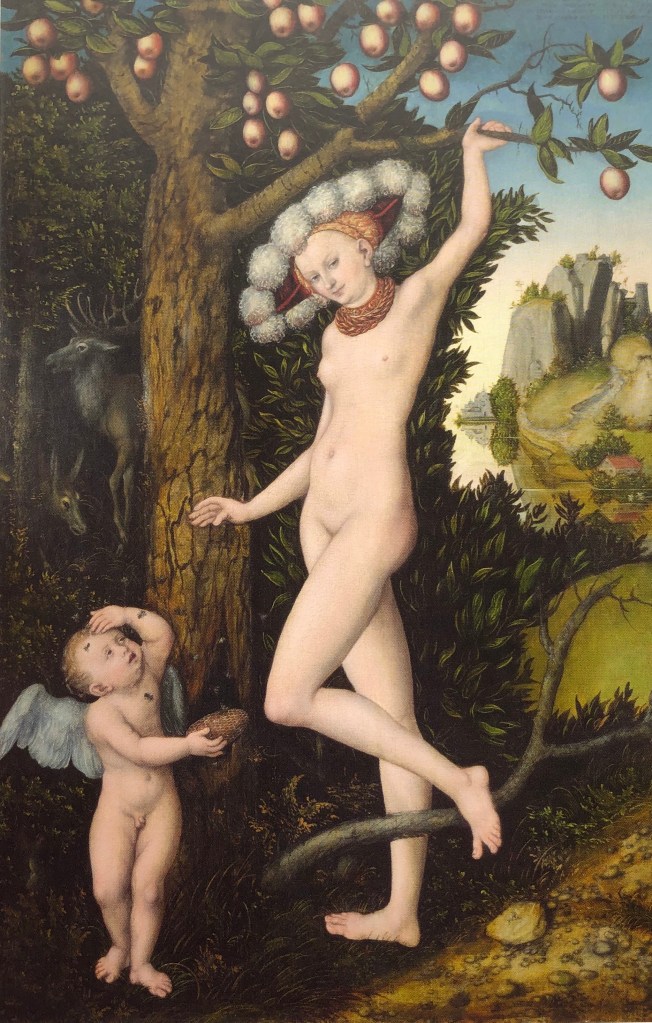
IMAGE 2
Lucas Cranach the Elder
“Cupid Complaining to Venus”
1526-7
Oil on panel
82.1 x 55.8 cm
National Gallery
We were so excited to go to our first exhibition since lockdown. Compton Verney is a small gallery and this exhibition (on Cranach and then artists inspired by his work – see separate blog post) was a perfect size to take in for a first trip. I must confess to having been completely ignorant of Cranach’s work before attending – but I bet I’d pick him out in a crowd now. This image and its derivatives will feature several times in this series.
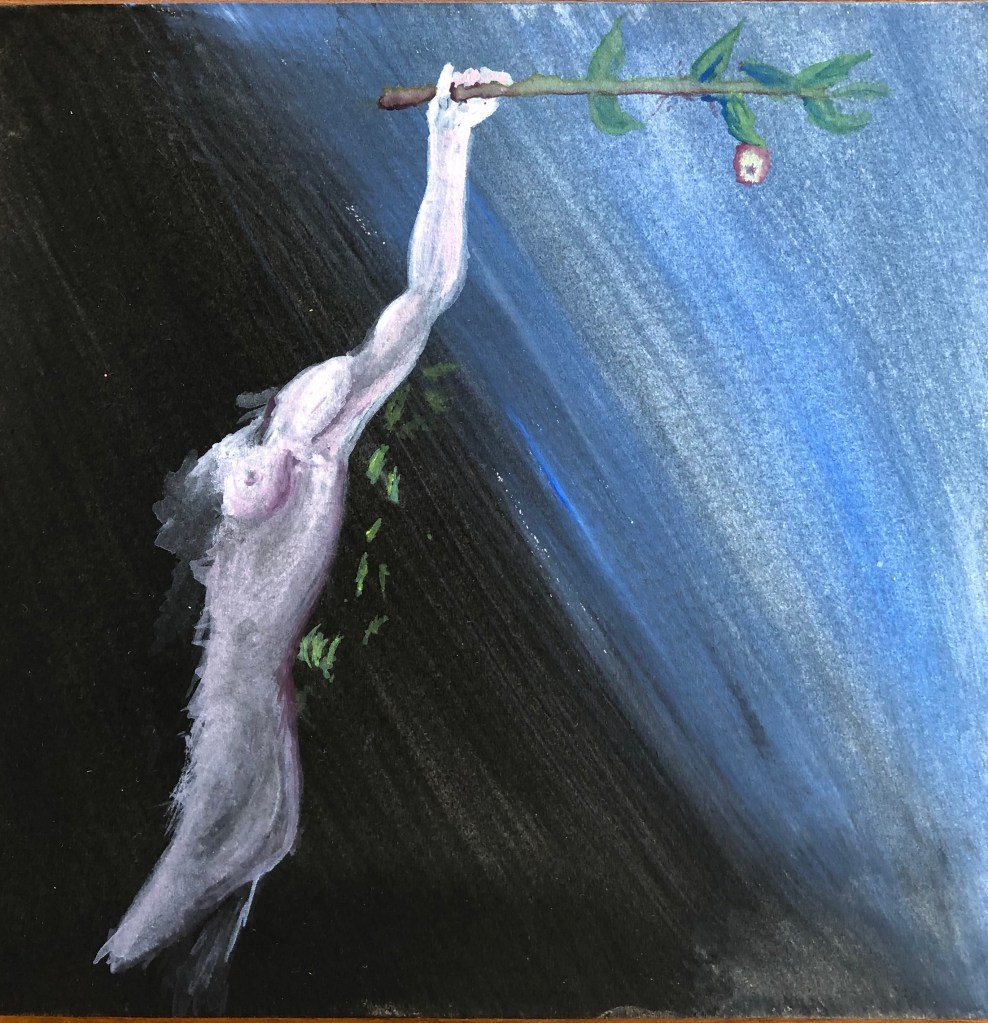
This is my version.
I was particularly taken with that line from her hand all the way down to her leg, so that was the section I chose. I chose a graduated ground, from black to light blue. The figure is off-centre, roughly on a vertical third, as I liked the idea of the curved diagonal meeting the straight horizontal branch with its one tempting apple. I included just a few leaves behind the figure to “place” her in front of a bush (otherwise I thought it might look as if she was hanging from the branch), although looking back at the image now I’m not sure these were necessary, and possibly look slightly out of place.
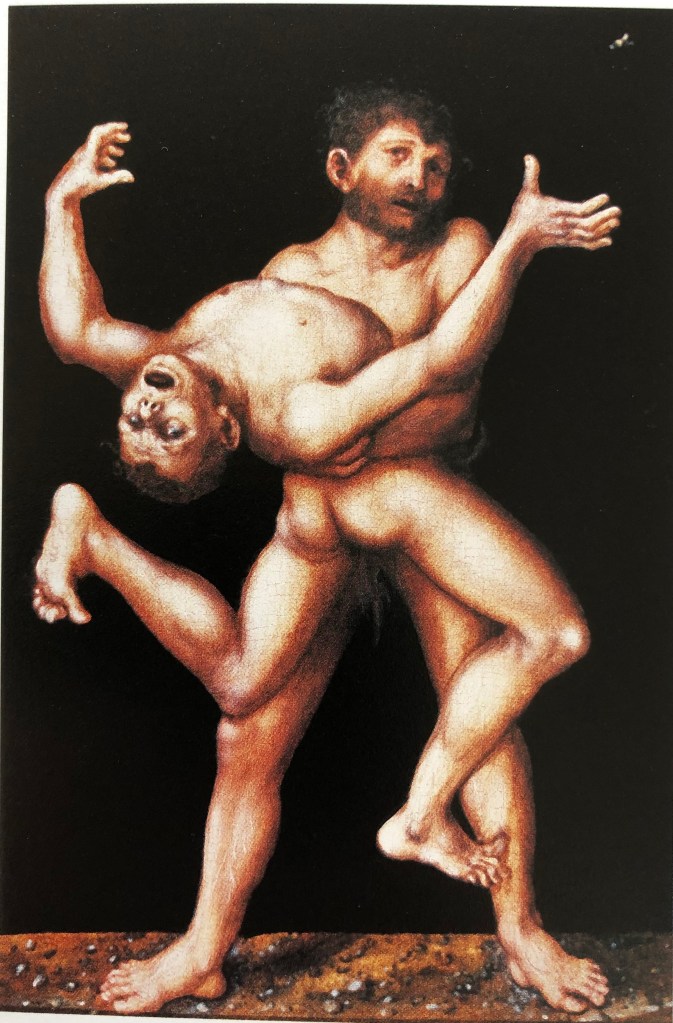
IMAGE 3
Lucas Cranach the Elder
“Hercules and Antaeus”
C 1530
Oil on panel
26.5 x 17.5 cm
Compton Verney
Another selection from the Cranach exhibition at Compton Verney – the original is actually really small for such a “big” subject matter. It has Cranach’s characteristic dark background and the main protagonist standing on a stony surface.
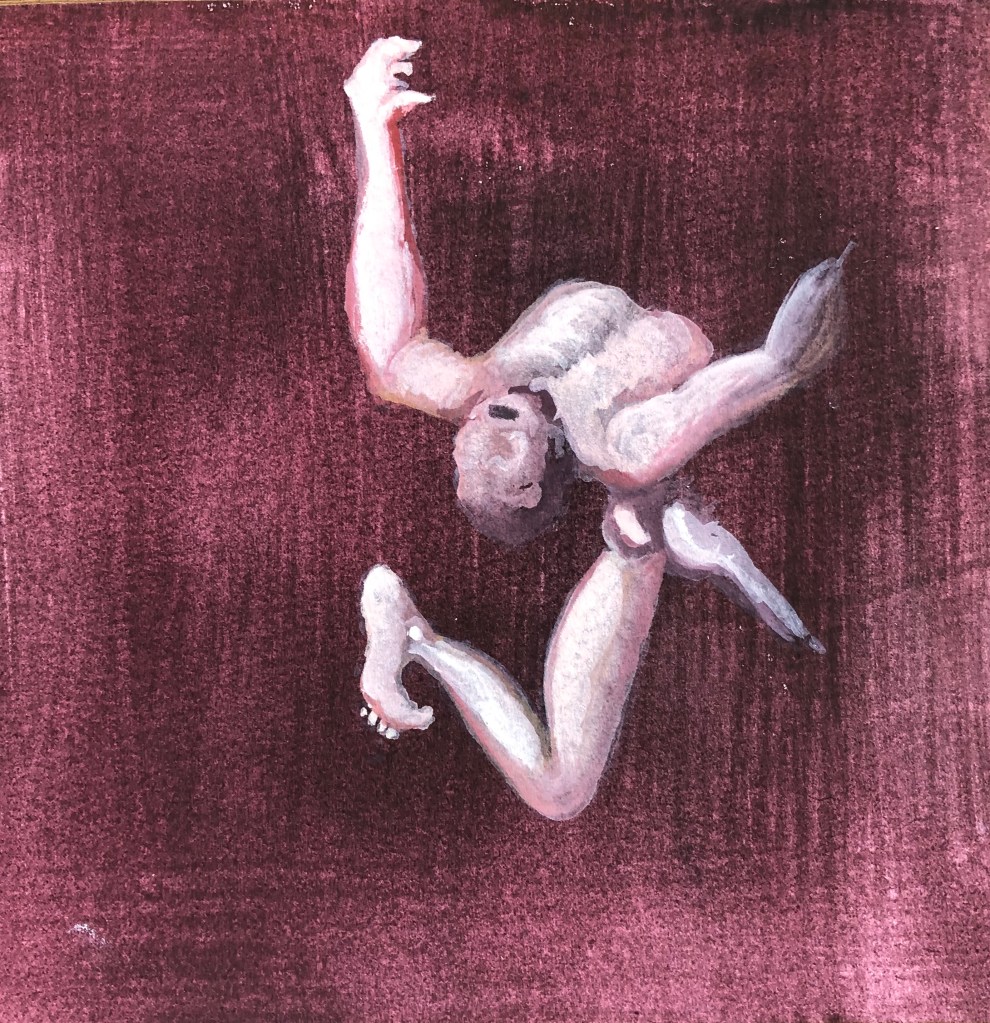
This is my version.
I decided that I didn’t want the background to be completely black – when you look at Cranach’s the black background has a reddish tinge to it – so I went for a mix of black and red. I was drawn to the figure of the giant with all those mirrored curves, so I chose him. It’s a strange pose, and takes a bit of getting your head around, but I hope I have captured some of the dynamism of the original. I originally meant to include Hercules’ arms, which are supporting the giant, but decided (having learnt from the extraneous leaves in my Image 2 painting that it wasn’t always necessary for a painting to be spelled out) that having him look as if he is in free fall adds to the sense of movement.
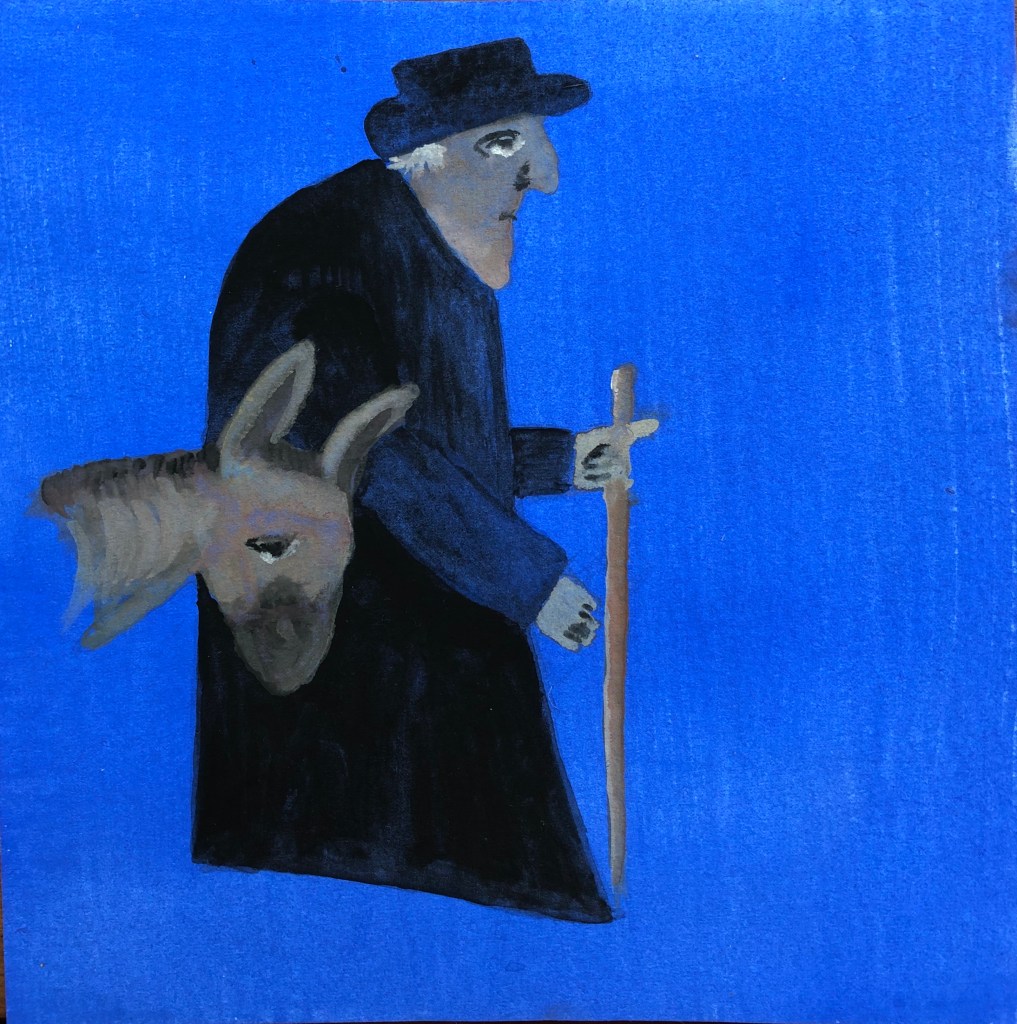
IMAGE 4
George Smart
“Old Man and Donkey”
1833
Collage on paper
37 x 31 cm
Compton Verney
This rather whimsical collage from Compton Verney caught my eye – it’s of an old postman doing his rounds. I’m struggling to say why it appealed to me, and have decided that it is the patient and slightly resigned expression on the faces of both man and beast, captured in the same handful of simple marks.
This is my version. I moved the donkey over as it was those expressions that I really wanted to try and catch. I originally intended to include some simplified elements of the background scene but then changed my mind and painted a simple mid-blue ground (rather startlingly blue in the photograph, the original being not quite so overwhelming). Not sure I’ve got the mirroring of the expressions exactly right – such a small difference of the flick of a brush can change the old man into a kindly old Moses and the donkey into looking distinctly woebegone!
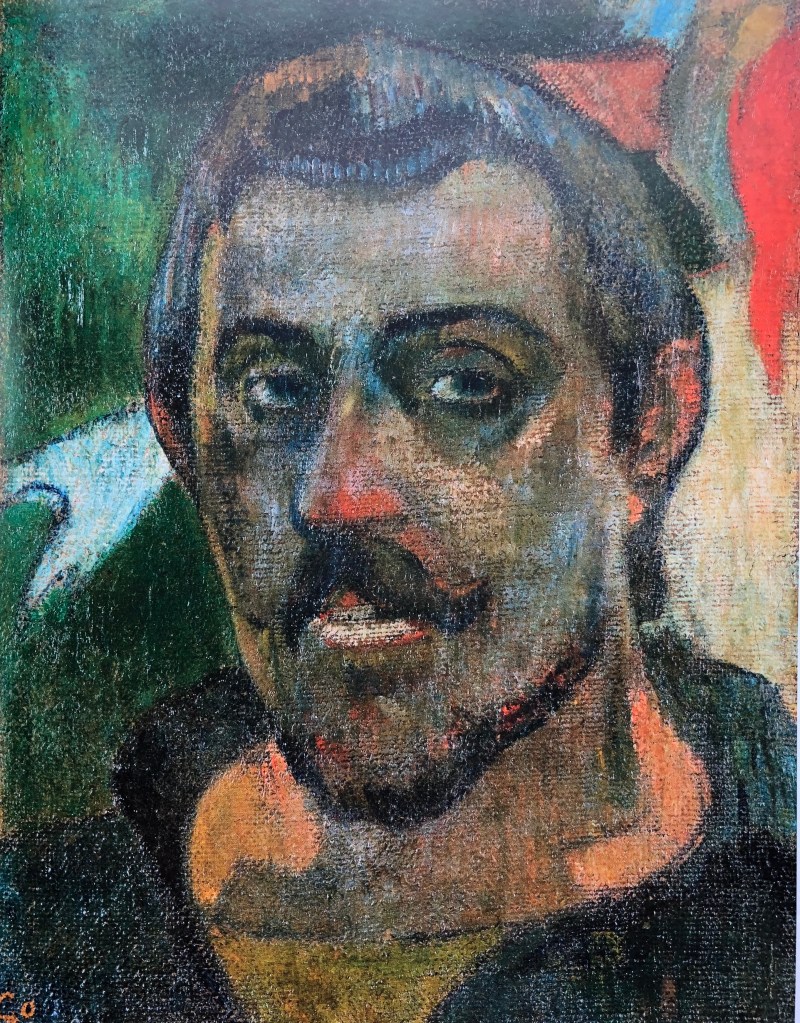
IMAGE 5
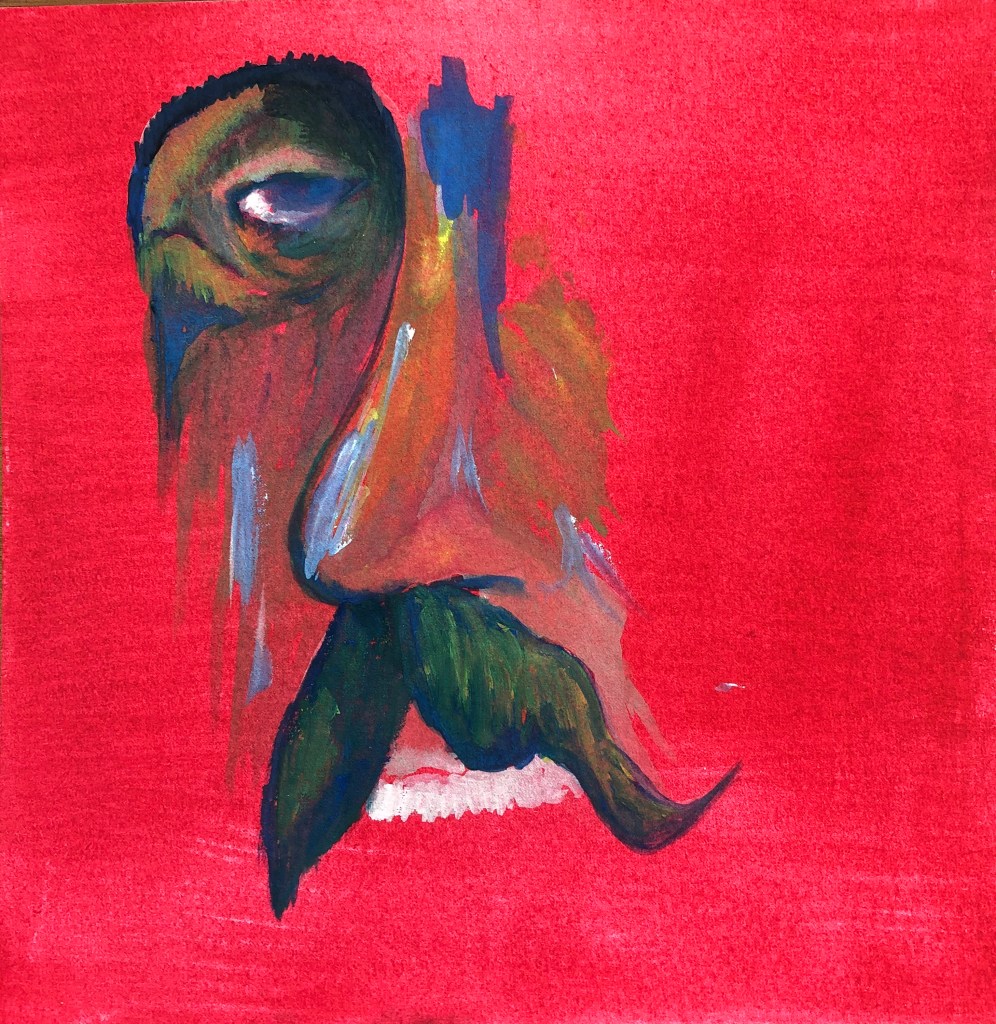
Paul Gaugin
“Self portrait”
1889-90
Oil on canvas
46 x 38 cm
The Pushkin State Museum of Fine Arts, Moscow
This is a reminder of a visit in January 2020 to the National Gallery to see the exhibition of Gaugin portraits. He painted a number of self-portraits, often dressed up as some character or other, but I liked this one for its straightforwardness. Like Cezanne, he often goes for pairs of complementary colours, and it was the huge range of colours in this image which made me choose it for this series.
This is my version.
The original seemed to have a reddish-orange underpainting, so I went for a glowing red background. I had been attracted by a pair of adjoining “2”s – the first a sweep of brow to nose and the other, on its side, the shape of the moustache – so that’s the part I chose. I feel I managed to come near the wide range of colours he uses and am pleased with the vibrancy of the piece, although (not that it matters) I don’t think I’ve quite got a likeness as I’ve made the eye too small.
IMAGE 6
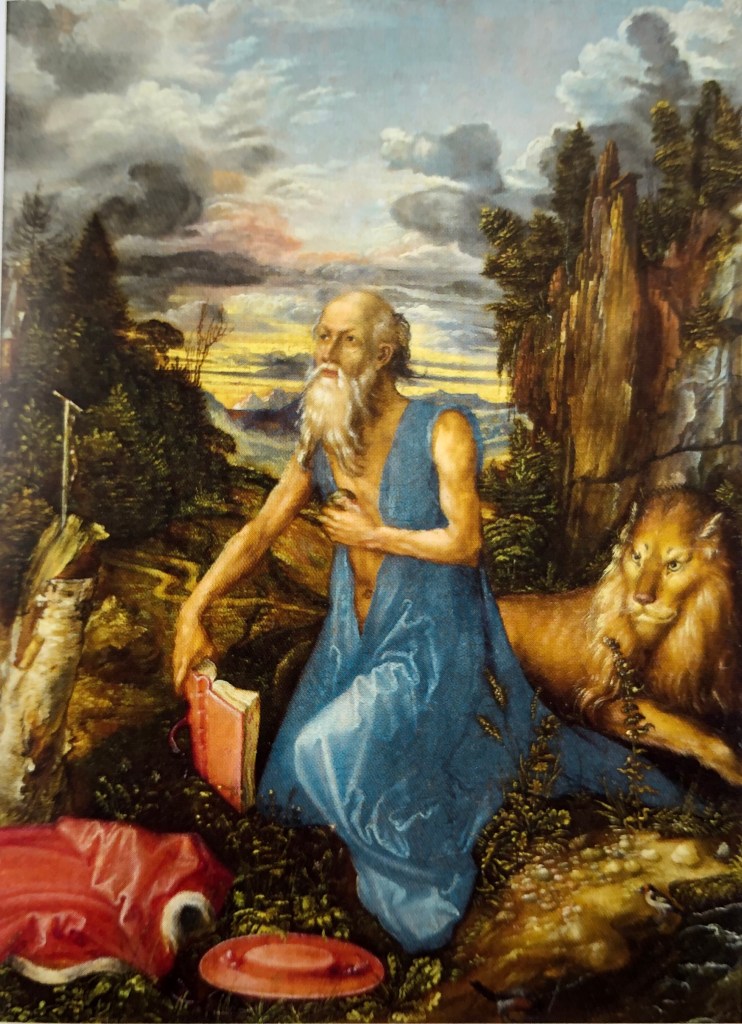
Albrecht Durer
“Saint Jerome”
C 1496
Oil on pearwood
23.1 x.17.4 cm
National Gallery
No series is complete without some reference to Durer. They had some of his prints, comparing them with Cranach’s, at Compton Verney as part of the exhibition, and I found this painting in the book I bought there. We have an etching of Durer’s Saint Jerome, along with his lion, in our study, so I always look out for him.
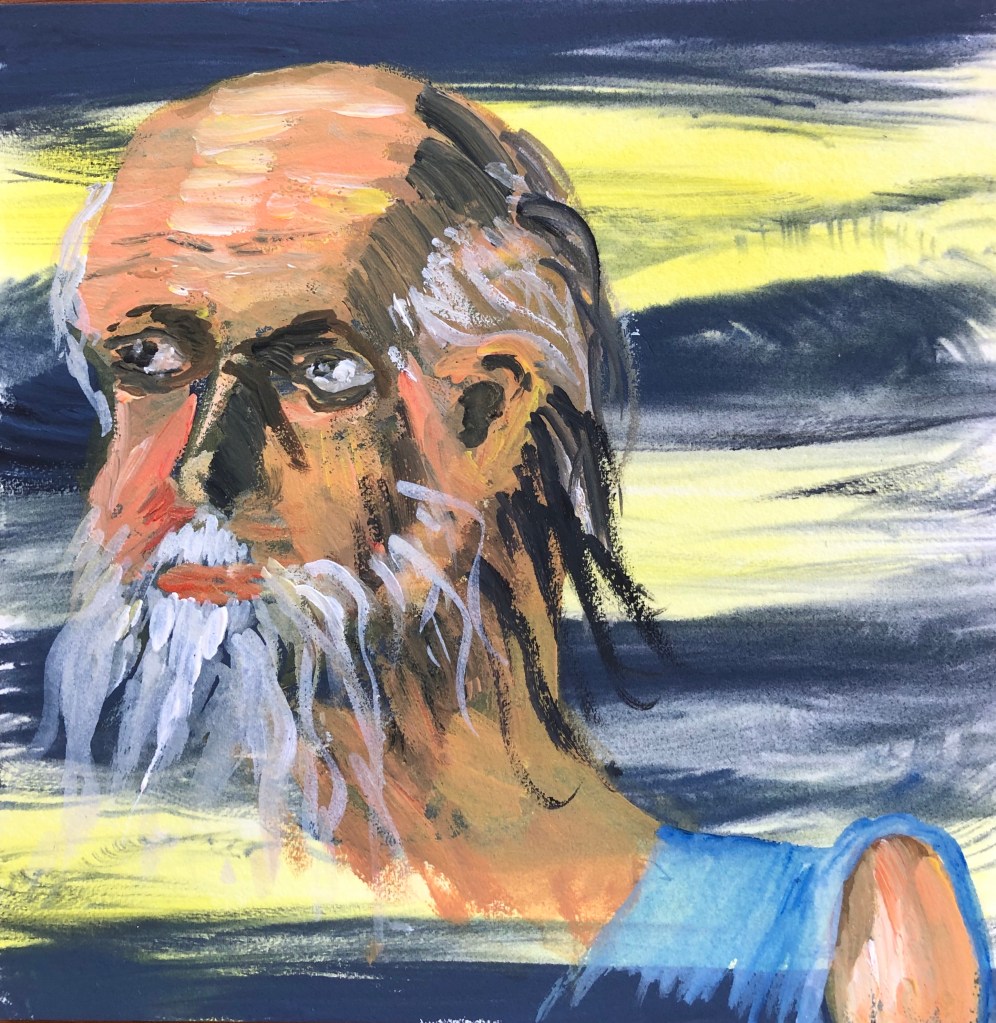
This is my version.
I had been drawn by the yellow of the sunset combined with the reflected ovals of the head and shoulder, so chose this section. I experimented with a more patterned background to reflect the sky I had liked – then panicked a little when I had to paint lighter colours over it. This pushed me to really experiment with the paint, applying it in small strokes but with more gesture and energy, and quite a bit thicker. Fortunately it worked and the head emerges from the background quite forcibly, I think, although I found I hadn’t left enough space to get the shoulder rounded as I had originally planned.
IMAGE 7
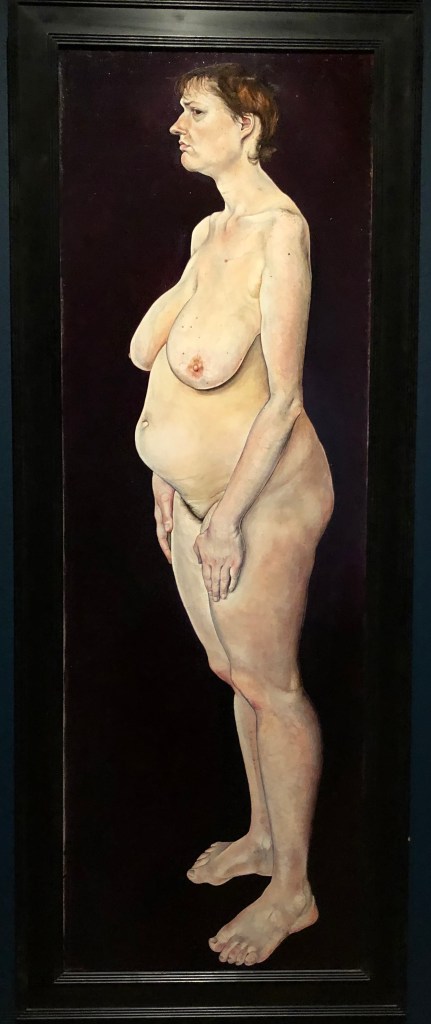
Ishbel Myerscough
“Untitled (Woman)”
1994
Oil on canvas
Flowers Gallery, New York & London
This painting, and one other, was at the Compton Verney exhibition in the section of “painters inspired by Lucas Cranach the Elder”. Ishbel has taken Cranach’s motif of a nude against a plain dark background but, whereas his ladies were beautiful in an idealised way, stretched-out to emphasise their womanly curves, she has painted her nude subjects exactly as they are, warts and all – they are very striking, and no less beautiful for being highly realistic.
This is my version.
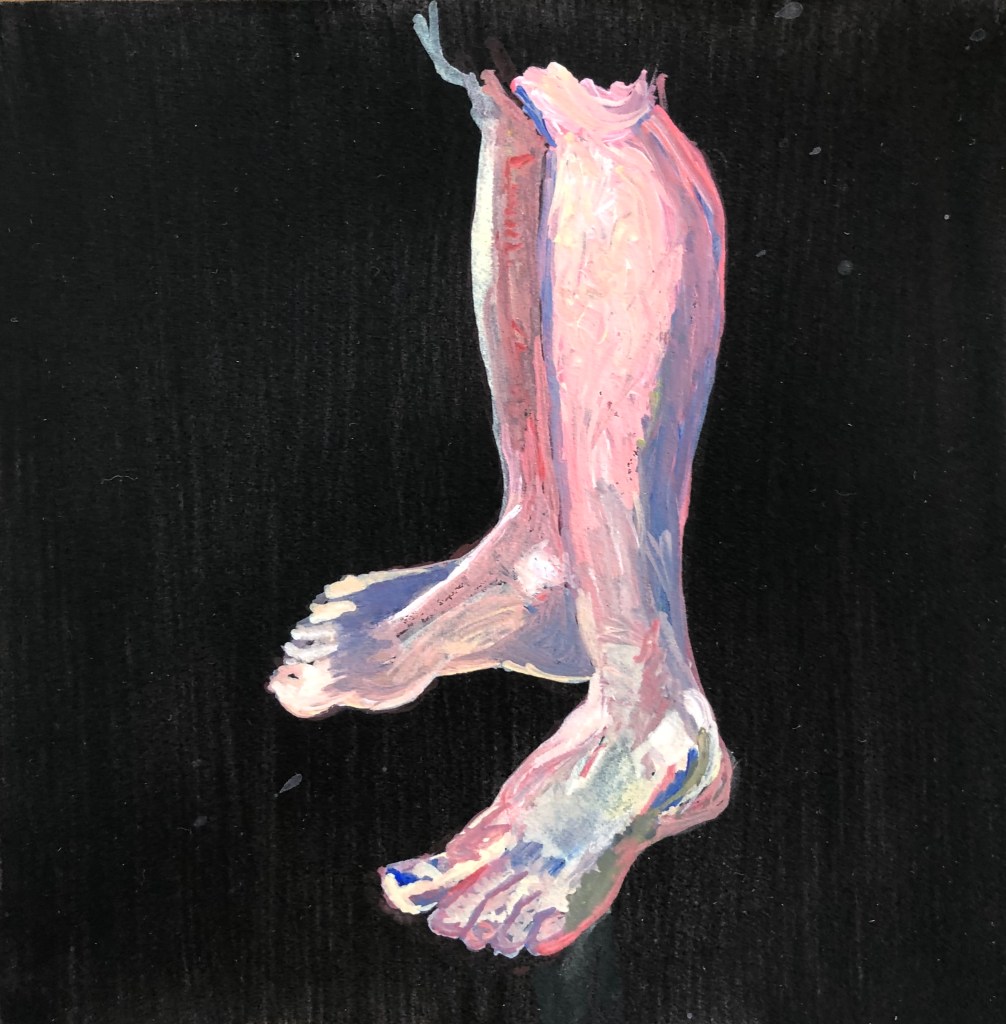
I was drawn to the legs and feet: they are angled to plant the figure very firmly, I liked the curves, and, frankly, you can never draw (or paint) enough feet, they are the part of figure drawing (along with mouths) which I always find hardest.
The outcome is a bit Francis Bacon, looking slightly more like raw meat than legs and feet, but I really enjoyed building up the layers and putting in the highlights and shadows – I felt quite free about almost going over the top with my darks and lights.
IMAGE 8
Henry Raeburn
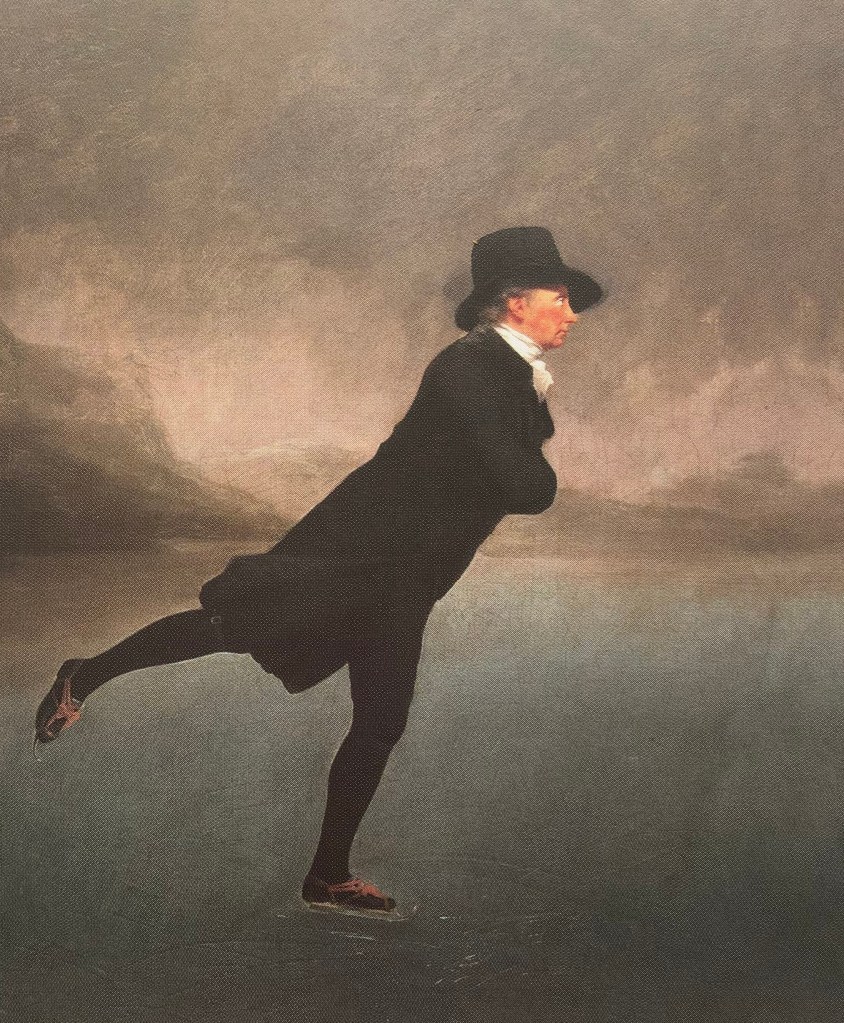
“The Skating Minister”
c1790
Oil on canvas
76 x 64 cm
National Museums of Scotland
We saw this painting a couple of years ago in Edinburgh – the subject shows such poise and confidence – had to have him as a found image in any series of characters.
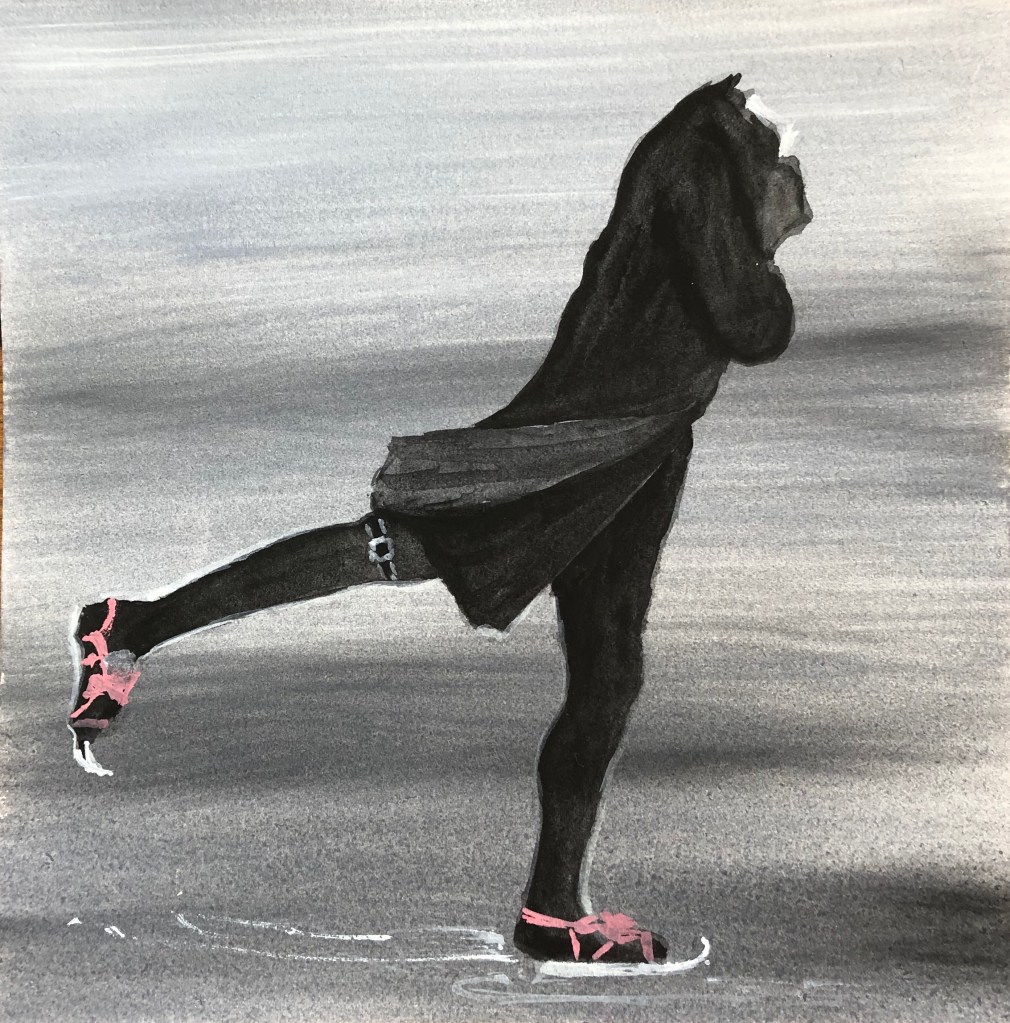
This is my version.
I liked the lines, shoulder to foot, down both the front and back, so they both needed to go in. I think I’ve got the lines, although not the correct angle of the overall figure, he is too upright – I did the inked tonal drawing in my sketchbook better (see video).
The background is a warm-ish grey, graduated from light to dark as you move down – could have got it a tiny bit darker right at the bottom to show up the skates better.
IMAGE 9
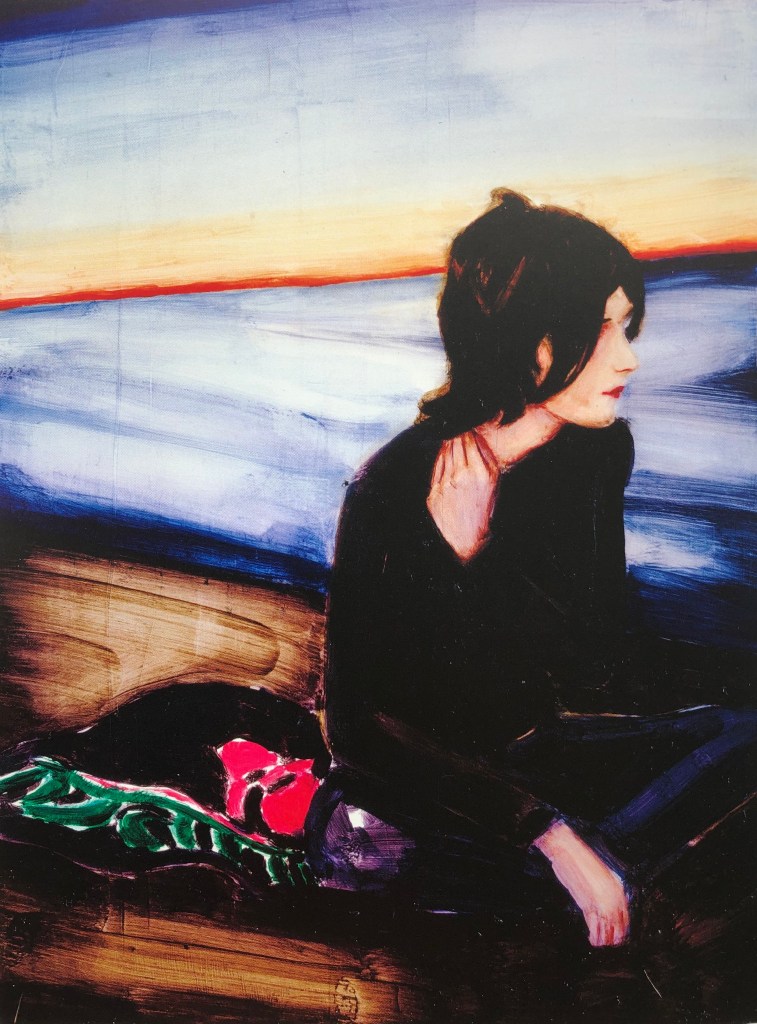
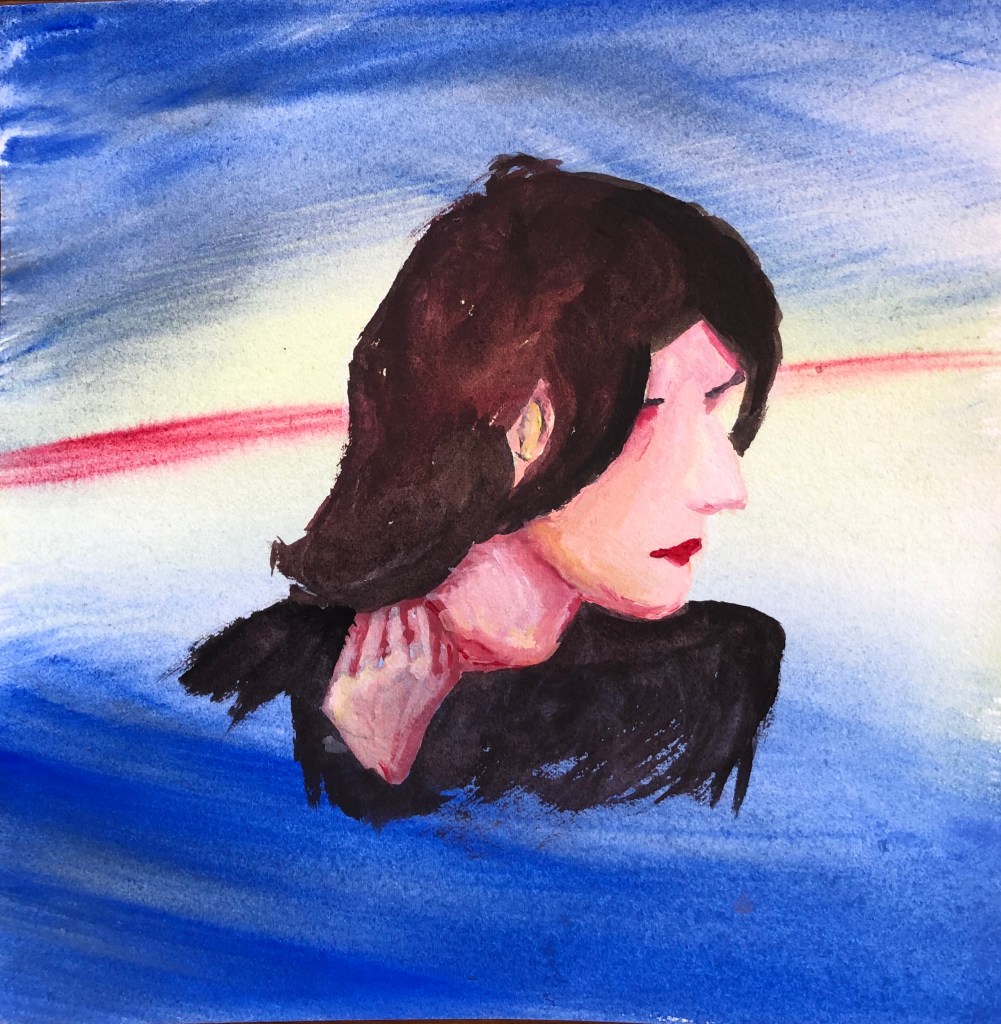
Elizabeth Peyton
“September (Ben)”
2001
Oil on board
30.8 x 23.2 cm
Private collection
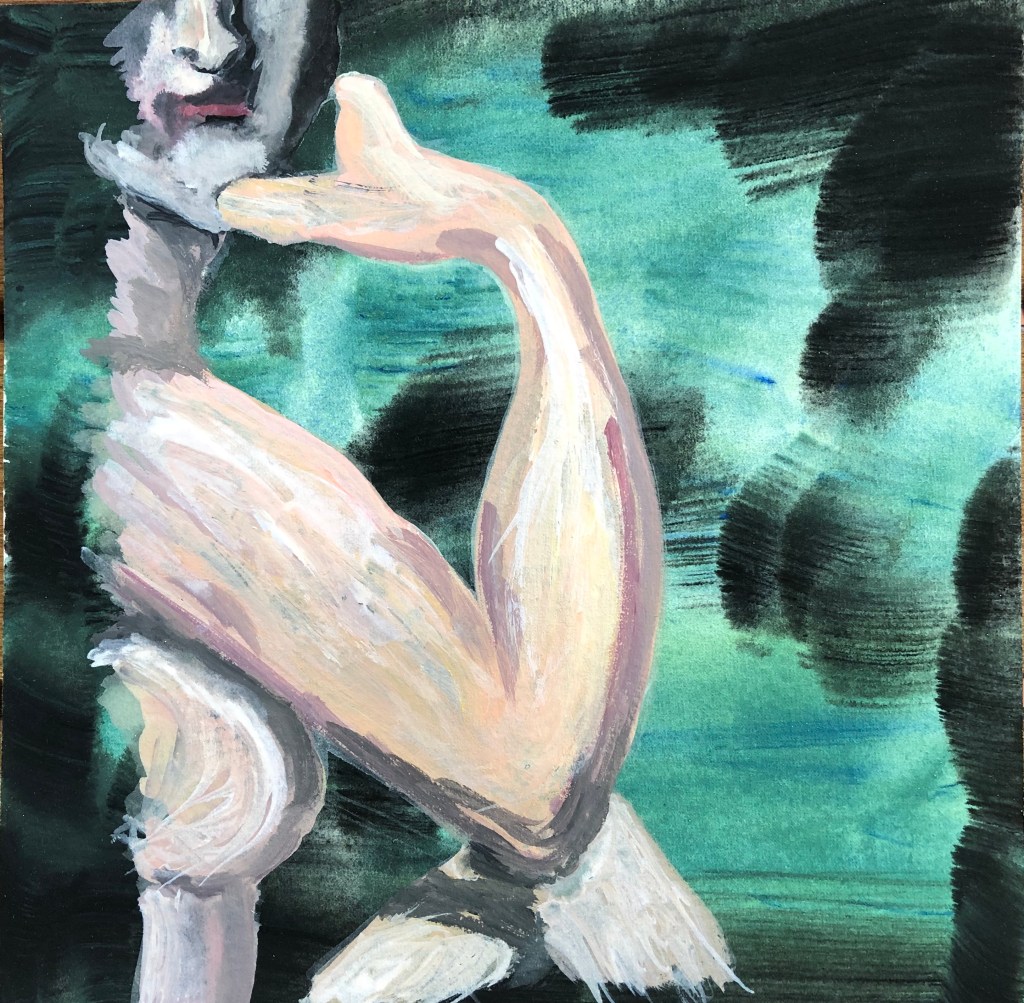
Elizabeth Peyton was one of the artists I researched at the start of this Part. She manages to say a lot with a few well-placed brushmarks – something I could do well to learn from – so I picked this rather contemplative chap staring out over the water.
This is my version.
I was attracted by the repeated rhomboid shape of the face, the ear and the hand, so decided to try that section. I replicated the background very roughly with areas of blue, light yellow and a streak of red, although in my painting this red streak feels de trop and I should have painted over it. I have got the mirroring shapes enough, although the hand is too small. I failed somewhat with Elizabeth’s lesson of “less is more” by overworking the neck, which has doggedly remained the wrong shape and colour – in the end I left it, as I felt it was coming to dominate the whole painting. I managed to keep the face and hair much more lightly worked, and it shows to advantage beside the epic neck.
IMAGE 10
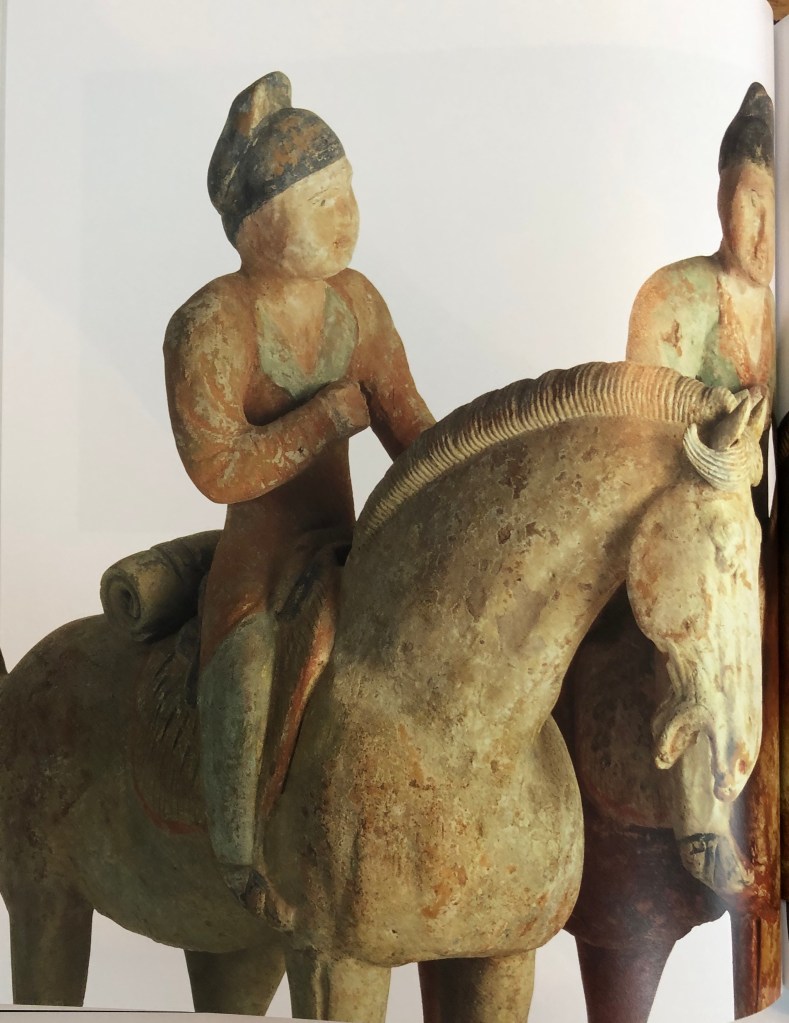
“Set of twelve painted equestrian figures”
c. AD 700-800
Tang Dynasty
Pottery, each 48.5 cm high
Compton Verney
Compton Verney has a small but dramatic Oriental section, the doorway to that room being guarded by two rather fierce looking Samurai statues.
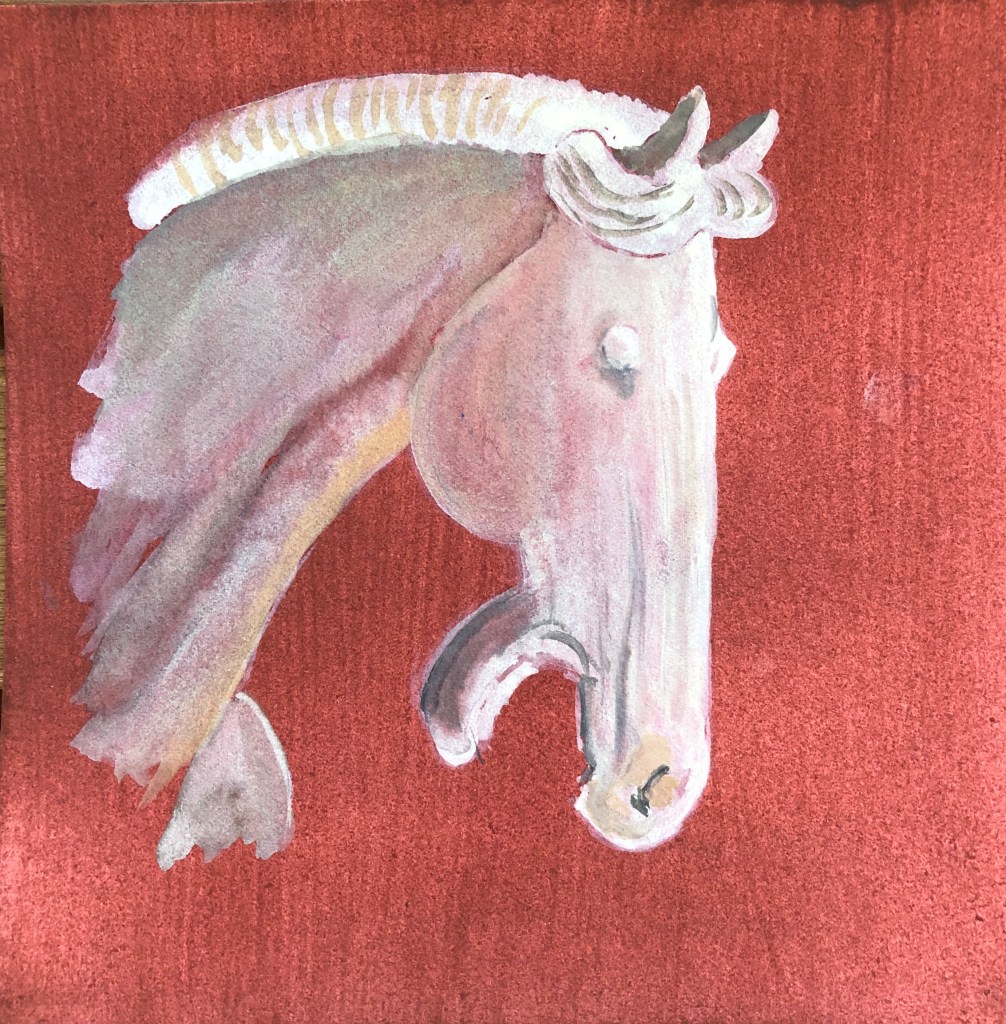
I chose this horse and rider for Exercise 4 and was pleased with my outcome – so it seemed that this pairing needed to be revisited for this project.
This is my version.
I had intended the horseman to be my character but, as I was doing my blind continuous line drawings, the horse kept pulling on my attention with that dramatic vertical head, until I gave in and decided that he had more character than his rider and so merited inclusion in his place.
The horse and rider behind him have quite a terracotta feel so I went for that colour as a ground. As I was building up my layers there came a point where I had to decide whether to add more or to stop – so I stopped. Hopefully he looks solid-and-yet-fading (he’s very old); this wasn’t what I was originally going for, but I suddenly came to a point where I looked at the image and thought – that’s it.
IMAGE 11
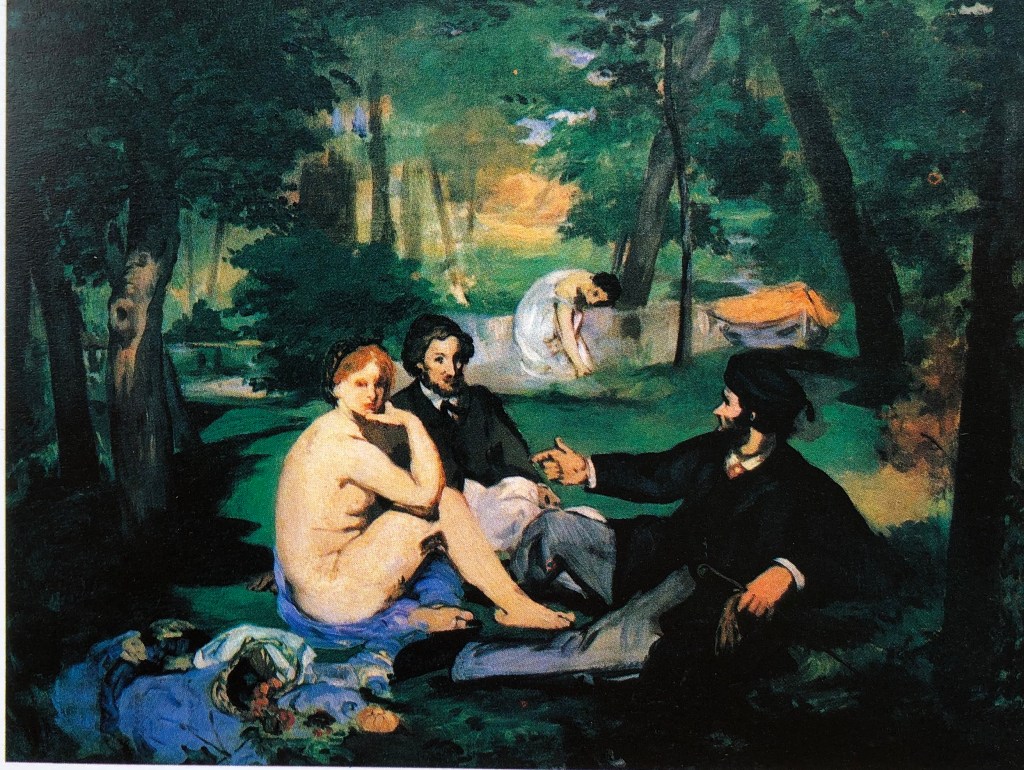
Edouard Manet
“Dejeuner sur l’herbe” – early version
1863
Oil on canvas
Final version was 205 x 264.5 cm
Courtauld Institute Galleries
I had come across this whilst looking at one of the “essential reading” books for the course: Waldemar Januszczak, 1980. “Techniques of the World’s Great Painters”. Chartwell Books, Inc, New Jersey.
I preferred this version to the final finished one, which is much more polished with all the fine detail – this felt much more rough and ready and you could follow the artist’s brushstrokes.
This is my version.
I was always going to have that insouciant shoulder in, and I was attracted, for the purposes of identifying a section, to the negative shapes between elbow and leg, elbow and chin, and hand and chin. I have tried to use the artist’s loose brushstrokes, both in the ground and in the figure. The dual colouring of the ground was, in retrospect, a mistake, it is too bold and detracts from the figure – it would have been better to have made it one or other of the colours. I think the arm and body went well and show that gestural quality of mark making; the leg does do that but is too small, and I could not resist overworking the face so that is all wrong – again, I think I did much better in the tonal ink drawing in my sketchbook (see video).
IMAGE 12
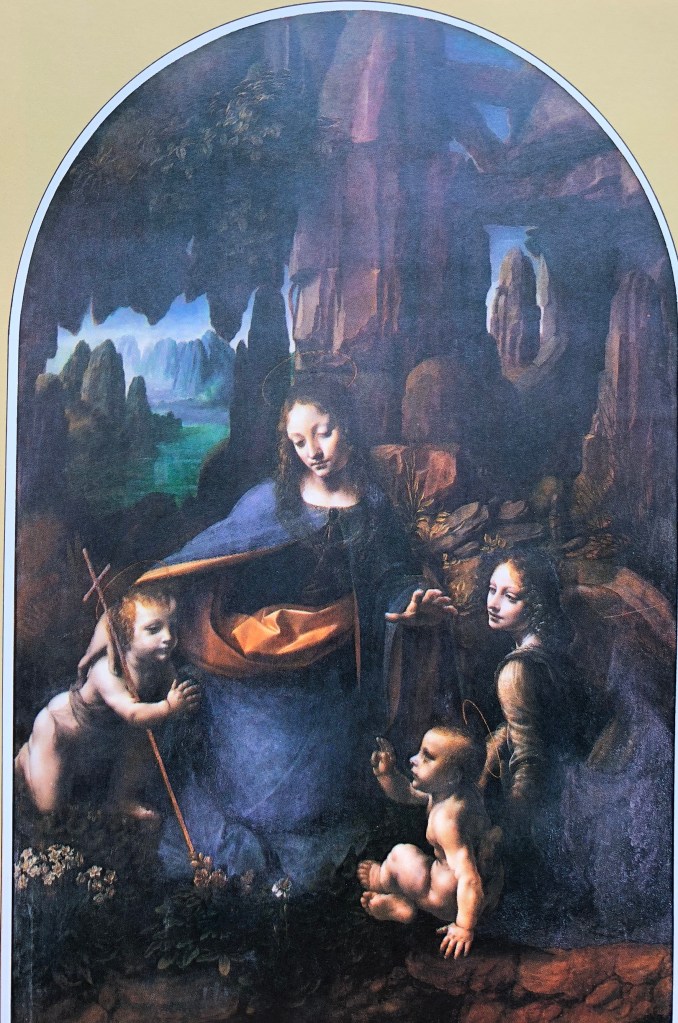
Leonardo da Vinci
“The Virgin of the Rocks”
C 1508
Oil on wood
189.5 x 120 cm
National Gallery
Again, I found this image in the essential reading (see reference in “Image 11”, above).
I particularly chose it because of the rocky entrance to the cave in the background, which reminded me of Mimei Thompson’s work, which I had researched earlier in this part and had liked.
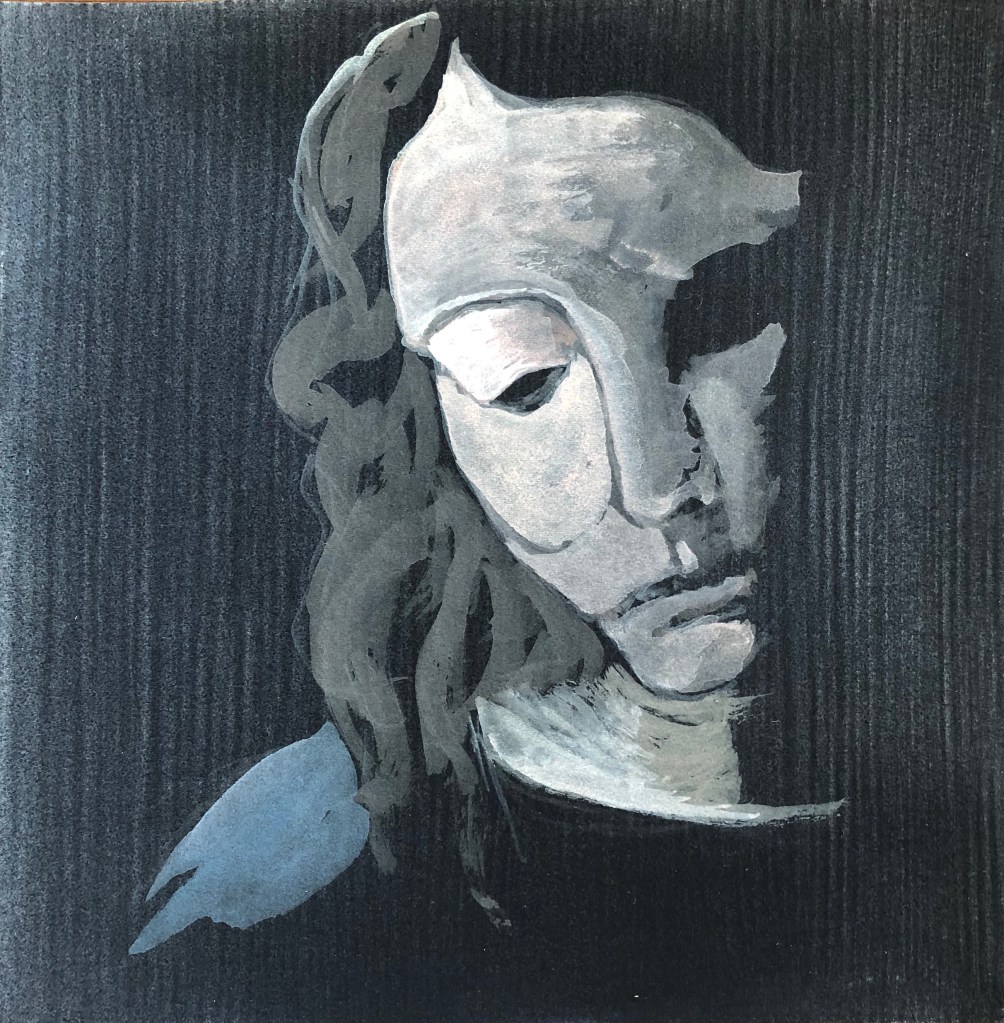
This is my version.
I was originally going for the child on the left as I found his pose interesting, but kept being drawn back to the Virgin’s face – which is the idea of the painting, I suppose! – particularly the line of that lit side going down to the curve of her dress. I chose an indigo ground to reflect the shadowy rocks behind her, with some fairly strong vertical strokes. Again, much like the painting of the Chinese horse, I was building up layers and suddenly got the feeling that I needed to stop; the image was quite ethereal which seemed to suit the character of the subject, so I just built up the bits where the light would strike and then left it.
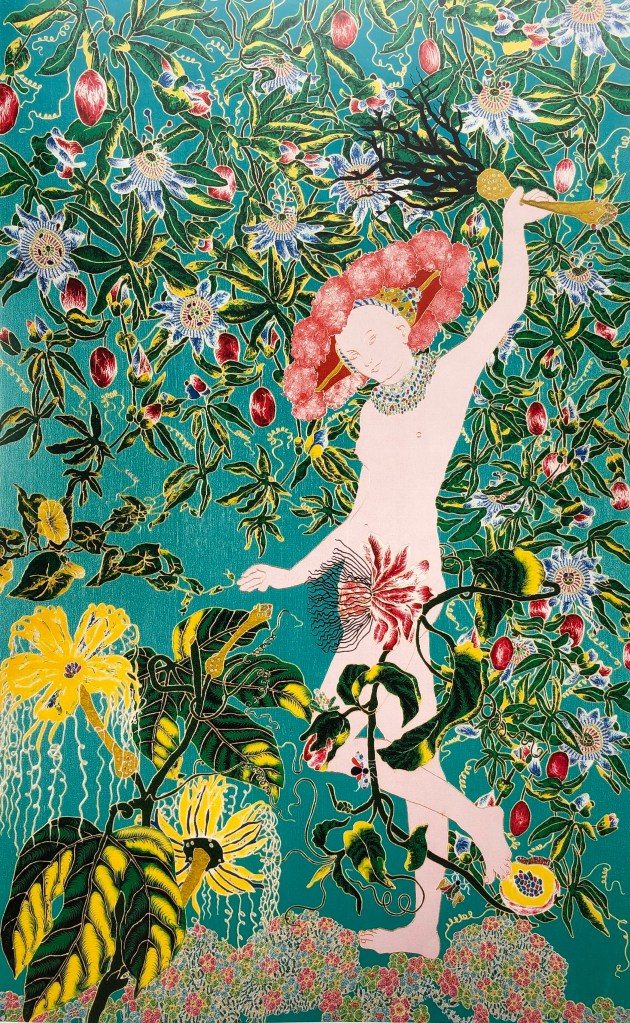
IMAGE 13
Raqib Shaw
“After Lucas Cranach the Elder”
2001
Oil, acrylic, enamel and glitter on board
166 x 104 cm
Central St. Martin’s College of Art and Design, London
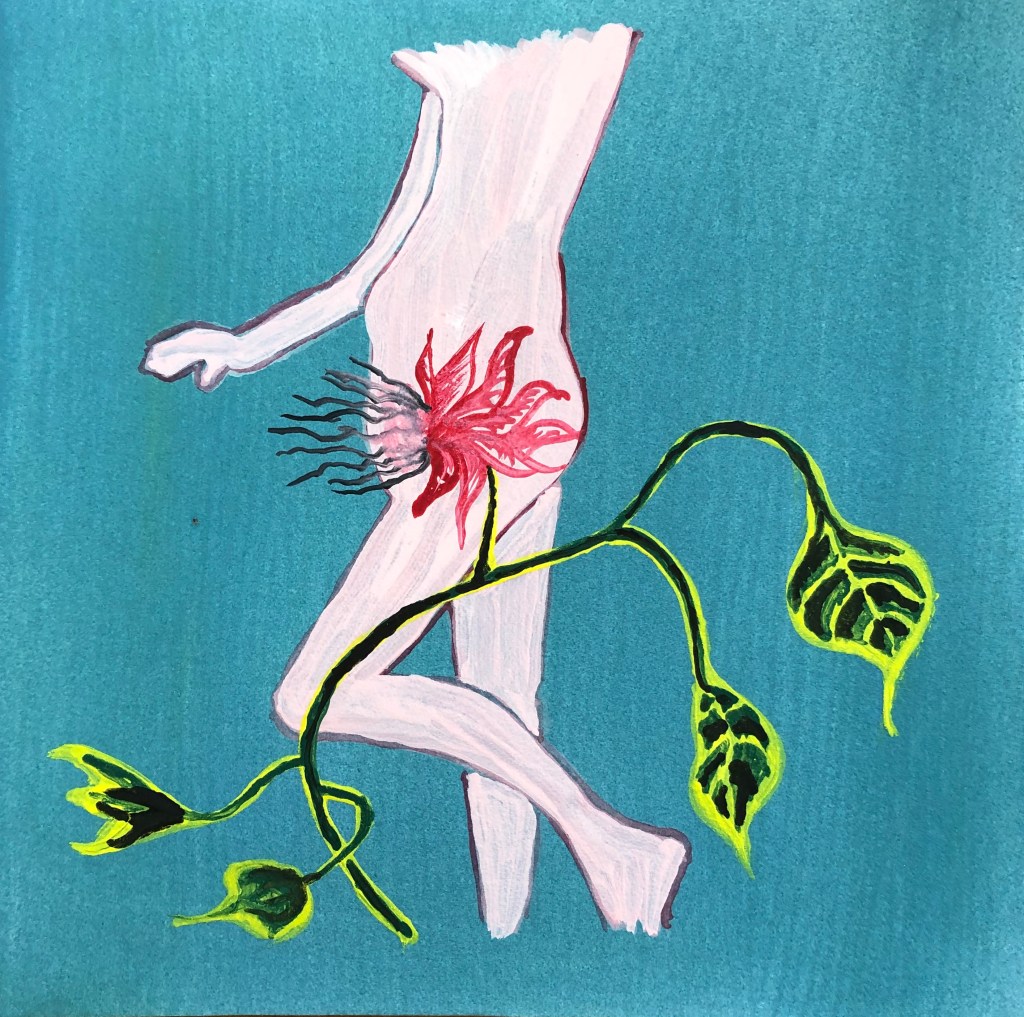
Needless to say, Raqib Shaw’s work was included in the exhibition at Compton Verney as part of the group of artists who had been influenced by Lucas Cranach the Elder. He had taken just Venus, not Cupid, as an essentially flat image, and placed her in an exuberant garden of luxuriant, not to mention slightly sinister, plants.
This is my version.
I was interested in the lines around the hips and legs, so made this my main focus. The choice of background colour was easy. I just indicated the rather malevolent foliage – it would have been easy to get carried away with this and lose the central image. My only issue with this painting is that I haven’t quite managed to achieve an even coating of paint over the body – I wonder if I should have let the paint dry more before adding the next layer.
IMAGE 14
Peter Doig
‘Paragon”
2006
Colour digital print (oil on linen)
92 x 115.5 cm
Private collection
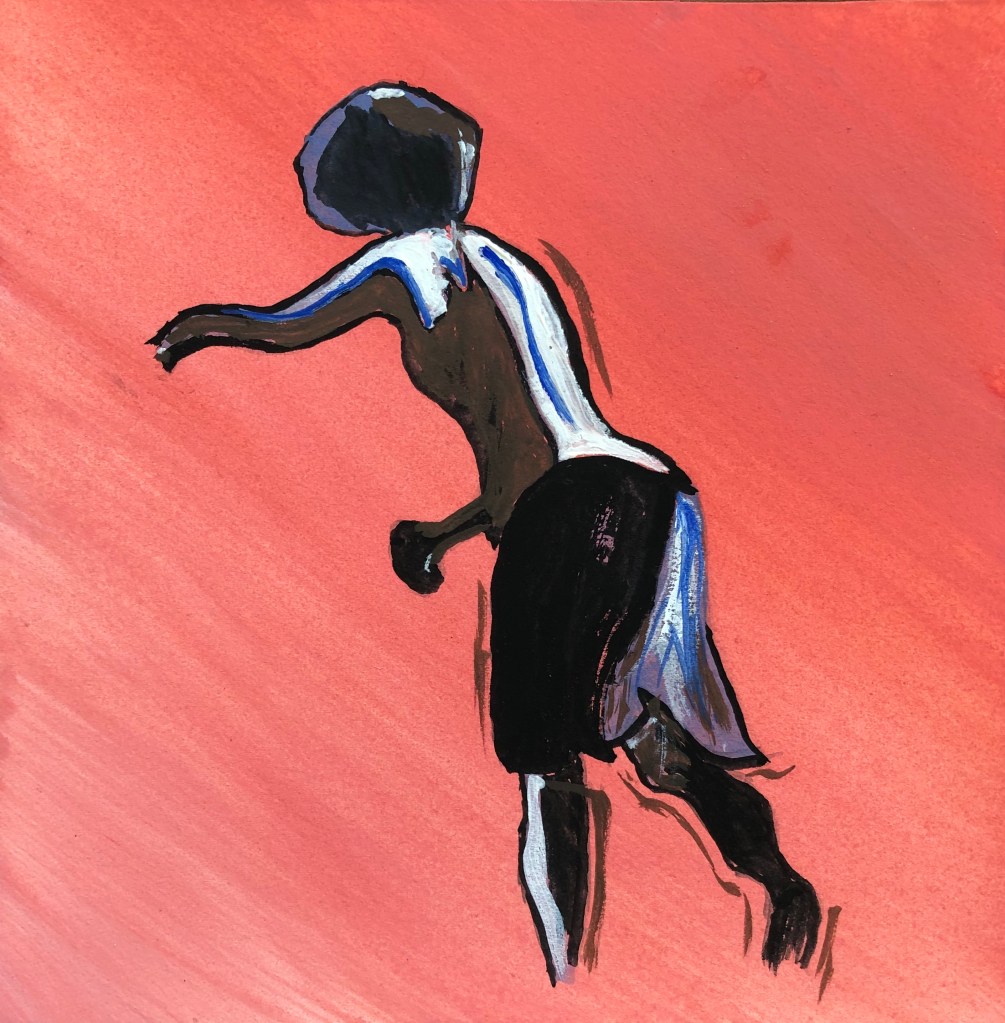
Peter Doig was one of the artists I was asked to research at the start of this Part. I liked his work as it looks simple at first glance but then seems to have lots of hidden layers. This seemed a joyful image of a game of cricket on a beach (albeit equipped only with a bat but no ball or wickets), and he has some interesting complementary colour contrasts going on (orange/blue, red/green). I picked it for my series as I was listening to the test match commentary on the radio whilst painting.
This is my version.
I chose this player because of the lovely line which runs down his back from the top of his head to the tip of his shorts. I made the ground an orangey-red graduated diagonally, light bottom left to dark top right. There were so many directional lines/patches in the original which again belied its simplicity, and I tried to get those. I feel this painting is a success – it’s striking, I’ve got the sense of movement whilst keeping clean lines and echoing the simple look.
IMAGE 15
Pablo Picasso
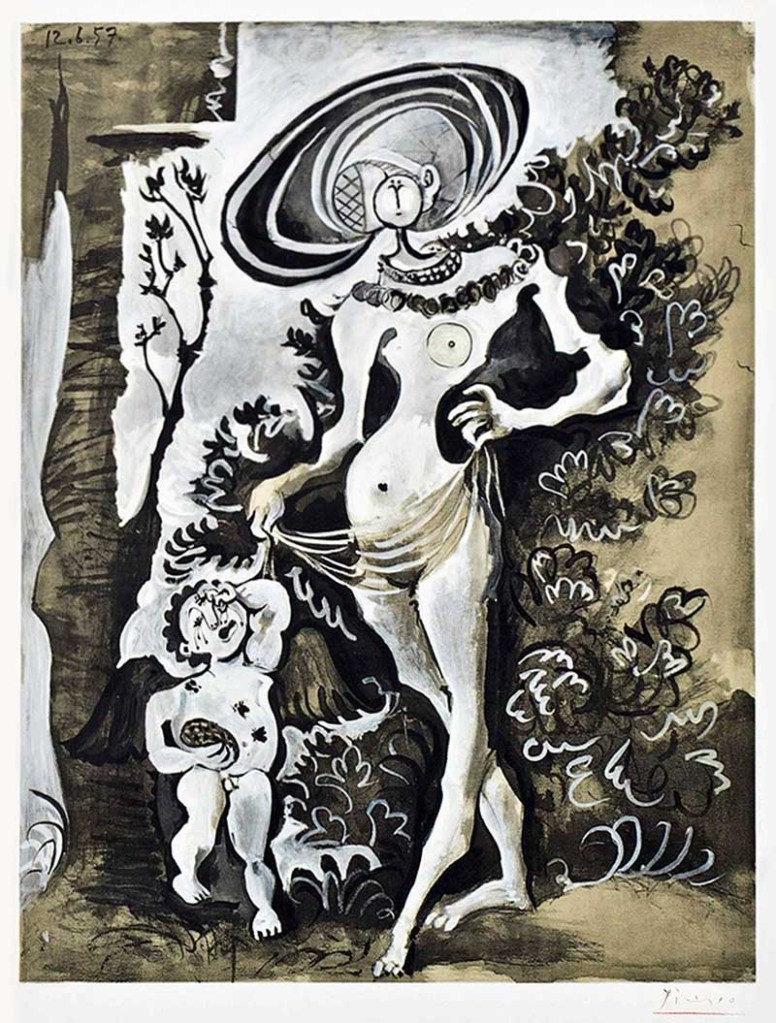
“Venus et L’Amour d’apres Lucas Cranach L’Ancien”
1957
Colour lithograph on Arches wove watercolour paper
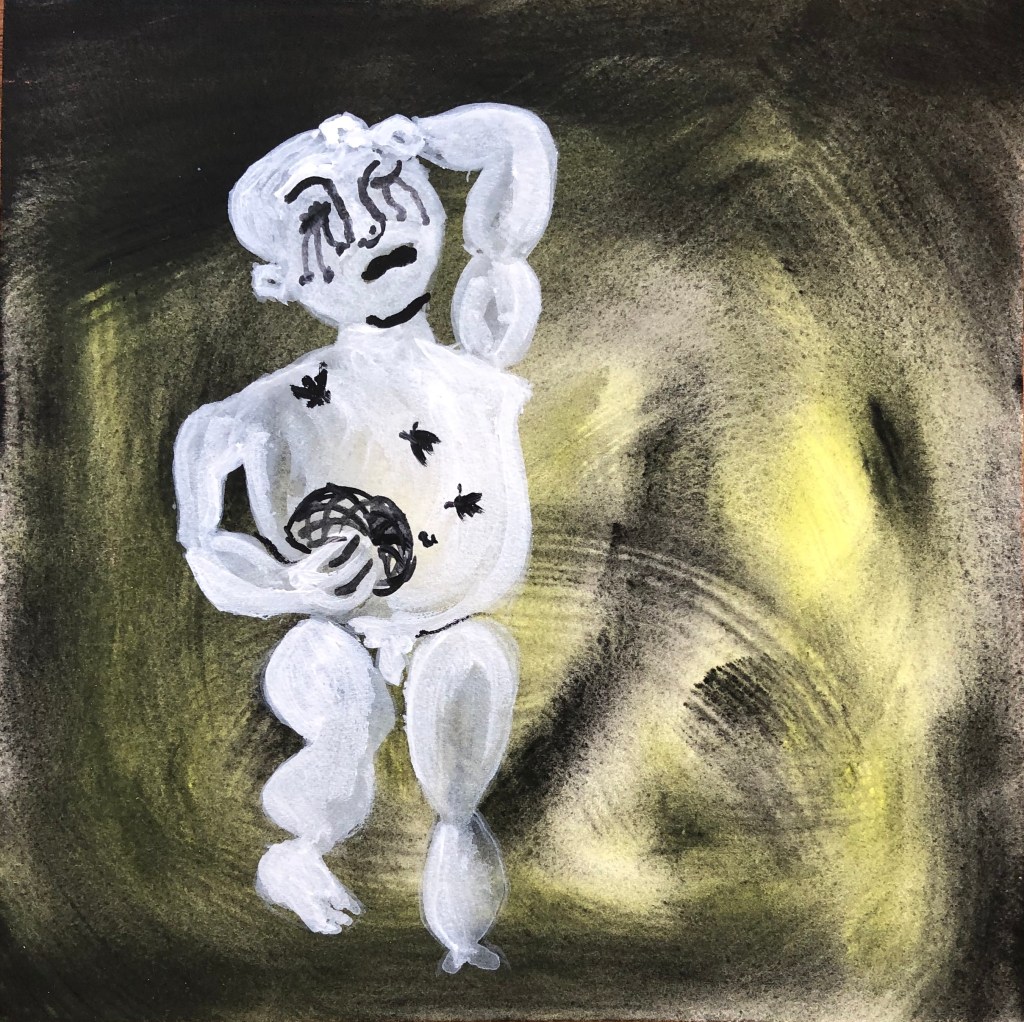
This again was in the Compton Verney exhibition in the gallery of “artists influenced by Lucas Cranach the Elder”. Picasso goes against Cranach by breaking the contours of Venus into sharp, unexpected angles. He has an interesting interpretation of her head and hat which I did think was going to be my choice when I was drawing, before I found curves on the figure of Cupid and decided to go for him instead.
This is my version.
I have to say this is my least favourite of the pictures. The background is too all over the place and I would have done better, still using the yellow and a tinge of black, but as a uniform layer. Also, I didn’t personally like the subject matter of a crying child – although it provided me with a puzzle trying to get all those interlocking ovoid body parts right – which I think I have mainly done. But I felt that he belonged in this series and was rather missing out to multiple representations of Venus.
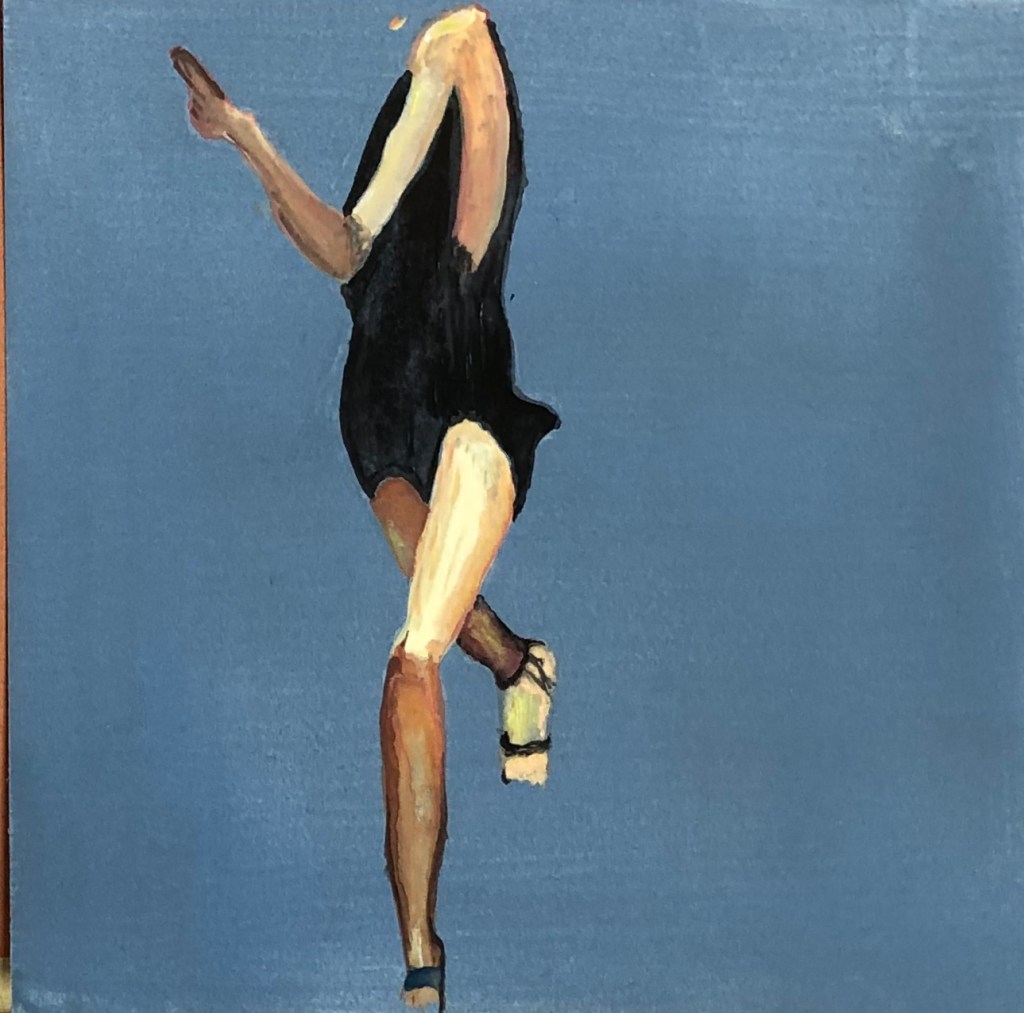
This is another artist I researched at the beginning of this Part. I was interested in this image at least in part because of the title which doesn’t seem to fit the image (surely she is not walking but running); also I listened to a really interesting interview with her on the Art Newspaper’s podcast “A brush with….” which went out on 19th August 2020, and which encouraged me to go back to her work and look at it afresh.
This is my version.
I liked the contrasting perspective of her legs and the way the line of the front leg was mirrored by the arm – so I needed to get nearly the whole length of her body in – quite a challenge on a 6 inch square piece of paper. I haven’t got the line of the front of her body quite right but don’t think this matters as there is still a sense of movement. I learned my lesson from the Picasso and resisted the temptation to break the ground into sections, keeping it plain instead.
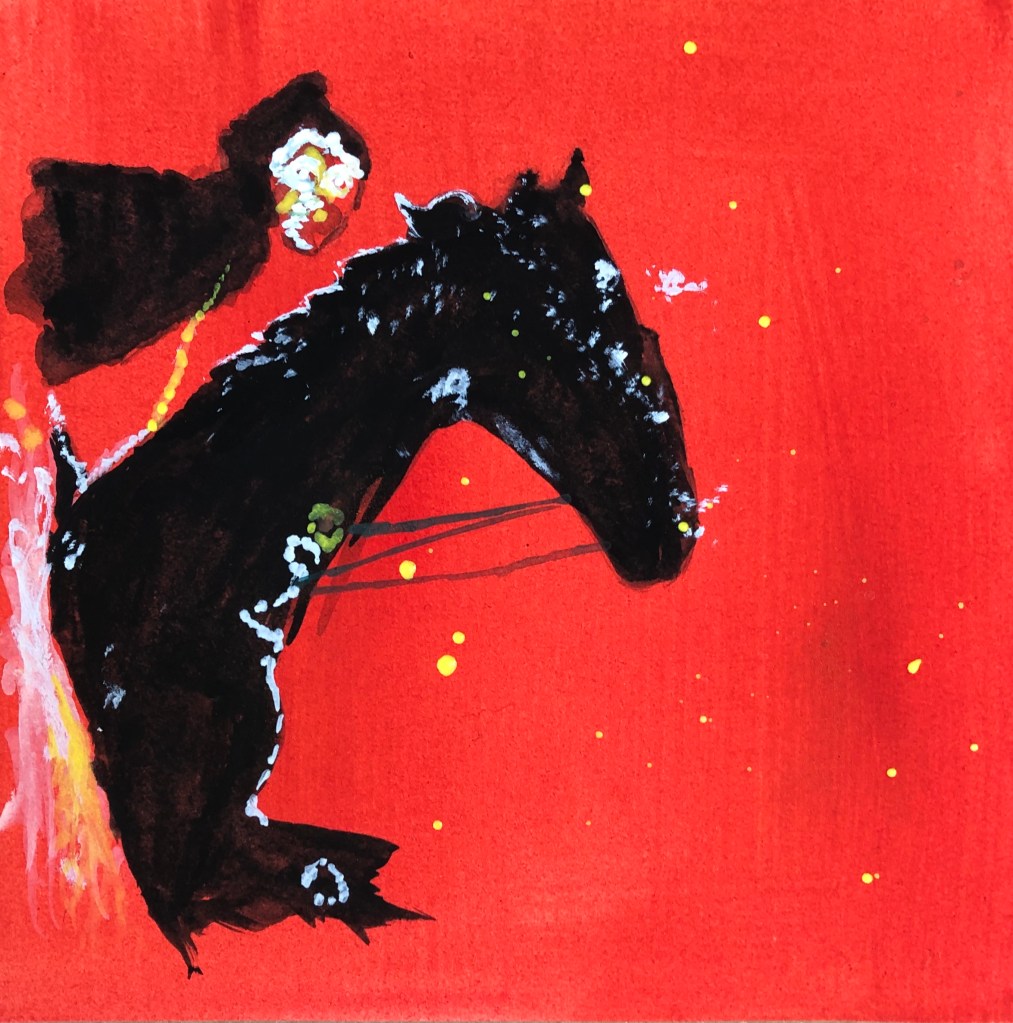
I researched this artist earlier on in Part 1. I found his images very strange, ghostly and otherworldly, but they do pull you in, and he does like a bright colour, as do I.
This is my version.
Flushed with success at horse-drawing after the Chinese horseman, I decided after some drawing practice that I could include horse and rider in this picture – it’s together that they provide the drama, and their shapes mirror each other. I resisted the temptation to go wild with colours in the ground, sticking to a vibrant red to contrast with the black figures. I included details on the figures, but minimal detail of the surroundings – it’s different from the original, but I believe it works.
IMAGE 18
Lucian Freud
“Untitled (Self-portrait)”
1978
Oil and charcoal on canvas
60.1 x 60.1 cm
Private collection
This was the inspiration for my “part of the figure” idea – it’s such a striking image when you see it up close, and seems so strange that he paints creating perfectly formed sections.
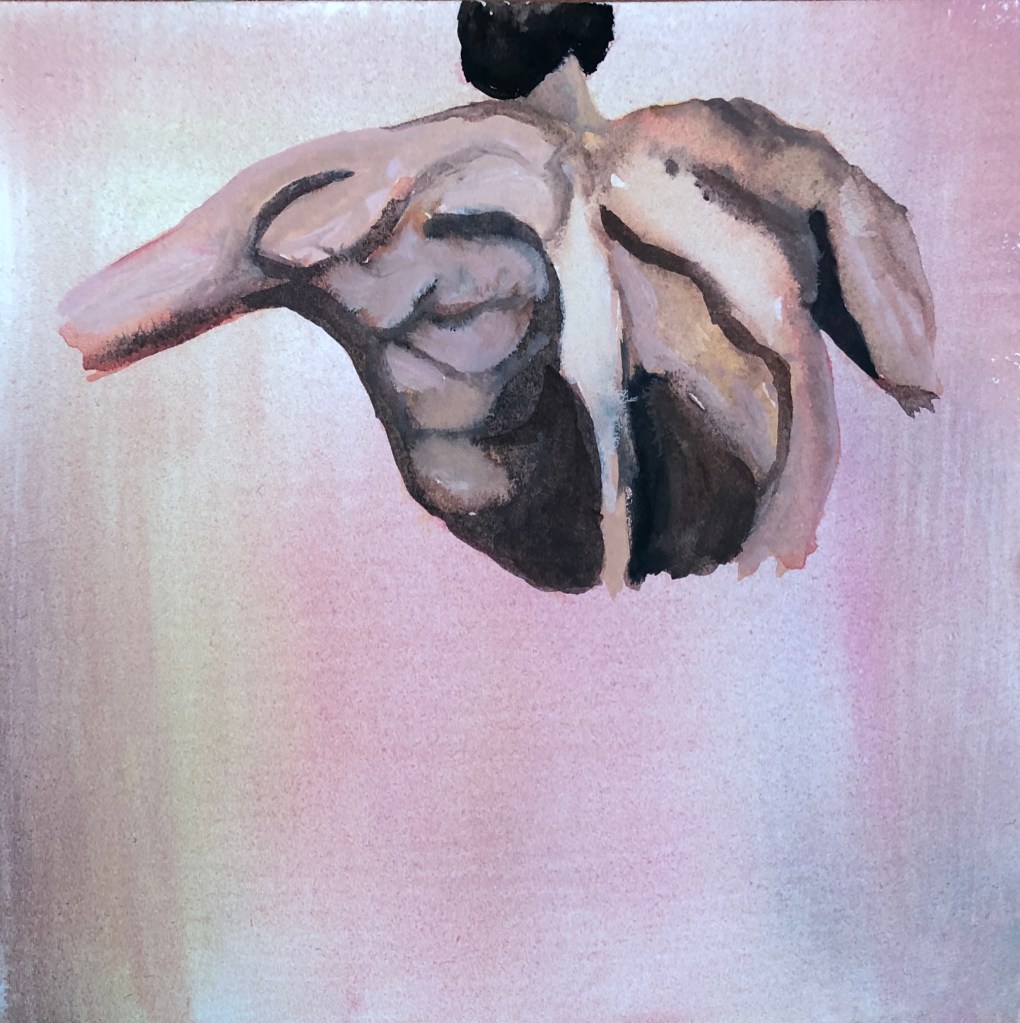
This is my version.
This background is not completely plain – I wanted to give the impression of a work in progress going on underneath, and I think in this case the variegated ground works without dominating the painting. The photo looks a bit “brighter” than the original for some reason – this highlights the fact that I don’t think I have got the balance of lights and darks quite right – was very aware of my tendency to overfiddle.
IMAGE 19
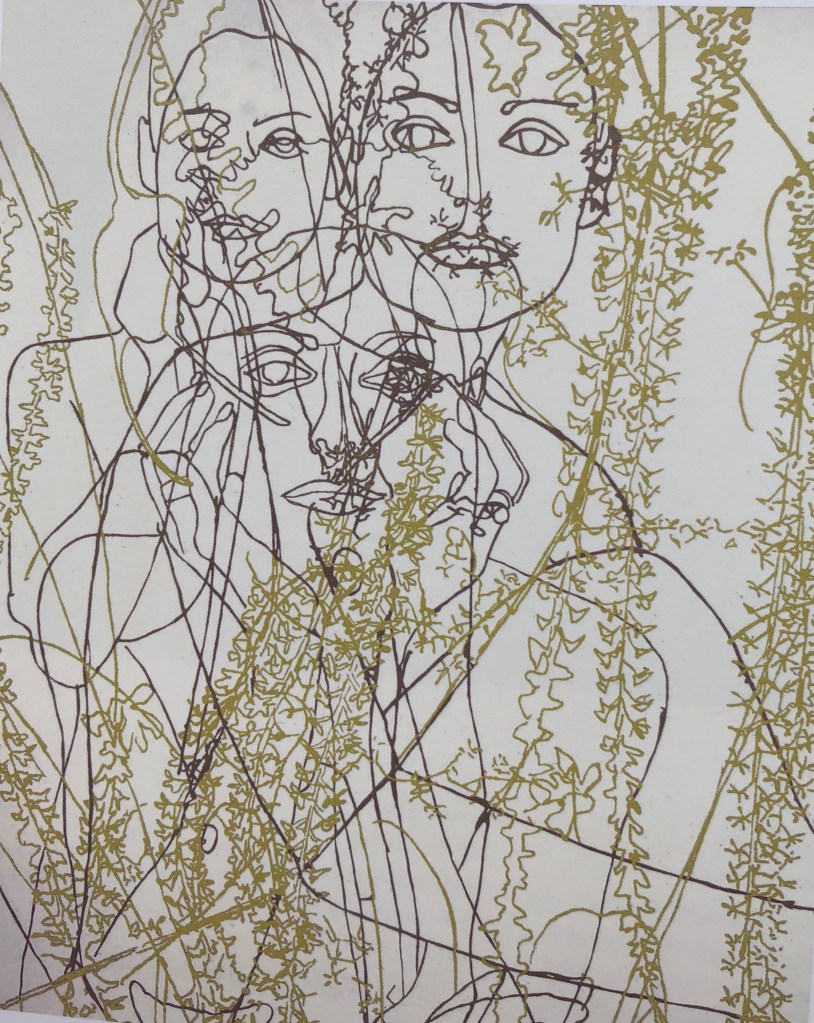
Gary Hume
“Water Painting”
1999
Enamel paint on aluminium panel
300.5 x 244 cm
Seen in: Tony Godfrey (2009), “Painting Today”
Phaidon Press Ltd, London (one of our essential reading texts)
Another of the artists whose work I looked at at the start of this Part. It looked a bit like a continuous line drawing, and I chose it really because I thought it would challenge me to draw faces with one clear line, rather than my usual scribbly style.
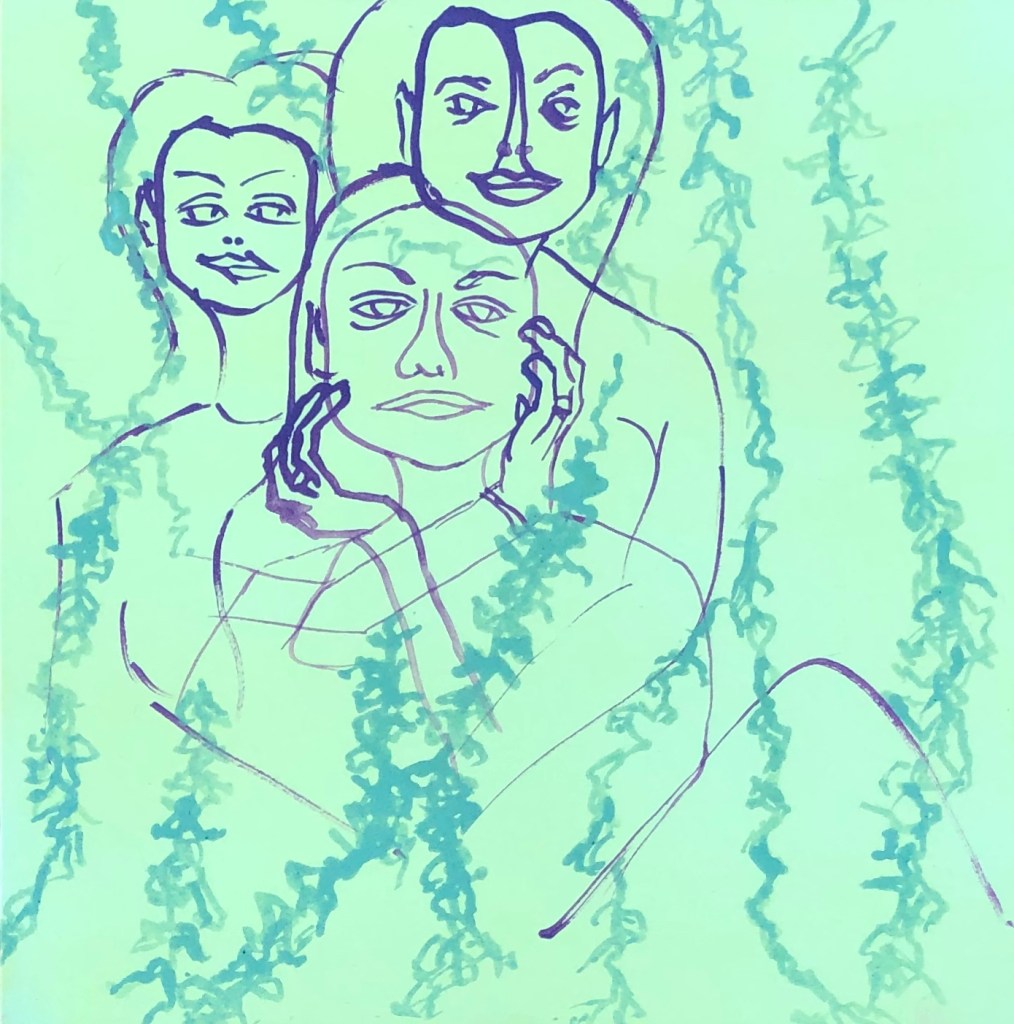
This is my version.
Interestingly, another strange camera effect, as my original is a fairly violent bright yellow rather than green – I know lemon yellow is at the cool end of the yellows, so am guessing the camera has caught and emphasised the coolness so that it tumbles into green? This really did challenge me to draw the figures with a clear line, so I didn’t look at the original when painting (having practised already in my sketchbook in pencil and pen) but just went for it, having pre-mixed the paint (whereas in the other paintings I had been mixing on the go, sometimes on the paper). I have learned that drawing clear lines in this exposed way with a rigger goes much better once the initial paint load of the brush has been discharged.
IMAGE 20
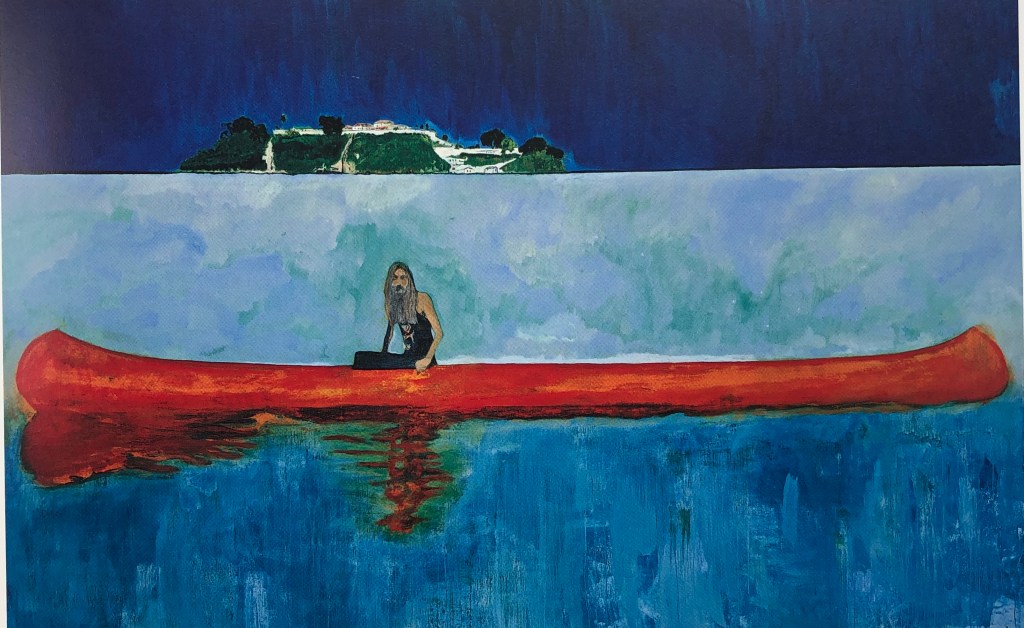
Peter Doig
“One Hundred Years Ago (Carrere)”
2001
Oil on canvas
240 x 360 cm
Seen in the recommended text “Painting Today”
(see reference in Image 19, above)
This was a typical Peter Doig painting to me – looks so simple at first glance, until you start thinking about it – why is this rather odd hippy-type chap floating around in the middle of nowhere in an epically large canoe and no visible means of propulsion? Peter Doig is the only artist to be in the series twice, but his images and characters are so varied that this felt within my self-appointed rules as not being repetitive.
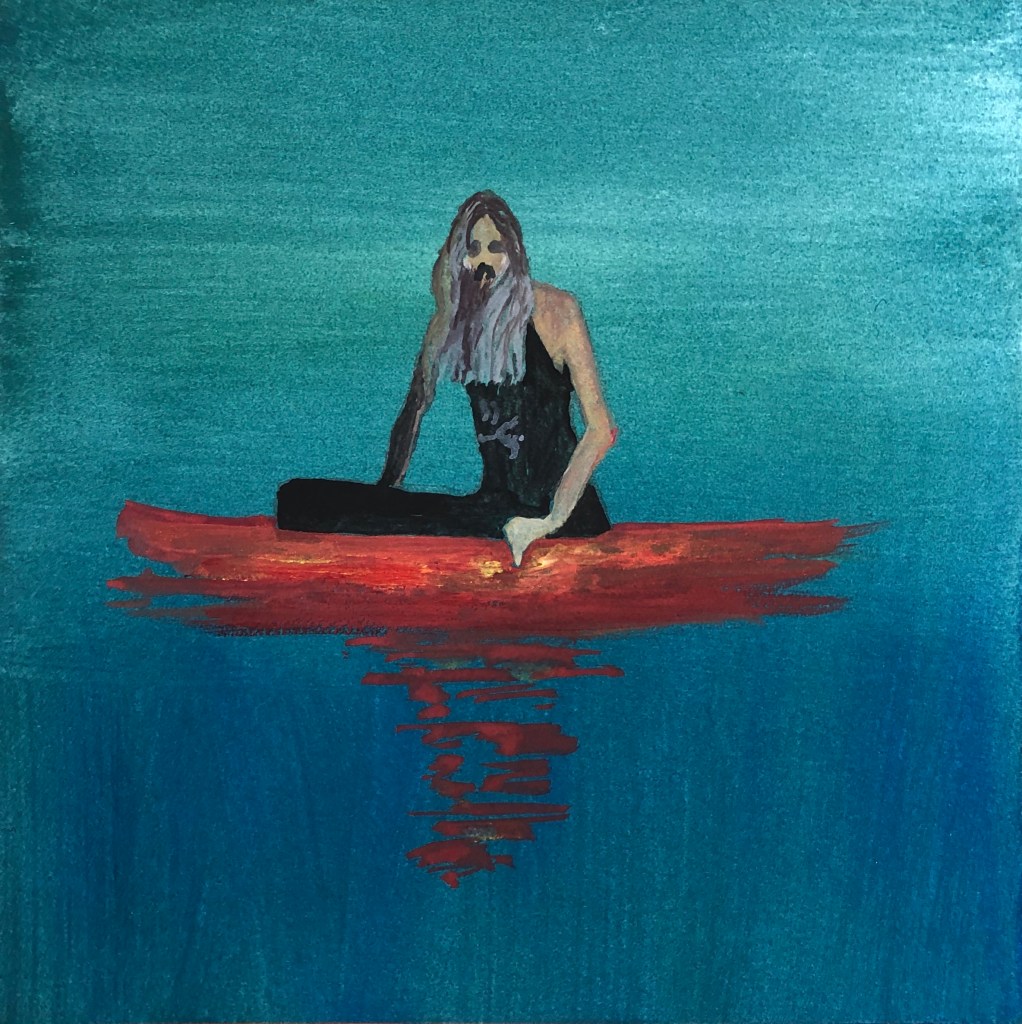
This is my version.
Interestingly, as well as being the only duplicated artist in the series, this is the only time I have painted the figure entire, truncating only his canoe (so he now looks rather as though he’s sinking). It was that negative space triangle between arm and body that drew me in, but then I had to relate the other arm to it, and he has such an interesting head that I couldn’t think what to leave out. I am quite pleased with the graduated ground going light to dark as it goes down, but also switches part-way from horizontal to vertical strokes – I felt some subtlety was needed to be in keeping with the artist.
PRESENTATION OF THE SERIES
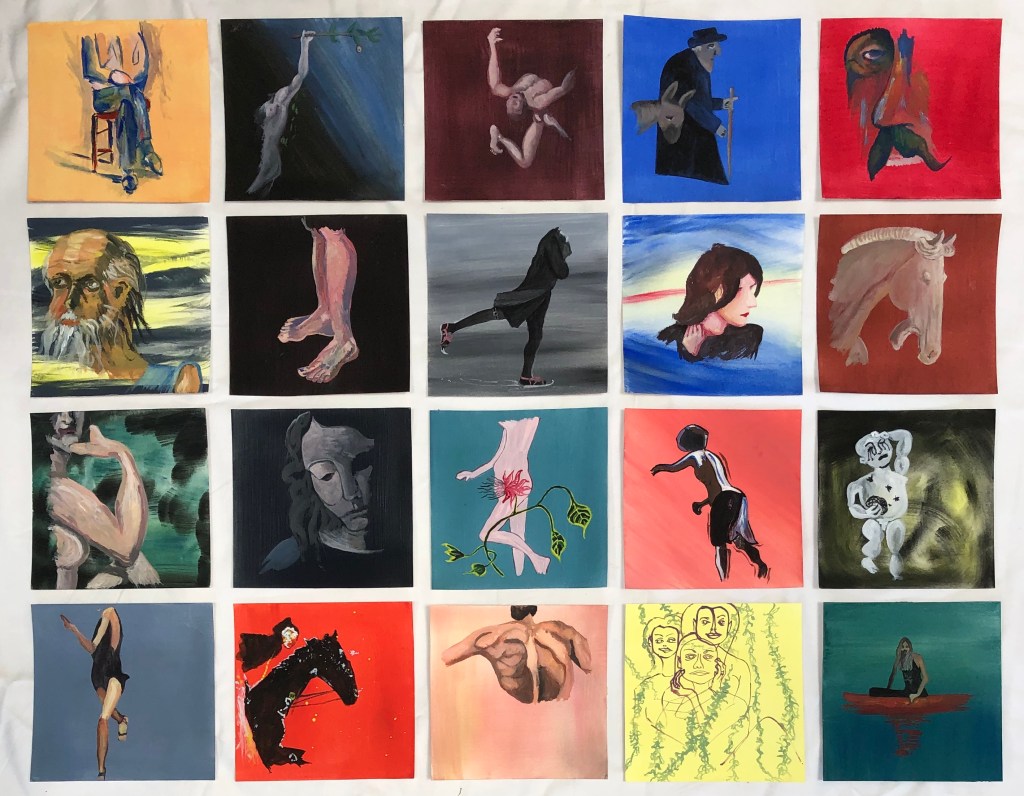
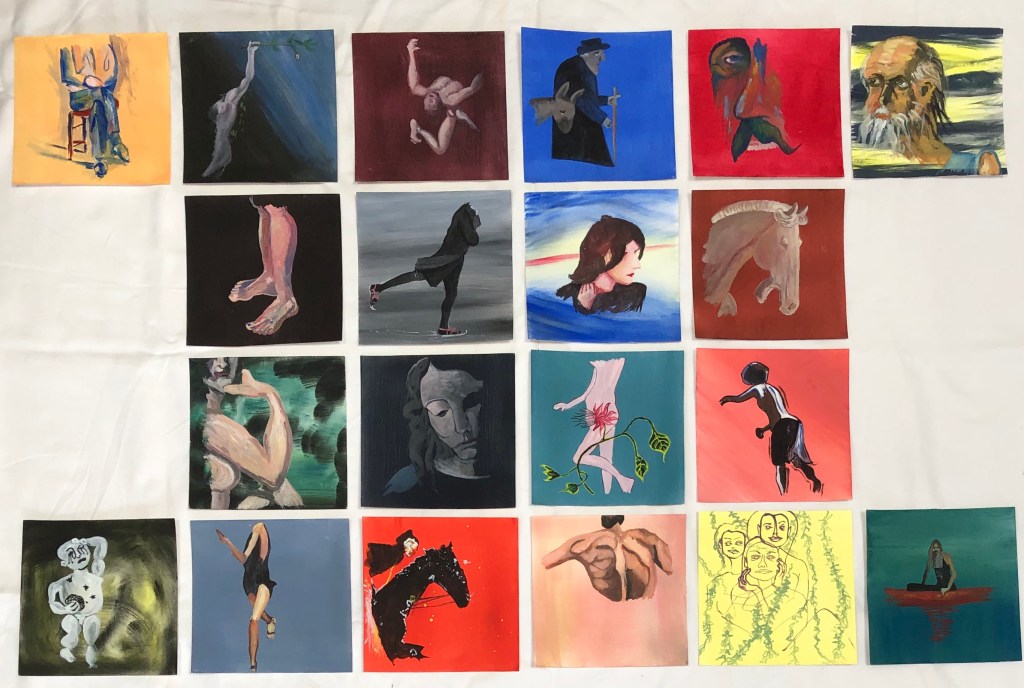
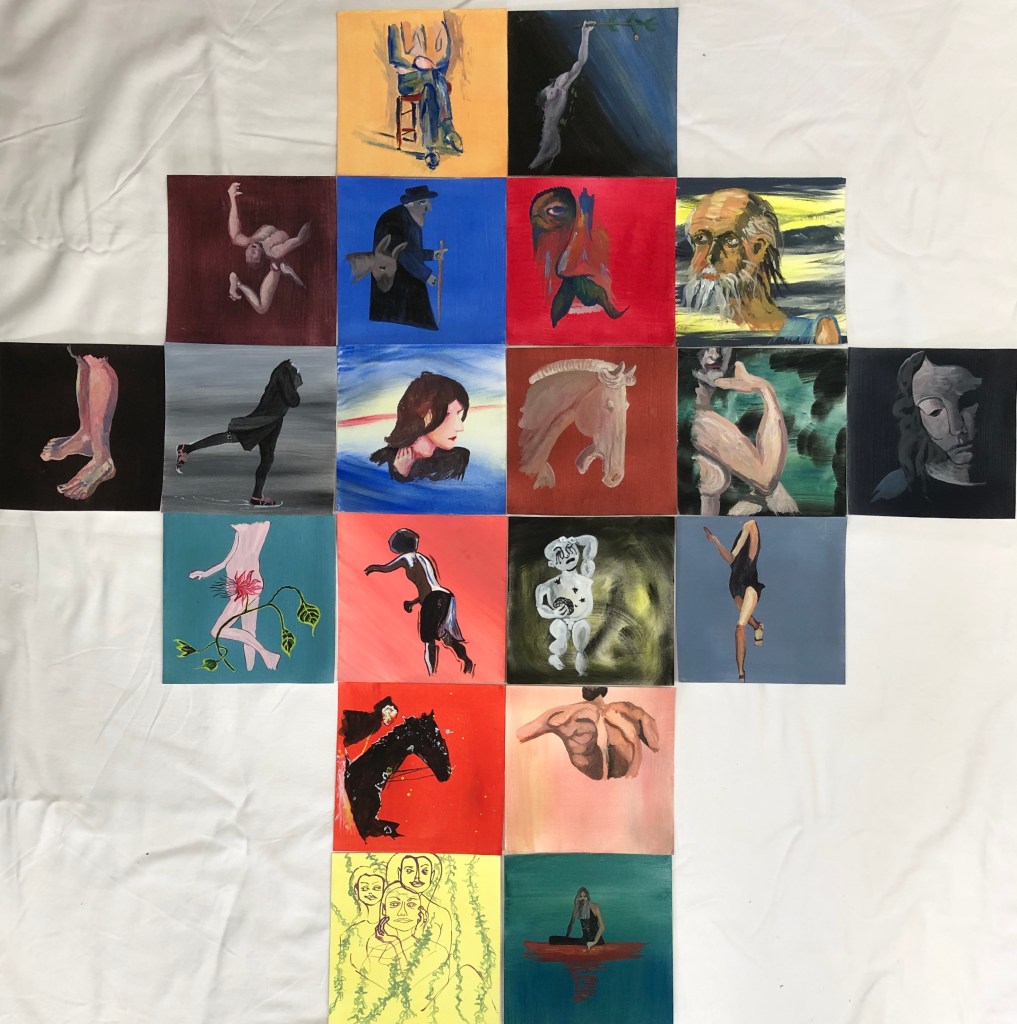
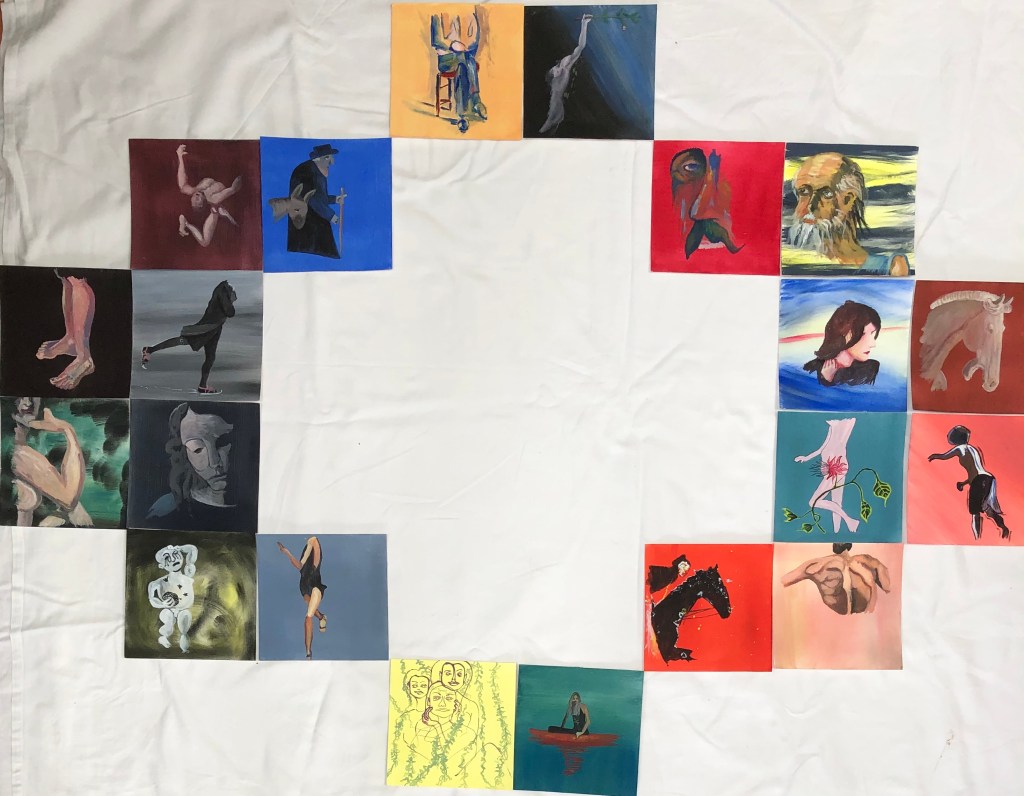
I tried various layouts….
…….a grid with no spaces in between…
…a grid with spaces in between…
…and various other mathematical permutations and combinations:
These latter efforts did feel like fiddling for fiddling’s sake, there being no valid reason for presenting them other than as a block; the only decision then was to have spaces between or not. I came down in favour of yes and then consulted my family (without telling them my choice) and all of them picked the block with the spaces between – this way the pictures are all close together, so the eye can flick between them to compare and contrast, but each just has that little private space of its own to allow it to stand out and be considered on its own merits.
NOW WHAT?
I started out with three aims, and should like to reflect back on them here.
Create a series which felt coherent
I feel I have mainly succeeded. The images and styles are very different, and are chosen because of my personal learning journey, but they:
Are all the same size
All have a clear ground on which the figure was placed
Are all images of parts of figures
Are all created using the same medium
Are all created using the same limited palette of three primary colours plus black and white
I have made the most of my palette of colours, often using them in a very intense form, at other times more muted. Each painting is different and uses something of the style of the original artist, but my way of painting a simple background and then placing the figure onto it has created a series which is vibrant and clearly belongs together. I did consider ordering the pictures by date, or by colour…but this would be false as the paintings were not chosen for age or colour – they are a record of my learning, which was not ordered, but jumped around and wove back on itself, and I think my final presentation reflects this.
If I were to do this again I think that, to increase the coherence of the piece, I would simplify the one or two experimentally “wild” backgrounds and have them all either homogeneous or very subtly graduated.
Learn about the use of egg tempera, a relatively new medium to me
I have really enjoyed learning about this medium, my previous experience, prior to this course, being with watercolour. Hence my panic when I got to Durer’s St. Jerome with its rather strident background – but I found that, by applying the medium with a little “brio”, I could have the background only showing through where I wanted it, and not where I didn’t. The paint can be used very thinly and built up, or very robustly, as with the grounds. The paint I bought, made by Sennelier, has a good level of pigment, and some really vibrant colours can be achieved.
Taking the use of this paint on:
Of course, my experience of it is only in small paintings on paper – I now need to experiment with it on different supports (canvas, board, etc) and at larger sizes.
Learn a little about other artists’ painting styles by replicating some of their work (without getting hung up on making exact copies)
I have learned:
How hard all these artists must look at their subject matter
Detailed images are obviously closely observed, but those who apparently simplify and almost abstract must, it seems to me, almost look harder because they need to understand their subject matter but then think how to represent it (rather than just showing it as it is) so it is recognisable
Looking, thinking and then carefully placing a well-judged line is much more effective than a load of tinkering about!
Going forward with this: my preparatory drawings have shown me the beauty of a simple line, which all of these artists have demonstrated. To progress, I need to carry on with the continuous line drawing, preferably blind, so that I improve my confidence in the production of images which I (and hopefully others, too) find pleasing.
Was really pleased to see that my enjoyment of the course is showing through
WOULD like to submit for formal assessment eventually – NEED TO TELL tutor when submitting next assignment for advice
PERSPECTIVE – aarrgh!! Well, I’m not very good at this, and it’s a bit key, so will need to do lots of sketchbook work on it, drawing in the eyeline as per tutor’s examples so I can really see which way my lines are converging, and where necessary exaggerating the “front” line lengths till I have got much more of a feel for it. Just little things like the lower ellipse in the pot being more rounded because it’s further away from the eyeline – so obvious, yet I hadn’t seen it before.
Research– I totally agree I’m not using it enough or building it into the development of my own work. I need to pick a couple of threads to take through into exploration in my sketchbooks (e.g., as mentioned, the use of shadows, which I found interesting to read about but haven’t really done anything with)
Backgrounds and viewpoints – I am not really thinking enough about these – my “still lifes” float and I need to think more about how to set them within a defined space and reflect on the angle from which I view things (rather than just sticking them on the table next to me and drawing them from there)
Sketchbooks – I don’t think I am sketching nearly enough (have already bought and read the Scheinberger recommended text) and think I am still trying to keep my sketchbooks too “nice” rather than using them as a tool – have bought some smaller ones to try and use much more regularly and to feel freer about experimenting in.
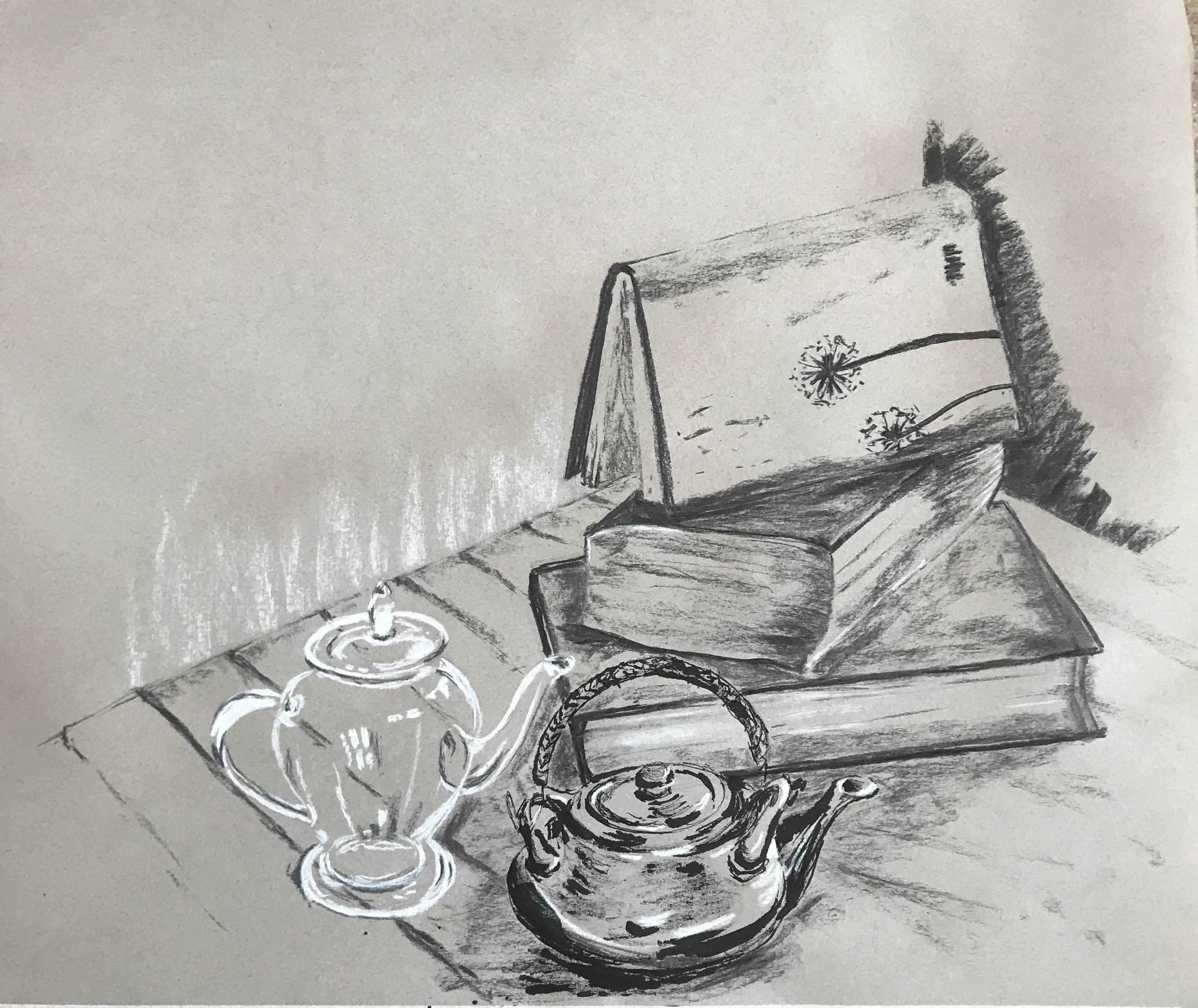
I have been an inveterate bibliophile since I was a child, and my husband will tell you that I cannot pass a bookshop without going in – hence our house is full of piles of books. I am also a lover of random teas, and a bit of a teapot collector. In fact, what better way to spend an afternoon than sitting in our garden room with some books and a brew…….
….so this seemed an obvious still life setup for me. I liked the curves and ellipses of the pots, contrasting with the rectilinear shapes of the books, and have tried to arrange it in a fairly pleasing triangular composition.
See what you think……
I tried to select my materials to match the different objects:
My favourite ink and a stick for the oriental ceramic teapot, to give it solidity and to evoke ritualistic tea ceremonies/Chinese brush painting
White and grey conte crayons for the rather fugitive and ghostly glass teapot
Charcoal for the “wood-derived” objects – the books, the table and the shelves in the background
I chose a mid-tone sugar paper as support to allow me to focus particularly on the lights and darks
So, how did it go?
Overall, I am pleased with the composition and think I have produced a fairly vibrant drawing.
I am particularly happy with the ceramic pot at the bottom foreground – I enjoyed this the most (maybe because I feel quite free using the ink and stick – it is such an unpredictable medium that I feel able to go with the flow and not panic at unexpected splodges and blots, just trying to weave them into the image).
I have done a bit of practice with the glass teapot and feel happier with its shape than I have hitherto; I am slightly concerned that it does look rather too ghostly and floating, but it gave very little shadow to anchor it down.
The pile of books – aarrgghh! – thought this would be the easy bit but it always seems to go slightly awry, I think I have a bit of an issue with perspective which will need work as the course progresses. I sprayed the drawing with fixative and put it on the floor to photograph it, when I immediately saw the angle of the right-hand corner of the bottom book was not right – I have tried to draw over it and improve it, but didn’t want to make too much of an issue with it as it would spoil the rest of the drawing.
I have just suggested the table, shelves and wall in the background to fix the objects in space, as obviously the books and pots were my focus. I’m never quite sure how much to put in, and will often just indicate tone contrasts between background and focus objects, rather than making the background too fussy and detracting from what I want the viewer to concentrate on.
Demonstrate drawing skills using a wide range of media
I have used charcoal, dip pen and ink, stick and ink, palette knife and ink, oil pastel, chalk pastels, Conte crayons and pencil throughout the course of this first part of Drawing 1.
Use drawing, tone and colour to represent three dimensions
I have used line and various shading techniques such as hatching and blocking to show tone. I haven’t investigated colour much – believe this is to come.
Explain the rudiments of linear perspective and other drawing systems
This isn’t something which has specifically come up as a requirement; it is certainly something I have grappled with when setting up and representing still lifes; foreshortening is an aspect which needs work
Reflect perceptively upon your own learning experience
I certainly feel I have learned over the course of this first part, and have tried to incorporate notes to this effect, either within my blog, or as notes on my sketches
Assessment criteria
Demonstration of technical and visual skills – materials, techniques, observational skills, visual awareness, design and compositional skills
I have used a range of materials and drawing techniques (see above). I am learning the importance of careful observation; I certainly go around now looking at everyday objects and thinking about how I would represent them on a page. I think my sense of design and what makes a good composition are things for me to be more aware of – I was having tea with an artist friend the other day and she randomly exclaimed what a great composition a blue vase of orange tulips framed by a doorway would make, and as soon as she said it I could see it was very Vermeer-like; but I haven’t got to the stage of automatically seeing these things for myself yet.
Quality of outcome – content, application of knowledge, presentation of work in a coherent manner, discernment, conceptualisation of thoughts, communication of ideas
I believe the quality of my drawing has improved over the course of this part, and I have enjoyed using and applying techniques and materials I had not tried before; particularly using ink other than with a pen, and using charcoal or crayons to create blocks of tone. I hope my work is presented in a fairly orderly manner organisation-wise, although the presentation of drawing on a page is not always quite what I intended, sometimes not the size I originally intended or centred as I had meant it to be – usually because of the first element in the drawing being mis-sized or mis-placed on the page. “Conceptualisation of thoughts and communication of ideas” I have taken as meaning having an idea of what to draw and then conveying that as a realistic image – I think I am in the early stages of this – I not longer cast around for what to draw, having fallen in with the idea that anything is fair game for drawing – but I need a lot more work on taking it further and conveying a mood or a message.
Demonstration of creativity – imagination, experimentation, invention, development of a personal voice
Hmm….I wouldn’t say I am able to demonstrate much imagination as yet, my work is still very representational. However, I have enjoyed experimenting with different media and I hope this shows in my work. Invention…I have tried bits of this when doing the experimental mark making; it was fun, I enjoyed it, but I can’t say I was always delighted with the quality of the outcomes. Development of a personal voice…. Again, don’t think I have a lot of evidence for this – I think I have a default style of drawing, but this is not the same thing.
I have enjoyed thinking about what I have done, and putting critical thoughts into words, more than I thought I would – hitherto I would paint a picture from a photo and either think “yes, that’s not bad” or “back to the drawing board”, and cast about for the next photo to copy. My research so far has included books recommended by my tutor, books on the essential reading list, and other texts I have found from libraries (both the OCA online library and the Plymouth University library, which I have joined for a year.) I feel my reading has been quite scattergun at the moment, there seems to be just so much out there to lap up and take in; I have tried to absorb and use some key messages (keep collecting good examples, try different styles of drawing, think about composition, mood and message), but early days yet.






 Sue J's blog