WHAT?
OCA tutor Hayley Lock led two Zoom workshops, a fortnight apart, focused on the triptych “ The Garden of Earthly Delights” by Hieronymus Bosch. In the first session we looked at the painting in some detail, and were also pointed towards other artists whose work featured gardens/plants/animals/the figure, looking in particular at aspects such as scale, colour, patterns and repeats.
We were placed in smaller groups and invited to work on a response to the presentation together for a while, and then continue with this in the gap between the sessions, communicating by Padlet.
SO WHAT?
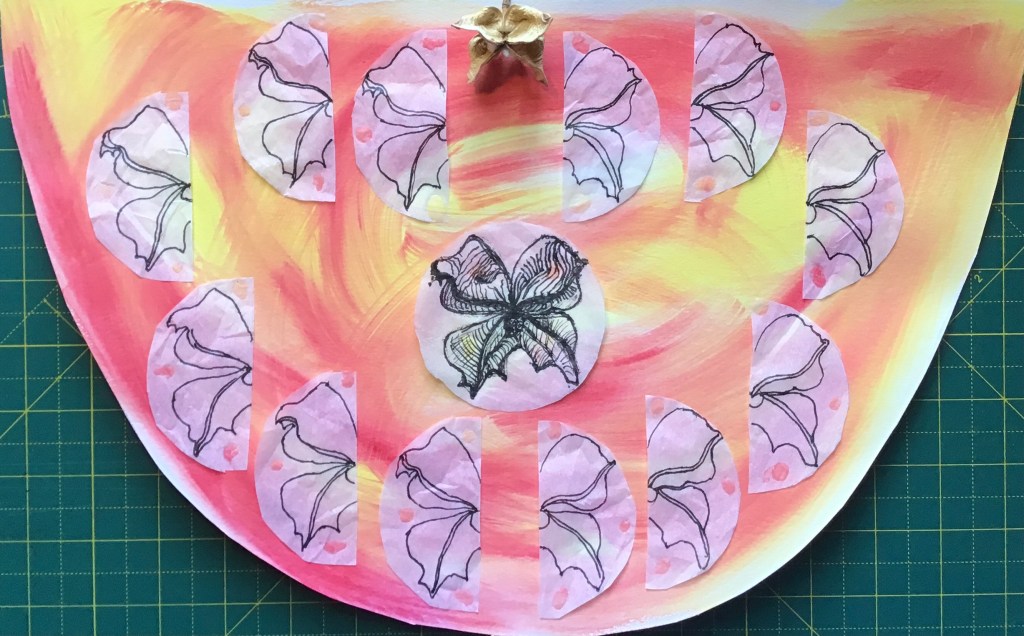
My initial “unthought-through” response in the group session using the shapes we had cut out within the session was to create a repeating pattern based on semi-circles.
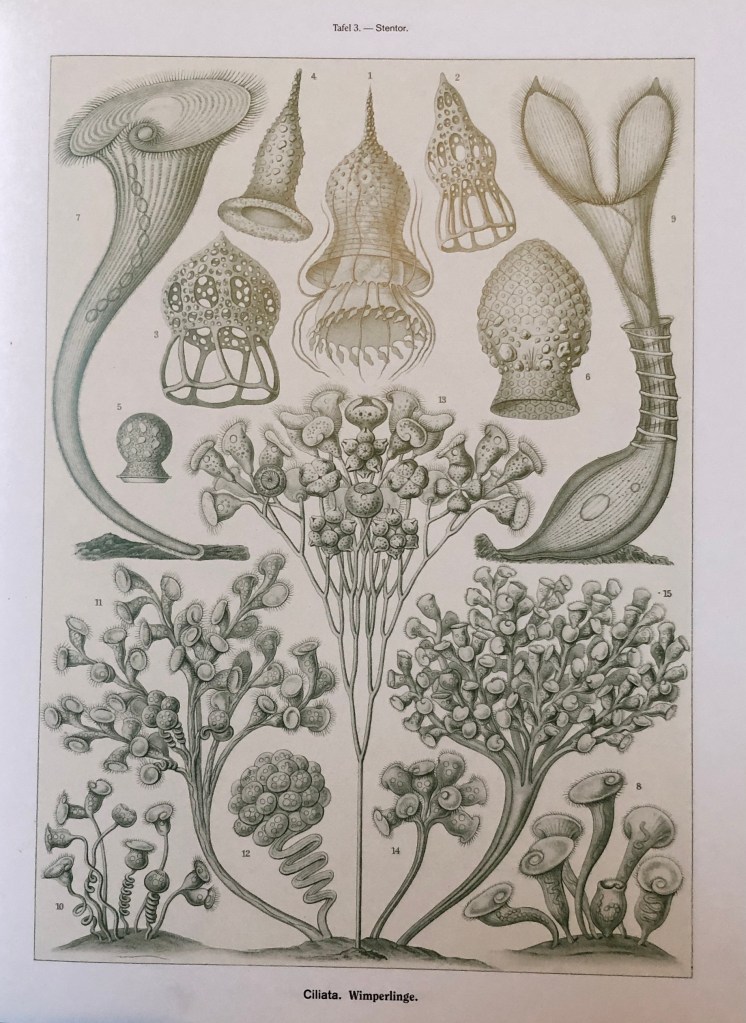
I wasn’t overwhelmed with that – the background was all wrong apart from anything – but I was inspired by the session. I went away to look at Ernst Haeckel’s 1904 book (my copy being a 2019 reprint by Prestel Verlaine of Munich, New York and London) “Art Forms in Nature”, who was one of the artists whose work had been recommended to us, and is a favourite of mine.
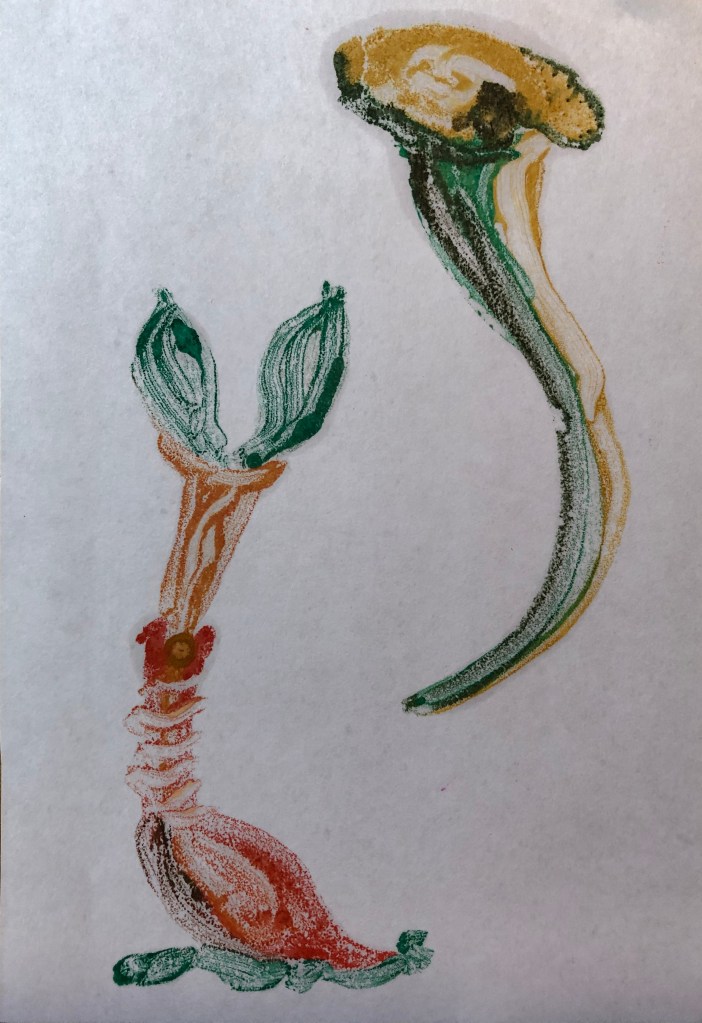
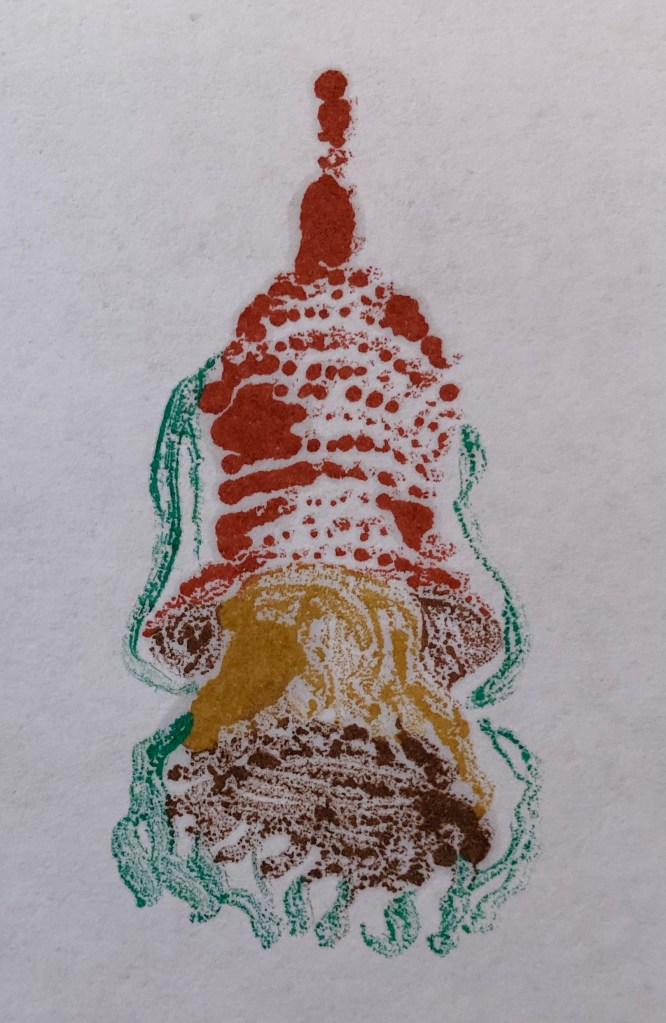
As I am just figuring out the process of monotype, I decided to have a go at some Bosch-like images to make prints of, inspired by the images on one particular page:
This was fun – didn’t really know what I was doing, used oil paint on glass with Zest-It solvent onto thin cartridge paper, trying different thicknesses of brush and varying marks. The process really does transfer the brushstrokes much better than I thought it would, and my attempts to add tone in the third image by having unbroken marks on one side and dotted marks on the other are at least a partial success – to be remembered……
I also thought the colour/pattern design aspect would lend itself to enamels, which I particularly enjoyed using in Part 2. I used Raqib Shaw’s method again of drawing some triangular diatoms (single celled organisms) from Haeckel, tracing them onto a small gessoed board which I had prepared with a matt black egg tempera ground, and drew over the tracing with gold acrylic liner. Once this was dry I filled in the diatoms with coloured enamels – I had no colour reference to work from, so just wanted the overall effect to be patterned, striking and shiny against the plain matt background. 
In the second session, the student groups took it in turns to show and talk about what we had done so far – my takeaway from this was the huge divergence in the artwork which resulted from a shared input.
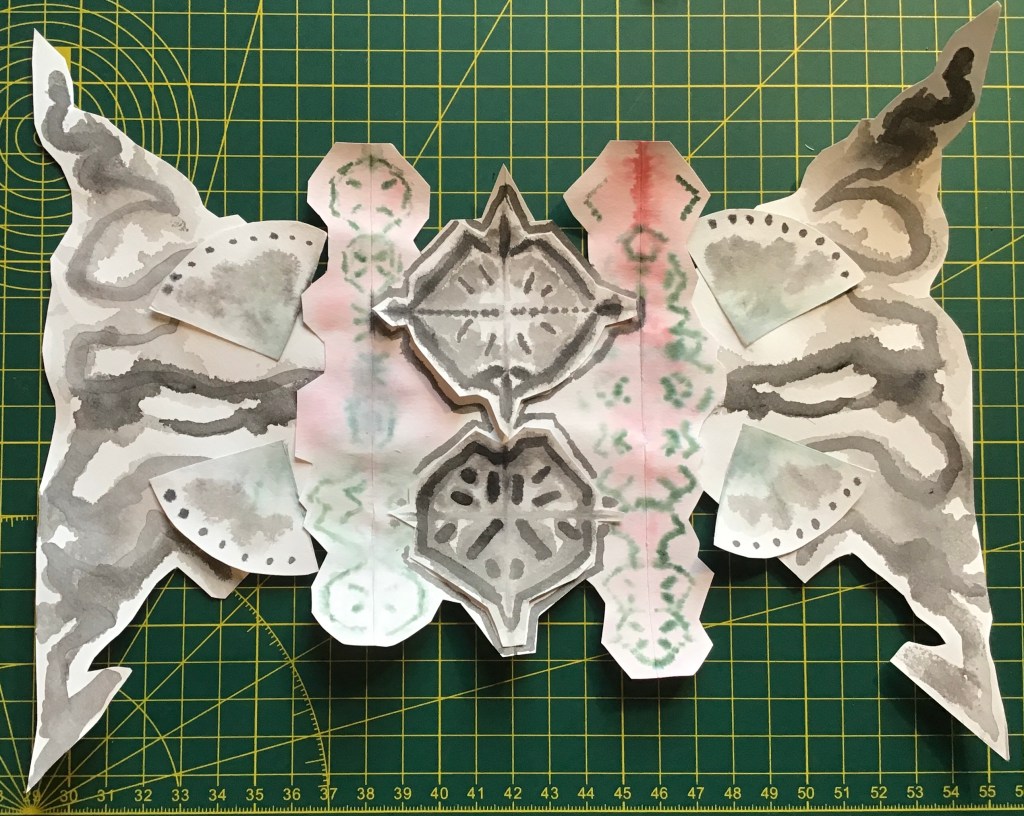
We then worked in the styles of Bruce Connor and Alexander Tovborg to create a potentially never-ending drawing based on gridded, folded squares and circles using the inkblot technique, cutting, joining, working into, overlaying…..all based on careful observation of one natural thing and mark-making accordingly. Again, everyone’s was very different; I used two water-soluble felt pens, a lot of water and, when these gave out, dilute black ink. Not sure what it was or where I was going with it, but it was fun.
As part of my background work on this topic, I had looked at www.botanicalmind.online and had been interested in the work of Philip Taaffe – see e.g.: (can’t seem to insert image, sorry)
Philip Taaffe, Lalibela Kabinett, 2008. © Philip Taaffe; Courtesy of the artist and Luhring Augustine, New York.
I suppose I envisaged the work I had produced as a result of these workshops to fit into a project a bit like this of Taaffe’s.
NOW WHAT?
A fanciful and a pragmatic takeaway:
- Fanciful – I would have time to pursue and develop this investigation into natural forms and produce something in the style of Taaffe’s work – although making it my own
- Pragmatic – To give myself permission to cut loose and play with form, design and pattern a little “just for fun”, even though it might not lead to anything finished.








 Sue J's blog