We went to see the exhibition of Barnett Freedman’s work. I hadn’t known about him before, and was interested to learn about his background as an East End Jewish immigrant – I grew up in the East End (Cockney born and bred) and knew many people with similar stories, energy and drive.
SO WHAT?
The gallery’s emphasis seemed to be on his posters and book covers, familiar to many of a certain age. I was more interested in:
The process of lithography, which I hadn’t understood before but which he had seen a niche and made his own – incredibly time-consuming and involved, it seemed to me, but he had it down to a fine art.
His pop-up see-through scenes, which no-one else seemed to look at, but I found fascinating in their detail and his working out of the perspective.
His war work – he was appointed official war artist. For this he shed his stylised figures and painted individuals realistically – my favourite was a huge painting showing everyone who worked in a particular factory, by name, from the directors down to the ladies doing the lowliest jobs – each one named and obviously carefully observed.
They also had a great book shop – treated myself to books on Cezanne, Frank Auerbach and Maggi Hambling; Cezanne and Hambling being old favourites, and Auerbach because I had seen one of his works in the standing collection at the gallery, a nude lying on/sliding off a couch (didn’t note the details!!!), where the paint was so incredibly thick as to be sculptural – couldn’t take my eyes off it, just amazed it hadn’t all slid off the canvas under its own weight …so I need to learn a bit more about him.
NOW WHAT?
On the basis of what I’ve seen, I need to:
Get better at observing faces and the small differences from “standard” that make them into the likeness of an individual, not just a generic face (Freedman and Hambling both do this so well) – practise!!!
First exhibition visit since coronavirus lockdown to Compton Verney gallery to see exhibition of Lucas Cranach the Elder’s work. We had an hour, in groups of 10, to look at two smaller rooms and a large gallery which was split into work by Cranach, and then more modern work by other artists inspired by Cranach.
SO WHAT?
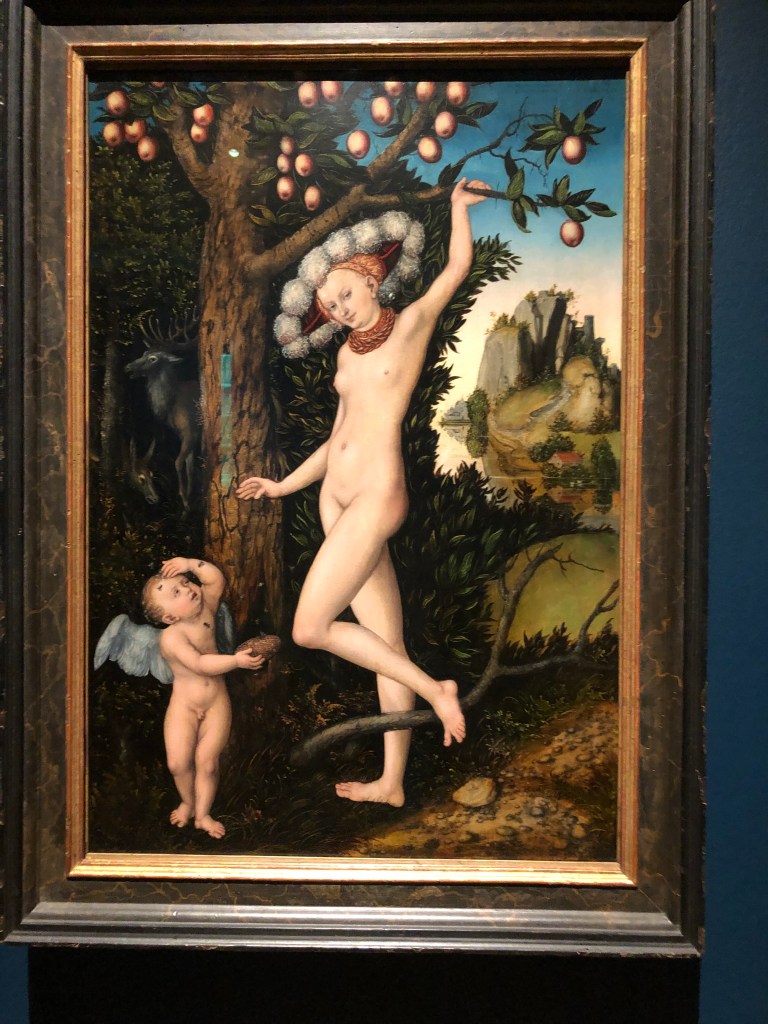
“Cupid Complaining to Venus”, 1525, oil on wood. National Gallery, London.
This was one of my favourites, showing the elongated nude against the dark background standing on stones for which Cranach is known; Cupid’s aggrieved expression is very amusing.
There were examples of reactions to Cranach’s work by, amongst others, Picasso; his German dealer, Daniel-Henry Kahnweiler, remarked that “…one of Picasso’s notable characteristics was the need to transform existing works of art”.
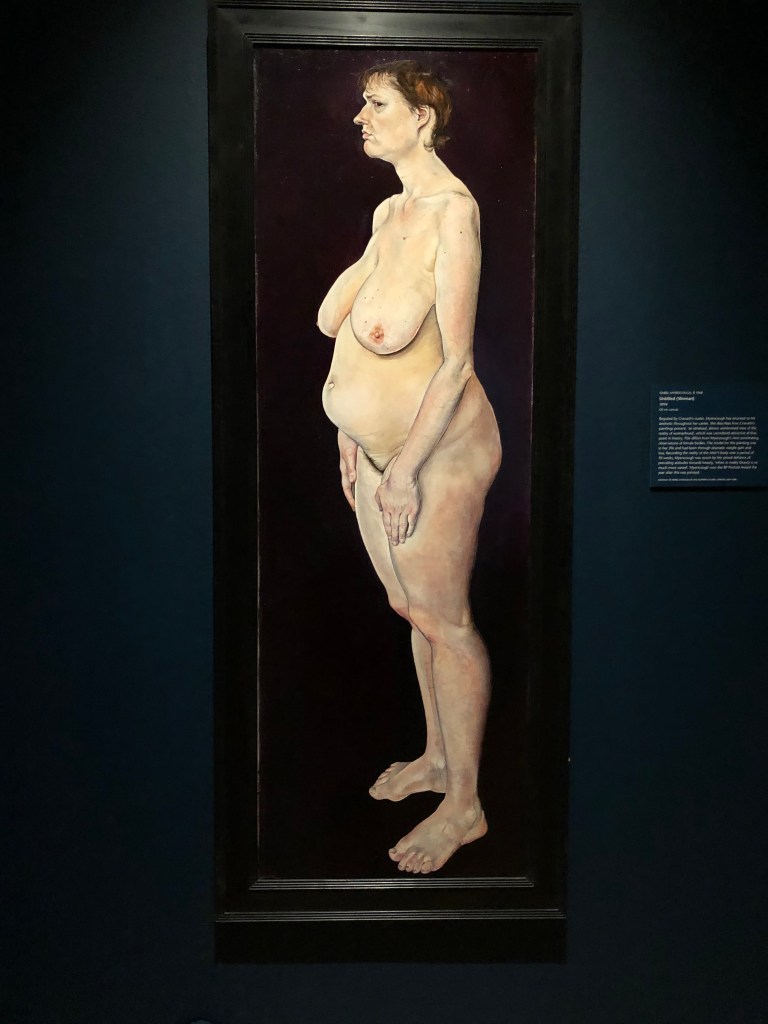
I was taken with the work of Ishbel Myerscough, for example “Untitled (Woman)”, 1994, oil on canvas. Flowers Gallery, London, New York. She has taken Cranach’s “motif” of a nude figure against a dark background, but her figures are representational rather than idealised.
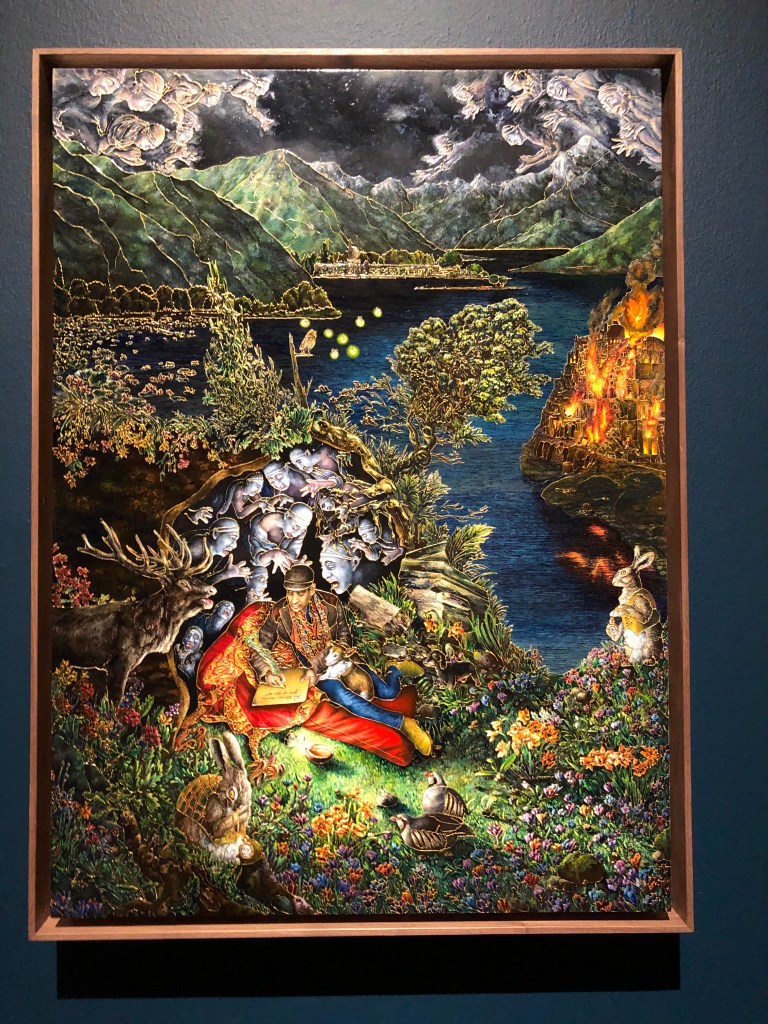
I also enjoyed the brightly coloured enamel paintings of Raqib Shaw, such as this example, “Exquisite Penance in Exile…after Cranach”, 2019-20, (based on Cranach’s painting The Penance of St. John Chrisostum), acrylic liner and enamel on aluminium. Raqib Shaw and White Cube.
Seen close up, these paintings are highly textured and reflective.
NOW WHAT?
This exhibition really brought home to me the way that many current and recent artists take the work of earlier masters and use them as a basis for their own work in so many different ways.
I am going to try and use some of Cranach’s paintings as “found images” for use in the exercises in Part 1 of Painting 1.
For Christmas I was given Bell, Balchin & Tobin (eds for the Royal Drawing School), Ways of Drawing – Artists’ Perspectives and Practices, (2019). Thames and Hudson, London. This is just a fantastic book, so many ideas, takes and styles, and loads of great advice. This little extract was perfect inspiration for life drawing – it’s from an essay by Ishbel Myerscough called “Focusing on the Individual”:
“I try to encourage the alchemy of concentration. Drawing is like magic. If we allow ourselves to detach from the world around us and form a perfect bubble between ourselves and the object, to shake off feelings of expectation or embarrassment or indeed our own hope for brilliance; if we stay calm, treat the viewed in an almost abstract fashion, focus on the essential; if, at first deliberately and then unconsciously, almost meditatively, we remove the fact that we are looking at a nose or an eye, or even a head or a person; if we watch the way that the line of the inner eyelid lifts at the corner, the improbability of the shape of the shadow under the nose – if we concentrate that hard, not making judgments while we are doing so but forging ahead until the trance is broken, when there will be an opportunity to stand back and assess – if all that is truly achieved, then magic is made. Whether or not the observation is right, in proportion or even has a likeness, an intensity has been achieved, a point of fascination. And that is what a drawing really needs.”
We went on our annual culture fest to London 6-10 January this year, trying to walk the tightrope of visiting as many exhibitions as possible without getting brain freeze.
Tate Britain – William Blake
This is quite brain freezing by the time you get even halfway round – I noticed several people pausing and looking around, taking a deep breath and clearly thinking Oh my goodness – there’s more!?
I don’t think I’ve ever seen a body of work quite like this. It spans Blake’s life, and he was prolific, meticulous, talented……and yet his art didn’t seem to me to develop and grow. His figures, whether drawn or painted or printed, are all in the same mould – tall, highly muscled, thick-necked, either nude or diaphanously clad, with straight Roman noses and pointed chins, staring dark eyes and often dark open mouths. Females and angelic types have hugely long thighs; heroic looking men have thick, muscular thighs. His favourite of all appears to be the man with the flowing beard, who at some stage in each series (he painted loads of series telling stories, some intelligible, others less so) is bound to feature sitting staring out of the picture full face with his knees tucked up under his chin. Gestures are sweeping, bodies are either oddly contorted or else gracefully flowing. He often drew or painted to illustrate a text, which is meticulously written, often tiny.
The only sets of pictures where individuals seem to depart from his “standard” faces are (a) the Chaucer series, where one can easily pick out particular characters, and (b) his late pictures of his visions, such as The Flea.
It was all so, so strange – one felt compelled to get to the end and give it all one’s full attention, and yet there was a feeling of drowning in it and disappearing into his, obviously brilliant, yet surely disturbed, psyche. But his influence on artists to follow, whether consciously or unconsciously, is there for those who look – surely Byrne Jones was attracted by the tall, sweeping ladies with the slightly bowed heads; Ronnie Mackintosh by the symmetrical angels in The angels hovering over the body of Christ in the sepulchre, c.1805, ink, watercolour on paper; Gaudier Brzeska in his more twisted forms?
Royal Academy – Lucian Freud self portraits
Inspiration!
The progression here was so startling – from line to paint, sort-of-good-ok to wonderful.
The drawings at first were average art student standard but grew in confidence as he started to experiment with composition, often having himself peering into drawings rather than being the obvious subject, and his use of varied mark making became an object lesson. An oddity was his facial proportion; his eyes were often set way above halfway up, making the top of his head seem artificially flattened or squashed – surely not a mis-seeing as his seeing becomes his superpower?
As soon as he jumps to painting, the oddity of proportion disappears. His experiments with watercolour are interesting as he does achieve lights and darks and gradations of colour, but the oils are what blows you away. The “seeing superpower” is highlighted by the way he works – a quick scrappy charcoal sketch, and then straight in with the painting which appears to grow out fully formed from the centre – the complete opposite of the advice I’ve always been given about working all parts of the image at once for harmony and continuity. Uncanny. Sheer brilliance. Unusually though, he never puts highlights in the eyes, making them seem like wells of dark, which all adds to the compelling quality of the images.
Royal Academy – Laura Knight
This was just a one-room exhibition, but was of great interest to me as it featured many of her drawings and sketchbooks from her interest in life drawings of circus performers, dancers etc – hence very relevant to my current work on Drawing 1 Part 4. At first it seemed to me as if she had two styles of sketching which was a little confusing – but I think it’s because, when she has a moderately static scene in front of her, she has time to put in shading (which she often does quite heavily – see e.g. Figures by the pool, c 1959, black biro in a sketchbook, Royal Academy of Arts, London), whereas when the subject is highly mobile, she focuses a lot of information into clean single lines (e.g. Drawing of ballet dancers, c. 1930s, pen and ink on paper, Royal Academy, London – about which she says: “..found the value of what I call rhythm, repetition of line, accented beat and cross rhythm, as in music”.) Lots of useful similar examples to be found in Valentine & Wickham, 2019, Laura Knight, A working life. Royal Academy of Arts, London.
National Gallery – Paul Gaugin – Portraits
When this exhibition was first reviewed in the national press, it seemed as though the gallery was very anti Gaugin’s attitudes and morals on the basis that he had taken advantage of young girls in Tahiti – and so I went with a positive mindset, determined to form my own opinions. I have never been completely sure about Gaugin anyway, he has always been in my mind the less talented half of the short-lived partnership with Van Gogh. The way the exhibition notes were written harped on rather about how frankly self-obsessed Gaugin was, how he was forever depressed about his lack of commercial success, etc, which did little to bolster my opinion of him – it felt they were showing his works almost in spite of themselves.
So, what of his actual work? Bright colours abound, and nearly every painting had a main pair of colours which were complementaries; blue and orange dominated, but there was also much red and green, and only a smattering of purple and yellow, although this was the dominant pairing on one of my favourites, Woman of the Mango, 1892, oil on canvas, Baltimore Museum of Art. He is a capable draughtsman, although there was not too much simple drawing to go on; my favourite was of a sketch of a face, or parts thereof, which he executes in very clear bold lines, and in which he was practising a nose which I could then identify about three paintings along – so he obviously did use drawing to work through tricky bits. His drawings of his erstwhile friend, Meijir de Haan (1889-90) and L’Arlesienne, Madame Ginoux, 1888, depict strong characters with a few bold confident lines. In his early days his paintings shimmered and had the short dabbed directional brushstrokes of Van Gogh, and I preferred those – for example, Interior with Aline, 1881, oil on canvas, private collection; and his still lifes are very Cezanne-like, e.g. Still Life with Profile of Laval, 1886, oil on canvas, Indianapolis Museum of Art. I suppose the later paintings feel as if they lack life because they look very flat, being painted apparently in thin washes; it seems that he disapproved of Van Gogh’s habit of applying paint thickly. And yet, by far my favourite painting in the whole exhibition is the last one, rendered shortly before his death; it is a self-portrait (Self portrait, 1903, oil on canvas, Kunstmuseum, Basel), looking directly out, no side, no weird objects in the background, no assumption of a character, no artifice, no bright colours (although he returned in a muted way to his apparent favourites, orange and blue) and I thought – here is the man – shame he didn’t do loads more of this.
National Portrait Gallery – Pre-Raphaelite Sisters
This was a spur of the moment afternoon visit after the Gaugin in the morning – we wondered if we had the brainspace and concentration to do it justice, but it was as a well constructed exhibition with (good from my point of view) several excellent portrait drawings which have illustrated to me only too plainly just what can be achieved with graphite, charcoal and chalk. Back to the drawing board, then….
A couple which blew me away by the way of illustration are both by Dante Gabriel Rossetti;
Fanny Cornforth, 1874, coloured chalks on paper, Birmingham Museums and Art Gallery
Christina Rossetti, 1866, coloured chalk on paper, private collection.
British Museum – inspired by the East
This exhibition looked at the effects of Islamic art from about 1500 upon us in the West. It explores the fascination we had with the Ottoman (Turkey etc) and Sarafid (Iran) empires (and indeed their gradually growing interest in us) and how this was fed by artists who went out and drew and painted somewhat idealised scenes, and of course, other artists who never left their studio but drew from a jumbled mismatched set of objects acquired from dealers. Some great drawings from life by Delacroix, but slightly disappointed by Ingres who totally invented harem odalisque drawings as Westerners were not allowed access and they therefore used their imaginations and used this as a bit of an excuse for female nude life drawings (in fairness, he was by no means alone in this, but I had thought better of him). Interestingly, the image on the publicity material which had drawn me in in the first place, a beautiful turquoise ceramic decorated vase, turned out to be 1800s European and based on the revival of ceramic, enamelling and glassware skills inspired by the Oriental Islamic craze. Stand out object by far for me was a set of 4 decorated tiles from 1500 – all the Western replicas and offshoots were around, but couldn’t match it for brilliance and sheer joyousness.
British Museum – Kathe Kollwitz
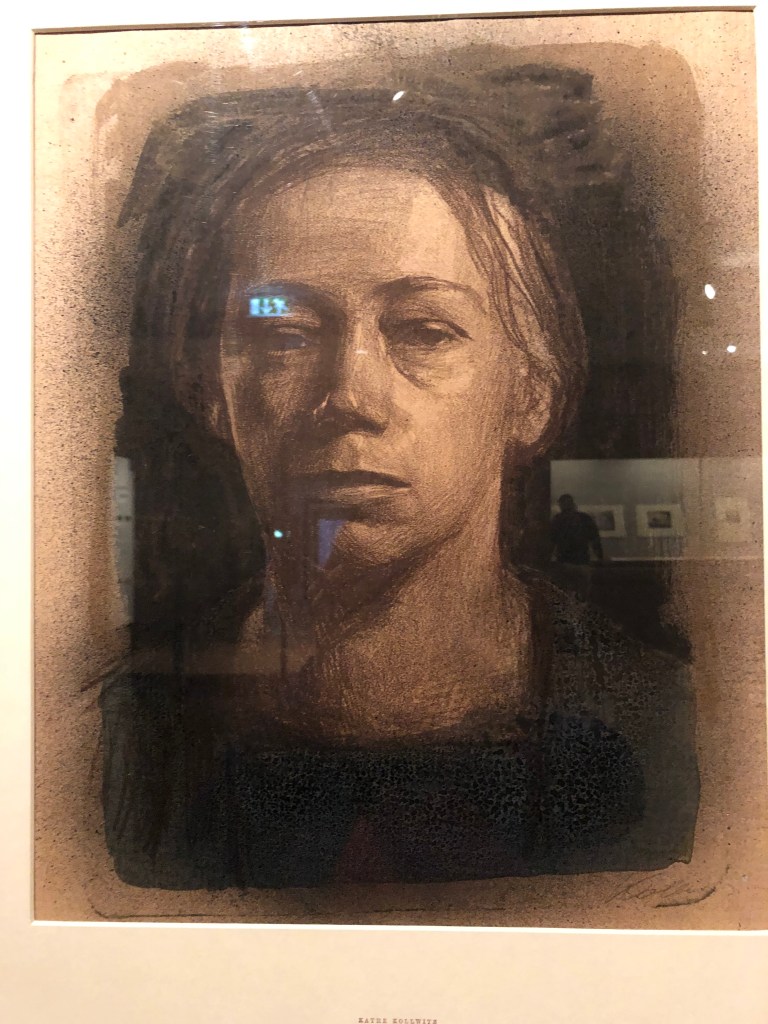
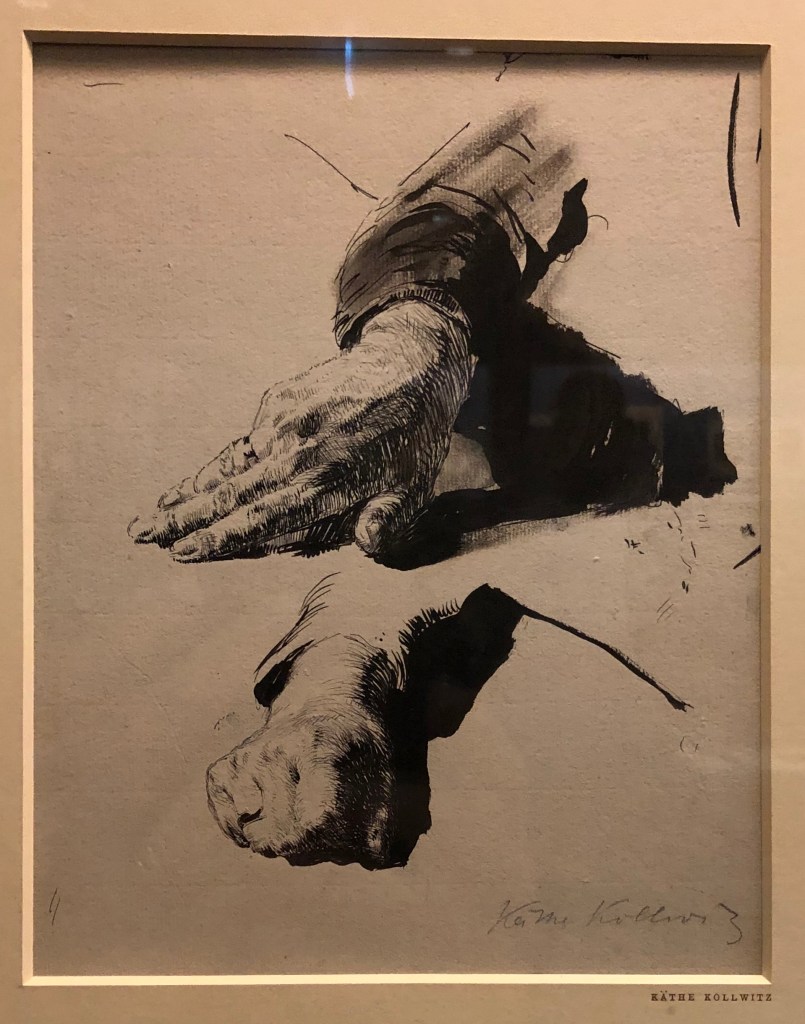
Unexpected and only open for two more days! I hadn’t known that this German artist of prints and etchings. Much of her work on show related to the First World War and was rather harrowing, as was her work on the death of a child (she had lost her son Peter) and, very self-indulgently, I wasn’t feeling in the mood for being harrowed. But there were a few excellent life drawings and portraits which drew my attention – specifically……
Self portrait in full face, 1904, crayon and brush lithograph in three colours overworked with black wash, British Museum
Studies of the artist’s left hand (or her right hand drawn as a mirror reflection) 1891, pen, black ink and wash, British Museum.
British Museum – Pushing Paper
I had already purchased the book accompanying this small exhibition (Seligman, Isabel (ed.)(2019), Pushing Paper, Contemporary drawing from 1970 to now, Thames and Hudson Ltd, London) so had an idea of what to expect, although art is almost invariably much more striking in real life, and that proved to be the case here.
Several pieces one ‘gets the hang of’ better, for example: David Nash’s Wooden Boulder, 1981, black-and-white photograph with graphite, charcoal and gouache on cream card – in the book I hadn’t appreciated the map-like quality of the drawings, which stand out much more in the (much larger) original – maps in drawings always appeal to me for some reason, think I must try them out for myself… My favourite after looking round though was still the image they have chosen for the back cover – Minjung Kim’s Mountain, 2009, ink on hanji paper – a demonstration of how knowledge and experience of materials and supports can make or break a drawing.
Just back from lovely St. Ives in Cornwall where we stayed for a couple of days to celebrate our anniversary.
Weather was mixed, sometimes glorious and sometimes pouring, but got some lovely photos from our hotel which I am considering for foreground-midground-background analysis at some stage.
We had a very arty time; some notes here, and see also those in myA4 and A3 sketchbooks.
Tate St. Ives was showing an exhibition of the work of Otobong Nkanga, called “From where I stand”; it’s been on since 21st Sept and will be there until 5th Jan 2020. I read the gallery’s introductory information leaflet over a cup of coffee upon arrival and decided that this was going to be the sort of rather worthy-yet-preachy sort of thing that I wasn’t going to enjoy – so I was delighted to find that I was absolutely wrong….her basic theme was on the taking of minerals from the ground and people’s consumption of those minerals and the effect thereof, but:
She works in a huge diverse range of media – performance, woven textiles, drawing, photography, video and audio, installation…..
The size and scale of her work – the new wing at Tate St. Ives is pretty big, but her work filled it
Her interest in mapping and representing complex interrelationships and connections between people and the land in map-like diagrams was something which appealed to me (being a bit of a map nerd myself) – her pictures really clearly laid out all aspects of a complicated, and global, issue, and presented them for the viewer to reflect on and draw their own conclusions, rather than attempting to impose the artist’s opinions
Her clean lines and neatness and attention to detail also appealed to my tidy nature
I loved her use of bright clear colours – it was interesting the way she had blobs of all the colours she used in the corner of a picture, almost as if recording her palette for posterity
************
We mountaineered up Stennack Hill in torrential rain to the Leach Pottery– erstwhile home of the potters Bernard Leach and Shoji Hamada, their work being continued today by many visiting and resident potters. Quality and style of pottery as wide as ever; was struck by a display about a local lady potter – shame on me, I was sure I would remember her correct name but can’t quite, it was something like Sarah Davidson (oh dear) – anyway, she says that all her designs are based on her drawings, and that even though sometimes it looks as if a design is coming out of her head, she finds she can invariably trace it back to an earlier drawing in one of her sketchbooks – they had a couple of examples of her sketchbooks there, which looked as if they had been constantly carried around in her pocket, they were very battered and absolutely stuffed with reference material – a role model if ever I saw one.
*************
The Penwith Gallery was having its 70th Anniversary Exhibition (5th October – 2nd November) – an old pilchard factory has been converted into a beautiful space, surprisingly large and well-lit. A wide range of paintings, ceramics and sculpture was there to wander amongst, but I found three contemporary artists, all of differing styles, whose work I liked, and whose styles were very clearly developed:
Sally Spens: she had a set of etchings on display relating to the Venice Biennale, where she had observed corners, gateways and so on – but she had a series of moon jar designs which I loved – the shape of moon jars has always appealed to me, and her oriental designs were very pleasing – she obviously draws carefully with clean lines. On her website,www.sallyspens.com, she says: “Drawing has always been central to my practice, both as a textile designer and as a painter/printmaker. It is important to me that the images are handmade, and originate from my drawings and experience. “
Mary Ann Green: I found a card of hers, a picture called “In the Silent Fold of the Land” – it’s a landscape with not much obviously going on, but she has made it interesting by shading some parts in detail and others not at all, and by introducing little bits of colour into what is overall a black and white drawing. I looked her up and found that she is a member of the St Ives Society of Artists; many of her other pictures include this same folded hillside motif.
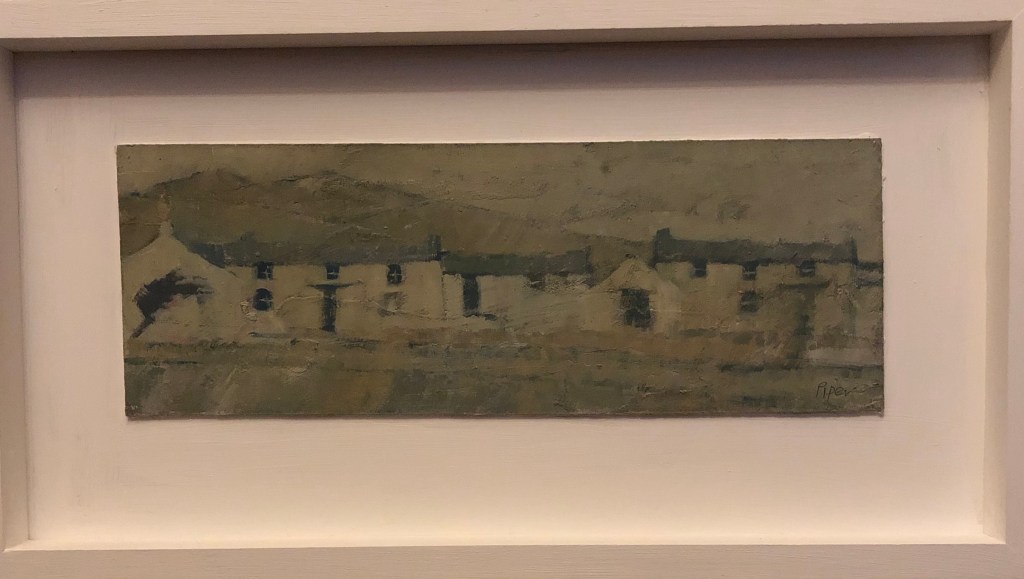
John Piper, a member of the Penwith Society, also has a motif that appears many times in his work – little rows of Cornish cottages, battered by wind and weather, hunkering into the landscape, absolutely characteristic of West Penwith, the far end of Cornwall. He paints in oil and we liked one of his paintings so much that we bought it! This is “Soft Carn”, and is painted in oils on board. First time I’ve ever owned a painting with a sealed provenance before! Its tones are muted but if you look at it carefully you find little patches of bright pinks and blues – and the view is of an area very close to my heart.
We’ve been away to the wilds of the Scottish Highlands.
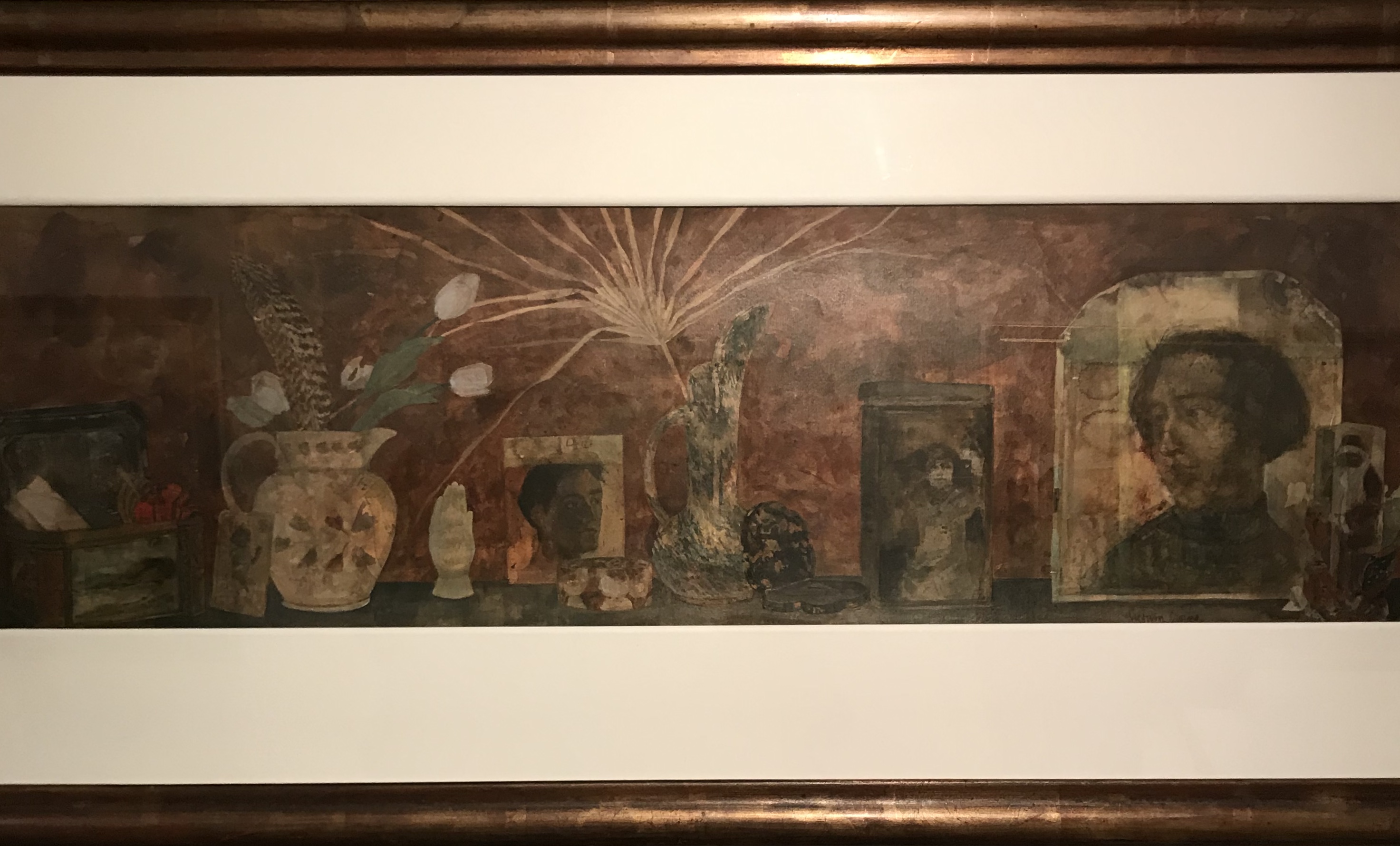
Whilst in the moderate civilisation of Inverness, went to an exhibition of Victoria Crowe’s paintings and drawings at the Inverness Art Gallery. These were mainly portraits, predominantly of older people although not exclusively, and she likes to try and tell the sitter’s history by the choice of pose together with what’s in the background (through the door, out of the window, etc). However, she also had a few still life paintings – these were mainly long and thin, as if painting the contents of someone’s mantlepiece. I found these rather odd as compositions, the objects didn’t seem to relate to each other particularly, they were a bit like horizontal lists. I wondered if, again, she was telling the story of the owner of the objects by using this method. The lighting in the exhibition room was rather poor in that I often had to move to the side to be able to see the painting or drawing because of the reflections of the spotlight, so it was hard to get a decent photo…
I found it quite a static presentation of a series of objects though, it didn’t especially appeal to me, although that may have been at least in part due to frustration at the lighting.
Most of the time spent out in the wilds we spent walking, but I tried to do some still life at our cottage every day. I worked on two particular things:
Some blind contour drawing as explained in Kaupelis, R (1980) Experimental Drawing. Watson Guptill Publications. I found these difficult but fun; what they are really good for is making me draw a line rather than a fidgety set of scrappy lines for an outline, and also for little details – because I am reallylooking at how an object appears, rather than having a glance and then drawing what I think.
Some thumbnail sketches for various compositions of found sets of objects – see Still Life Sketchbook. Because I didn’t particularly like the way Victoria Crowe had composed her “long, thin” horizontal pictures, I tried to make mine different by enlarging and cropping, rather than lining things up in the way I had found too static.
I have just been reading Drawing on the Right Side of the Brain (see blog post), which puts forward the proposition that, by making art, you reveal yourself.
This book, Art as Therapy, looks from the perspective of the viewer and what they might expect to get from art. The writers make the point that, hitherto, there was an agenda for the making of art, set by religions and states, which artists would draw upon for subject matter, and then interpret in their own way; thus the “messages” of the agenda-setting organisations were propagated to the masses. Nowadays, however, the idea of an agenda “dictated” by organisations smacks of propaganda, which is generally regarded as something untrustworthy and to be avoided.
However, the writers suggest that the general principle of a universal agenda of inspiration for artists to draw upon is not a bad thing, and they go on to say that this agenda could be driven by the basic human needs of the viewers.
“Artworks would look to commemorate, give hope, echo and dignify suffering, rebalance and guide, assist self-knowledge and communication, expand horizons and inspire appreciation.”
“We should dare to conceive of art as more than just the fruits of the irregular imaginations of artists. We should channel and co-opt artworks to the direct task of helping us achieve self-knowledge, remember forgiveness, and love – and to remain sensitive to the pains suffered by our ever-troubled species and its urgently imperilled planet……..If we want art to be more powerful, and of more consequence in our individual and collective lives, we should be ready to embrace this unfamiliar strategy.”
Stirring stuff – a call to arms. I have to say that some of the practicalities which they go on to argue, e.g. about the commissioning and showing of art, sound rather far-fetched and tortuous. But as an artist, how do I feel about the general proposition?
It is undeniably true that sometimes, when looking at pictures officially designated as “great”, one does find oneself underwhelmed – often one can appreciate the high levels of skill and technical expertise, whilst not really connecting with what the artist was trying to put over – and maybe that’s because they weren’t trying to put over anything more than a doctrine or teaching which they didn’t necessary choose or agree with.
But as an artist (albeit not great and only just starting out), would I want always to be having to put over a message? Sometimes the satisfaction of representing an object well (i.e. believably) is enough for me as artist. But what about my viewer? – what do they get from looking at my object?
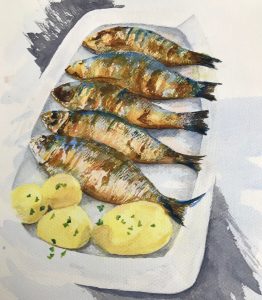
I am sitting in my garden room, where two pictures hang which I have painted (they have been chosen to put up by my husband). One is a picture of leaves in a jug and some garden twine. My husband finds it a pleasant picture to look at, and other visitors have admired it. What do they get from it? – it evokes a gentle gardening scene, and we all know that gardening is good for you, both health-wise and mood-wise – the act of gardening is an expression of hope, a looking forward to the time when one’s effort will be rewarded by beautiful blooms or a trug-full of runner beans. I think this qualifies as the authors’ second suggested purpose of art (see pg.65) – “A purveyor of hope.” The other picture is of a dish of sardines – actually my husband’s lunch during a much-enjoyed holiday in Portugal, quickly snapped on my phone and then rendered in watercolours once we got home. And look, this qualifies as the first of the authors’ stated purposes: “A corrective of bad memory….a mechanism to keep precious things in good condition.”
So, maybe the artist’s need to express a particular thing in a particular way, and the viewer’s need for the artwork to fulfil a specific therapeutic need, are compatible? One can choose to keep for oneself the things you paint/draw/make purely for yourself, and put “out there” the things you think other people might derive some benefit from.
This is a fascinating book, which develops at length the proposition which I have often see, that anyone can draw if only they can learn to see.
She takes the view that art is a non-verbal and revealing language: I particularly found this comment very interesting…
“The object of drawing is not only to show what you are trying to portray, but also to show you. Paradoxically, the more clearly you can perceive and draw what you see in the external world, the more clearly the viewer can see you, and the more you can know about yourself. Thus, drawing becomes a metaphor for the artist…..As your skills in seeing increase, your ability to draw what you see will increase, and you will observe your style forming. Guard it, nurture it, cherish it, for your style expresses you.”
This is a heady and somewhat unsettling suggestion. I am just looking at my most recent drawing, done this afternoon, and wonder what this says about me?
Not a great one for navel-gazing, but I do have to say that I feel I have been quite freed up by the requirements of the first part of the course to work on big pieces of paper – it has been very liberating and has encouraged me to make big, bold marks; not always accurately, but this hasn’t worried me and I have been confident to overdraw them and make corrections without a feeling of failure.
§§§§§§
“New evidence found by Jerry Levy in her doctoral studies showed that the mode of processing used by the right brain is rapid, complex, whole pattern, spatial and perceptual – processing that is not only different from but comparable in complexity to the left brain’s verbal, analytic mode.”
She goes on to quote from J.E. Bogen’s “Some Educational Aspects of Hemisphere Specialisation”: “Parallel Ways of Knowing:
Intellect Intuition
Convergent. Divergent
Digital Analytic
Secondary Primary
Abstract. Concrete
Directed. Free
Propositional. Imaginative
Analytic. Holistic
Lineal. Non-lineal
Rational. Intuitive
Sequential. Multiple
Objective. Subjective
Successive. Simultaneous”
I have to say that, until signing up for this course, I would have identified myself very much with the verbal, analytic left brain camp – but think I have made a good start on letting the “whole pattern, spatial and perceptual” side have a bit of a go – it feels rather daring and rebellious at the moment, but I’m hoping I can keep it going, free myself up and learn to express myself clearly in a mode other than verbal.
I found the book, Gombrich, E.H. (2014), Shadows; The Depiction of Cast Shadows in Western Art. Yale University Press, very helpful in thinking about the placement and intensity of shadows. In particular, I liked a pair of very old quotations which made real sense to me:
“Shadow: The darkness created by opaque bodies on the opposite side of the illuminated part.”
“Shadow: In the language of painters it is generally understood to refer to the more or less dark colour which serves in painting to give relief to the representation by gradually becoming lighter. It is divided in three degrees called shadow, half-shadow and cast shadow. By shadow (ombra)is meant that which a body creates on itself, as for instance a sphere that has light on one part and gradually becomes half light and half dark, and that dark part is described as shadow (penumbra). Half-shadow (mezz’ombra)is called that area that is between light and the shadow through which one passes to the other, as we have said, gradually diminishing little by little according to the roundness of the object. Cast shadow(sbattimento)is the shadow that is caused on the ground or elsewhere by the depicted object….”
After Filippo Baldinucci, Vocabularia Toscano dell’Arte del Disegno, Florence 1681.
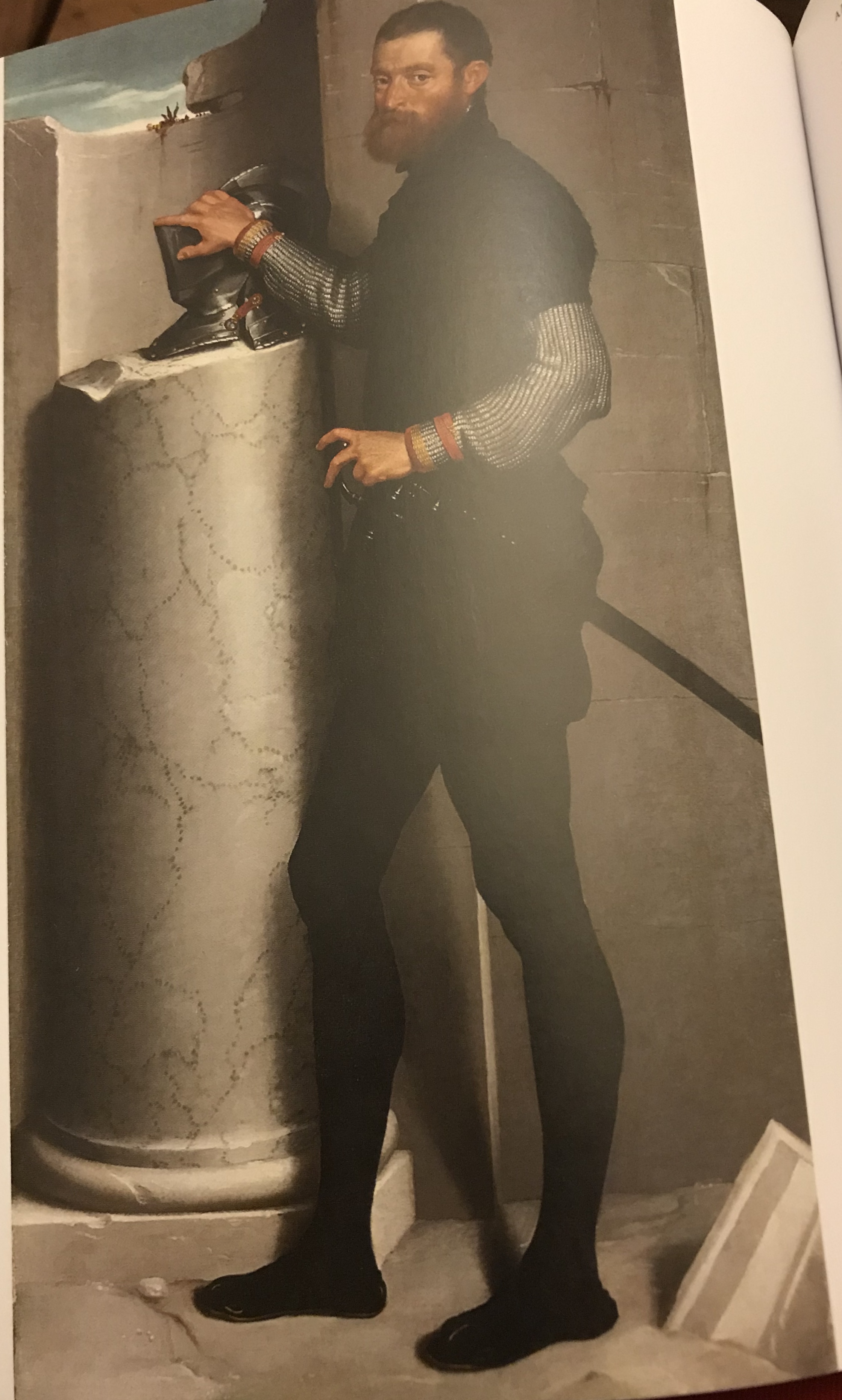
I know this is frightfully wordy and technical, but I hadn’t really thought before about the shape of an object causing its own shadow on itself, and then also being subject to the shadows cast upon it by other things. I have been consciously trying to think of this as “modelling shadow” and “cast shadow” when I have been sketching – as exemplified by the painting by Giovanni Battista Moroni – Portrait of a Gentleman with his Helmet on a Column Shaft, 1555-6.
I shall continue to keep looking really carefully and drawing what I see, but it’s useful to have something which helps you to understand and analyse when you get to that part of a drawing where you have to look over and over to try and make sense of what you’re seeing.
This is a great book, I read it in one sitting. It’ll be one to go back to when I’ve lost my way and can’t see the wood for the trees! I found the first few chapters particularly relevant to me, as it spelled out….well, I quote…”Your job is to collect good ideas. The more good ideas you collect, the more you can choose from to be influenced by.”
I liked the idea of finding out about an artist who interests me…and that leading me on to other artists, till I become part of a “family tree” of artists…I have already found this working out a bit with my research into Odilon Redon, in particular his use of tone to create atmosphere – am writing another blog post on this as we speak!




 Sue J's blog