I was really glad that my tutor saw an improvement in my life and portrait drawing
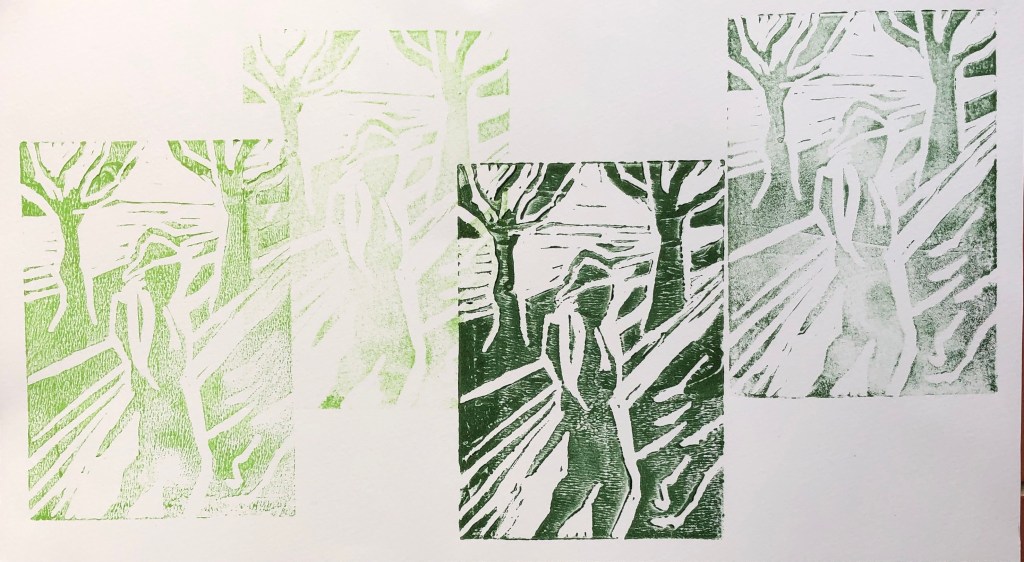
I feel I fell into a “line of enquiry” early on in the section which led to a particular set of outcomes; I am pleased with these outcomes, which filled the brief in an interesting way, but I think that, by pursuing this line, I missed out on an alternative set of monoprinting experiences. I found all the resources which my tutor supplied with my feedback both interesting and informative. As a result I have bought some more simple equipment as suggested and have been playing around some more with printing; I have made some lino prints and experimented, using acrylics, with ghost printing and adding more liquid and paint…
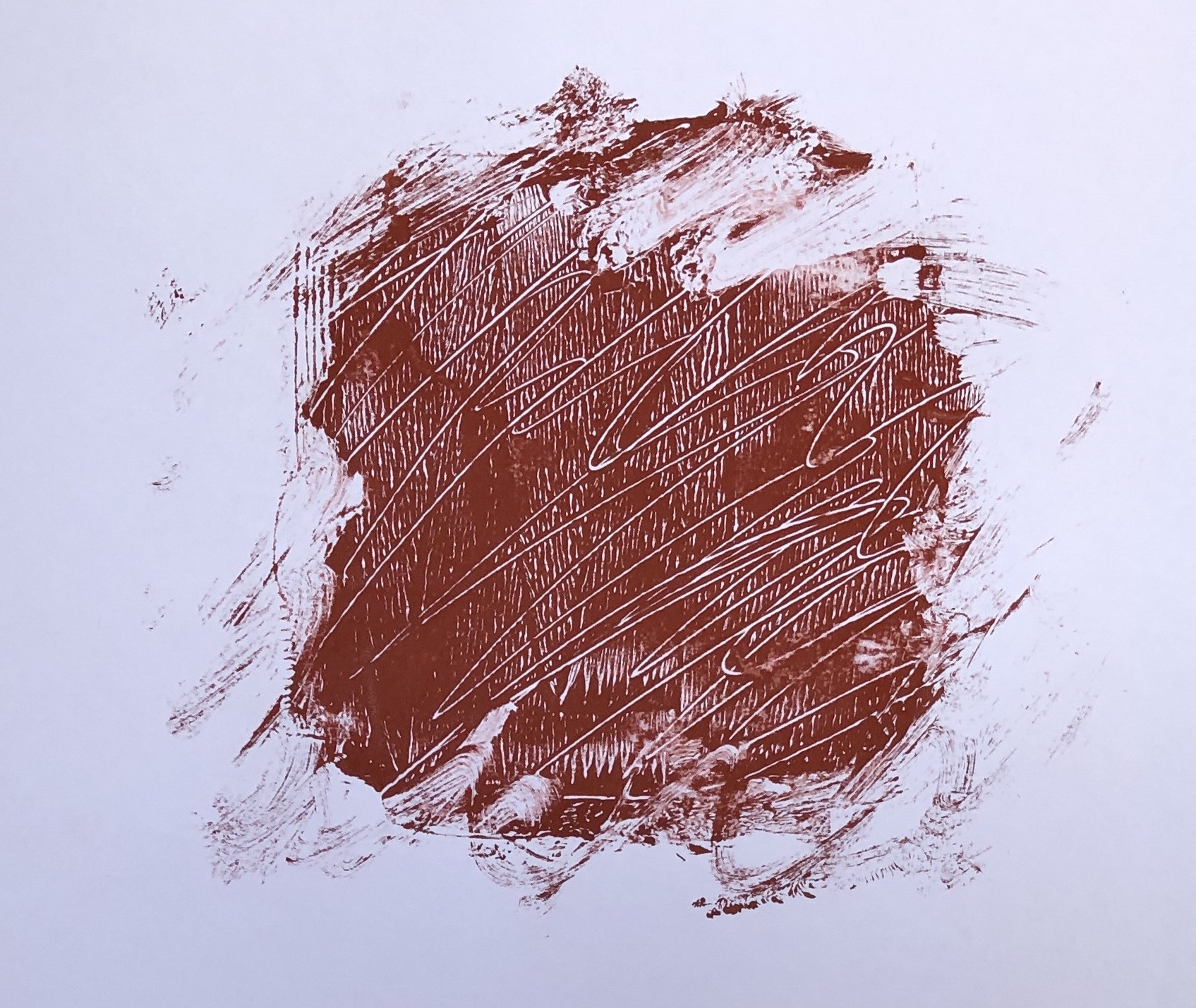
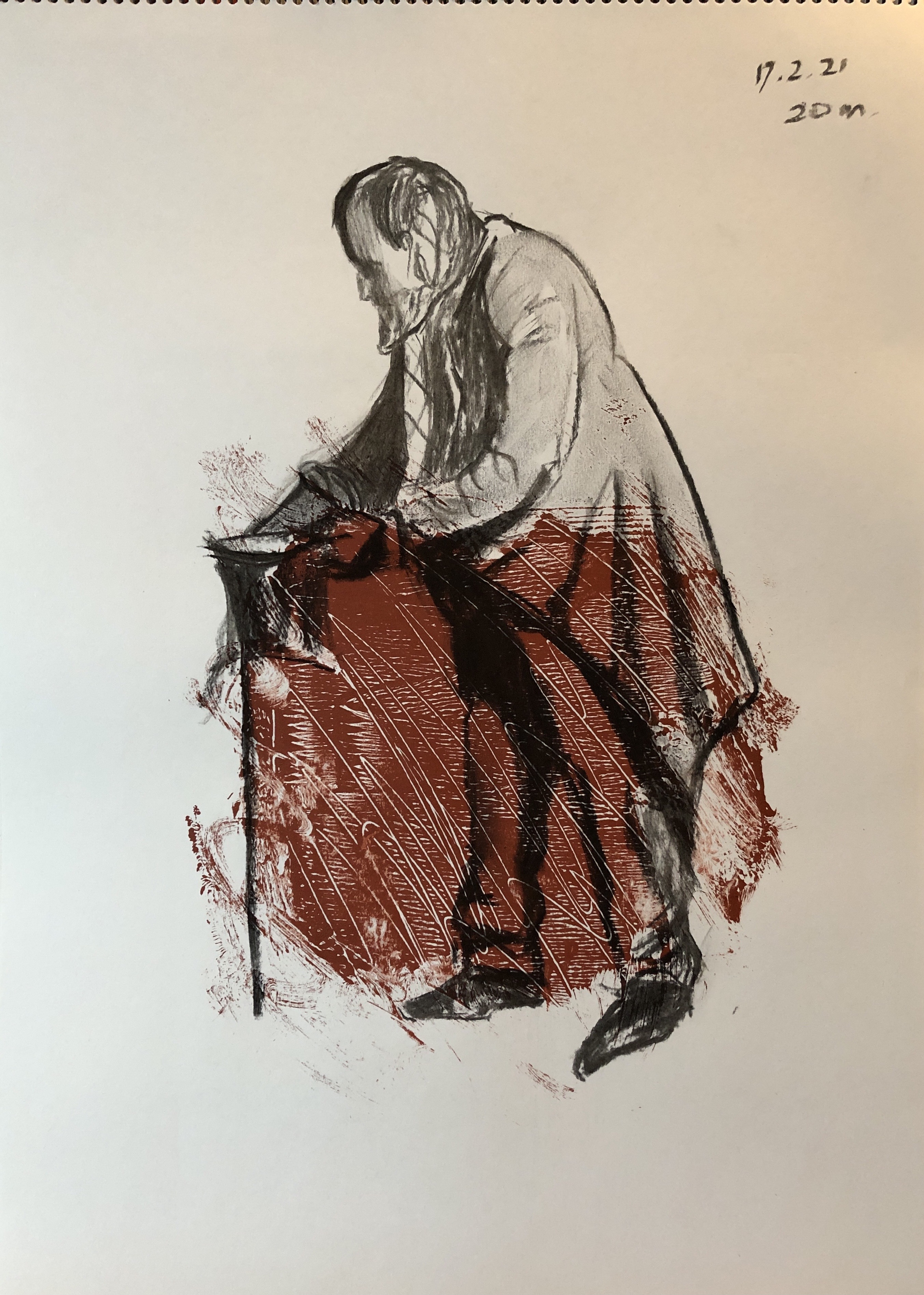
…and I have made loose abstract monoprints with the remnants of my rolled-out plate which I have then used as a ground for life drawing:
My tutor suggests that I could have made greater investment in colour. I felt anyway that my colour knowledge is not a strength, and have enrolled on a short course on colour with the St. Ives School of Painting, led by Jill Eisele (see separate blog post on “Hearts and Minds”).
NOW WHAT?
I feel I want to continue to explore printing, and as a result of my tutor’s interesting comment about taking it back into painting, I should like to try to do exactly that and incorporate some printing into my tondo paintings.
I need to practise using what I am learning in the ‘Hearts and Minds” course about colour.
I need to look ahead to Part 5 and firm up on my essay ideas.
As I have worked through this section, I have been particularly influenced by the work of various artists, in particular Marlene Dumas, Paul Wright, Maggi Hambling, Annie Kevans and Milton Avery (see earlier blog posts). As a result, I have developed a method of monoprinting which:
Is ethereal in the sense that sections of the print fade at the edges and I have only chosen to paint into certain defined areas
Is calm and meditative
Has colours which are “harmonious” (see blog post on Milton Avery)
Picks out key areas of the face to make a clear and believable portrait (especially eyes, mouth, and bone structure)
I did acquire the suggested additional reading, “Reappraising Drawing Past and Present, by Michael Craig Martin (1995, London: Hayward Gallery)”; I read the essay at the beginning of this section and was frankly a bit mystified as to why we were being asked to look at it at this point. However, I now totally get it – it is the characteristic features of monoprinting in oil which have allowed me to develop this style, where it is OK to have parts which look hazy and underprinted.
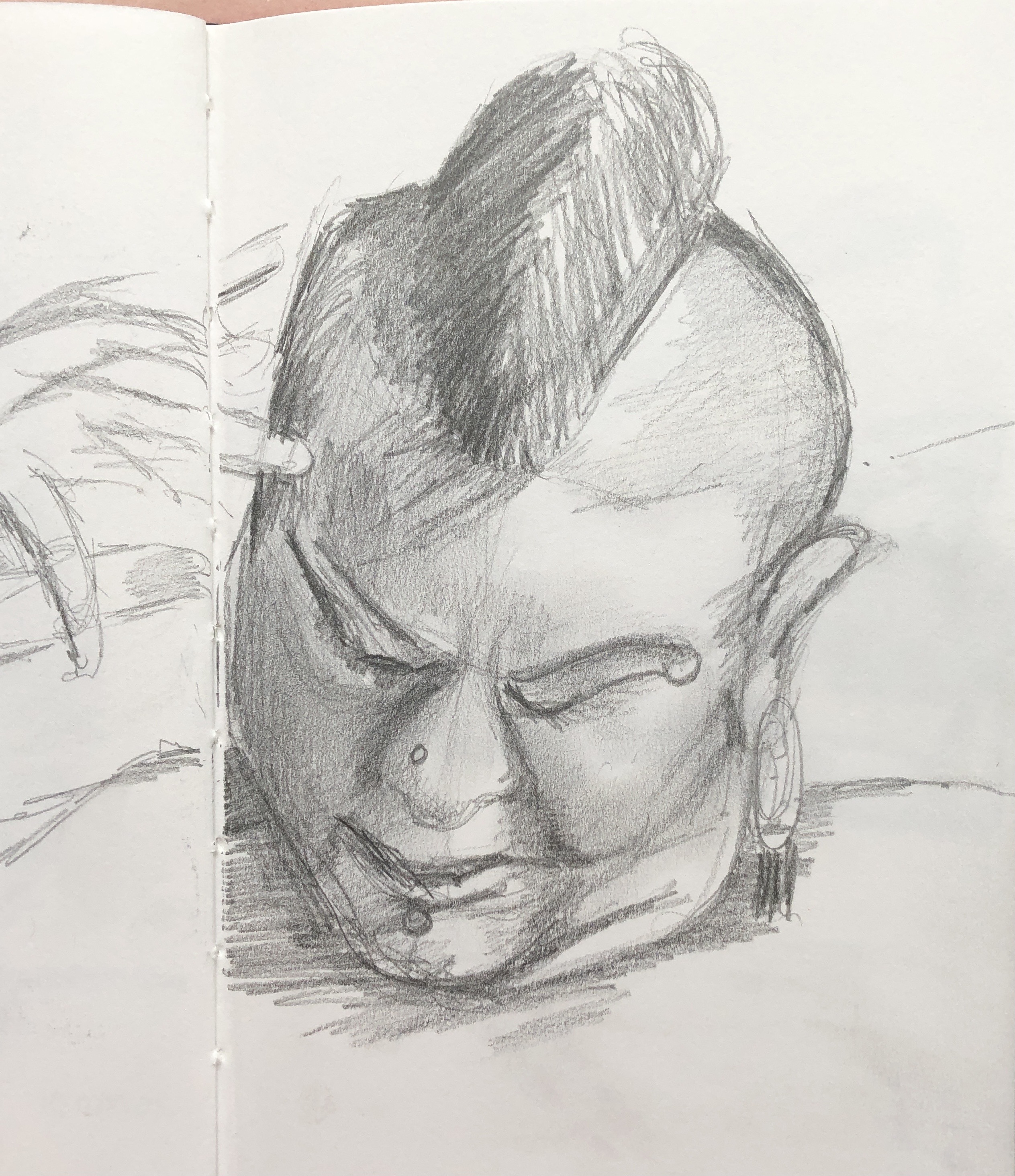
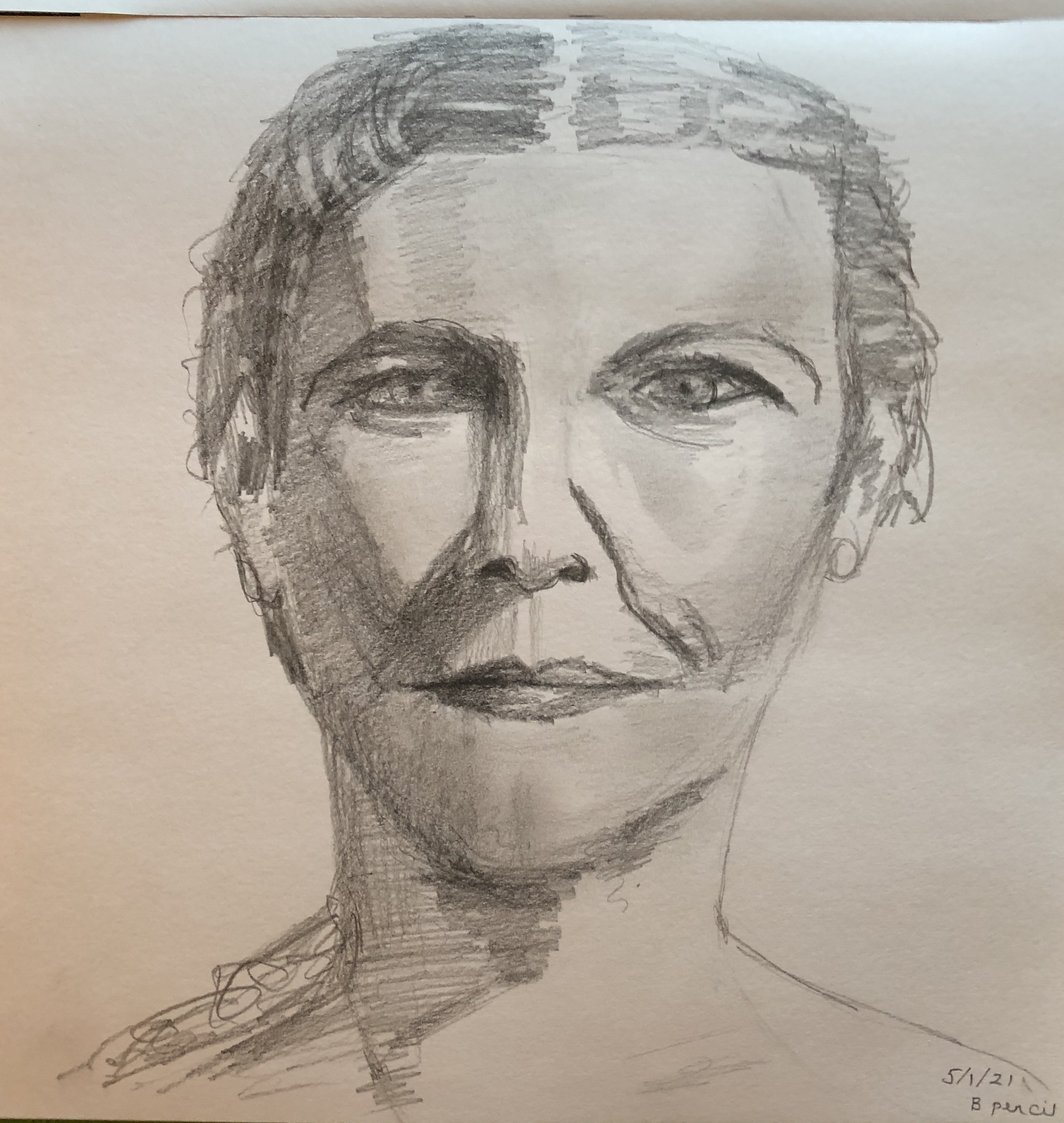
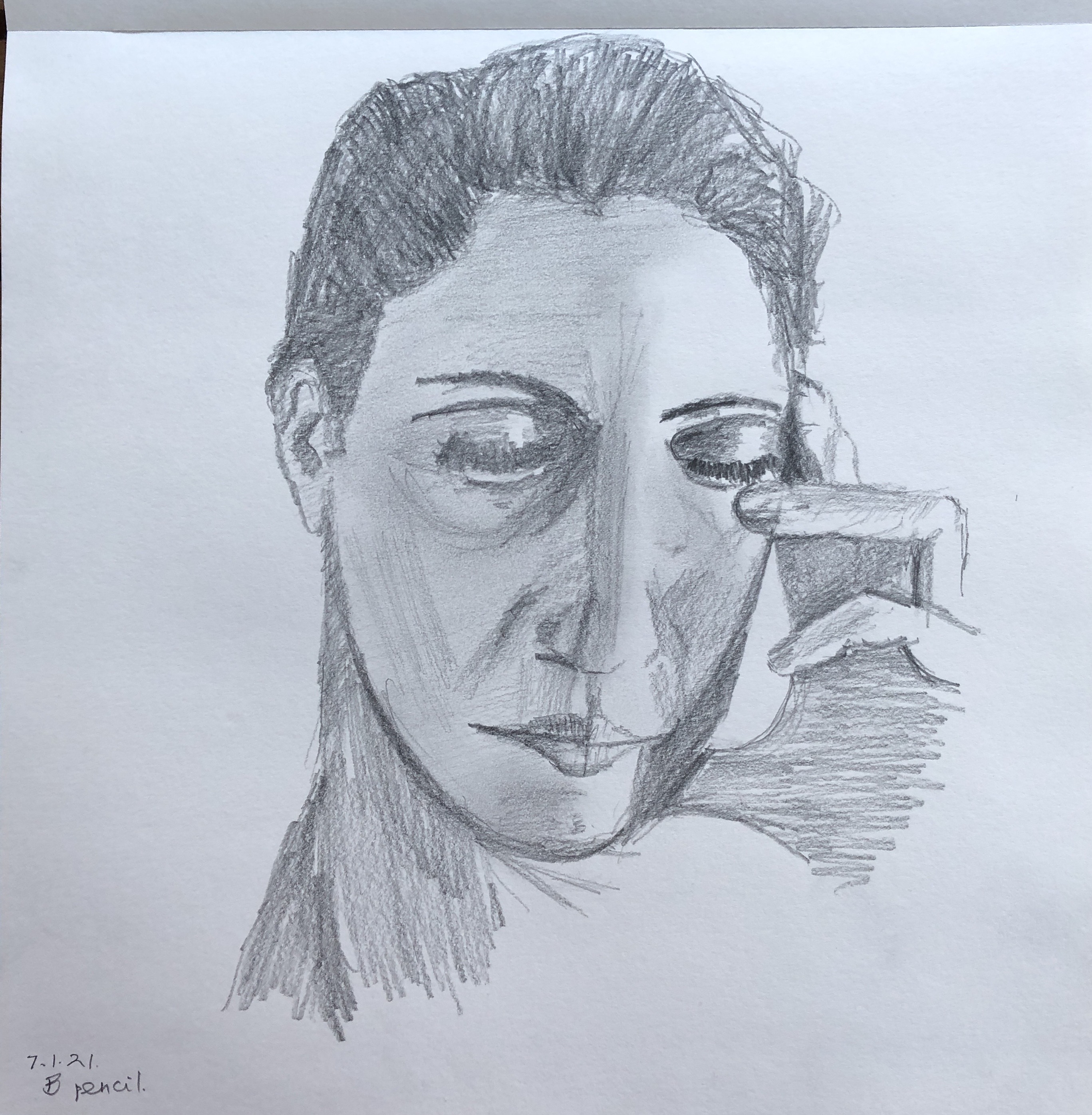
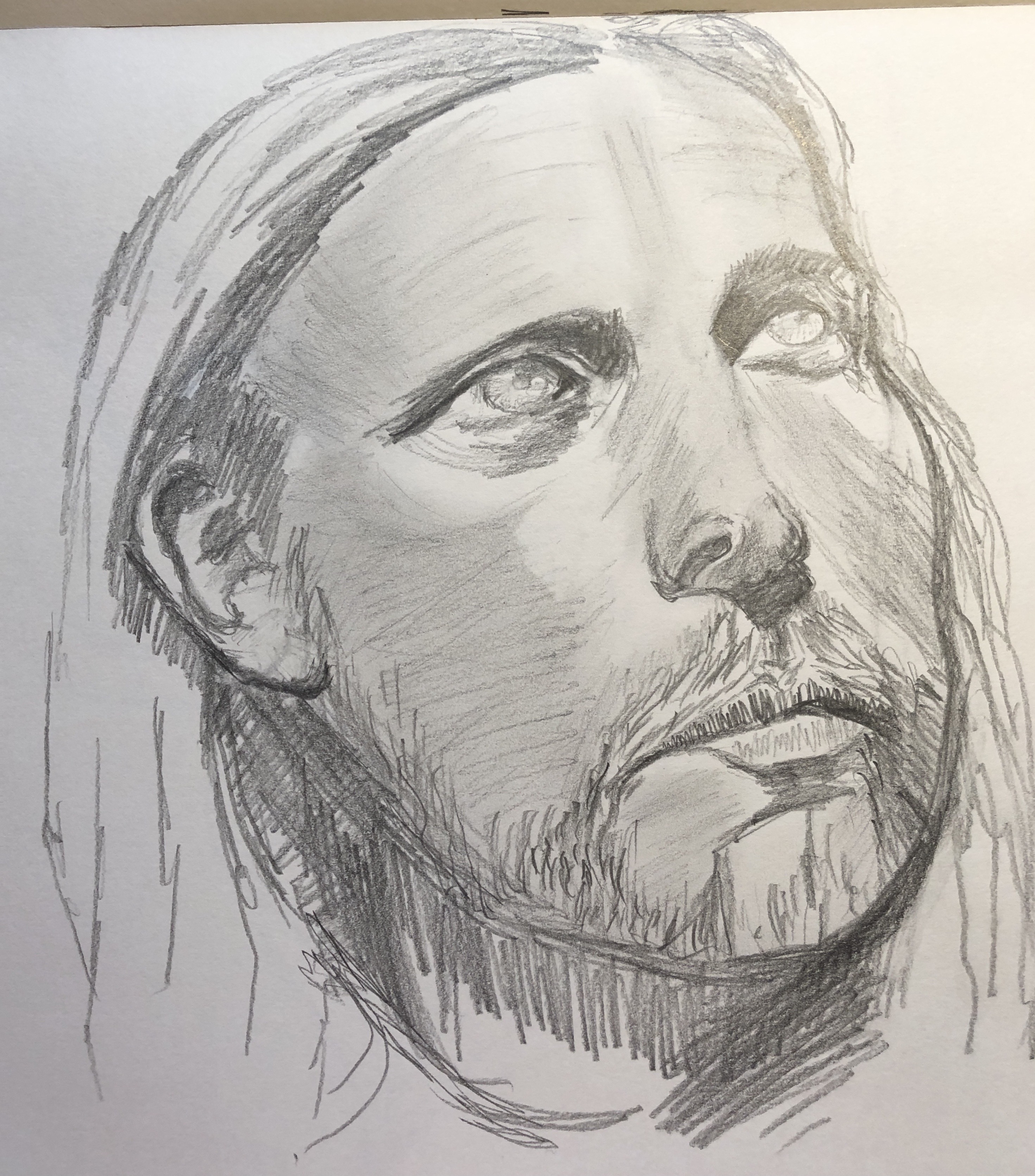
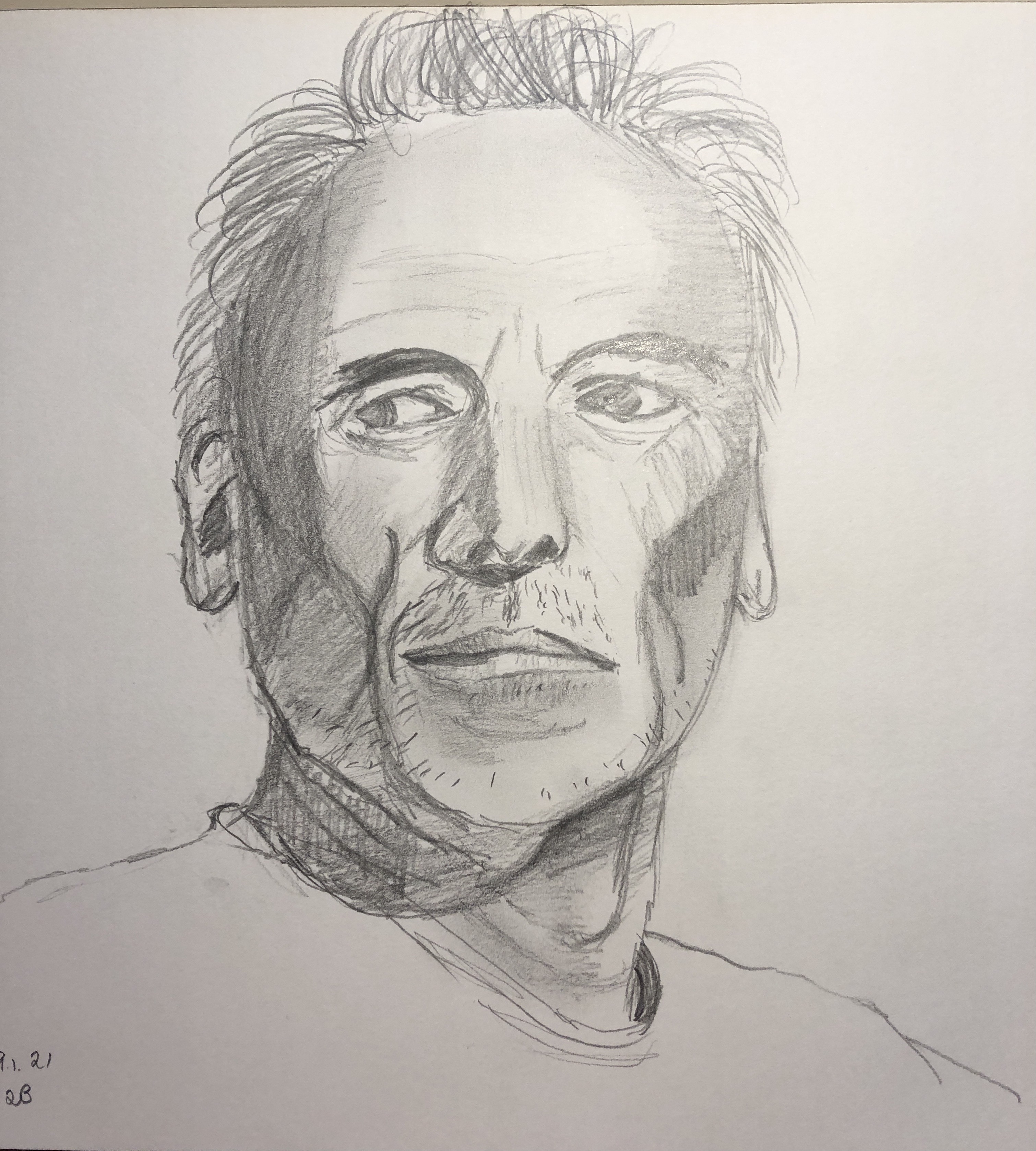
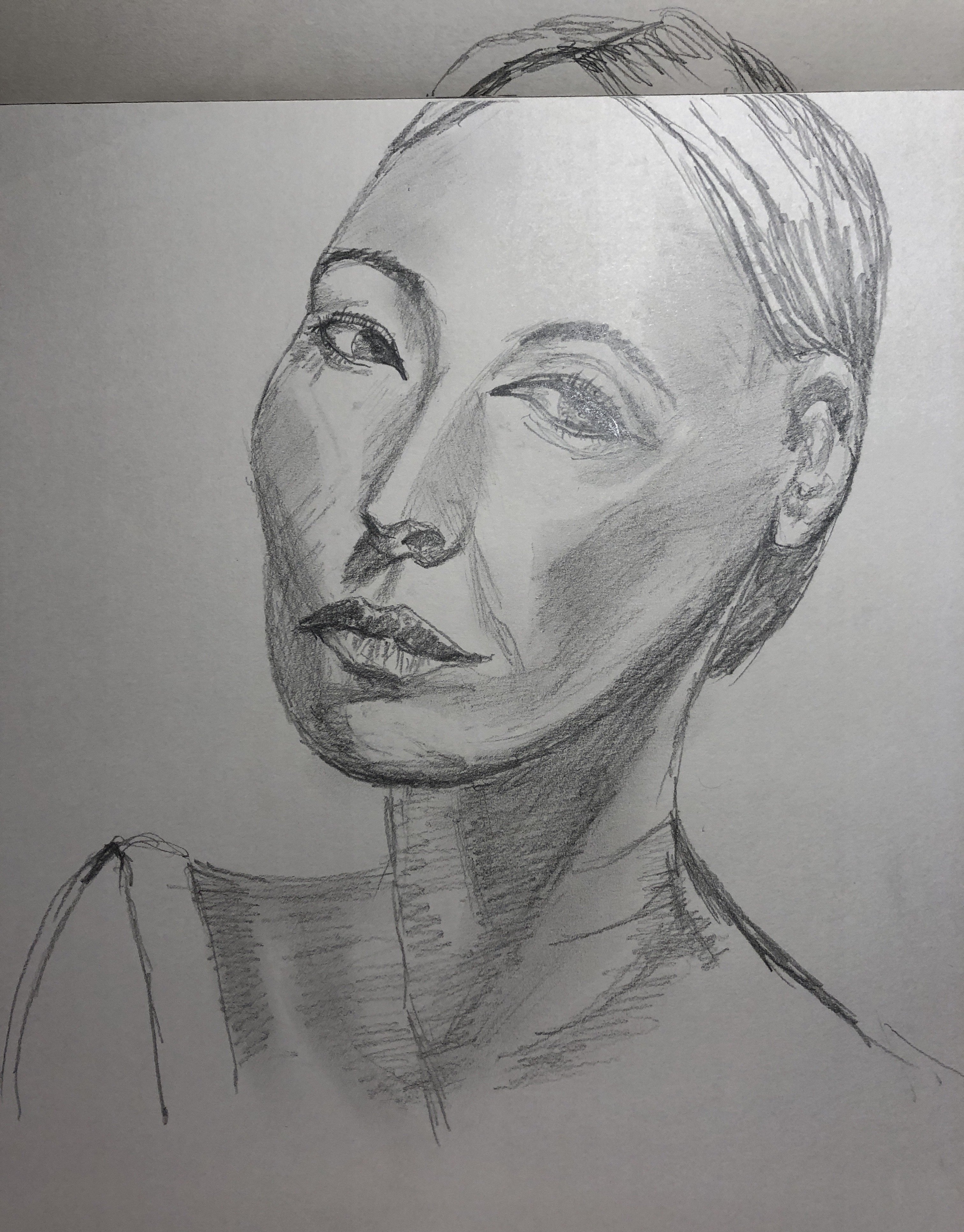
I have also been working on building my confidence with portraiture, using the resources available from Raw Umber Studios, and have been making portrait and full body drawings in 2B pencil, worked into with a putty rubber. I decided to use some of these portraits as my “base” images for the printing, rather than borrowing images from books or magazines, so that the work is completely my own.
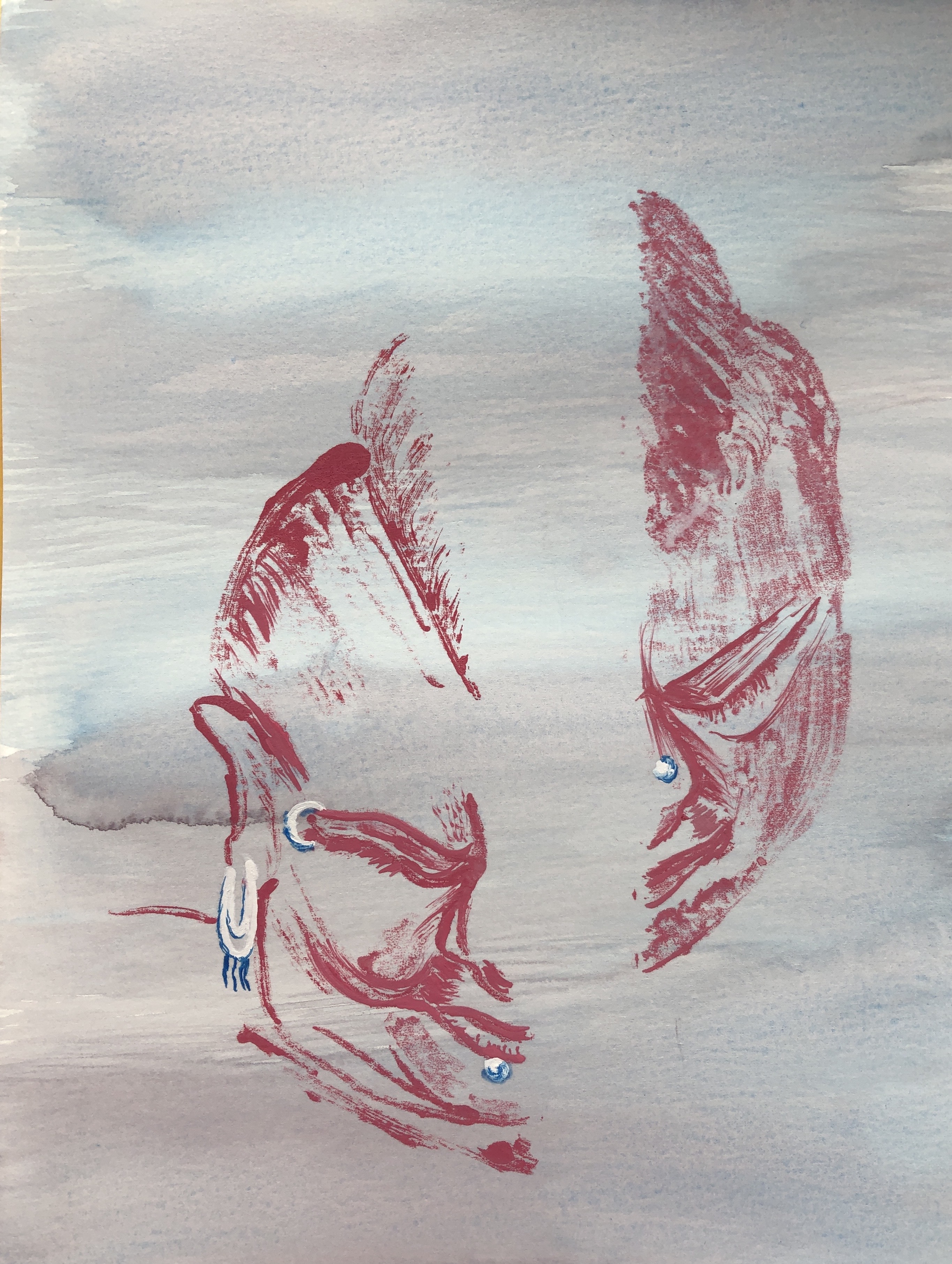
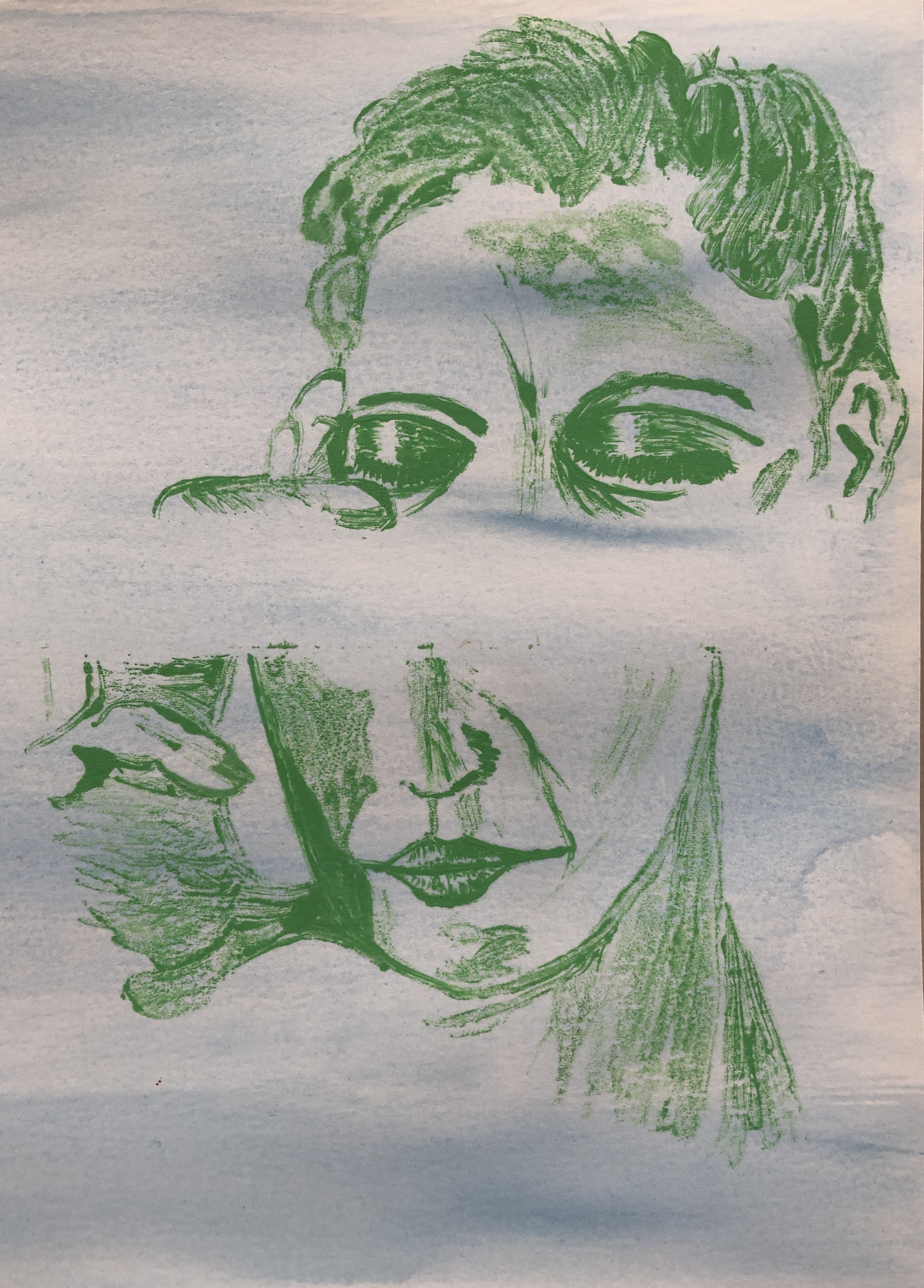
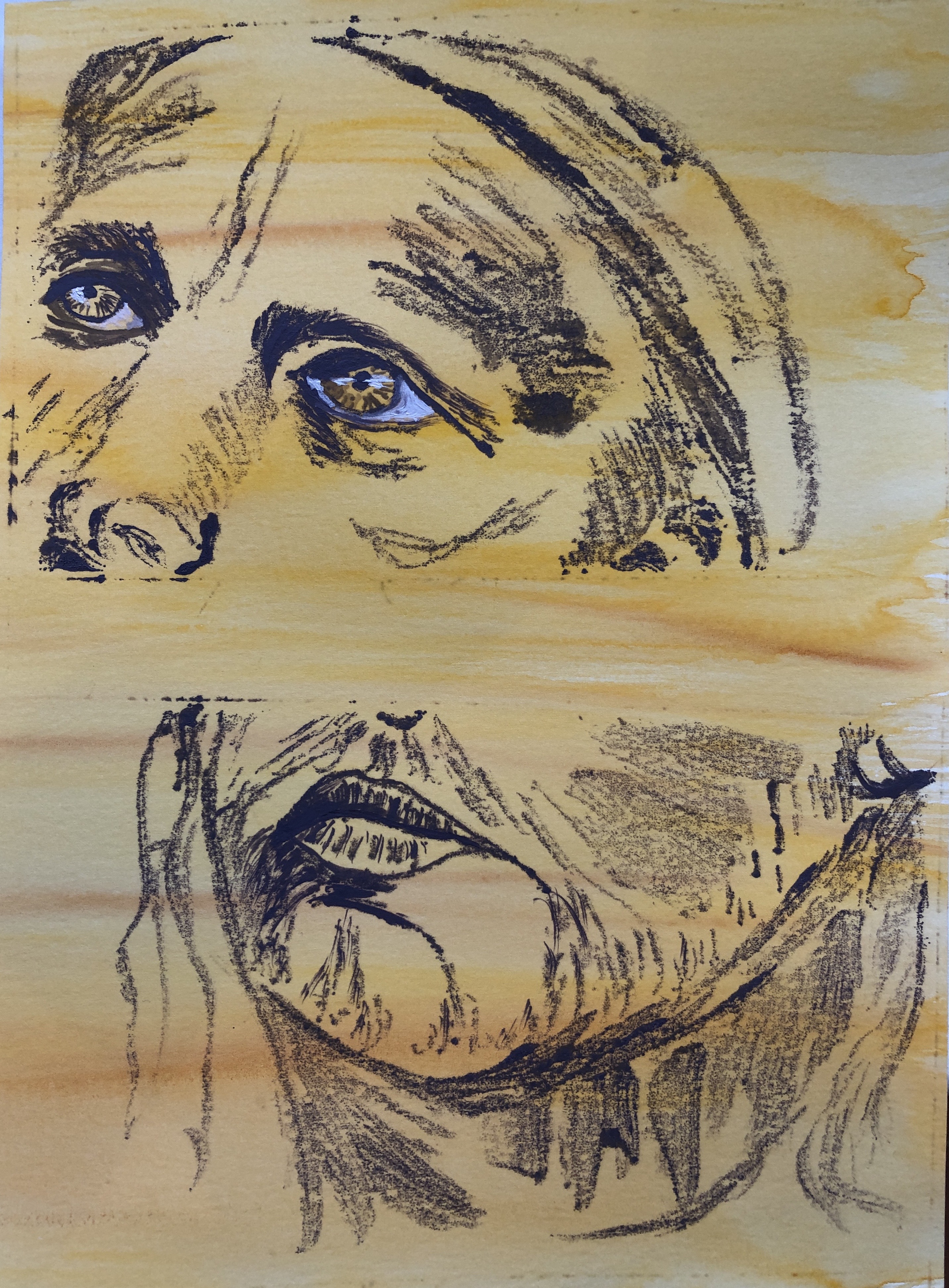
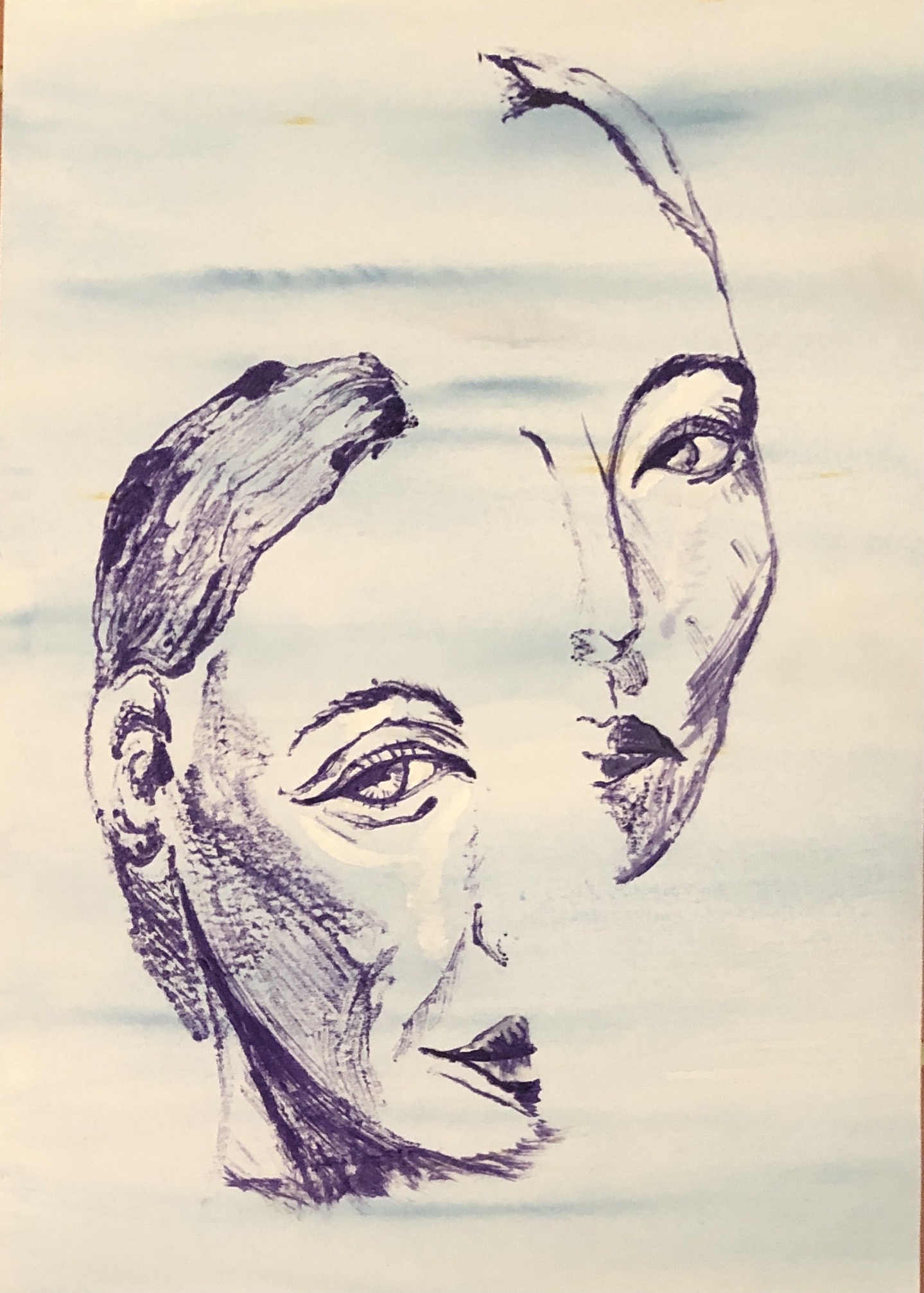
I had also wandered into a method of printing a face in two halves. I found it fun and wanted to continue with it, but took time out to think what the point of these images was. I try to keep COVID stress out of my work, as my art is my refuge from COVID, but I have heard and read from so many people that they find it difficult at the moment to concentrate on tasks and their mind is all over the place, that I think my images might convey a sense of this “wandering mind”. Also to me, who is a bit of a daydreamer at the best of times, the images feel as if they depict one half of me trying to focus on something, while the other half of my brain has drifted off out of the window into the wide blue yonder. I was going to entitle my assignment pieces “Daydreaming” – but my husband very wisely said that it would be better to leave the viewer to put their own interpretation on the pictures, and on reflection I think he is perfectly right.
SO WHAT?
After experimenting with supports and backgrounds (see earlier blog posts) I decided to work on HP watercolour paper. I wanted some colour in my background (to represent my “wide blue yonder”), but experience had taught me that this shouldn’t be so busy that it distracts from the print. Hence I covered some sheets with watercolour washes:
Cerulean blue with streaks of Prussian blue
Mix of cerulean and Prussian blues with some areas of perylene maroon
Indian yellow with streaks of burnt sienna
I prepared three A3 sheets and then cut them in half, so each print is just under A4 (taking into account the edge strips where I had attached the paper to the board for stretching).
Image 1
This was printed onto the blue/maroon mixture, and I chose crimson as the printing colour, with the jewelry picked out in cerulean and white once the print had been made. I used a feather to drag the shadow over the face whilst still on the plate, and drew in some of the fine lines on the plate for the hair.
Image 2
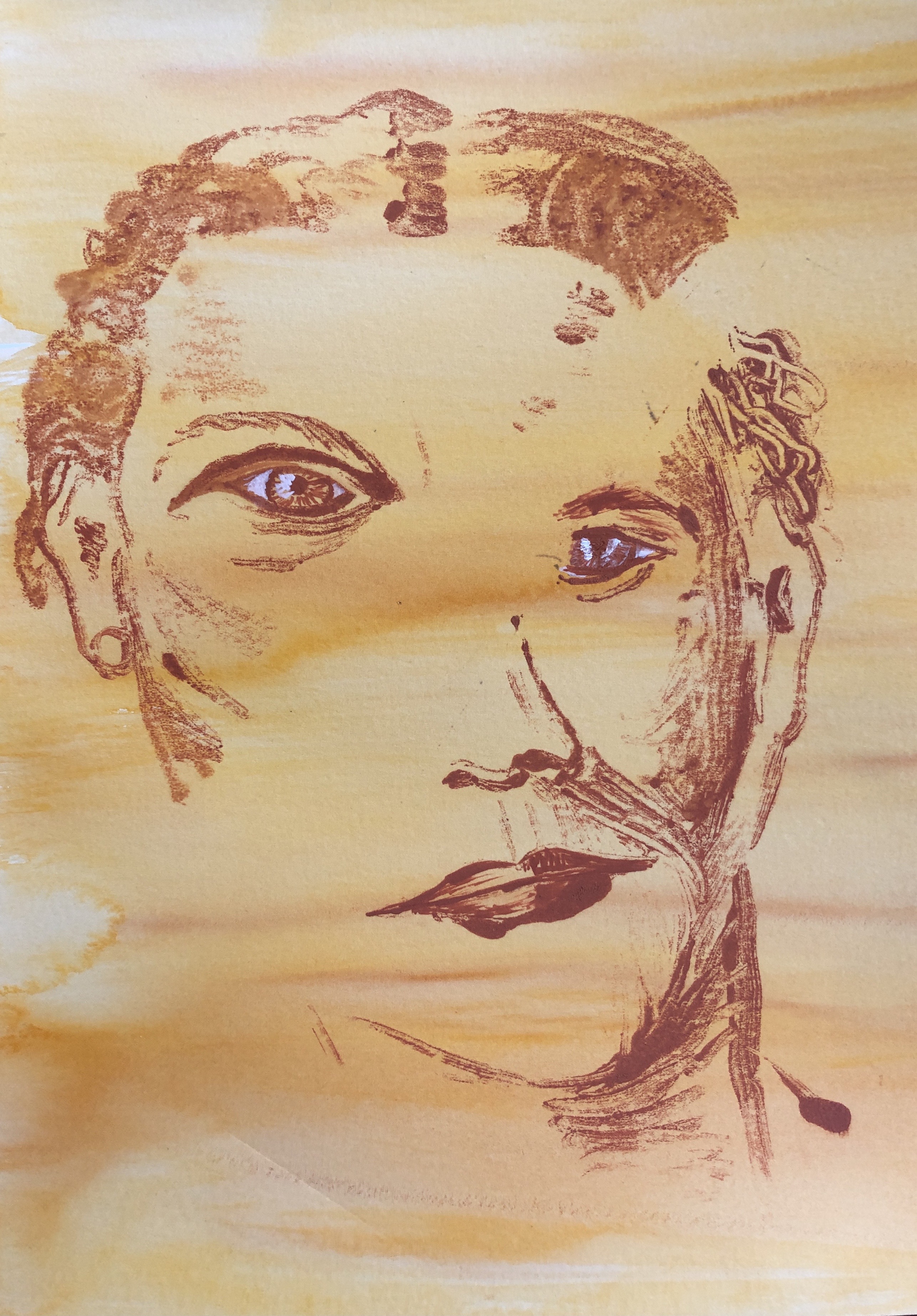
This was printed on the yellow/sienna paper. I wanted a strong deep orange to print with, which I mixed from yellow ochre and cadmium red with a touch of white. I made the texture of the hair with a cotton bud before printing, then worked into the eyes and mouth on the paper to define them.
Image 3
This was printed onto the cerulean blue; this is quite a green-ish blue and I was looking for colours to harmonise, so I chose emerald green with just a dash of white for the print. Again, I added texture to the hair with a bud whilst still on the plate. To further define the image once printed, I worked into the eyes and mouth, and just defined the shape of the strong shadow on the “hand” side.
Image 4
This was printed on the yellow/sienna paper. I thought I would experiment with a complementary colour for the print, so mixed up a purple using cerulean blue and cadmium red with a touch of white. Once printed, I worked into the eyes and mouth. My glass plate has tape around the edges and I found the paint was getting trapped along one edge in particular and was showing up on the print, so had to give this a good clean before moving onto the next print.
Image 5
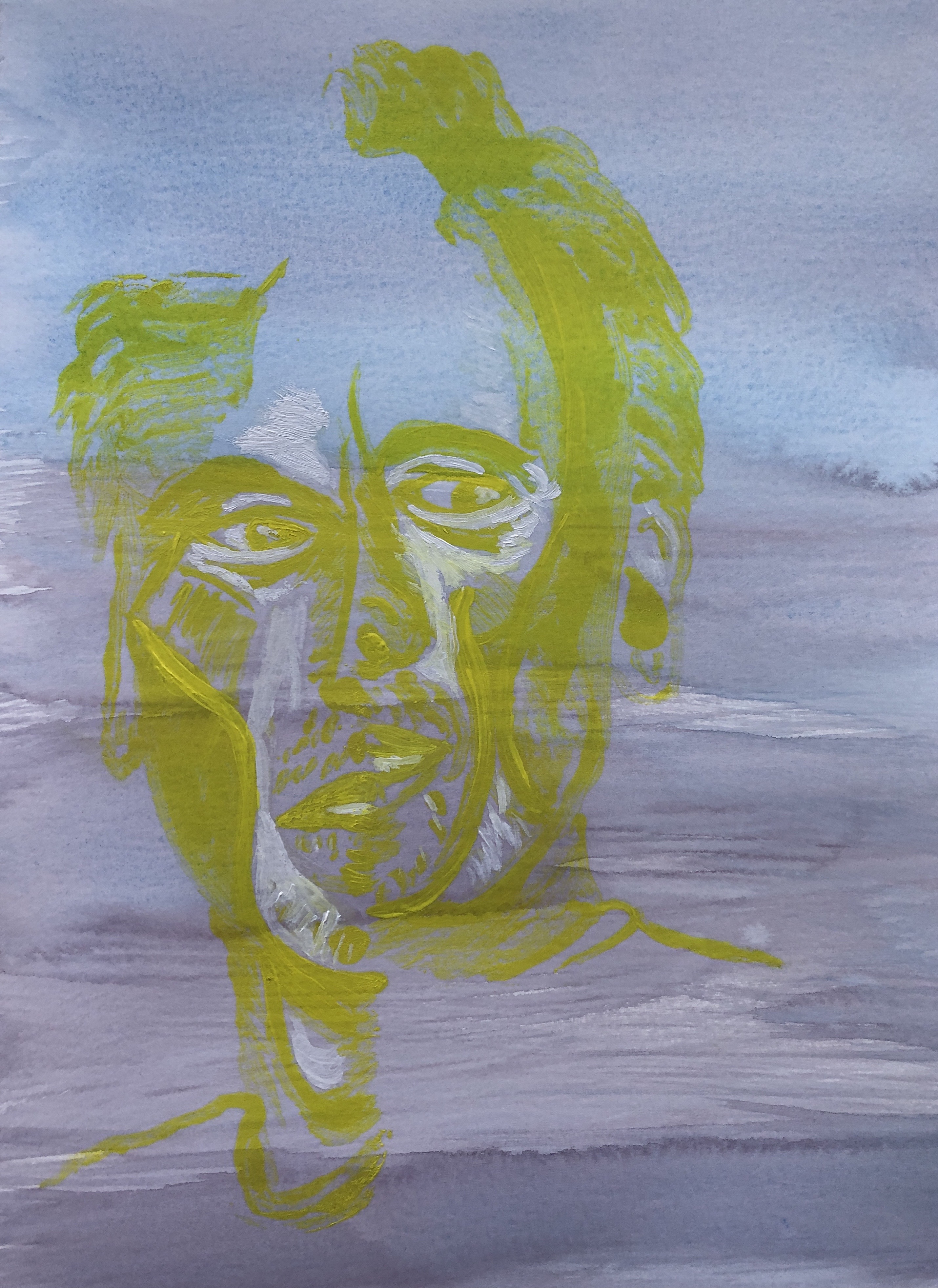
This one turned out rather differently. It was printed onto the blue/maroon, and I had quite liked the way Image 4 with its complementary colours turned out, so tried printing this one using lemon yellow. I had also been trying to vary the position of the split between the two images and, as they had all been a fairly wide split so far, I thought I’d try something a bit closer, but just one higher and one lower. Two things happened – first, the yellow didn’t show up as strongly as I had hoped in the print so I had to paint into the eyes and those really strong contour lines of the face with thick yellow and also some white to make them stand out, and it makes for a rather ghostly effect . Also, the second print ended up very close to the first, just slightly higher, so the face is misaligned rather than completely split apart, and I suspect the viewer will have to look quite hard to work out what’s going on.
Image 6
This picture was printed on the cerulean blue paper (which looks a little washed out in this photo but is the same blue as Image 3 above). I thought this time I would try a dark blue on light blue, so I picked ultramarine violet for the printing paint. Once printed, I painted into the mouth and also the eyes, particularly clarifying those amazingly arched eyebrows.
Now I had six monoprints, from which I needed to make a selection of three. I was pleased with the way all of them had come out for differing reasons and so, finding the choice difficult, asked my husband, two adult children and granddaughter (11) for their favourite three. Interestingly, they all chose two the same (Image 1 and Image 6), with one vote each for the other four. So near and yet so far…
I had looked at the ways the artists suggested in the course text laid out their exhibition of collections of portraits. Luc Tuymans, Annie Kevans and Chantal Joffe have all gone for simple side-by-side arrangements on occasion, with either simple black or white frames or, in the case of CJ, no frame at all. If I were exhibiting these six prints I would arrange them lined up sequentially in the same way, probably each in matching white mount and very simple and minimal black frame. To get a bit of an idea of how this would look, I laid my prints out on a white sheet in groups of three to see if this helped me with my selection.
In order to present a representative sample of my work as my final submission for this Assignment, I have gone for this combination:
This was on the basis that it shows an example of each background and varied directions of split (vertical, horizontal and diagonal).
NOW WHAT?
I feel that my portrait drawing has improved as I have progressed through this section – I am growing in confidence in drawing shapes and tones rather than “an eye” or “a nose” – but need to continue with regular practice to maintain and develop this skill. I remember, back in the day when we could go to live demonstrations, a portrait artist telling us that, to be any good, one needs to aim to do “a head a day”….so, a way to go yet.
I have developed my own style of printing throughout this Part which I hope people will find interesting to look at. I think they fulfil my starting criteria of being:
Ethereal and meditative
Calm and harmonious, in that the relative colours of background and print are not “startling”
Working as accurate portraits even without every little detail
Arising from the characteristics of oil monotypes
I very very nearly chose the “ghostly man”, Image 5, as my third picture in my final choice because he was unusual. I think that, if I were to develop this method of working further, this closely-printed pair of prints, resulting in a slightly distorted portrait which would present the viewer with a different type of puzzle to decode, would be the way to go. To do this with any accuracy would mean I would need to devise a more accurate method of knowing exactly where to place the paper onto the printing plate.
Overall comments: I was very pleased with this – the first time I felt I had constructed a proper body of work rather than an assemblage of exercises.
I do intend to try and complete the final assignment piece once either my right hand is sufficiently back in action to tackle bigger drawings, or my developing left-handed drawing becomes more confident in tackling straight lines.
Feedback on assignment: my Tutor’s comments have directed me to think more carefully about the final layout and presentation of my drawings; I have sketched out a plan of how the four drawings will fit together, assembling them around an ornate compass needle showing the compass points from my house – serendipitously, they are pretty well North, South, East and West. They possibly won’t be complete rectangles – I have an idea of cropping the pieces of paper before mounting them onto the background piece.
Sketchbooks: I was pleased that my Tutor liked my use of a home-made sketchbook and I am hoping to do more of this – this was a simple home-made example in concertina format, and I cannot believe now that I missed out on the possibilities this offered for a continuous drawing or set of drawings. I have investigated Canaletto’s drawings on the Royal Collection Trust website, www.rct.uk; it was interesting to read that, as well as doing sketches in situ as preparatory work for paintings, he also did many pen drawings intended to stand alone as finished pieces. I was also tickled to read that some pin holes are found in his drawings, indicating that he had used the pin-and-string method to work out perspective – what’s good enough for Canaletto is good enough for me! In his Grand Canal drawings from the 1720s, he created his compositions from 25 successive pages of a sketchbook (I seem to remember that John Virtue did something similar), and my action point here therefore would be to think about using this sort of continuity in the future.
I am really enjoying now using my sketchbook as a resource in which I can try things out and use the successes for reference in the future (and maybe even the things which initially seem like failures – one drawing’s “failure” might work really well in a different context).
My remark about whether a picture needs a foreground made sense to me at the time, particularly in relation to a drawing of the end of the garden where there was nothing much except grass in the foreground. However, I have thought about my Tutor’s comments and I now totally get what she means about having something in the foreground to establish depth and perspective – the result of a bit of a lightbulb moment when I happened to see this image in a magazine: John Everett Millais, Dew-Drenched Furze, 1889-90, oil on canvas, Tate Britain.The extraordinary depth of the painting is established by those few wisps of grass right in the foreground. Thank you, Rachel and Millais!
Research: I am beginning to enjoy research and to look forward to this aspect of the course as a way of finding out what I might try next (or, what I really don’t like the look of). I probably still don’t do enough work on comparing artists’ work (rather looking at each as a stand-alone) – I can see how this might be valuable, and will try to do it more often.
Learning log: It is tempting sometimes to gallop through the practical work and exercises without stopping to think – they feel like the “fun” bits – but taking time out to stop and reflect in the blog is helping to embed what I’m learning and to structure my next steps.
I have experimented more with the materials I had said I wanted to improve – notably charcoal, Conte crayons and inks. I have given some thought to my support, as suggested by my tutor, and have started working on coloured grounds (paint, charcoal, pastel, newspaper and gesso). Compositional skills still need to enter my consciousness a bit more, but I am feeling much more confident with perspective and feel I have some quick-check tools to support me.
Quality of outcome
Although I was unable to physically complete my Assignment 3 piece in time due to injury, I am pleased that I had worked out what I hope is a clear and coherent plan for it which was based on my learning throughout this part. Something to work on for the future, I think, would be pulling out the salient points and not including every detail – I have tried it in bits, but know I need to do it much more.
Demonstration of creativity
Having taken “developing expressivity” as my target for this Part, I feel I have given myself permission to let rip a bit (within the limits of being a Capricorn) and to follow areas and try little experiments which were interesting to me, whether or not on the tick-list of exercises. Having said that, I have really enjoyed this Part, I felt it was well-constructed and I can’t pass a window, a tree, a cloud or a corner now without immediately thinking how I would draw it.
Context reflection
I have found the suggested research in this Part much more helpful and less scattergun (or maybe that has just been down to my approach to it). I have tried to follow up on and develop points and ideas I have mentioned in my blog, and am starting to feel that it is ok to use parts of another artist’s ideas or examples without having to sign up hook, line and sinker.
I need to preface these notes with an explanation:
Three days ago I tripped over a kerb (rushing to a local art exhibition, annoyingly) and landed on my shoulder – was taken to hospital by ambulance, and it turns out that I have a complex multiple fracture. It’s very painful, so I am on morphine for it, and I am waiting for an operation to see if it can be fixed or, if not, to replace it. It’s my right arm and, wouldn’t you know I am very strongly right-handed, am finding it very difficult to do anything with my left – it is taking hours to type this!
In view of all this, I have decided to submit my Part 3 work to my tutor (I had already completed all of it apart from the last two exercises in Project 5) along with my plan and such preliminary work as I had done prior to the injury, and hope that this might prove enough.
Preliminary work
Thinking that I would need to spend quite a while in situ doing drawings in a cold wet November, I did a set of rapid, rough A3 sketches in pen from windows in my house, all showing buildings, tree etc, as well as allowing for the demonstration of linear, angular or aerial perspective
Sketch 1 was looking down from the attic window of our 3-storey house at the road, a small group of houses across the way, and a hill with trees behind – all flanked by gable roofs . Sorry – my daughter took the photos of the sketches for me, not the way I usually take them and I can’t turn them – so this needs to go round a quarter left.
Sketch 2 was the view from our first floor bay window looking down on next-door’s porch roof and driveway, across to next door’s bay window and then on down a windy road which forks then disappears into trees
Sketch 3 is looking out from a different first floor window into our garden, onto the garden wall, down a side road with a lane off, making a z-shape – again, the photo needs to turn a quarter left.
The final sketch is from the ground floor study window – the view (of the houses opposite and along and background woods) is nicely framed by the dark garden wall and shrubs, trees at the side and looping right overhead, with central focus of a much-pruned beech.
Plan
After attending the South West group meeting, listening to speakers there, reflecting on Lydia Halcrow’s work (see separate blog post), thinking about series pictures (e.g. John Virtue, David Hockney) I decided not to choose just one of these sketches to work up for the assignment, but to present them all as a tessellated group. Lydia, John Virtue and some of the photography students at the meetings were all trying to represent a journey as a series of images; I thought of mine as offering a series of potential setting-off points, depending on which image you chose to jump into – a bit like the beginning of JRR Tolkein’s The Hobbit, where Bilbo Baggins was promised an adventure by just stepping onto the road outside his door, the particular adventure being determined by which way he chose to turn.
I intended to work up each image on A3 so that, when assembled, the total would be the required size. I was going to simplify each image quite considerably (as I had done in Project 5 in a set of drawings of the Church – see sketchbooks) and intended to work quite loosely on pastel paper with some pieces of gesso-coated newspaper – in the style of the church example here.
My medium would be mainly inks (applied with both brush and pen), plus some charcoal and Conte crayons – not necessarily monotone, but a limited palette of 2 or 3 colours at most.



 Sue J's blog