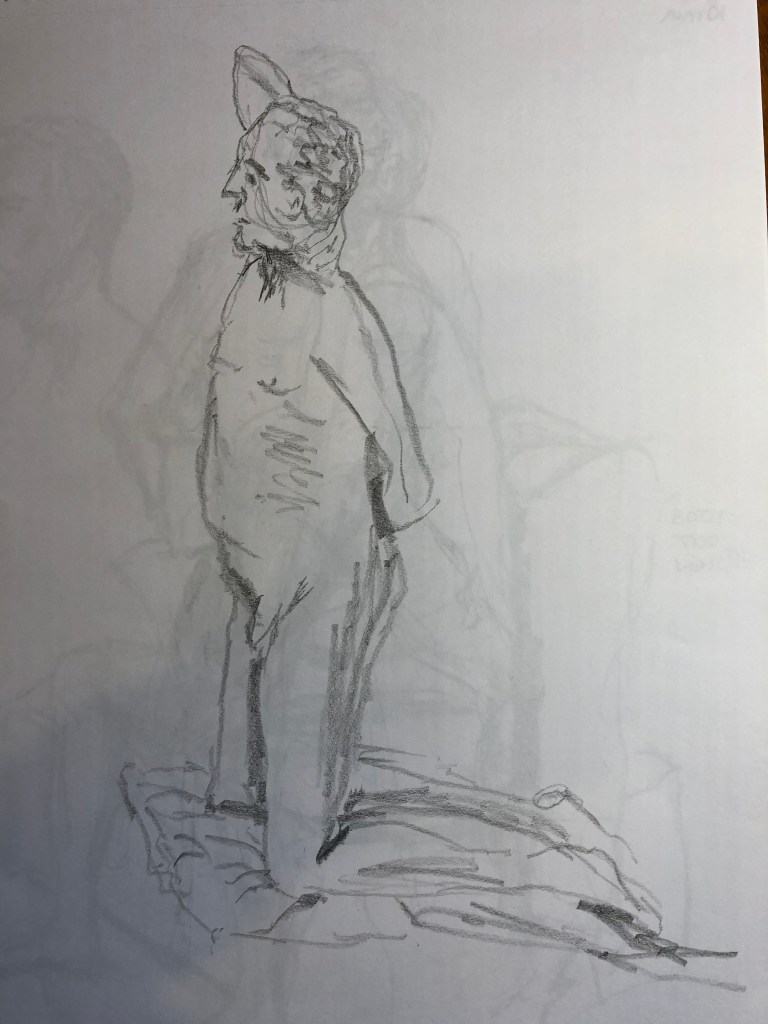
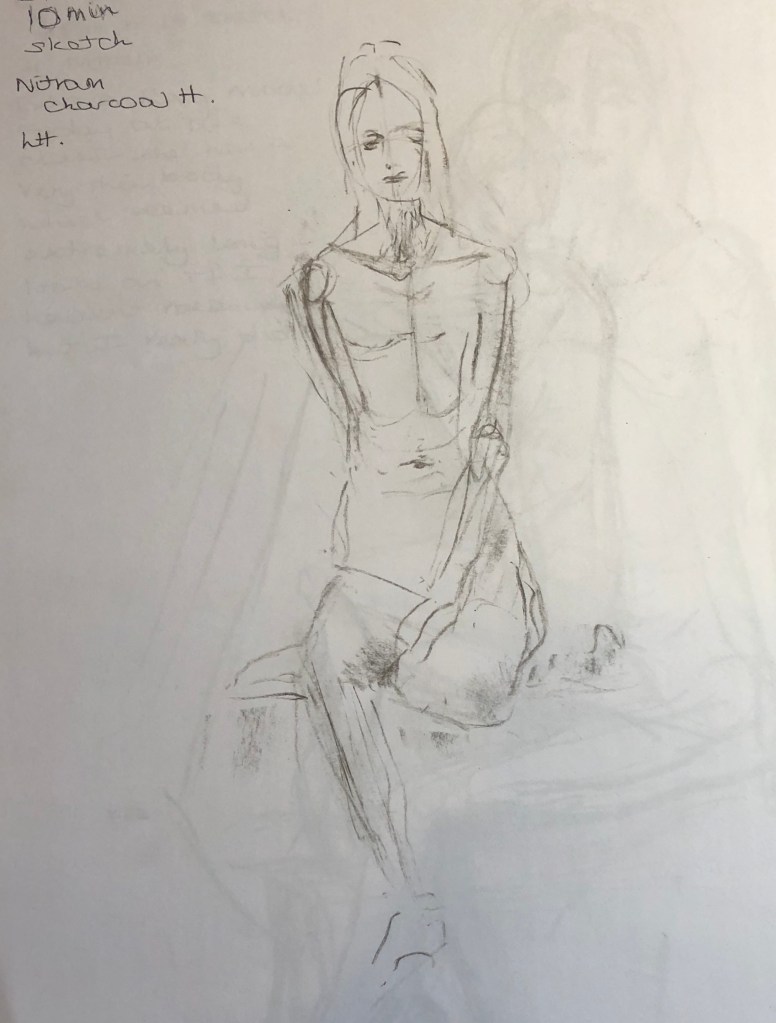
Drawing 1; Part 4; Project 3 – Form; Exercise 4 – Energy

I sat one evening watch a bit of a draw-along video from the RA – helpfully entitled Life Drawing:Live! –  which featured a highly agile male model. I had intended just to watch and learn for a while, but he swung straight in to such perfect poses for this exercise that I just had to grab my nearest sketchbook (A4) and pencil (2B) – yes, wherever you go in my house now, there are sketchbooks and drawing implements left lying about, which I am arguing is the mark of the true artist – and have a go. These were 2 minute poses moving on to 3 minute poses, and I really focused on getting the lines moving plus trying to maintain proportion by quickly indicating joints.

The drawing I am most pleased with is the second – I think I’ve got some good sweeping lines there which do convey a sense of movement. Actually, these were all rather more adventurous poses than we are graced with at our local life drawing group, and I enjoyed the challenge of trying to analyse them really quickly for key markers and get them on paper within a very limited timescale.

Then, in last week’s life group, we had a clothed female model, tall and willowy, and obviously a favourite of the group as they asked her straight away for a series of 2-minute “movement’ poses – which was ideal again for this exercise, although I was a bit caught out by the way she moved from one pose to the next without even time to turn over the page!!! – certainly focused the mind and the eyes.

I used an HB Nitram stick, and got more confident as I went along in actually making proper use of it towards the end and make bold sweeping marks. The first image is actually two poses (didn’t have time to turn the page) – well caught I think, but too faint and tentative. Second was better but out of proportion, legs too short.

I am pleased with the third – nice bold, committed marks and much better proportion – you can feel the movement in this one, I think.

Drawing 1; Part 4; Project 3 – Form; Exercise 2 – Essential elements

These drawings come from my life drawing groups – they come from different sessions (and therefore with different models), as we generally only have one or two 10-minute poses per session – so they are not a sequence as such, although I have tried to show them here in date order to show progression – if any!

These two are of a male model, drawn in pencil. I did rather fear for him in the second pose as he went quite a deep shade of puce trying to hold it. Working left-handed still, I find it takes a while to hit my stride accuracy-wise; however, I am fairly pleased with the proportion with these, including the bit of foreshortening of the right forearm in the first pose, and have managed to indicate at least the darkest areas of tone.

This lady is a group member from a session where the model had not appeared and so we took turns at drawing each other for 10/15 min – clothed, naturally. I think I’ve given her rather a long neck in my efforts to show the slight slant of the front shoulder in the slumped pose she had chosen, but I think I’ve done rather better with the proportion of the legs – and again, have managed to get the darkest tones in. This was drawn with a 3B pencil.

The last two in this section are from a session with a very striking lady model – she was extremely slim and seemed to have a very long body, especially abdomen, as a result – I found her fascinating to draw as her bone structure was really clear.

Hard to get it all in in ten minutes! I was pleased with the first sketch in particular – I had done quite a bit of reading about marking in the major joints (shoulders, elbows, hips, knees) and I measured particularly carefully as her body looked so unusual to me, so I think in that first one I really “caught” her, bones and all, and still had time to add just a little bit of shading. It was I think my first go at using the H Nitram charcoal for a live drawing – this particular hard grade of the Nitram takes a bit of getting used to and I struggled rather with establishing the darks quickly; however, I think I achieved the tonal shading side of things better in the second sketch, which was a tricky pose to capture in 10 min.

Has there been a progression?- Yes, I think I’m gradually beginning to look automatically for key markers and measurements.

Drawing 1; Part 4; Tavistock Group of Artists, 10.2.20 – talk by Colin Pethick entitled “La Belle Epoche – The golden age of portrait painting?”

Colin Pethick is a local artist – see his website, www.colinpethick.com

He gave an entertaining and highly knowledgeable illustrated lecture on La Belle Epoche, the period roughly between the 1890s and the end of the First World War – see my notes in A6 notebook 1. He had promised us that he would introduce us to painters we might not have come across before, and this was certainly true in my case, starting with Charles Durand who ran the Ecole des Beaux-Arts in Paris, which was the place to study portraiture at the time, and one of whose star pupils was Singer Sargent. He went on to talk about the way Sargent was the talk of the town but later became eclipsed by portrait painters with a loose, freer style who focused on the key parts of the painting and left other parts suggested by a well-chosen brush stroke rather than minutely depicted. He extolled the virtues of Jules Bastien-Lepage, pioneer of the square brush method, who taught James Guthrie (one of the Glasgow boys) and Stanhope Forbes of the Newlyn School. He sent us to look for the work of Cecilia Beaux The Amsterdam Joffers, Anders Zorn, Giovanni Boldin, Ilya Repin (especially – he did that wonderful portrait of Musorgsky just before he died, 1881, The State Tretyakov Gallery, Russia), Sir William Orpen, Sorolla (well, at least I knew about him!), and Henry Tonks…

He went on to talk about his experience as one of the contestants on Sky TV’s Portrait Painter of the Year programme – highly entertaining, and although he didn’t win his heat, he was pleased that the sitter selected his painting to keep.

Finally, he took general questions, amongst which was….so what do we need to do now to get our portraits current and noticed? He talked about how difficult this was, taking the example of Sargent who was initially feted and copied, but then people got fed up with his work because he didn’t come up with anything “new”. He said that the modern portrait painters didn’t try to just get a likeness, they tried to go past a superficial likeness, almost through it, to show more than was apparent on the outside. He himself, when painting, does virtually no underdrawing (although he might have done preparatory studies) – he just marks in the mid line and the eyeline and then tries to “find” the person in the paint. Interesting.

His final bit of advice: if you want to get good at portraiture, draw or paint a head a day without fail. Also interesting, although a little daunting.

Drawing 1; Part 4; Project 2; Research point – foreshortening

Rather than drawing myself…. I watched a TV programme on BBC Four on Tuesday 4th Feb 2020 called Life Drawing, which was exactly what it said on the tin – they had live models in different poses for varied lengths of time, and audience was encouraged to join in – so I did (also bullied by husband into having a go, he really enjoyed it).

One of the poses was a bearded man lying flat out on the stage in a cruciform position, covered by a cloth, and the TV camera view was straight on, i.e. feet first. It was an extremely strange angle to draw from; nothing looked like anything (apart from the feet) and I found it very difficult, getting the chest too long, which made the shoulders wrong which meant the arms didn’t join on properly…..but it really brought home to me the absolute need to NOT make ANY assumptions, but to measure properly.

Andrea Mantegna’s 1480 painting The Lamentation of Christ, tempera, Pinacoteca di Brera, which shows the dead Christ laid out in a marble slab in a pose very similar to that of the gentleman depicted above looks equally weird, and John William Waterhouse’s Saint Eulalia, exhibited 1885, Tate, does a similar thing, except in this painting the lady is depicted head-on.

I watched an interesting little video on https://www.khanacademy.org/humanities/approaches-to-art-history/the-language-of-art-history/v/what-is-foreshortening which takes a look in detail at Raphael’s 1510-11 painting, The School of AthensVatican and considers how the painter has achieved the illusion of depth by careful placement of light and shadow.

Drawing 1; Part 4; Review of a BBC TV programme – The Story of the Nude 2.2.20

Notes made during the programme:

Emblematic of western culture? – 2 and a half thousand years ago in Ancient Greece. The images of athletic bodies: makes were power, women weakness. Praxiteles – started off the male gaze?

Medieval – Adam and Eve – nudity equated with vice and sin and the fall from grace. Christianity gave the nude a shameful aspect in the European tradition.

Italy – Renaissance – rediscovering the nude as celebrating the power and potential of humanity eg Michaelangelo’s David (although soon after unveiling, his manhood was covered by a fig leaf – too much of an eyeful! Patrons of art at that time wanted to show their link with the beautiful classical world. Four years later, Michaelangelo created the Sistine Chapel surrounded by male nudes. Sister Wendy – the height of beauty was a young male body – she said they were all thinking, beauty was not enough!

Andrew Graham’s-Dixon thought the male figures were not always recognised as spiritual- Christian message being drowned out by the erotic. 

Interpretation always changing.

Women still a vessel, men showed power.

Sam Roddick’s interpretation of Boticelli’s Venus – first Renaissance enchantress – inspiration for 21st century women – Venus is not ashamed but sexually celebratory. Is she way off the mark though? 

Baroque – nude driven underground – commissioned for private viewing, usually by men, eg Velasquez’ Rokeby Venus. Artists creating pictures to be consumed by the male gaze.

Rococo – Boucher – Resting Girl – “not interested in character – he loved painting flesh” – but also “an amazing painting of its time” – Louise Buck

19th century – Goya – The clothed Maha and the naked Maha. She is not painted as a goddess but as herself, and she looks out at us frankly and without embarrassment. At that time nude was still sculptural – but this is frank, shows pubic hair – as if she has caught us out in the act of looking at her. 

1863 – Manet’s Le dejeuner Sur l’herbe – broke all the rules – “in your face” nude painting that challenged the history of nude painting – a new chapter in art painting. She is challenging us and accusing us – unsettling the men who looked at her and making them feel uncomfortable about their slightly dodgy habits. 

Not changed till 1970s – only about 20-30 nudes have been seen by their artists as people – all the rest were objects to be looked out and consumed –  John Berger.

2001 – Kirsty Walke explored The Knight Errant by Millais – he originally painted the woman looking in a completely different direction, looking at the knight rather than away. 

Courbet’s nudes designed to titillate – “great haunches and buttocks””! Modern presenter saying we present art better now!

Freud tried to explain the nudes power on the male psyche.

1907 – Picasso – Les demoiselles d’Avignon – now we have moved on from seeing things like this as tribal art – Robert Hughes was saying that tribal masks in a nude was shocking – violent abstraction.

Modern art – the artist’s intent is important, the body is there to be acted upon.

Where is there left for the nude to go? – Lucian Freud – “as far as I’m concerned, the paint is the person”.

Jenny Saville – “ jarring and displacing”? – challenges the viewer to think about their assumptions about the women painted and the way they view them. 

What’s next – how can the nude stay relevant?

***************

So, what did I take from this?

  • It was useful to revise some of the key points in the history of the Nude – I had previously not clocked the Goya painting, so good to have this pointed out.
  • Interesting to see that the two up-to-the-minutes artists quoted were Lucien Freud, whose self-portraits I saw last month at the Royal Academy (see blog post on the London Galleries) and was blown away by; and Jenny Saville whom I struggle to get on board with – really too much flesh – but know she is admired by other students on the course I have talked with in online group sessions – Felicity was definitely one.
  • The challenge of “what next” – that’s down to us students – very exciting (although slightly worrying since I’m really struggling with noses and ears…)
Drawing 1; Fine Art Group “virtual studio” morning, 1.2.20, with tutor Caroline Wright

We had four hours this morning to get together. After initial introductions we had a substantial period of time to work on a project; then we got together with another student as a pair to share and discuss our work; bit more time to work; then we got together at the end when each student had a chance to show what they’d done and one or two other students were invited by name to comment thereon.

My work today was on Part 4, Project 6, Ex 1 – studying and drawing loads of ears, noses, eyes, etc, to make a kind of bank to which I can refer. I started with noses, which are really weird things when you look at them in isolation, rather discombobulating, so I switched to ears – which turn out to be even more unworldly. I was using the Unsplash site to generate images of heads, so tried to make sure I had some seen from the side and some face-on. I started off with a 2B pencil but, with my left hand, the fine control was not there so I switched to an HB Nitram stick which is much more forgiving of what I am able to do.

Part-way through this, I had a conversation with fellow-student David. His task was really out there – he is doing Drawing 2, and had to do a drawing with a pencil attached to the end of a 4-foot long bamboo stick. Wow. He decided to work standing up and walking around – he had had a practice run the day before and was visibly refining his procedure and control over his mark-making as he went. He drew an orchid onto A1 wallpaper, and his medium was a Pierre Noire Conte which he sharpened to a prodigious point – although it had worn to a sharp chisel edge by the time he spoke to me. He managed to produce a very recognisable line drawing of the orchid, and was now concentrating on adding tone. Hope my shoulder is better before I get onto that!!

He recommended www.proko.com for videos showing how to draw facial features, and also a text by Andrew Loomis from the 1950s which he says has some really helpful demonstrations of facial drawings to work through.

Caroline the tutor pitched in then to offer me some advice about drawing the face (or indeed anything) – she recommended running your hands over e.g. the eyes, nose, chin etc – feel the planes and the sweeps, which will help in the drawing of gestures. She clearly believes in constantly returning to the object you are drawing for reference – she posted this quote for us to consider from the book “Mute objects of expression” by Francis Ponge, 1976, Archipelago Books:

BANKS OF THE LOIRE

Roanne, May 24, 1941

From now on, may nothing ever cause me to go back on my resolve: never sacrifice the object of my study in order to enhance some verbal turn discovered on the subject, nor piece together any such discoveries in a poem. Always go back to the object itself, to its raw quality, its difference: particularly its difference from what I’ve (just then) written about it. May my work be one of continual rectification of expression on behalf of the raw object (with no a priori concern about the form of that expression). Therefore, writing about the Loire from a place along the banks of the river, I must constantly immerse my eyes and mind in it. Any time they dry up over an expression, dip them back into the waters of the river. Recognize the greater right of the object, its inalienable right, in relation to any poem… No poem ever being free from absolute judgment a minima on the part of the poem’s object, nor from accusation of counterfeit.

She herself was working alongside us during this session on a commission she had been given to make some artworks for public exhibition representing the River Cam,  and today she was making some smaller prints from photos she had taken of the water whilst actually swimming in the Cam – it felt quite special to have her working with us, and gave her an idea of our experience of the session so she could judge timings, I guess.

After a bit more work we got together, took it in turns to show our work, and were called on individually to comment on a piece – good practice in looking carefully but quickly and analysing on the hoof.

A useful session – see A3 sketchbook and separate blog post (eventually) on Project 6 Ex 1.

Drawing 1; Part 4; Notes on art group demo by Richard Woodgate

31.1.20

This afternoon the Whitchurch art group had a session with Richard Woodgate, a local artist who runs a gallery in the Ox Yard at Buckland Abbey, a nearby National Trust property – “The Woodgates’ Gallery” – see www.nationaltrust.org.uk.

Richard comes to us fairly regularly; his specialism is atmospheric landscapes and he generally runs a paint-along session on a theme we have requested, e.g. clouds or trees. Today was a little different however in that he picked up on various odd queries which we had made along the way, and dealt with them. Three aspects were covered, all of which were useful to me:

  1. Putting figures into a landscape. He talked about tops of heads being roughly at the same height on a level landscape (ie, not looking up or down on the scene), so that all you then do is change the size of the figure. Dots and smudges in one colour for distance – slightly bigger blobs and a bit of colour variation for mid ground, and then heads, bodies, stronger colours for foreground. He doesn’t do feet, but rather grounds the figures with a bit of shadow – see experiments in my A4 sketchbook.
  2. Someone had sent him a very bucolic photo of a local stream with trees and fields and asked how he would turn it into a painting. He demonstrated by showing how he works things through quite meticulously in his sketchbook, trying out compositions and making notes on colour choices and what does and doesn’t work. He explains his choices on moving features of the landscape, or removing some bits altogether, or combining them with another photo or sketch very well, and stresses the importance of planning a picture before starting – I don’t think I do nearly enough of that.
  3. Someone had asked about making greens. Richard’s palette only contains shades of red, blue and yellow, and he mixes all the colours he needs from these. He showed us how to make a colour chart – see A4 sketchbook. He says that colours need to look fresh so you should only mix two (this is watercolours he is talking about) – more leads to mud. He emphasises the importance of taking the time and trouble to really get to know your colours well and what they can and cannot do – that way you identify gaps in your palette and know what to go and buy, rather than buying all sorts of ready mixed colours that you don’t need. He showed us one of his colour charts where he mixes various reds and blues to make greys – he calls this his “50 shades of grey” chart – boom boom!

Drawing 1; Part 4; Project 2 – Proportion; Exercise 2 – A longer study

This longer study was done on the same day and with the same model as the drawings included in Exercise 1. Again, the drawing was done with my non-dominant hand in 3B pencil, and we had an hour in which to complete it.

This extra time gave me much more opportunity to measure, check and re-check, and also to block in some of the background, which has helped the image considerably by making it look more solid and therefore more lifelike.

The leading leg looks very long, but I measured it several times, and of course the model is slant on to me so a small amount of foreshortening has come into play.

I am enjoying the freedom that use of the non-dominant hand brings – it is not yet accurate for fine work, but I am letting inaccuracies go and just working over them, even though this occasionally results in a slight blurring of surfaces.

I have to admit a certain pride in this drawing – the face is not right, but I am confident in the proportions, and it is a much better representation than I thought I would be capable of at this stage.

All downhill now, then,………

Drawing 1; Part 4; Project 2 – Proportion; Exercise 1 – Quick studies

I had joined a life drawing group in Tavistock soon after starting this part of the course and was “training up” my left hand to be able to draw, having broken my right shoulder. Life drawing was extremely new to me, and a combination of this, along with a lack of leftie fine motor skills, have made these first drawings look quite faint and tentative, despite being done with a 3B pencil.

Before going, however, I had watched a video in YouTube (sorry, details not noted down – bad practice) about proportion – the head being roughly one-eighth of the height of the body, belly-button around ⅜ down and groin halfway, so I used these to see if they were approximately right, and I think it’s worked pretty well with this model, who seemed to me to be a fairly “standard” build.

I didn’t worry too much about the facial features as I was unused to working at such speed. In the first drawing, even though the course notes said not to be tempted to draw outlines, I’m afraid I did exactly that as I only had 5 min. I also transgressed by starting with the head, as my cunning plan for establishing correct proportion meant I needed the head in first to be able to measure out my eighths…oh dear.

The next two sketches were 10 min each, so I had a bit more time to block in bits of tone to try and establish form as well as outline. I could see I had drawn the legs too short in the first of these, so made up for this in the second of the ten minute drawings by really concentrating on the legs and making sure they were correct – a great improvement, I think.

The group then went on to longer poses, and I can see that this is going to be an ongoing mismatch with this unit, in that what is possible from a weekly life drawing class is not always going to match up with the exercises. My plan therefore is to find at least some work from my life group which relates to each exercise as time goes by, combined with filling in gaps using work from images in books and online. I have done loads of reading around this subject over the course of the last 3 or 4 weeks due to my unfamiliarity with drawing people, so feel I am learning loads and experimenting loads and gaining great experience, all rather serendipitously – so will have to have periods, like this evening writing this blog post, when I just stop and look back at where I have got to so far.

Drawing 1; Part 4; Research point – depiction of nudes over time

  • Just watched the first part of John Berger’s ‘Ways of Seeing”. His point about art critics’ tendencies towards ‘mystification’ was particularly interesting to me; I used to rely on reading the text about a painting after only a cursory glance at the image, but I do feel that as time has passed I have got much better at standing and looking carefully at a work of art and trying to pull some things out of it myself before reading the text – I do find that any mismatches between text and my understanding from the image then tend to jar, and one is then left wondering whether the critic actually does know more than me (entirely possible, obviously) or whether their’s is just a different interpretation, perhaps as a result of prioritising one feature of the image over another (as the children did in the video).
  • Part 2 was very thought-provoking. I can imagine a modern-day Me Too enthusiast having forty fits over it, especially over the attitudes of some of the ladies interviewed, one of whom in particular reflected the passivity JB had talked about. I had never really thought much about the derivation of the nude as a class of painting but, if pressed, would have said that it derived from the classical Greek tradition, where male nudes were as common as females, if not more prevalent. I was therefore quite taken aback by JB’s suggestion that for “nude” in European painting read “female sexual object to be ogled at and preyed upon by men”. Now that I have been made to think about it, I can see that JB’s take on it is much more pragmatically realistic than my own rather naive, high-minded and unworldly view. Surely though, there was then (certainly is now) a class of people (men – John Ruskin?) who would buy an exquisitely drawn or painted nude out of admiration for the artist’s skill in creating an image, rather than just to lust over it? Need to watch the next episode…..
  • As I should have expected, Part 3 took a different tack and looked at the traditional European oil painting as an expression of wealth, property and power, which I had previously touched upon in my research on the history of still life from the 17th century onwards (see Part 2). Interestingly, he did this time mention painting of the classical stories (including many nudes), but represented them as a set of characters and costumes (whether clothed or not) into which the purchaser could step in their imagination and live out the stories in their dreams with themselves in the title role – a power, yes, but open to anyone who has ever read a book.
  • Part 4 looked at advertising, and its purposes and effects as in 1972. Over the 38 years since, the explosion in the use of imagery to manipulate people’s thoughts and actions has made the present a time to be even more aware of what is being said and implied, and to be conscious and wary of the implications of accepting suggestions at face value. One particular thing which struck me, in the context of the nude, was the amount of sexualised images which were taken for granted as the natural way of things – his sequence of adverts filmed up what looked like an Underground escalator, is exactly as I remember it used to be, with image after image of scantily dressed women, or women hanging off dominant men – and at the time I accepted this as just how adverts were, whilst not in any way applying their messages to myself, but yet not going the extra mile, as some women did, and protesting about this state of affairs. Such images of scantily dressed women still occur today, but are more balanced with images of scantily clad men, and the “message” feels different – in the words of the song, sisters are doing it for themselves.

I went on to read Eisler, Georg, 1977, From Naked to Nude, Life Drawing in the Twentieth Century, Thames & Hudson. He refers to Berger’s work but feels that the idea of the male ‘owner-viewer’ is not the whole story, suggesting that, historically, sexuality was a woman’s only weapon, and that, as the subject of a nude, she gains dominance over the patron, reducing him to the more uncomfortable role of voyeur – certainly that’s the look I see in the eyes of the feisty lady in Manet’s 1863 Le Dejeuner sur l’herbe, oil on canvas, Musee d’Orsay, Paris.

I also read the online article by Marion Simon https://quillette.com/2019/09/10/in-praise-of-renoirs-male-gaze/ , which includes a link to an interesting lecture on Youtube given by Martha Lucy called “The Trouble with Renoir. The point is made here that reactions to an artist’s work and the way it is perceived varies and depends very much on the mores of the time. Marilyn Simon’s article is interesting in particular for the distinction which she draws between her own self-image and the potential image of herself as an artist might see her, and goes on to say: “Contemporary feminism insists that men and the male gaze objectify women, thereby making men into the powerful, brutish, and oppressive monolithic force we commonly know as “The Patriarchy.” Yet the male gaze often reveals men’s vulnerable side. The way they see reveals not their power but their yearning; their desperate need for tenderness in a world that can be hard and unkind, and which turns men into cogs within the economic machinery.” I think this was a more technical way of saying what I tried to summarise in the previous paragraph!

Everything I read about this complex issue seems to send me in a different way. On a recent visit to London (see separate blog post about the London Galleries) I was extremely dismissive about the work of Kathe Kollwitz which I came across in the British Museum (it had been a long day and I was quite tired, in my defence…). Since then though, I have found myself moved to do some drawings inspired by her work (see A3 sketchbook), and was extremely interested to read about her ideas in Betterton, Rosemary, 1996, Intimate Distance – Women, Artists and the Body, Routledge, London and New York. She takes the traditional “male gaze” view, that the artist may “look at but not inhabit the body” and portrays the dichotomy which this necessarily creates for a female artist in her drawing, Self Portrait and Nude Studies, 1900, graphite, pen and black ink; although the author goes on to develop an Oedipal theory about motherhood which I am not sure I followed.