Painting 1; Part 1; Research into Alli Sharma’s black and white paintings

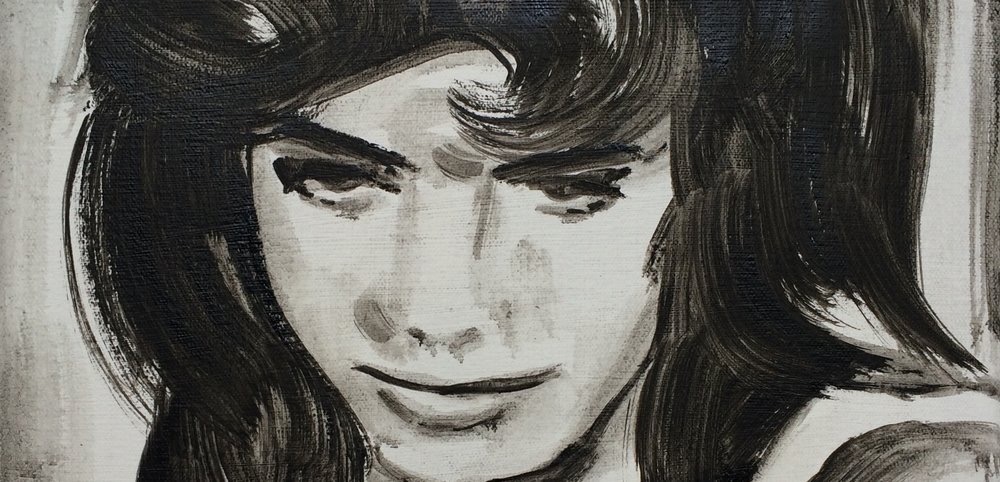
Of all the “black and white” artists I looked at, I chose to study Alli Sharma in more detail because of her subject matter and her expressive gestural brushstrokes.

IMAGE 1

WHAT?
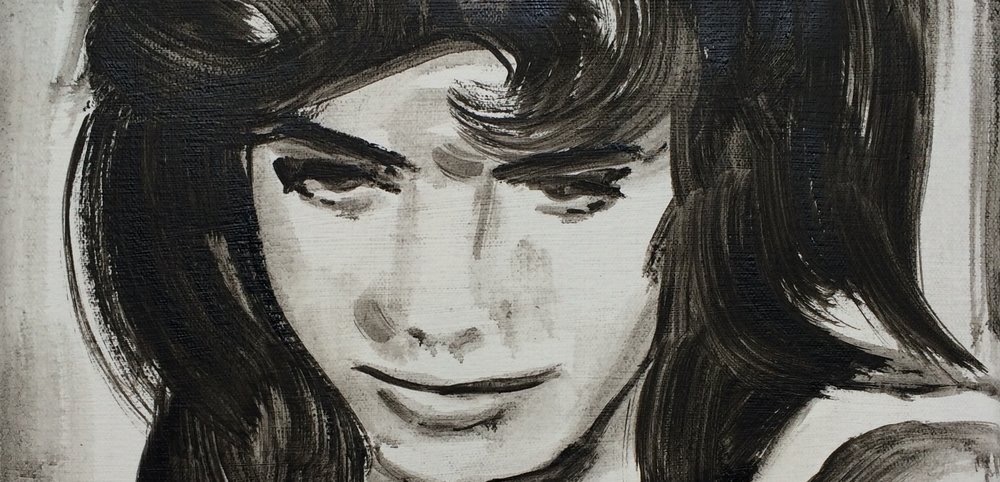
“Billie Whitelaw, Charlie Bubbles (1967)”

2012

Oil on canvas

50 x 50 cm

This image is a detail on the front page of Alli’s website, www.allisharma.com. I felt drawn to it because of the pensive expression of the subject – neither happy nor sad, you wonder what she’s thinking about. It’s interesting that she has originally painted it in square format, but has chosen this section to front her website – this cropping is effective as you feel it cuts to the chase. Your eyes are drawn straight to hers, depicted dramatically with heavy dark strokes. I wasn’t sure whether she had left the white of the face as white canvas or had painted them in over a background thin wash – I suspect the former. I read in her Artist Statement on www.axisweb.org that one of the themes on which she chose to paint was”…the women of 1950s social realist cinema…” – I feel she has succeeded here in her mission to “…transform the overlooked into substantial painterly icons.”

SO WHAT?
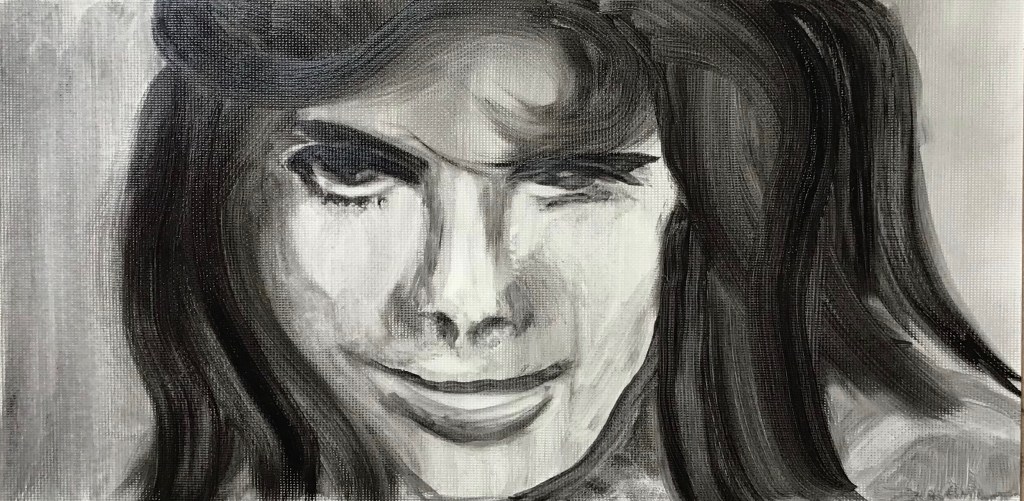
Painting in oil in black and white is new to me, so I tried to copy this image onto oil paper in the same proportions as the original. I had found some water-mixable linseed oil so tried using this to thin the paint for light washes, rather than water; the feel was better as the paint mixed with the oil more readily, and I found then that if I had made marks in the wrong place I could lift them using a brush slightly damped with water. I tried painting with my non-dominant hand, standing well back from the easel, to improve the steadiness of my mark-marking – just needed to switch to the right hand for the details under the eyes; I used a large hog filbert to encourage me not to fiddle, but did cheat with a soft size 4 flat for the under-eye bit and the light in the eyes. I most enjoyed the big sweeps of undiluted black to create the hair. 

NOW WHAT?

  • I prefer using the linseed oil to water as a thinner, although it does seem to increase the drying time.
  • I made the lights of the face by my “damp brush lifting” technique, which was messy – I should have left these areas white when putting down my initial wash.
  • My uneven eyebrows have given her a calculating rather than thoughtful expression…..even though it’s loose and gestural, details matter….but…
  • Big black swirls of paint are huge fun!

IMAGE 2

WHAT?

“Ingrid 3 (A Kind of Loving)”

2014

Oil on canvas

50 x 40 cm

Seen on http://www.allisharma.com

Not sure how this makes me feel – knowing that it’s taken from an old film again, I suppose it makes me feel interested to know what the subject is doing – she seems to be looking down at some task. The head and shoulders pretty well fill the space, with the same gestural marks and suggested loose background. The dabs depicting the hair and the pattern on the blouse are directional; the controlled detail is again in the eyes, nose, mouth and the edges of the collar.

SO WHAT?
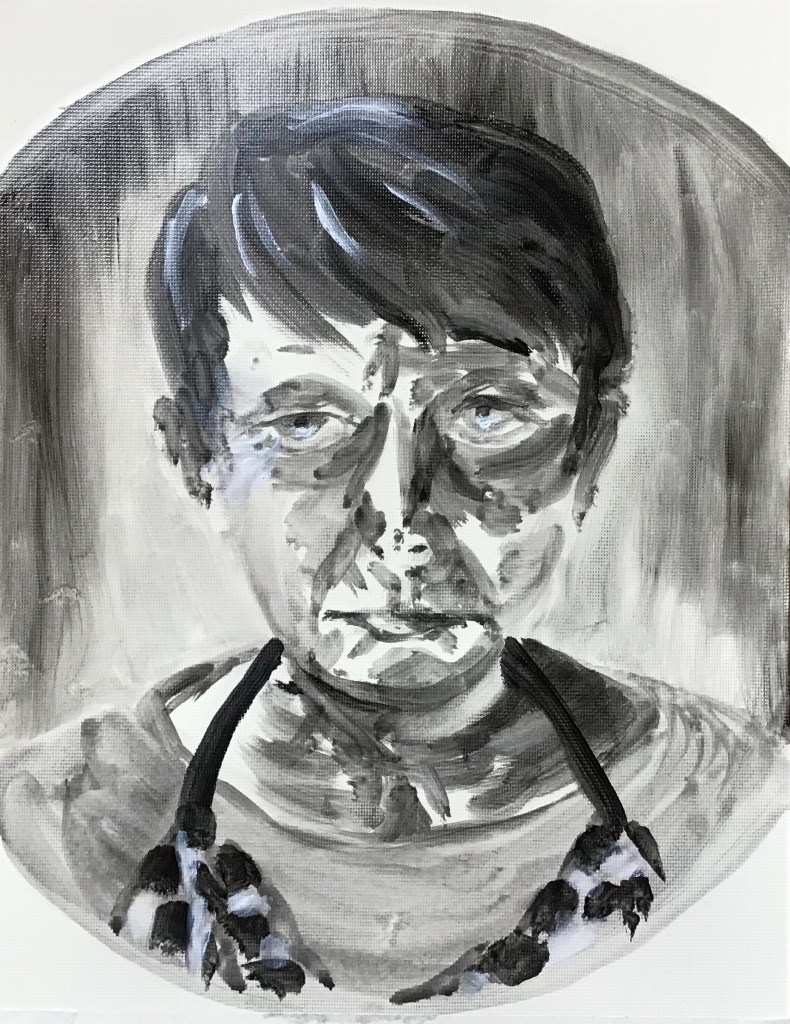
I was quite taken with the hair and the patterned blouse so wanted to have a go – decided this time to try a self-portrait using a round shaving mirror balanced on the top of my easel. I used oils on oil paper, diluting again with linseed oil and just occasionally water, and relied mainly again on my hog filbert to try to stop me fiddling. I chose to truncate the composition to focus on the head and shoulders, as in the painting by Alli above.This time, instead of putting a light background over the whole thing, I put a very light outline on the page to indicate the figure, and put the background around that, varying the tone to indicate shadowy areas. I also decided to experiment at the end with a tiny bit of added white on my lit wrinkles (laughter lines!), eye highlights, grey hairs and checked apron.

NOW WHAT?

  • The composition is very central but I think it works, as does the loose background with directional strokes differentiating the image from the edge of the mirror.
  • Much better leaving the light areas unpainted rather than trying to lift paint out
  • The directional dabs to make the checked pattern worked well to convey a hanging and therefore twisted fabric
  • I tried to be bold and directional with the facial features, but it looks clunky and overworked – perhaps I should have changed to a smaller brush. I think rather that my issue is that Alli has been much more sparing with the details she includes on the face – an absolute bare minimum. I need to remember I don’t need to include everything – the viewer knows what a face looks like and will fill in the gaps.
Painting 1; Part 1; Research – painters working in black and white

Raymond Pettibon

Example: 

“No Title (Do you have…)”

2000 

Ink and felt tip pen on paper

22 x 32 in

Patricia & Morris Orden

(can be seen on www.moma.org)

  • This artist’s earlier subject matter did not appeal to me, so I chose this later work as an unusual subject where the steam train seems to be ploughing it’s way through a muddy field – an interesting subject which makes you look
  • Great variation of mark thickness and direction, building up tone through cross-hatching
  • Incorporates text, as do many of his works – this is all about poetry, which seems to bear no relation to the subject image – again, makes you look and try to puzzle it out

Jose Toirac

Example:

“Sin Titulo No 15”

2000

Oil on canvas

39 x 39 in

(can be seen on www.mutualart.com)

  • Portrait which completely fills the canvas vertically – his hat touches the top edge and his feet go off the bottom slightly – makes you wonder why in that case he chose a square canvas – but maybe that’s exactly why –  it gives the image an “edginess”
  • The horizontal dragging of the paint surface is interesting to the viewer because it makes you analyse the artist’s process – did he paint the portrait “normally” and then just drag a brush over it?
  • Painting is predominantly mid tone – makes the light of the hands and face, and the dark of the hat and hair, stand out

Alli Sharma

Example:

“Billie Whitelaw, Charlie Bubbles (1967)” – detail

2012

Oil on canvas

50 x 50 cm

Seen on www.allisharma.com

  • Big broad brushstrokes clearly visible; direction of strokes important in creating the image
  • Strong light/dark contrasts
  • Not huge detail
  • Feels dynamic, as if painted all in one go

Gia Edzgveradze

Example:

“Derby”

1983

Oil on canvas

70.9 x 66.9in

Seen on www.artnet.com

  • Looks like an automatic drawing that you do whilst thinking about something else
  • Inclusion of numbers makes you think it’s some sort of map or route diagram or puzzle
  • Title is rather mysterious – maybe the painting is a route map of the horse race the Derby? – this is suggested but not confirmed in the New York Times article by Vivien Raynor on Feb 2nd, 1992 entitled “Art; Russian Works Come to the Forefront”.

Painting 1; Part 1; Research into works of Tim Gardner – examples of photorealism

I chose to look at two watercolour paintings by Tim Gardner because this medium seems less commonly used for photorealistic images.

WHAT?

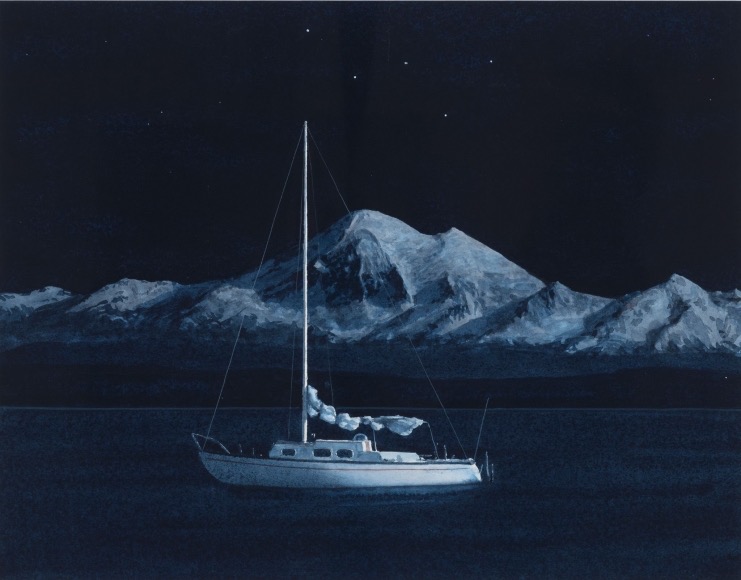
The first example of his work I chose was “Sailboat in Moonlight with Mt.Baker and Cassiopeia”, 2015, watercolour on paper, 14 x 18 in, seen on website of 303 Gallery, New York.

This really caught my attention because of its mood of serenity; I do like a snowy mountain picture (am currently reading about Scott’s travels in the Antarctic), and he has created it virtually in monochrome, apart from a small dash of brown on the boat. The title exactly lists what you see, foreground to background, and the composition is unusual as he has arranged the three titular elements centrally, one under the other. Watercolour is less commonly used for such dark and dramatic blocks of colour.

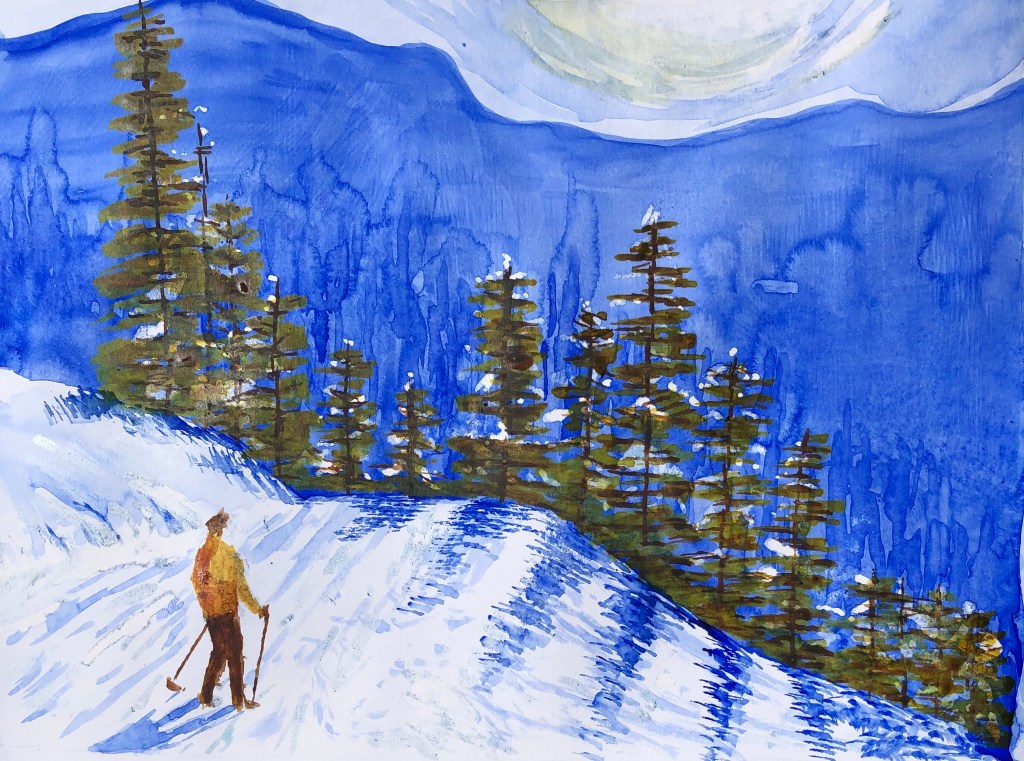
The second work I chose was another snowy mountainous scene, this time with lots of light:“Silver Ledge”, 2009, watercolour on paper, 24 x 33 in; also seen on the website of 303 Gallery, New York.

I thought this was slightly less photorealistic,  and more of a likely scene to tackle with  watercolour. This image has an equally “wide open spaces” feeling, and the emotions it depicts to me are wonder and exhilaration. The composition is more classically in thirds, the two features to which my eye goes first, the sun and the figure, being diagonally offset from centre. The palette is again predominantly blue, with dashes of yellow (lemon on the figure, a touch of Naples maybe around the sun) and brushstrokes of green and brown for the main trees. The title presumably refers to the flat area on which the figure stands? – although that is wider than a ledge to my mind.

SO WHAT?

I decided to work on my responses to these pictures simultaneously. I worked in watercolour at A3 size: the ”sea” picture on hot pressed watercolour paper pre-soaked and stretched; the “mountain” picture in my multi-media sketchbook. This way I could keep putting down washes and leave one to dry whilst working on the other. 

BIG issue: I drew over the white patches I wanted to preserve on both pictures first with masking fluid and left that to dry. Something made me check that the fluid was going to come off after applying about three washes – and was dismayed to find it wouldn’t come off cleanly, was quite sticky, rather like the stickiness left when you try to peel off an old label. I can only assume that, since I haven’t used my masking fluid for over a year since I’ve been doing Drawing 1, it has become degraded.

I used Prussian Blue throughout, starting putting the washes on with a round size 8 sable but soon moving to a 1 in flat. Once I found the masking fluid wasn’t coming off cleanly, I decided to adapt and leave it there as my light blues (it has a blue tint). I changed to a half-inch flat for the details of the mountains, boat and water. 

My painting does not have such a dark sky and water as Tim’s; the effect is very different – I wonder if he used some black? I hope mine is still a serene image, although it is not as immediately dramatic.

Here in the mountain picture I seem to have gone the other way and made my background too dark and dominant. I used the 8in round for the background. I tried creating those “cauliflower” runs to indicate the midground trees – worth a try, might have been better with deciduous trees….then I swapped to the half-inch flat for the figure, near trees and shadows. I worked in ultramarine for the majority of the picture, just adding bits of gold, green-gold and burnt umber for the figure and near trees and the sun. Again, I left the non-functioning masking fluid reworked slightly to incorporate it as light blue. I have made the figure just slightly too large – that and the over-dark far mountains throw the scale out.

NOW WHAT?

I learned:

  • It’s vital to check that older masking fluid still works before it ruins your painting!!!
  • I’m not sure I am temperamentally suited to creating highly photorealistic paintings – I don’t have the patience; also I have worked quite hard to learn to work expressively, which I feel is constrained by exact photorealism 
  • Working on more than one painting at a time saves a lot of waiting around for things to dry
  • Small errors in the size of a feature or the tone of a wash can have a big effect on perceived scale
  • Having your main features right in the middle of a painting can still work as a composition

Painting 1; Part 1; Research into painters using Photorealistic style

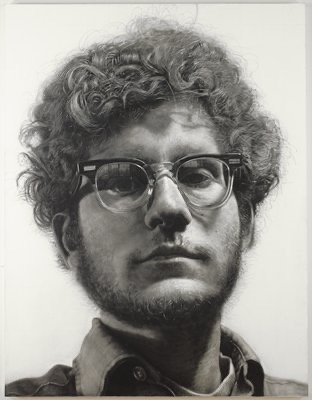
Chuck Close

Example: 

Frank”, 1969

Acrylic on canvas

42.75 x 30.25 in

PaceWildenstein, New York

  • Gridded up from an 8 x 10 in photo
  • Made eye catching by being painted in black, white and grey
  • Does look exactly like a blown-up photo!
  • Does it “catch” the character? I’m not sure…

Mark Fairnington

Example: 

“Specimen (1)”, 1999

Oil on canvas

202 x 66 cm

Can be seen on www.markfairnington.com

  • He did many of his paintings from taxidermy specimens in museums
  • Dramatic because much larger than life (it’s an insect)
  • Hugely closely observed – very clear detailed layered mark making and use of shadow to create the feeling you could literally just pick it up

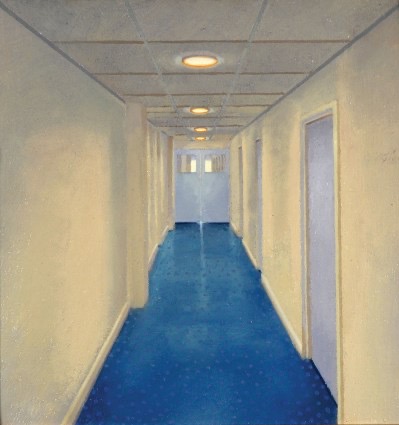
Robert Priseman

Example:

“Study for Corridor”, 2006

Oil on linen

30.5 x 30.5

Found on www.goldmarkart.com

  • Was not generally drawn to the choice of subject matter in the examples of his work which I could find online – a personal thing
  • Quite a limited and muted palette
  • Strong perspective pulls you into the painting

Tim Gardner

Example:

“Sailboat in Moonlight with Mt. Baker and Cassiopeia” , 2015

Watercolour on paper

14 x 18 in

Found on website of 303 Gallery, New York

  • I was more drawn to his landscapes than his paintings of people – mainly younger people in groups or urban areas
  • He also uses oils, but his watercolours struck me by being very “definite”. i.e. not wishy-washy – almost more like gouache or acrylic
  • Striking and bold use of monochrome here

Painting 1; Part 1; Research into Mimei Thompson

WHAT?

I chose to look into the art of Mimei Thompson from the group of artists working with loose thin paint layers because I was drawn by her choice of colours and unusual formations.

Image 1

Heliconium

2019, oil on canvas, 60x70cm

From http://www.mimeithompson.com

This is such a feel-good painting; the adjacent complementary colours zing, and after all – flowers and butterflies – what’s not to like? Yet the image, like all Mimei’s images, have to me a sense of the “other”, a dreamlike world – possibly because of her technique of swirling motifs making up structures; there is just a hint of strangeness in there which gives it an edge. It is that swirl within the leaf that my eyes go to straight away – I have begun to look for it, and it is placed on the third from the bottom and the left. The composition is circular – you either follow it up the leaf and down the flower stem back into the leaf or vice versa, only drifting aside to take in a butterfly after a couple of circuits. It looks like a realistic plant, but given a fantasy bent. Many of her recent paintings feature plants, either individually or grouped, and insects (sometimes dead) – she seems to treat them in a detached way so that one can look at them with interest rather than distaste, being drawn instead to analysing brushstrokes.

SO WHAT?

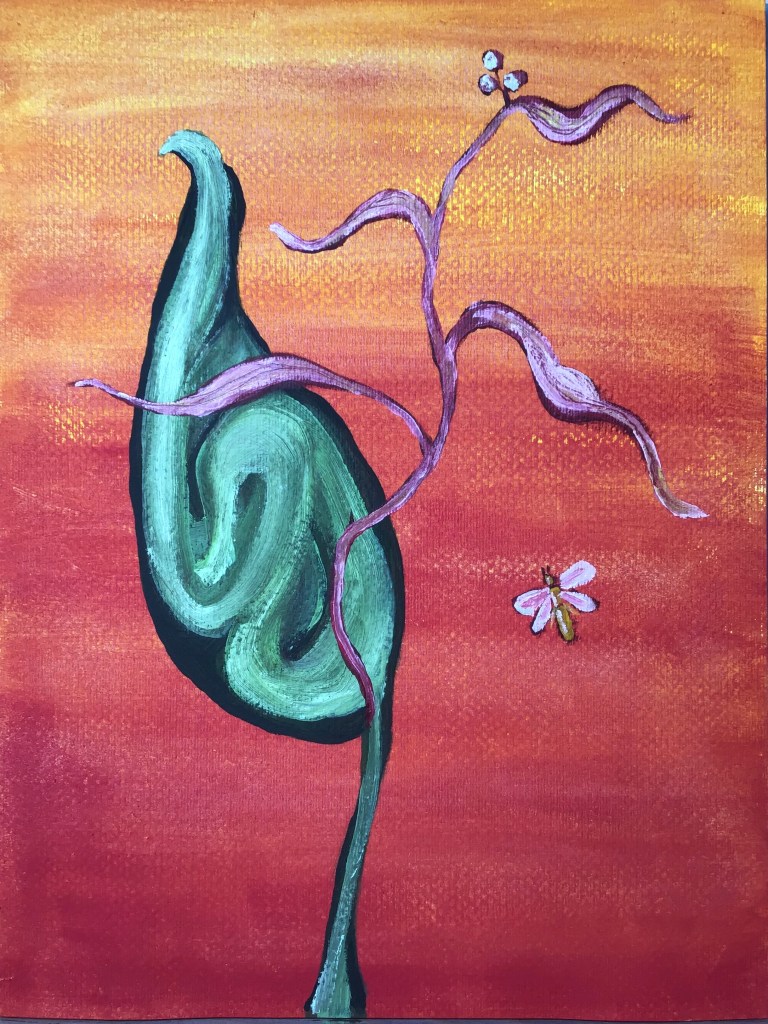
I wanted to try working in oils as I had no real experience of this – I have chosen water-mixable oils as I have a small studio, asthma and a tendency to migraines. I worked on oil-prepared paper on a block. I decided to loosely copy but simplify the image in order to try new skills. I painted in three stages:

  • Thin layers of lemon yellow, then cadmium yellow, then cadmium red, applied one on top of the other with horizontal strokes and a wide flat hog bristle brush – the whole then left to dry
  • The green leaf structure: background of burnt umber, then thin layer of green mixed from ultramarine and cadmium yellow, followed by green mixed from ultramarine, lemon yellow and white, all applied with a hog bristle filbert, and left to dry
  • The flowers and butterfly: cadmium red/burnt umber mix, followed by cad red and white mix, gradually turning whiter with a little lemon yellow, all applied with a soft-haired size 4 flat – I also experimented at the end with adding darker streaks by using a palette knife to cut through the top lighter layers.

NOW WHAT?

I learned:

  • How different a painting experience is using oils – it has an addictive gliding “feel” to each stroke, but not letting it dry at least a bit in between layers can lead to muddying of colours
  • To use a mahl stick – first try anyway – I was painting with a long brush, trying to hold it in the middle and using arm movements rather than fingers and wrist – but accuracy is difficult
  • I need to investigate more what different brushes will do for me when using oils
  • Photography! – this photo was taken right where I painted it, which is under a Velux window on a bright day, yet the colours look flat and boring here, whereas in my original the lemon yellow underpainting zings through much more and the greens are much more yellowy and bright – here they look almost blue (and I did try it a few times). It’s the first time that I’ve taken a photo of my work and thought that it doesn’t reflect my work well.

IMAGE 2

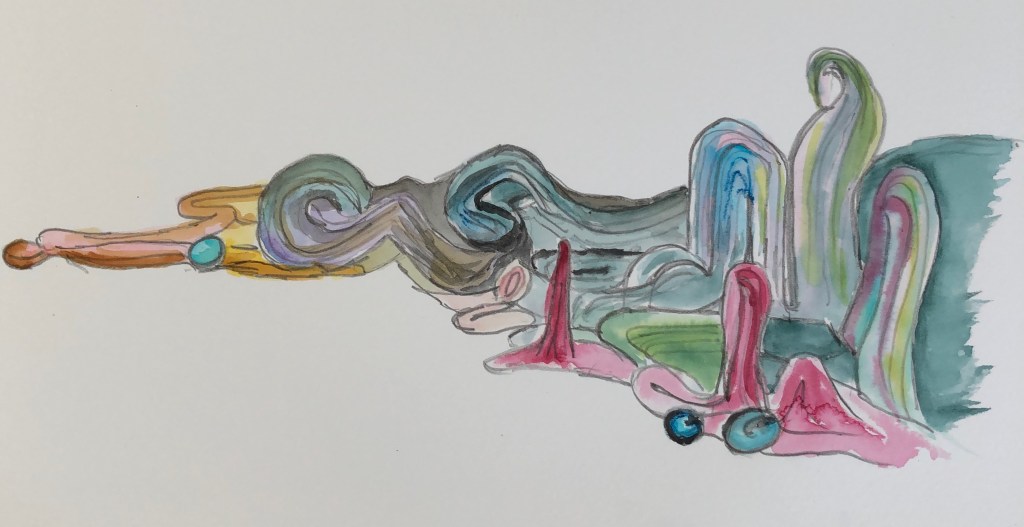
Untitled Cave Painting (1)

2011

oil on canvas, 76x61cm

From www.mimeithompson.com (also shown in OCA materials)

When I first saw this image in the OCA materials I didn’t like it – that oozy, drippy quality she achieves with her shapes didn’t feel comfortable, combined with the fact that it looks like you are entering the cave and being drawn by the diagonal path into its dark and less-defined (and therefore scarier) interior. This is one of a number of “cave” paintings which she did in 2011 and which are on her website together. The effect on the viewer is different depending on the viewpoint – those starting outside looking into the dark background are unsettling, whilst those looking from the inside out to the bright exterior are much more hopeful. The palette of colours is similar throughout the series, some tending more to shades of one colour than a mixture; this painting combines most of the colours she chooses.

SO WHAT?

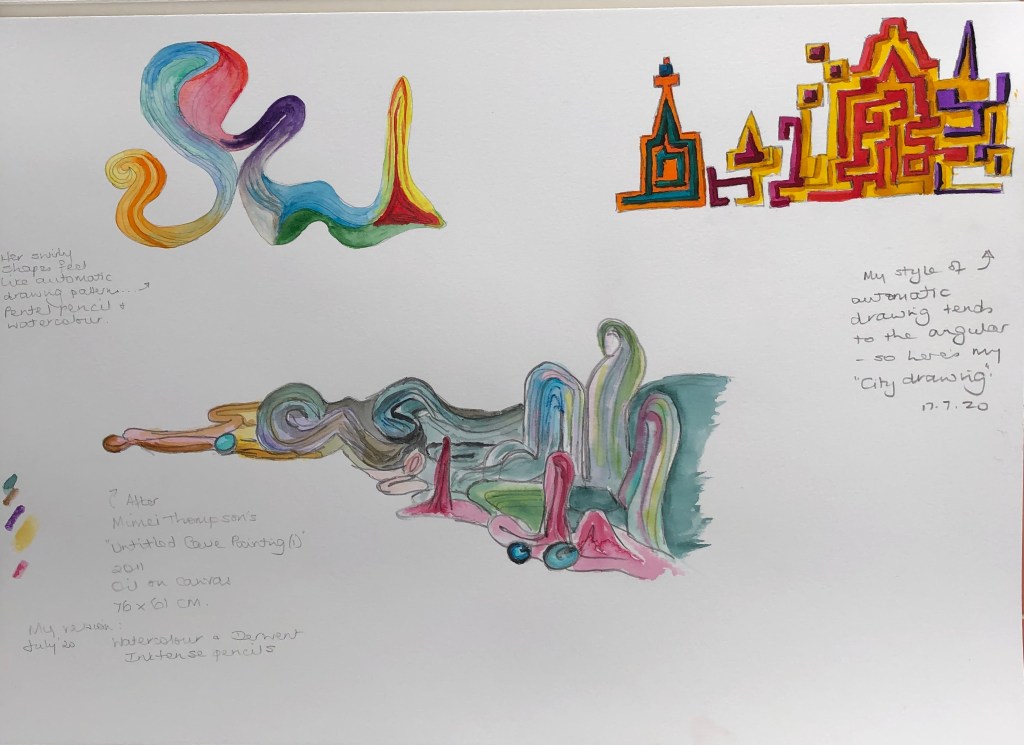
The effect of the coiled, swirling, almost melting structures needed investigating to see how she was achieving that in paint layers. In between waiting for oil layers to dry (Image 1), I experimented with pencil and watercolours, first on replicating a small section of her rock structure in the front right of the painting.

The more I tried to copy her image, the more it seemed to me like one of those automatic drawings which you do when you are on the phone, but then developed and controlled – so I tried making one up using paint layers (top left).

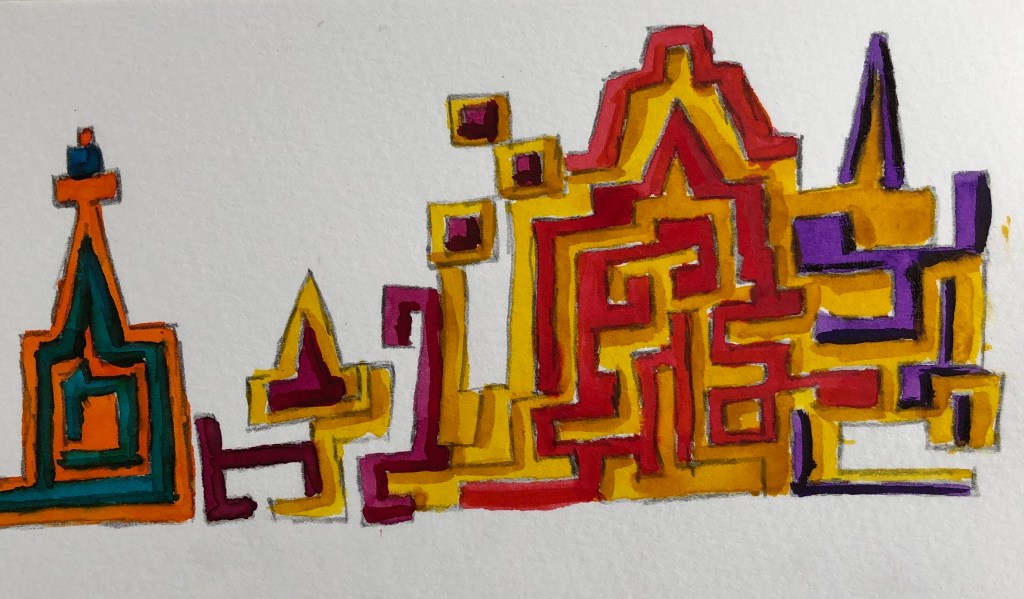
Then, because my own automatic drawing style tends towards the angular, I created my own “Cityscape”. I worked for all of these on hot-pressed watercolour paper as recommended in the course materials; I have hitherto only used NOT or rough watercolour paper, so this was another small first.

NOW WHAT?

I learned that:

  • Working in another artists’ style and trying to copy sections of their work makes you see it differently from just looking
  • I really like hot-pressed paper for drawing on – your mistakes become entirely your own!
  • Having a recognisable style can make a viewer give your work more attention as they seek out your “trademark” elements

Painting 1; Part 1 Research: Artists working with loose, thin paint

Mimei Thompson

Example:

Heliconium

2019, oil on canvas, 60x70cm

(from www.mimeithompson.com)

  • Quite jewel-like colours; here using complementaries; often a pastel palette or tones of one colour
  • Brush strokes visible
  • Characteristic swirls – as if squeezed from a tube like toothpaste

Annie Kevans

Example:

Kathe Kollwitz

2014

Oil on paper

40 x 30 cm

The History of Art series – from www.anniekevans.com

  • Very thin paint layers
  • Very marked brush strokes – loose and gestural
  • Sticks to including only the “key” information – nothing extraneous

Cathy Lomax

Example:

He watched what was going on

2019, oil on paper, 23x30cm

From “Film Diary” series

See image on: www.cathylomax.co.uk

  • Very thin layers, almost like watercolour
  • Quite a bit of grey and muted colours
  • Usually contains a figure or, more often, part of a person – invites viewer to construct a story around it

Eleanor Moreton

Examples:

The Family Wood

2018, oil on canvas, 90 x 120 cms  

http://www.eleanormoreton.co.uk

  • Often brightly coloured, quite jolly
  • Subject matter generally contains figure(s) and sometimes animals, usually outside
  • Brush strokes often left clear and loose

Painting 1; Part 1: Research into “flat, slick” painting style

Gary Hume

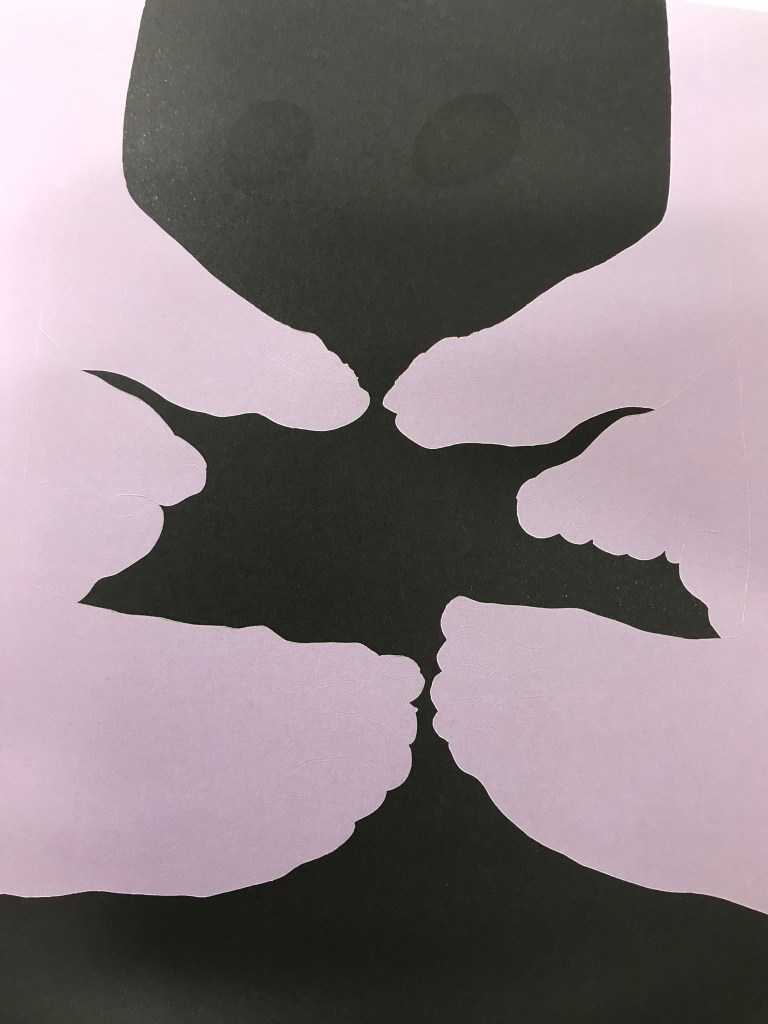
Example: Four feet in the Garden

1995

Gloss paint on aluminium

Arts Council Collection, South Bank Centre, London

  • Use of gloss paint gives it a shine
  • Dramatic contrast of black with a pastel colour
  • Makes you look – to try and work out what’s going on

Sarah Morris

Example: 

Midtown-Mountain Dew

1999

Gloss paint on canvas

84 x 84 in

Petzel Gallery

  • Gloss paint again for a shine
  • Many pictures in an angled grid – windows of tower blocks
  • Very crisp, sharply finished shapes

Ian Davenport

Example: La Mer Study (After Bonnard)

2018

Acrylic on canvas

Ian Davenport Studio

  • Paint is poured and left to run down and puddle at base to give marbled effect
  • His colour combinations in response to subject matter – to reflect his understanding of the world
  • Has a vast range of colours in his studio!

Inka Essenhigh

Example:

Wind Tunnel, 2008

Oil on canvas

162.6 x 198.1 cm

Victoria Miro Gallery

  • Other-worldly, “flight of fancy” subject matter
  • Use of strong colour (as the reds, here) or often a two colour theme
  • Often uses figures to prompt viewer to invent a narrative

Jane Callister

Example:

“Marshland”

2006, acrylic on canvas, 

36 x 36 in. 

APT collection, Santa Barbara,

California, USA

  • Imaginary landscapes
  • Many examples show vibrant colour contrasts
  • Again, makes you look – draws you in to fill in the story

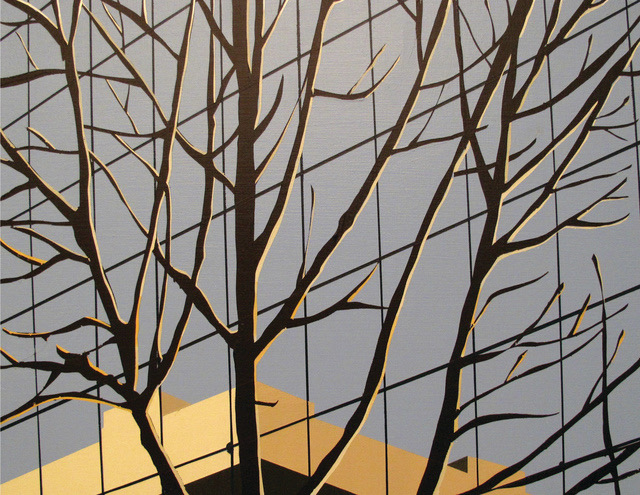
Brian Alfred

Example:

Golden Hour, 2009

Acrylic on linen

16 × 20 × 1 2/5 in

Studio La Citta, Verona

  • Many straight lines, geometric shapes, clearly-defined edges
  • Often urban scenes
  • Lots of light greys/browns/chalky colours

Painting 1; Part 1; Research into Jane Callister

IMAGE 1

WHAT?

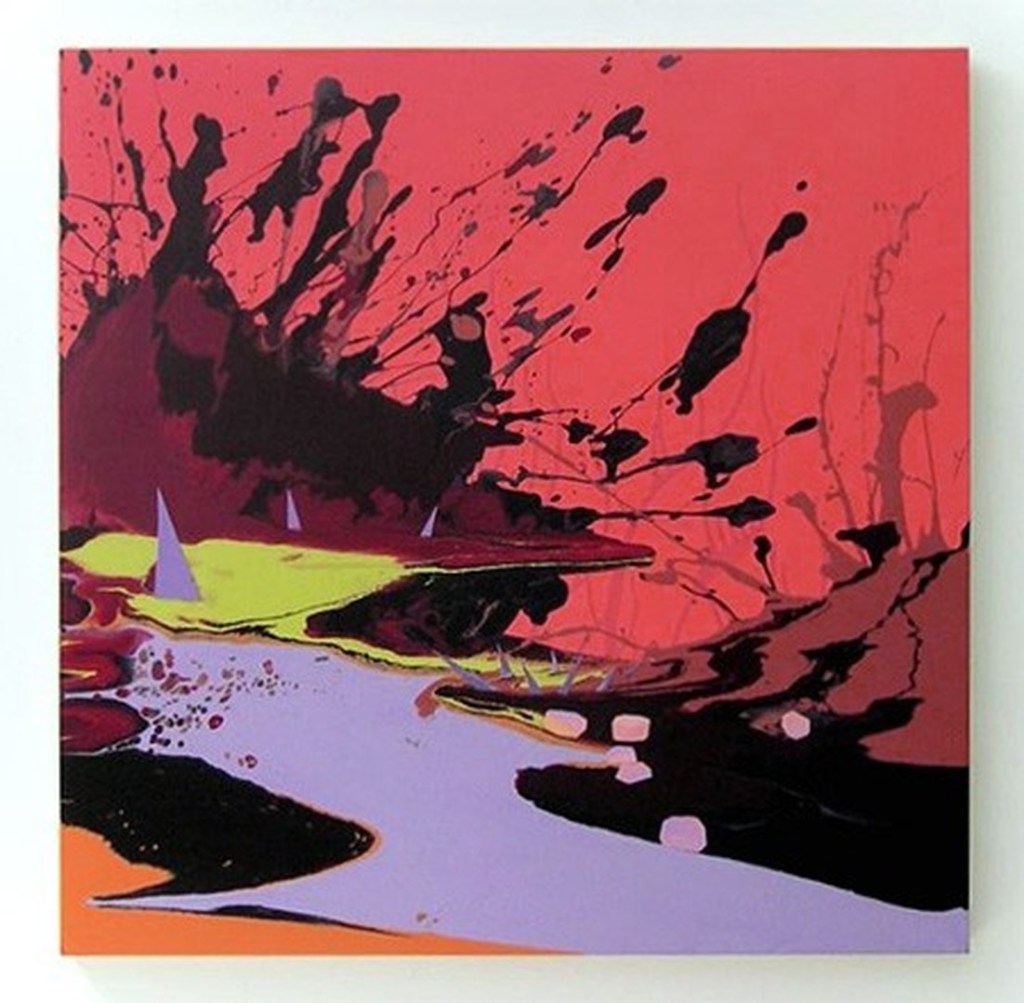
I was drawn to Jane Callister’s work by her use of bright, strong colours, the sense of dramatic movement she gets in her pictures, and the sci-fi/fantasy nature of her subject matter. 

The first painting which I chose to look at was “Marshland”, 2006, acrylic on canvas, 36 x 36 in. APT collection, Santa Barbara, California, USA.

The painting makes me feel, alive, awake, immediately engaged in trying to read things into the image and construct a story around it; some kind of fantasy quest – as if the hero has to cross the swamp to reach the distant forbidding mountain. The first thing my eye goes to is actually that pop of startling and unexpected yellow in the mid-ground, followed rapidly by the lilac marshland running diagonally across the image, pulling you in along the course the hero has to follow. The use of such startling colours seems to imply the unnatural nature of these hazards – backed up by the red sky and the splashes of dark, which to me are like eruptions and serve to emphasise that this is not a good place to be. The title is, I feel, a little at odds with the image – if I’d been told I was going to look at a painting called “Marshland” I should have imagined quite a gloomy palette of colours, predominantly green and brown – I think the title gives the viewer cause to pause and look more carefully at the image, re-assessing their expectations. The artist has painted in acrylic on a large square canvas, rather than a traditional “landscape” rectangular format – to me this serves (in the story I have already half-written in my head) as a limiting factor, as if to say to the protagonist “Look, this is the way you have to go – no good looking around to the sides, there’s nothing for you there – this is the only way.” The painting is held in the APT (Artist Pension Trust) collection, who have the “largest global collection of contemporary art” (from www.mutualart.com), whose curatorial team are skilled in supporting artists with high potential. The painting was made in 2006, the same decade as the Lord of the Rings series of films were released, and I think that juxtaposition and currency of fantasy films has just possibly fed into the artist’s work? – it’s clearly influenced my reading of it, anyway!

I had been asked to look at Jane Callister’s work as an example of an artist with a slick flat style. I therefore decided to have a go at painting in this style, simplifying the image rather than trying an exact copy, and specifically focusing on producing flat layers of colour.

SO WHAT?

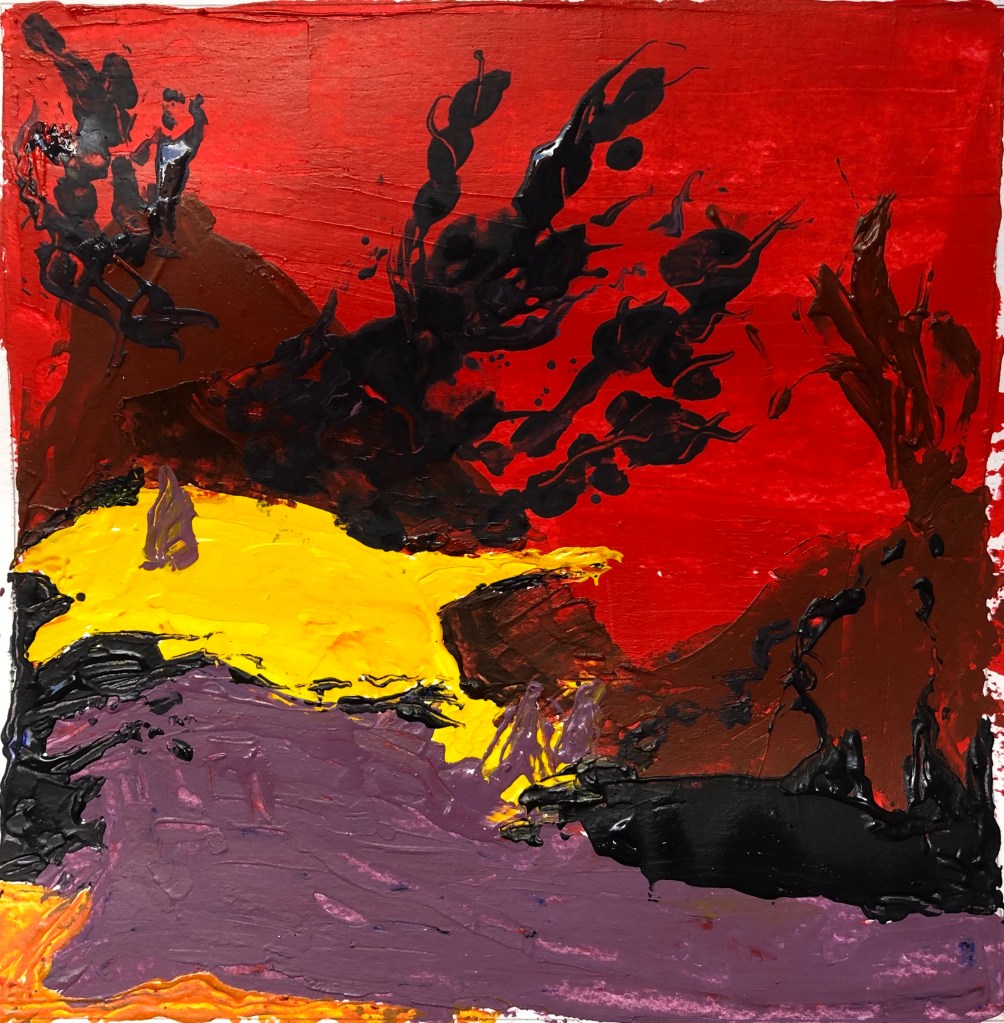
First attempt was with egg tempera – never used this before so I was very excited to try it out. I had the three primary colours plus black and white. I used some flat and round bristle brushes and worked in my multi-media sketchbook (250gsm paper) at 7 x 7 in. The red was applied in several fairly dilute layers; the yellow seemed a very strong colour and was applied more or less out of the tube with a few brushstrokes. The mauve was mixed using red, blue and lots of white and put on with broad flat strokes using a wider brush. The black was trailed, dabbed and splashed.

My second attempt was again in my sketchbook in a 7 x 7 in square, this time using some very old System 3 acrylics. I felt the brushstrokes had been noticeable in the egg tempera version so I thought I’d try a palette knife, seeking a much flatter finish. Again I had the primary colours, this time plus white and burnt umber. I applied the paint with even strokes with the knife to start with, and this gave a slightly flatter effect; however, when I tried this with smaller areas of colour, even with a small knife, all semblance of a flat surface went out of the window. So, huge respect to Jane Callister – I thought this would be really easy but it wasn’t.

NOW WHAT?

The “flatness” of the paint sections was my success criterion.

The egg tempera version ended up having the more even painting of the two, although the brush strokes were evident both in the layered washes and the thicker, less dilute mauve sections. I worked quite quickly, but have now read that egg tempera is a slower process. I am going to try using it again to respond to another of Jane’s pictures, but this time I shall:

  • work more slowly, letting layers dry in between and building the picture up more gradually
  • continue to use brushes, but try sables for a softer stroke
  • vary the direction of my strokes between layers to try and give better coverage and hence a more uniform finish

The acrylic version was my first attempt at painting in acrylic using a palette knife in this way – I feel the image I have produced has energy, but it has ended up the antithesis of my success criterion, and it should have been better because it is the medium Jane herself used to create the original. Again, I shall repeat this medium when responding to Jane’s next painting, but this time I shall:

  • stick with the palette knife for another try but also use brushes 
  • work bigger so I am not trying to paint lots of tiny areas with a knife
  • Build the work up in sections, allowing drying time, so that the paint does not move where I don’t want it to

IMAGE 2

WHAT?

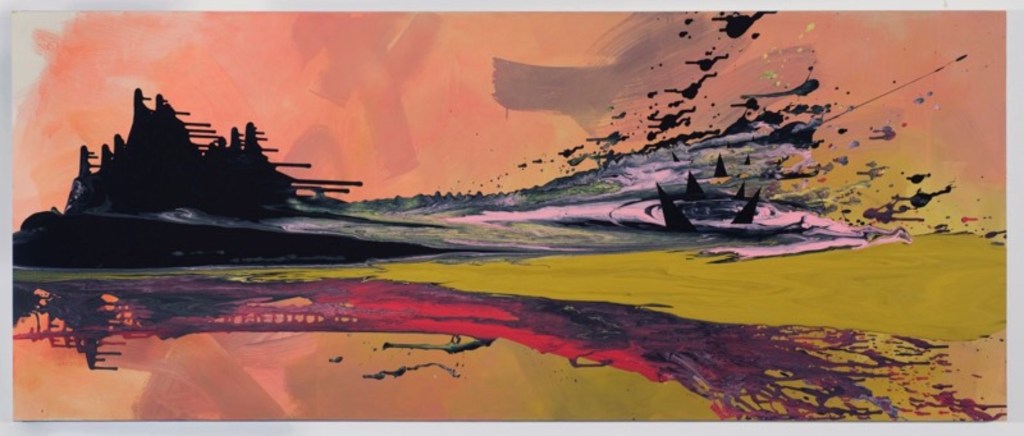
The next image that really appealed to me was “Expelled”, 2009-10 , acrylic on canvas, 38 x 92.125 in, also in the APT collection (see above). A very long painting!

Again, the initial impression was that the picture told a story – there was a lot going on which made me look. At first it seemed related to the “Marshland” fantasy tale – maybe the black section on the left, where I was drawn to look first, was an evil castle – but this time I tried to have the title in my mind as I was looking, and soon, a different interpretation emerged: a sinking battleship on the left and, on the right, a maelstrom with circling sharks. Do you hope to be saved by clinging to the sinking ship, or are you expelled into the waters to take your chance with the sharks? 

 In this painting Jane goes for a similar combination of brooding blacks contrasted with vivid, almost lurid, colours. The choice of shape is very different, however – the width is well over twice the height, suggesting to me that the expelling is a very emphatic process.

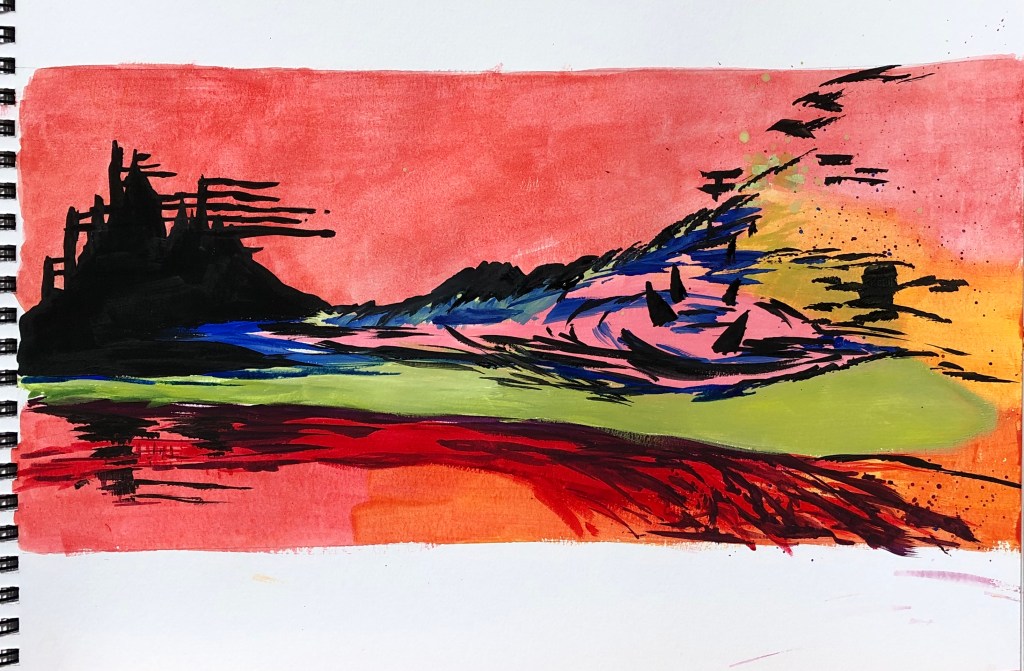
There is more detail in this image in terms of intermingled streaks of colour, but again, I am not going to try for a copy, but rather use it as a starting point to create a simplified version, focusing in particular on the production of flat areas of colour.

SO WHAT?

First attempt using egg tempera was on A3 mixed media paper, ruled off to be more in proportion to Jane Callister’s painting. A more even application of paint was tried by using repeated layers of paint with varying directions of brush stroke, using a soft-haired half-inch flat throughout.

This is the egg tempera version.

I moved on to the acrylic version, using some tubes of old Pebeo acrylics from my daughter, several of which had pearlescent colours; I chose some of these to create a lurid, garish effect. I also worked again with the soft-haired flat as I had liked the flexibility of brush stroke possible. I used mixed media paper but decided to work on the title of the painting by making my version very long, joining two pieces with sticky paper – I wanted to convey the effect of expelling. This was the mid-stage, before adding the black – I used several layers of watery paint, gradually building up until the last layer was straight from the tube.   I have changed the pink “blob” from a whirlpool into the thing which was being expelled.

 The black was initially added with a palette knife, then abandoned for a soft size 6 round brush, and only brought back in for the streaks. So, softer brushes better for flat, even coverage; knives better for gestural marks. What did work well was using cut-out templates for the “shark-fin” rocks; my tutor advised me to try masking for crisp edges.

NOW WHAT?

I’ve learned that:

  • Both media (egg tempera and acrylic) are best applied in layers, thin working up to thick, with varying direction of brush strokes, if your aim is to get even areas of colour; palette knives better for gestural marks
  • Black contrasted with strong bright colours can create dramatic images
  • Joining paper with sticky tape for painting does not always go well
  • I have a preference for pictures which I can read a story into – something to take forward into my own art?
  • The title of a piece (to which I had not previously given much thought) can create quite an effect on the way the viewer sees the image
  • I need to experiment with the streaks and splodges which Jane Callister achieves – didn’t do too much work on these as it wasn’t my focus, suspect she might tip the board and let the paint run?

Painting 1 (UPM): Initial Meet meeting with tutor, 13.7.20

Wide ranging discussion; some important points, in no particular order:

  • Get onto Instagram and follow contemporary artists (e.g. Claire Wood) – look for #WIP
  • Keep eye on discussion forum on OCA
  • Get onto email group by contacting help@oca.ac.uk and asking to be moved over
  • Masking is an important technique for clear-cut edges
  • Useful primary colour combo: Naples yellow, cobalt blue and alizarin crimson
  • Initial research activity: look up the artists suggested, write a couple of bullet points about their work –  “rate” them internally then pick the highest to focus on – remember you are looking at their work as an artist, rather than a layperson – show you have made a decision rather than gone with a whim
  • Lose the flowery language – notes and bullet points are fine in learning log – it is not a discursive document, it is a log of my learning. Good to include open questions. OK to write in my usual style, BUT THEN EDIT! Go through and highlight words/phrases referring to:
    • Process (e.g. tension)
    • Materials (e.g. wet. rough)
    • Context (artists, ideas) – keep these and then ditch the rest!
  • Using sketchbooks – not the same as in Drawing 1 – need to keep an eye on myself, make sure I am still looking hard at things and maintaining my skills – this is function of sketchbook
  • Have a look at Edgezine for more advanced examples of work
  • When submitting assignment include focused reflection including:
    • What will I take forward
    • What questions do I have
    • What do I want from my work (what do I like/not like)
  • Assignment 1 – 14th September (written feedback elected)

Drawing 1; Part 5; South West group day with Dr Michele Whiting – “Language in Drawing” – 23.5.20

Need to look out for workshops from Michele on academic writing – they will be in two parts, and will come out initially through the Fine Art pathway.

Michele gave a very interesting talk about the history of drawing, what it was/is and what it is for, and how it has changed over time – I understand that she intends to publish the subject matter of this talk in the future and so we have been asked not to share details here. I hope it’s OK for me to say that I was encouraged that she referenced Albrecht Durer and Vija Celmins in there, so I felt I was on the right lines with my Part 5 investigation!

I was also interested in her own working method, which comes out of walking (links to my study in Part 5 of Lydia Halcrow’s work and, of course, John Virtue – see separate blog posts within Part 5). Her method actually uses the bodily motion – she will walk in her studio in order to trigger memories of what she has observed whilst out walking. She also (as advocated by Vija Celmins) likes to test out materials until she feels she really understands them and what they can do.

She made the distinction between “output” – basically all the experimental work you are doing – and “outcome”, which is your final piece. If you are fine with your output but freeze at the point of making your outcome (guilty as charged), and you think that one of your outputs is better, then don’t panic, but take that one output and investigate what makes it work for you – how can you build this into your outcome?

We went into some warming/loosening up activities, which she says are always useful, amongst other things, when you are feeling a bit tight (artistically, not alcoholically). 

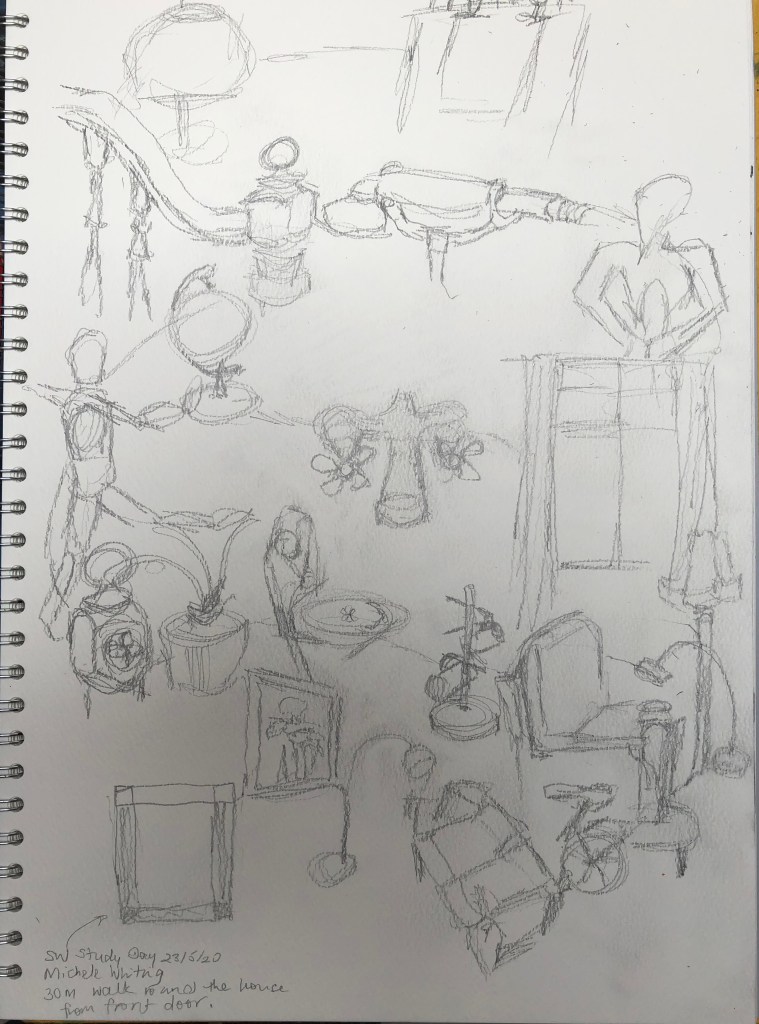
  • First task was to take a sketchbook, start at our front door, and walk around your house drawing (it was left up to us what we drew) – we were supposed to end up back at the front door, but I have an old 3-storey Victorian house with lots of rooms so I arranged to end up in my studio, which is under the eaves, as we only had 30 min for the exercise. Also, you were meant to keep your pencil on the page. There was no time for thinking about how you were going to tackle this, so I ended up doing one quick thing in each place. When you’ve finished it’s interesting to look back and see what you chose on the spur of the moment; I seem to have gone for lots of round things – wheel, lamps, statuettes, taps and shower head, garden chair, more lamps, globe and finials. Sure that says something about my psyche. Apparently, some of the other students didn’t progress beyond their hallway! – so just goes to prove how much stuff you have to hand which you can draw – no more thinking “I don’t know what to draw”.
  • Second activity was to take something simple from your kitchen – I chose a small squat jug – as subject matter. Tight timing again here – think it was something like 15 min to draw the subject 10 times whilst looking at it and your sketchbook, then 15 min to draw it 10 times looking at the subject but NOT your sketchbook, then 10 min to draw it 5 times looking at your sketchbook but NOT the subject OR your previous drawings. For me this proved the value of both the repetition and that exercise of not looking at your drawing page, which I did earlier in the course but had slightly forgotten; I was really struggling with the handle of the jug at first, but somehow knowing that you had to draw it without being able to see it really focused me in, and these are my final efforts.
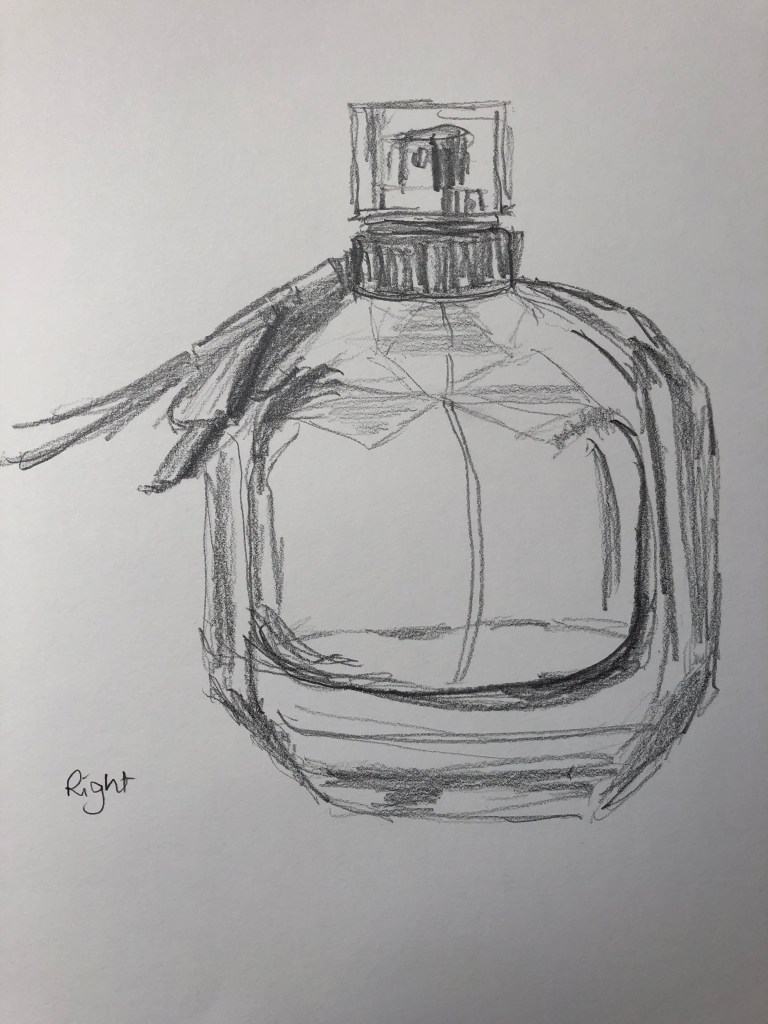
  • Third task was using an object which was of significance to me and which I could hold in my hand (I chose an empty glass perfume bottle, which had been the first bottle of perfume my husband ever bought me). We had first to hold the object in our non-dominant hand (Michele used the term “unorthodox”) and had 15 min to draw it with our dominant (orthodox) hand, being able to look at it for reference. Then we had to put the first drawing out of sight, hold the object in our dominant (orthodox) hand, and draw it from memory (i.e. being able to feel it but not look at it) with our non-dominant (unorthodox) hand. Phew! The drawings in my case were fairly similar, as of course I have been using my  left hand a lot after breaking the shoulder of my dominant right hand.

After sharing our work, Michele went on to suggest some other freeing/loosening up activities we could try out in our own time:

  1. Make yourself a box of tools which you have created – you don’t have to buy everything, you can make tools, so get inventive.
  2. Take a page and make a record of that day – you can draw, map write – the only rule is to have the date in the centre.
  3. Make a series of drawings of your face by feeling it but not looking – don’t have to do a full face, can do sections, use either hand…
  4. In your immediate environment, just pile stuff into a quick assemblage, don’t be over fussy, and just draw it.
  5. Do 50 drawings of the same object in 4 hours – see how your drawings change.
  6. Take a phrase and make an image using the letters as many times as you like.
  7. Make tonal range strips to explore your medium.

We had a quick discussion about assessment and issues arising from the change to digital submission. Points arising:

  • Choosing your blog posts – you will end up with only a small array – tutors were missing out on evidence of  “discernment”, but this will show the assessors your thinking and priorities.
  • Someone had tabulated their blog posts, referring to link and learning outcome. You could put links to a url or, if not confident with this, could make them into a pdf. You can reorganise written work from your blog. You can put your chosen blog posts into one document for ease of reference for the assessor.
  • Clarity, flagging things up is really important.