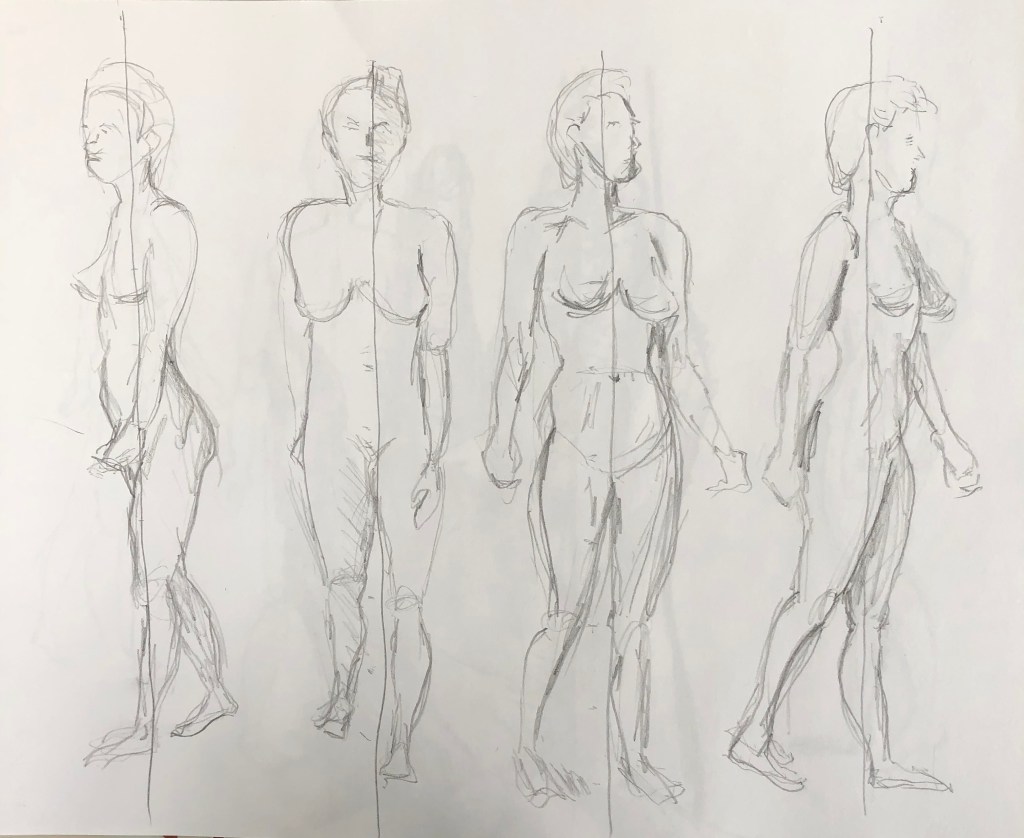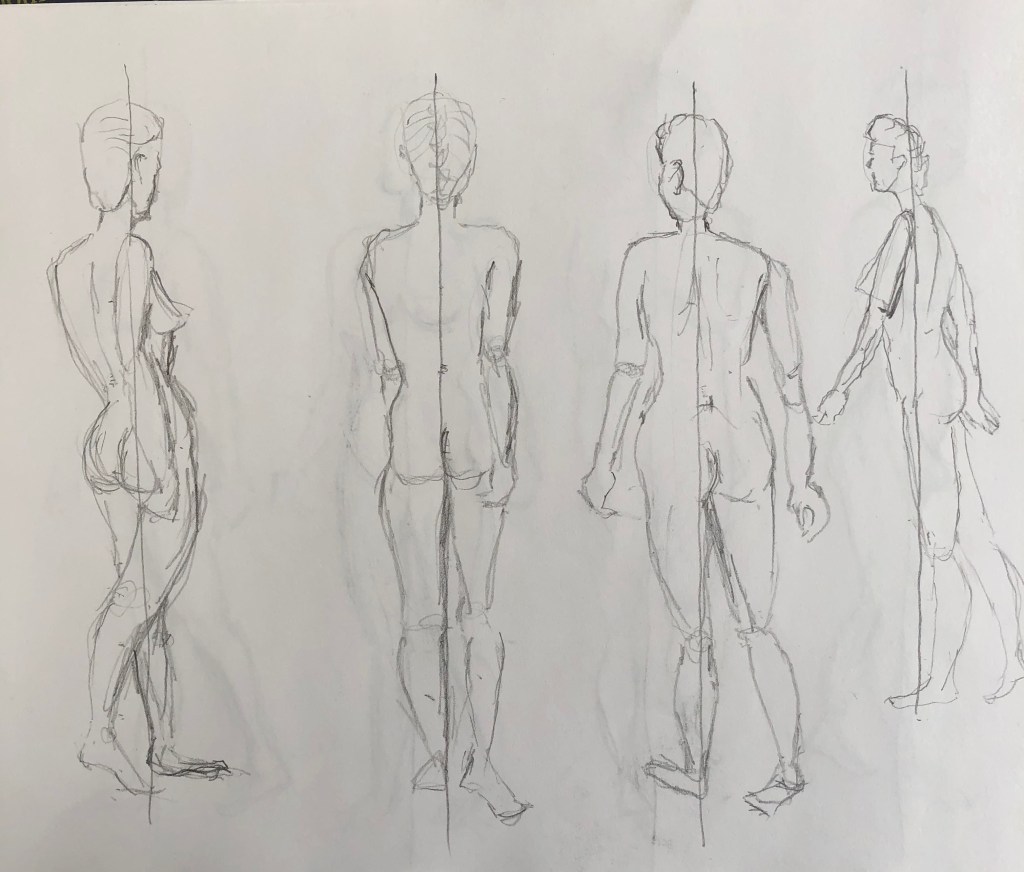
Drawing 1; Part 4; Project 2 – Proportion; Exercise 1 – Quick studies

I had joined a life drawing group in Tavistock soon after starting this part of the course and was “training up” my left hand to be able to draw, having broken my right shoulder. Life drawing was extremely new to me, and a combination of this, along with a lack of leftie fine motor skills, have made these first drawings look quite faint and tentative, despite being done with a 3B pencil.

Before going, however, I had watched a video in YouTube (sorry, details not noted down – bad practice) about proportion – the head being roughly one-eighth of the height of the body, belly-button around ⅜ down and groin halfway, so I used these to see if they were approximately right, and I think it’s worked pretty well with this model, who seemed to me to be a fairly “standard” build.

I didn’t worry too much about the facial features as I was unused to working at such speed. In the first drawing, even though the course notes said not to be tempted to draw outlines, I’m afraid I did exactly that as I only had 5 min. I also transgressed by starting with the head, as my cunning plan for establishing correct proportion meant I needed the head in first to be able to measure out my eighths…oh dear.

The next two sketches were 10 min each, so I had a bit more time to block in bits of tone to try and establish form as well as outline. I could see I had drawn the legs too short in the first of these, so made up for this in the second of the ten minute drawings by really concentrating on the legs and making sure they were correct – a great improvement, I think.

The group then went on to longer poses, and I can see that this is going to be an ongoing mismatch with this unit, in that what is possible from a weekly life drawing class is not always going to match up with the exercises. My plan therefore is to find at least some work from my life group which relates to each exercise as time goes by, combined with filling in gaps using work from images in books and online. I have done loads of reading around this subject over the course of the last 3 or 4 weeks due to my unfamiliarity with drawing people, so feel I am learning loads and experimenting loads and gaining great experience, all rather serendipitously – so will have to have periods, like this evening writing this blog post, when I just stop and look back at where I have got to so far.

Drawing 1; Part 4; Research point – depiction of nudes over time

  • Just watched the first part of John Berger’s ‘Ways of Seeing”. His point about art critics’ tendencies towards ‘mystification’ was particularly interesting to me; I used to rely on reading the text about a painting after only a cursory glance at the image, but I do feel that as time has passed I have got much better at standing and looking carefully at a work of art and trying to pull some things out of it myself before reading the text – I do find that any mismatches between text and my understanding from the image then tend to jar, and one is then left wondering whether the critic actually does know more than me (entirely possible, obviously) or whether their’s is just a different interpretation, perhaps as a result of prioritising one feature of the image over another (as the children did in the video).
  • Part 2 was very thought-provoking. I can imagine a modern-day Me Too enthusiast having forty fits over it, especially over the attitudes of some of the ladies interviewed, one of whom in particular reflected the passivity JB had talked about. I had never really thought much about the derivation of the nude as a class of painting but, if pressed, would have said that it derived from the classical Greek tradition, where male nudes were as common as females, if not more prevalent. I was therefore quite taken aback by JB’s suggestion that for “nude” in European painting read “female sexual object to be ogled at and preyed upon by men”. Now that I have been made to think about it, I can see that JB’s take on it is much more pragmatically realistic than my own rather naive, high-minded and unworldly view. Surely though, there was then (certainly is now) a class of people (men – John Ruskin?) who would buy an exquisitely drawn or painted nude out of admiration for the artist’s skill in creating an image, rather than just to lust over it? Need to watch the next episode…..
  • As I should have expected, Part 3 took a different tack and looked at the traditional European oil painting as an expression of wealth, property and power, which I had previously touched upon in my research on the history of still life from the 17th century onwards (see Part 2). Interestingly, he did this time mention painting of the classical stories (including many nudes), but represented them as a set of characters and costumes (whether clothed or not) into which the purchaser could step in their imagination and live out the stories in their dreams with themselves in the title role – a power, yes, but open to anyone who has ever read a book.
  • Part 4 looked at advertising, and its purposes and effects as in 1972. Over the 38 years since, the explosion in the use of imagery to manipulate people’s thoughts and actions has made the present a time to be even more aware of what is being said and implied, and to be conscious and wary of the implications of accepting suggestions at face value. One particular thing which struck me, in the context of the nude, was the amount of sexualised images which were taken for granted as the natural way of things – his sequence of adverts filmed up what looked like an Underground escalator, is exactly as I remember it used to be, with image after image of scantily dressed women, or women hanging off dominant men – and at the time I accepted this as just how adverts were, whilst not in any way applying their messages to myself, but yet not going the extra mile, as some women did, and protesting about this state of affairs. Such images of scantily dressed women still occur today, but are more balanced with images of scantily clad men, and the “message” feels different – in the words of the song, sisters are doing it for themselves.

I went on to read Eisler, Georg, 1977, From Naked to Nude, Life Drawing in the Twentieth Century, Thames & Hudson. He refers to Berger’s work but feels that the idea of the male ‘owner-viewer’ is not the whole story, suggesting that, historically, sexuality was a woman’s only weapon, and that, as the subject of a nude, she gains dominance over the patron, reducing him to the more uncomfortable role of voyeur – certainly that’s the look I see in the eyes of the feisty lady in Manet’s 1863 Le Dejeuner sur l’herbe, oil on canvas, Musee d’Orsay, Paris.

I also read the online article by Marion Simon https://quillette.com/2019/09/10/in-praise-of-renoirs-male-gaze/ , which includes a link to an interesting lecture on Youtube given by Martha Lucy called “The Trouble with Renoir. The point is made here that reactions to an artist’s work and the way it is perceived varies and depends very much on the mores of the time. Marilyn Simon’s article is interesting in particular for the distinction which she draws between her own self-image and the potential image of herself as an artist might see her, and goes on to say: “Contemporary feminism insists that men and the male gaze objectify women, thereby making men into the powerful, brutish, and oppressive monolithic force we commonly know as “The Patriarchy.” Yet the male gaze often reveals men’s vulnerable side. The way they see reveals not their power but their yearning; their desperate need for tenderness in a world that can be hard and unkind, and which turns men into cogs within the economic machinery.” I think this was a more technical way of saying what I tried to summarise in the previous paragraph!

Everything I read about this complex issue seems to send me in a different way. On a recent visit to London (see separate blog post about the London Galleries) I was extremely dismissive about the work of Kathe Kollwitz which I came across in the British Museum (it had been a long day and I was quite tired, in my defence…). Since then though, I have found myself moved to do some drawings inspired by her work (see A3 sketchbook), and was extremely interested to read about her ideas in Betterton, Rosemary, 1996, Intimate Distance – Women, Artists and the Body, Routledge, London and New York. She takes the traditional “male gaze” view, that the artist may “look at but not inhabit the body” and portrays the dichotomy which this necessarily creates for a female artist in her drawing, Self Portrait and Nude Studies, 1900, graphite, pen and black ink; although the author goes on to develop an Oedipal theory about motherhood which I am not sure I followed.

Drawing 1; Part 4; Project 3 – Form; Exercise 1 – Basic shapes

I used a set of photographs of a chap in the classical pose of “Thinker” taken from different angles to draw from – I went for a side pose, a back pose and a frontal pose.

I had some Nitram charcoal sticks as a birthday present so was eager to try them out – decided to start with the hardest H stick – this allows for quite a range of darkness from a thin faint line to something quite dark and heavy – seemed ideal for this exercise.

I used the head as the main measuring tool, working on the assumption that this was approx one-eighth of the total height of the body. I placed the building blocks of the body using simple shapes drawn very lightly, and then went over the lines to add appropriate dinks and curves before adding some shading to try and establish the 3-D nature of the figures.

I am quite pleased with the proportion of the first figure (side view), although I think he has ended up being the least “solid”. The second drawing (back view) was very interesting to draw, I don’t think I’ve tried a back yet and feel the shading is in the correct places but could stand being stronger to make the contrast of the slightly twisted-away side. I struggled a bit with the angle of the arm, but am pleased with the foreshortened left thigh, even though it was weird to draw.

The third drawing is face-on and probably the most complicated as far as the placement of the limbs was concerned. The foreshortening of the thighs again needed a lot of careful observation and is going to need much practice.

Drawing 1; Part 4; Project 3 – Form; Exercise 3 – Stance

For this exercise I used a book of photographs of nudes intended for artists (Harwood, J (ed), 1989, Illustrator’s Reference Manual – Nudes, Bloomsbury, London); this particular book, which I borrowed from the West Devon Group of Artists today, contains photos of both men and women in various poses, and each pose is “shot” from 8 positions – as if you had walked around the model and stopped 8 times to take a photo.

I chose a straightforward standing position to work from, and managed to draw all 8 poses within the art group session – so, allowing for stops to chat, about 10 min or just over per pose. I am still using my left hand, which is my non-dominant hand, and today I worked in my A3 sketchbook using  a 5B pencil. I worked sitting down, which doesn’t allow for the application of the same pressure as a standing drawing as it is less of a “whole arm” movement but is more restricted to the forearm.

I concentrated on the whole body rather than the face, but used the length of the head as a measuring unit to mark in where the rest of the parts should fall – I have been working on the basis of the head being one-eighth of the whole. I also tried to draw in the rough basic shapes first before refining them by adding bumps and wiggles and I didn’t erase any marks which weren’t quite right.

When I had finished each sketch I tried to mark in the line of balance, starting at the head and going straight down – I was pleased that most of the lines of balance were fairly close to where they should have been.

Drawing 1; Part 4; Project 1 – Fabric and form; Exercise 2 – Emphasising form with cloth

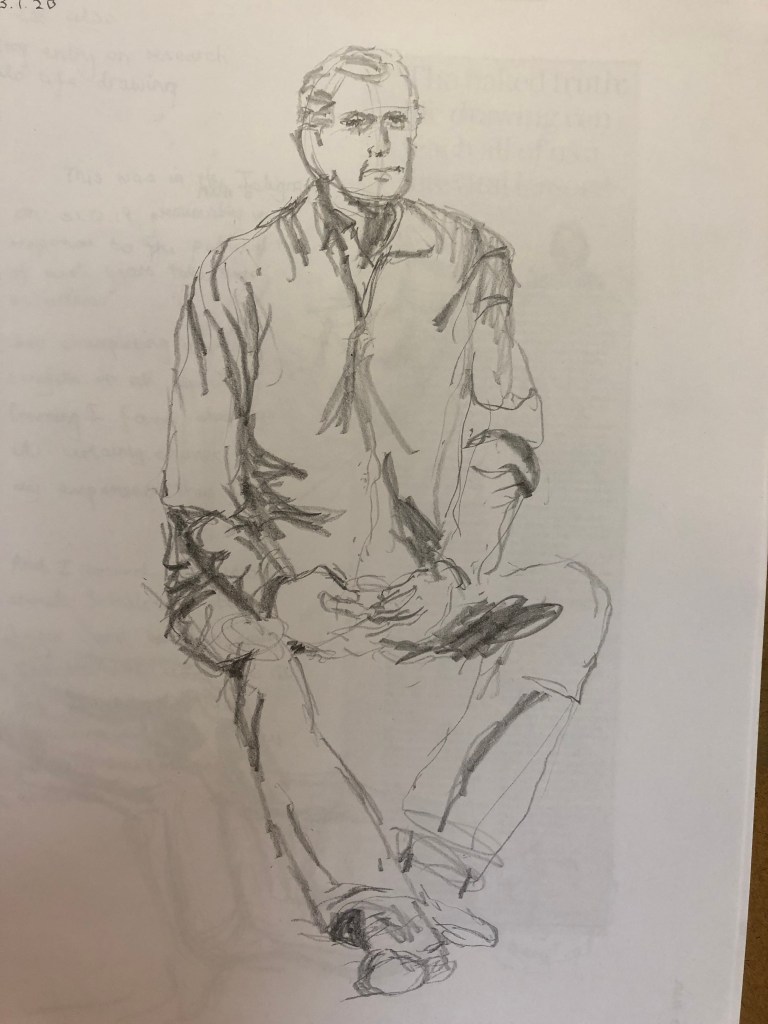
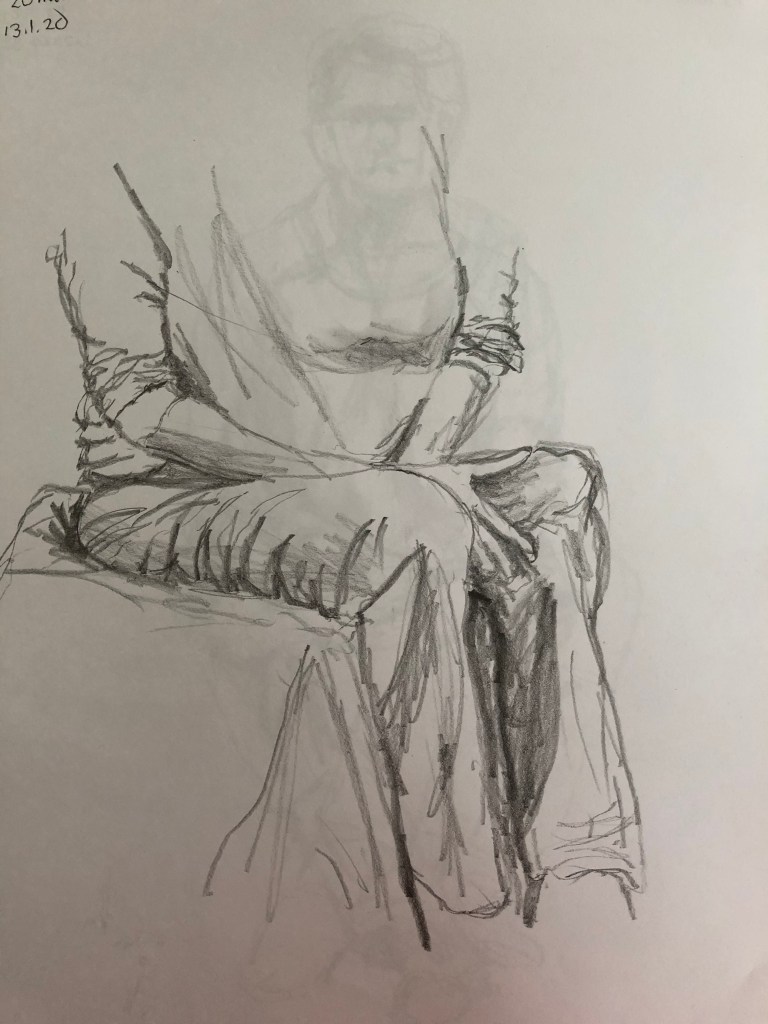
Today at the life drawing class in Tavistock, our model unaccountably failed to appear, and so we took turns drawing each other; and, since it was a cold and blustery day, serendipitously, nearly everyone was wearing a baggy jumper and/or trousers. A day made in heaven specifically for this exercise, I thought….

I am still unable to tackle life drawing with my dominant right hand, so am sticking with the left, using big expressive strokes and my trusty 3B pencil. I am gradually growing in confidence with life drawing, thanks to:

  • This now being my fourth session
  • My trip to London for a whistle-stop tour of as many exhibitions featuring portraits/people as my brain could accommodate (see separate blog post)
  • Reading a book acquired on voyage – Legaspi, Chris (2020), Life Drawing for Artists, Quarto Publishing Group USA Inc. – only partway through it, but it has confirmed that my big sweeping strokes are a useful thing, and made me understand the structure of a life drawing class and the point of all the different-length poses.

We did quite a few drawings today which can be seen in my A3 sketchbook, but I have photographed three to talk about here. 

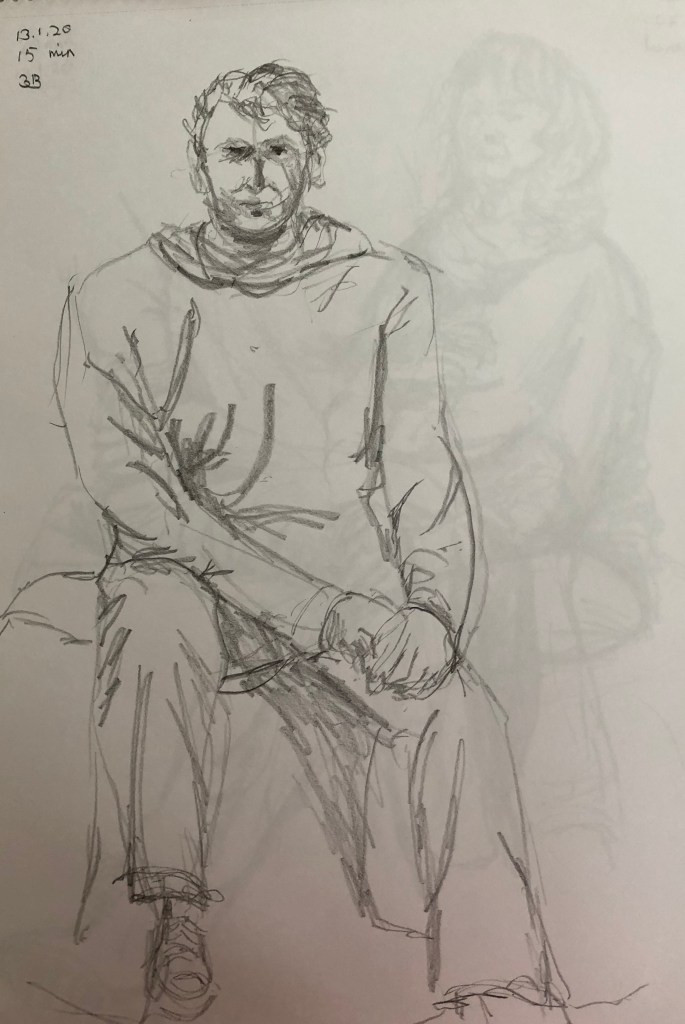
This gentleman had a big chunky fleece-type jumper and he adopted a helpful slouchy pose clutching his coffee mug which let the jumper fall into lots of folds. All the poses today were about 15/20 min as none of us are professional models so didn’t want to tackle anything unduly long or awkward and difficult to maintain, but this gave me time to get the overall structure of the figure in, practise placing the “crosshairs” on the face 

(a term acquired from my book – basically identifying the horizontal and vertical mid lines), and then concentrated on the folds of the jumper and how they gave definition to the torso and arms.

My next attempt was a slightly older lady who again had a baggy jumper, this time with the sleeves rolled up, and who also sported some fairly loose trousers which bunched up in some places and hung or flowed in others. I focused on the midpoint where she had tucked her right arm and hand between her knees – so I began with that hand and worked my way outwards. The direction of the creases does add a three-dimensional quality to a flat drawing. I am also trying to sketch in just a few folds from the cloth on which the models sit – just a few fold lines hopefully give structure to the seat and make more sense of the sitting position.

My third drawing to be discussed here is of a younger man wearing a chunky hoodie and thick jeans. I was lucky to have him facing full on for this sketch so hoped to use long bold lines for the folds in order to give structure to the whole form – I wanted to get the whole body as all the other poses today had been three-quarters on to me.

I think I have managed to catch something of his bulk; I think my attempts this time at depicting his “perch” have been slightly muddling with the trousers confused with the fall of the backcloth – but I was pleased with the way I had caught his right leg which was facing me straight on, foreshortening the thigh to virtually nothing..

Drawing 1; Part 4 – The Figure and the Head; Project 1 – Fabric and form; Exercise 1 – Drawing fabric using line and tone

Well, this was a bit of a challenge for my left-handed drawing – but I decided to embrace the advice I was given at the recent Zoom critique session, to loosen up and see what other things could be achieved with the non-dominant hand. I threw a bath towel in a heap on a stool and started in…

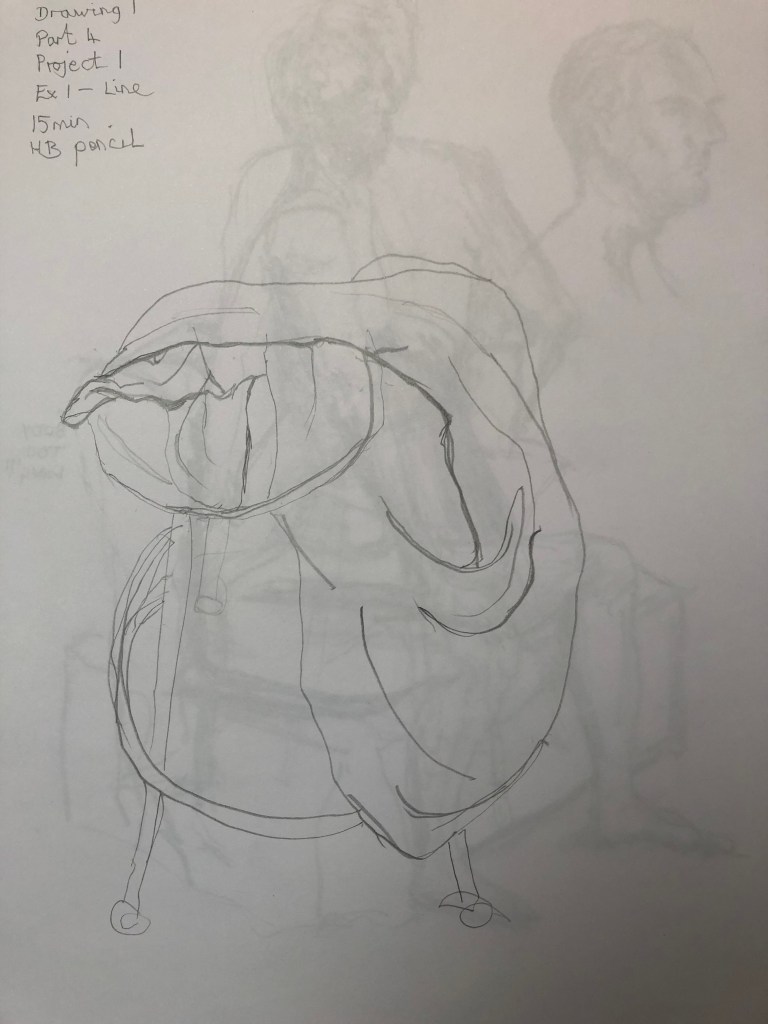
First up was the 15 min line drawing, which I decided to render in my trusty HB pencil. This was always going to be a struggle as I am finding it difficult to place and control lines with accuracy – and so it proved. However, sweeping lines are easiest for me – drawing with the whole arm almost, rather than hand, wrist and forearm, and so the outline is reasonably representative of the towel. I found it more difficult to represent all the inner folds, as much because it was tricky keeping track of them as it was drawing them with control.

Afraid this is also a fairly duff photo as the work on the reverse of the page shows through – however, after 15 min work, I think the viewer might just about grasp that it’s a drawing of some piled-up fabric.

Next was the 15 min tone drawing – I went for charcoal pencils for this as it gave me more flexibility to use the pencils on their side for wide sweeps of tone and blending.

I think this is more successful (as in, more recognisable), although I found myself going back and marking in some lines just to try and keep track of where I was.

I found the big sweeps and folds easier to represent and to make 3D than the really convoluted overlapping folds in the middle, which are a bit of a jumble and the surfaces are hard to follow.

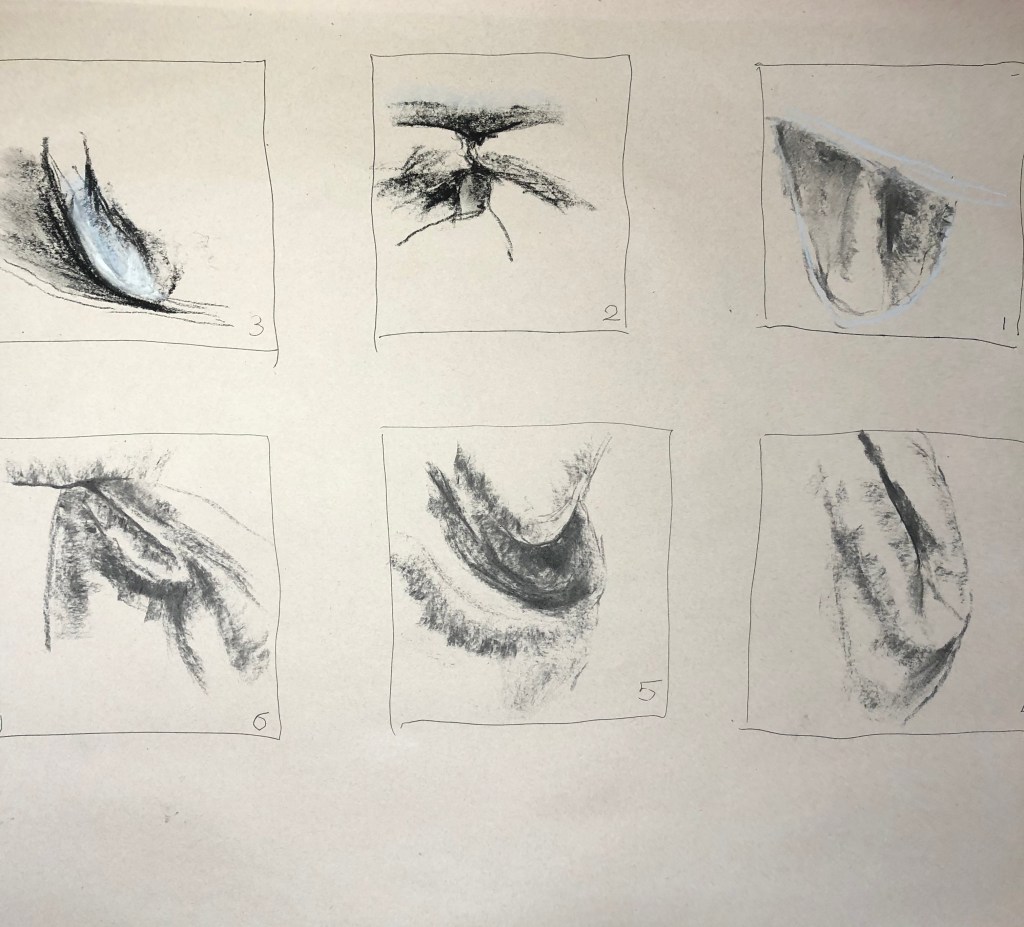
Moving on to the 5 min studies of small areas of the fabric, I felt the need to work (a) bigger, and (b) on paper that wasn’t white, so I opted for a sheet of fawn/grey sugar paper. I’m afraid that, because of the whole left-handed drawing thing, I worked the boxes from right to left, so they are numbered slightly counter-intuitively. My plan was to work in Conte crayons and charcoal, putting in the darks with the black, and the lights with the grey/white crayons.

I tried this out with the first three (moving top right through to top left), but I found it hard to get any sort of likeness, and was despairing slightly of being able to get the hang of this.

Moving down, I decided to simplify by really focusing in on just one fold, and also just used charcoal. This was much more successful and whilst by no means the finished article, these lower three look much more 3D and also more representative of the “feel” of the towelling fabric.

Much work still to do, though, I feel…

Drawing 1; Part 4; Research point – my thoughts on and reactions to life drawing

Well, I had already started on the second research point about the history of the nude, so have been made to confront issues that, in my naivety, I hadn’t really recognised before – see blog post on that research. So I’m going to keep this blog post as a document of my own personal feelings and reactions to drawing people – an aspect of art that I had always shied away from.

Last week I attended my first life session with a local group. The booked model had phoned in unwell that morning and replacements could not be found; hence we agreed to do a few 15 min sketches of members (all clothed) and then, as I have a broken shoulder and am struggling to draw left-handed, I volunteered to sit for a longer session after coffee. The experiences of being on opposite sides of the drawing board were quite different:

  • Sketching class members (strangers or passing acquaintances) was surprisingly forensic – initial qualms about rendering the sitter in a politely flattering light were dispelled once I discovered that we didn’t really go round and look at each others’ work, and I was soon blocking in heavy jowls, bags under the eyes, rolls of fat and double chins with the best of them. You soon lose yourself in the moment and it is as if it is only you and the model in the room; you are locked in a joint endeavour. Being compelled to work left-handed is, I think, going to be at least partially beneficial –  I am unable to produce a reliably accurate line, so am being forced to look for shapes and blocks of tone.
  • Acting as model (clothed) made me focus straight away on comfort, especially that of my smashed shoulder, so I was quick to establish myself in a slouchy but supportive position which I felt I would be able to maintain – unlike the class members who had preceded me who all adopted a smart, straight-backed, pull-your-stomach-in pose, gazing heroically into the far distance. And, once they are all drawing, you forget about them completely; it is like entering a wide empty hall in your mind with many doors – you can push against one door and start thinking about x, then return to the hall, enter another door and start thinking about y – whilst all the time leaving a small part of your brain in charge of remembering to check that you are still looking at the same spot on the floor whilst remaining relaxed and not forming a rictus-like stare. Time flew by and the agreed 40-min limit came way before I anticipated. I was tempted into glancing at the drawing of the group organiser (a local artist called Scott Russell – see his page on www.cargocollective.com) – he had gone for a portrait rather than full body, and I did think he had ‘caught’ my likeness – gratifying, although bringing home to roost the chubby cheeks (no, I’m sure they’re not jowls) I seem to have grown of late…
  • In this week’s life class we had a proper nude model, a young-ish lady whom the group had not hired before. She was, however, clearly experienced in the job, and generated her own poses without being asked (although she was happy to adjust them slightly if asked). She did three shorter poses and then two extended poses, one lying flat and head hanging slightly backwards, the other a sitting/reclining position. Her professional matter-of-fact manner made it feel not at all weird to be drawing her – it felt like a job of work for all of us. She did not obviously go round and look at our pictures of her, but when I said to her after the first of the longer poses “Gosh, that was really difficult ,” she came over to look at my drawing and remarked that I had had a very tricky angle to cope with – so I wonder if she draws herself.
  • Well, over the last few days there has been a huge string of arguments on the oca dr4drs email about life drawing classes and the sexual exploitation of models – going on to denigrate artists such as Schiele (whose drawing style I had found very compelling for its use of line), along with Gaugin and Freud, both of whose exhibitions I had been looking forward to seeing early in the New Year. So when I turned up this week at life drawing to find we had a male nude model, I paid particular attention both to my reactions and to his attitude. Ours is a mixed class. Our model was obviously experienced, like last week’s lady, suggesting his own poses and yet being open to slight moderations as requested by class members. He was happy to come round and chat in-between times, covering up in the breaks, and staying afterwards to join us for a glass of mulled wine (last session before Christmas). I observed my own reaction – at first slightly self-conscious because of my own self-awareness – but in no time at all one is totally absorbed in trying to render the pose, as everyone else seemed to be. Certainly, for me, the problem of getting the human form down on paper is the thing, and it seems to be so for the other members of the class, although of course you can’t tell what is going on in people’s heads, and are never going to be able to legislate for that – but there was nothing overtly sexual about any of it. The model was paid, was stressing his availability to come back another time, and appeared relaxed and comfortable with the situation throughout.

Notes on fine art group critique session on Zoom with tutor Helen Rousseau, 18.12.19

This took place between 6-8.50 pm  – there were 6 students plus Helen the tutor. After introductions and explanations of the working of the software, we had a “quick” reaction to each others’ work, followed by more in-depth critique, first with a partner and then the group as a whole.

My piece was this 15 min sketch from a recent life drawing class. I am currently labouring under the handicap of a broken right shoulder (yes, I’m right-handed, wouldn’t you know…) so am having to draw, very inaccurately, with my left hand. 

Immediate responses to the “quick” showing were:

  • Solid strength mood
  • Balanced
  • Perched, roughness
  • Uncomfortable
  • Both subjects solid
  • Strong position

An interesting and helpful discussion among the group followed my showing of my work (presented by my work partner for the evening, Felicity): if one lets go of – is freed from – the possibility/necessity of getting a drawing “right”, as I am having to do – where can you go? What other representations are there? What actually is right? – what other things can one convey apart from photographic accuracy? I confirmed that the experience is certainly making me observe much better, in order to give myself the best chance, and I am almost being forced to look much more in terms of shapes and their relation to one another. This conversation very much reflects a comment from my own tutor in response to my plight, who said she frequently advises students to work for a while with their non-dominant hand for these same reasons.

Other people’s work was diverse and we were all at very different points along the pathway, which afforded those further along to give the benefit of some nuts and bolts advice to those less advanced. We had a sculpture, a set of drawings, a large drawing telling a story, a still life and a portrait. Points for me to come out of these other discussions:

  • It can be helpful to work on several versions of a subject at the same time, allowing one to compare/contrast
  • Look for work of these artists, admired by other group members:
    • Jenny Saville (have done so – reminiscent of Freud?)
    • Maria Lassnig (have done so by looking at report of retrospective in 2016 at Tate Liverpool – apparently this was linked with work by Francis Bacon, and I can see why)
  • A defining characteristic of a fine art student is the ability to be critical (not quite sure how well I have achieved that by my slightly throwaway remarks above – must try harder).

Other points:

Need to install Chrome on laptop in hope of making Zoom work – it didn’t like Safari.