Neil gave a presentation comprising many inspiring images of arrangements of objects using pattern and colour. He included, amongst others, examples of his own work as well as that of Andy Goldsworthy, Christo and Jeanne-Claude, and Cornelia Parker. For some of these artists their work had no deeper meaning – they were looking for immediate aesthetic impact – the “wow” factor. One aspect which appealed to me was “knolling” – arranging items in a grid – an example was the arrangement Neil and his partner had created just by trying to sort out their tools. Neil made the point that he regarded all these arrangements as drawings.
SO WHAT?
Our task was to make an assemblage with found objects in two hours and photograph it; our theme was “How are you feeling?”. We would then look at each other’s photos in turn, without knowing whose it was, and say, not what emotion we thought the artist was trying to convey, but what we saw and how it made us feel.
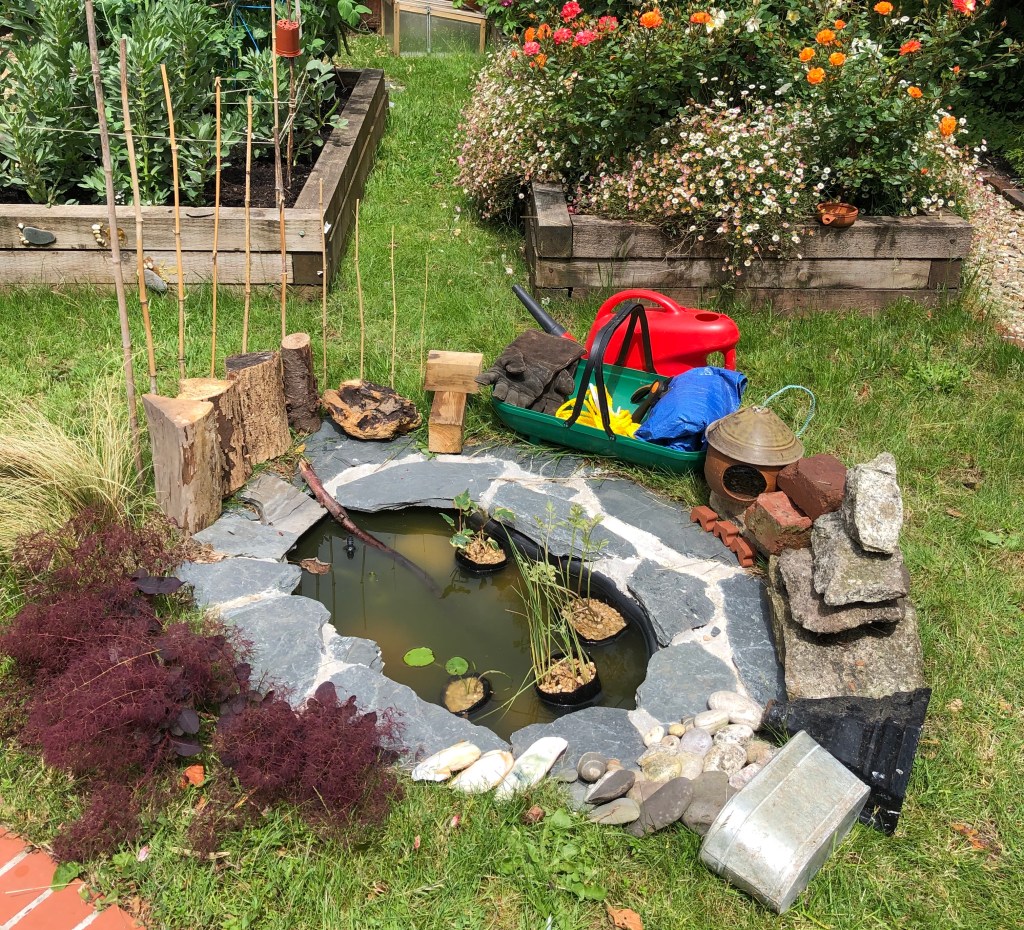
I was in the middle of a lot of writing, sorting and thinking about assessment, so wanted to remind myself that art was fun by making something playful. I collected a load of random stuff from around the garden and made an assemblage round our newly developed garden pond – I had been drawn to Neil’s knolling image and so decided to sort my objects by material, but then chose to arrange them, not in a grid, but around the pond perimeter. The overriding emotion it evoked in others was “calm”; I was pleased that they could all see how I had arranged my objects by material and texture to form a coherent whole.
NOW WHAT?
Four takeaway messages:
The notion of what is “temporary” – nothing is entirely temporary if it has been seen and appreciated as it will stick in the viewer’s memory
“Let your hands do the thinking – if you don’t know what to do, just do something”
The best way to respond to art is to start by describing what you see
The end result is not critical, it’s the process that’s important – so in my blog posts, I need to SAY WHAT I’VE LEARNED FROM THIS, NOT JUST WHAT I’VE MADE
This was going to be a learning experience in three parts:
Today: extend our knowledge, and play
Space between: self directed play, possible collaboration, and making an artist’s publication
Three/four weeks – presentation and discussion of our work
Artist’s publication: research and make, either physically or digitally. OK if it doesn’t make sense!
Ideas and inspiration: see padlet for examples:
Michael Landy’s Nourishment series of portraits of flowers which are overlooked
Louise Bourgeois Cell (Eyes and Mirrors)
Paul Nash The Garden, 1914, watercolour. His work changed over time, but he spent a lot of his time immersed in nature
Richard Billingham Ray and Liz series, 1994 – his parents – insight into a dysfunctional family
Hieronymus Bosch The Garden of Earthly Delights, 1510 – depicts the possible and the impossible
Bauhaus Teaching: see pdf in Books
Learning and Unlearning, 1913-33.
This text leads to our making: choose a found object of material and, working with the possibilities of the material, make a 3D thing, thinking about questions of scale where appropriate. We had 20 min.
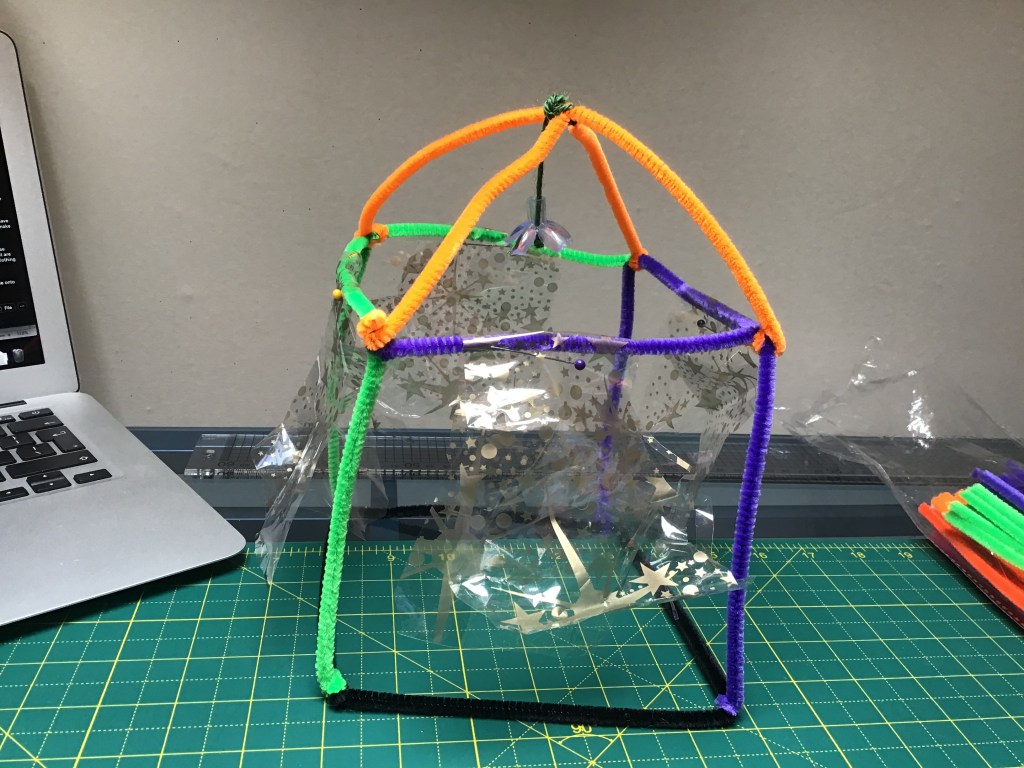
I made a box out of pipe cleaners I had bought to incorporate into my home-made coronavirus masks – it turned into a house with cellophane curtains and a plastic flower lampshade.
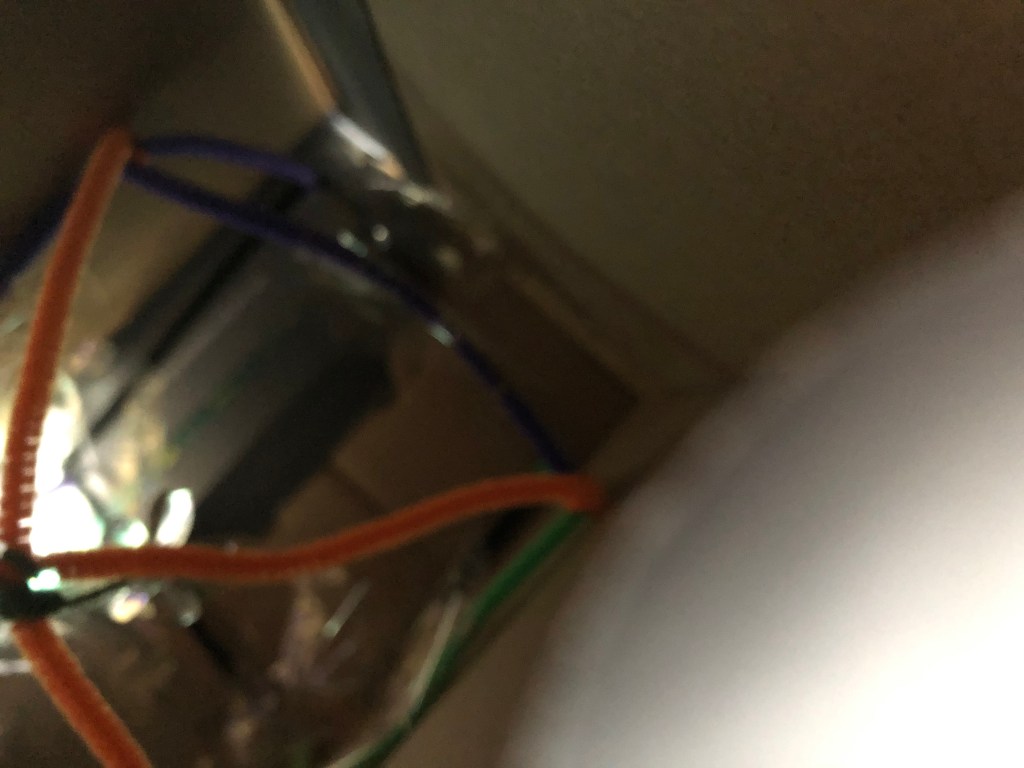
Next, we had to put our object in a box, mainly dark but lit somehow, and photograph it. I put mine in a shoe box and tried to light it through a slit in the box using the torch on my phone whilst photographing with my iPad…..and I can see now why I’m not doing a photography degree…
Everyone had to post their photos on the padlet. Many were experiencing technical difficulties and so we decided to adjourn to the in-between task: we could collaborate, appropriate, work together or alone, and create an artist’s publication, either physically or digitally. It needed to keep the same DIY vibe. We could look on the ICA website for examples, also the Whitechapel bookshop in London and “Printed Matter” based in New York.
My in-between work
I decided to work alone as I was not too confident in my digital skills for collaborating – and I have to confess that, when I started, I didn’t have too much of a clue what I was doing, so I began looking online at the websites Hayley had suggested, and soon became drawn into the wonderful world of artists’ publications which I hadn’t realised existed. It was also a good way to practise getting to grips with searching for things on the University Library – I hadn’t really made much use of this before as I had hitherto been going into the University of Plymouth library, but now this was closed, it was clear that I needed an alternative (I have also been attending the UCA library webinars every week, so was becoming increasingly aware there was a whole lot of stuff out there I was missing).
After a couple of days roaming the internet I decided to work on making an artist’s book, which is, I have discovered, definitely a thing.
I had been drawn to the Nourishment, 2002series of drawings by Michael Landy, which were quite spare and delicate, and also to the idea of Paul Nash spending a lot of time immersed in nature. We have spent so much time in our garden during the lockdown and are acutely aware of just how fortunate we are in having that when others have been shut up in tower blocks; so I decided that my book would be a celebration of my garden.
I went for a zig-zag book format which is easy to make and display and, following Hayley’s instructions, tried to keep it as “DIY-vibe” as I could. I did my drawings quickly with a dip pen and Indian ink on cartridge paper, scanning the garden through the window and picking out features. The cover was part of an old Amazon box covered with a quick abstract design made from watercolours. I decided to cut into the pages a little with a craft knife to give the idea that, in the garden, one often looks through one thing to the next. I put the title on a label made from an offcut of the cover design and attached it with a scrap of garden raffia. Voila! I know it is dainty and rather girly, but looking at it in the future will, I think, always bring me back to this time and make me appreciate what a lifeline the garden has been.


 Sue J's blog