Painting 1 (UPM); Part 3; Zoom workshops with Hayley Lock – “The Garden of Earthly Delights”, Nov & Dec 2020

WHAT?

OCA tutor Hayley Lock led two Zoom workshops, a fortnight apart, focused on the triptych “ The Garden of Earthly Delights” by Hieronymus Bosch. In the first session we looked at the painting in some detail, and were also pointed towards other artists whose work featured gardens/plants/animals/the figure, looking in particular at aspects such as scale, colour, patterns and repeats.

We were placed in smaller groups and invited to work on a response to the presentation together for a while, and then continue with this in the gap between the sessions, communicating by Padlet.

SO WHAT?

My initial “unthought-through” response in the group session using the shapes we had cut out within the session was to create a repeating pattern based on semi-circles.
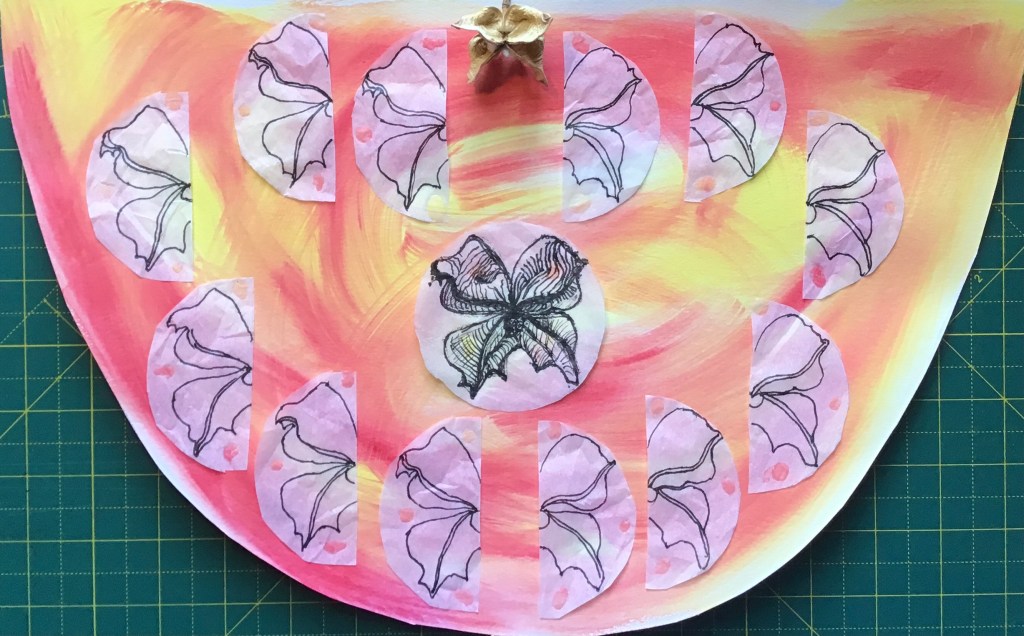
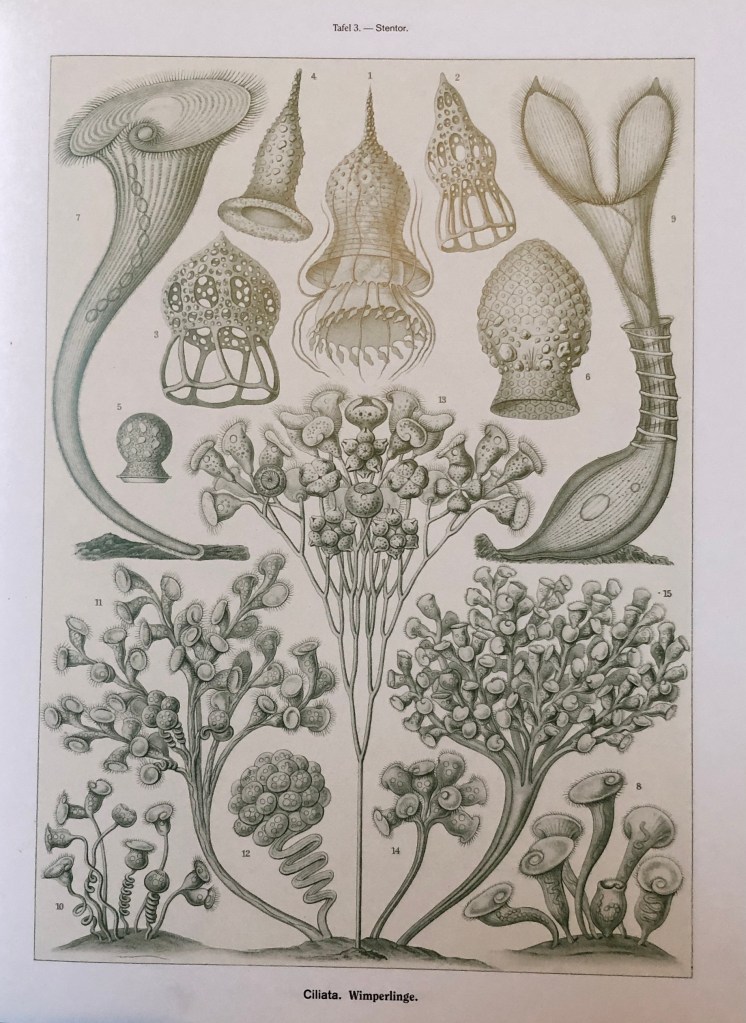
I wasn’t overwhelmed with that – the background was all wrong apart from anything – but I was inspired by the session. I went away to look at Ernst Haeckel’s 1904 book (my copy being a 2019 reprint by Prestel Verlaine of Munich, New York and London) “Art Forms in Nature”, who was one of the artists whose work had been recommended to us, and is a favourite of mine.
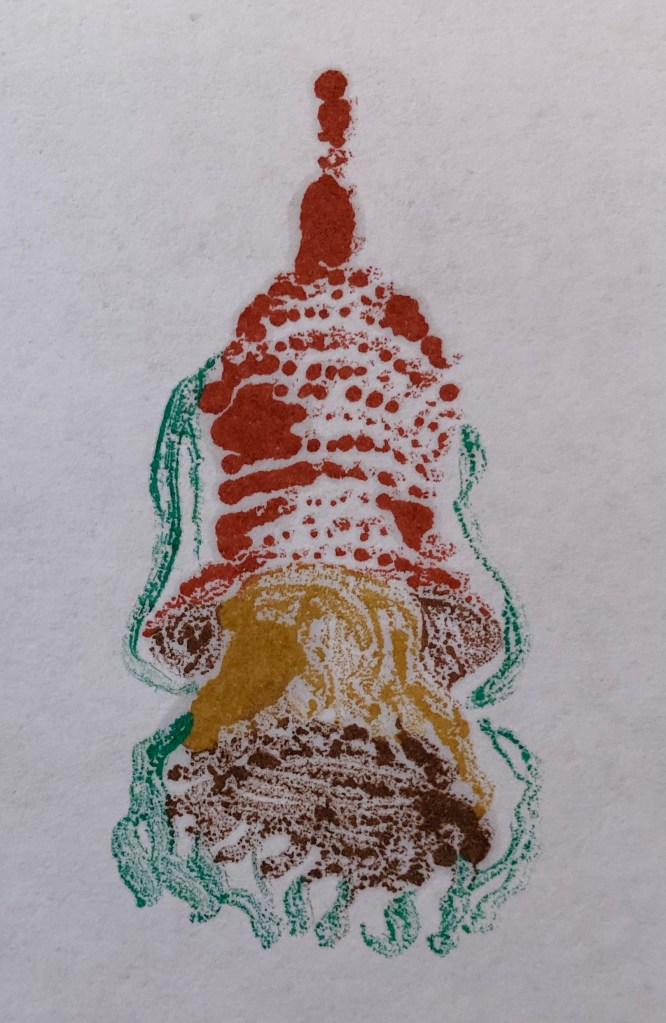
As I am just figuring out the process of monotype, I decided to have a go at some Bosch-like images to make prints of, inspired by the images on one particular page:
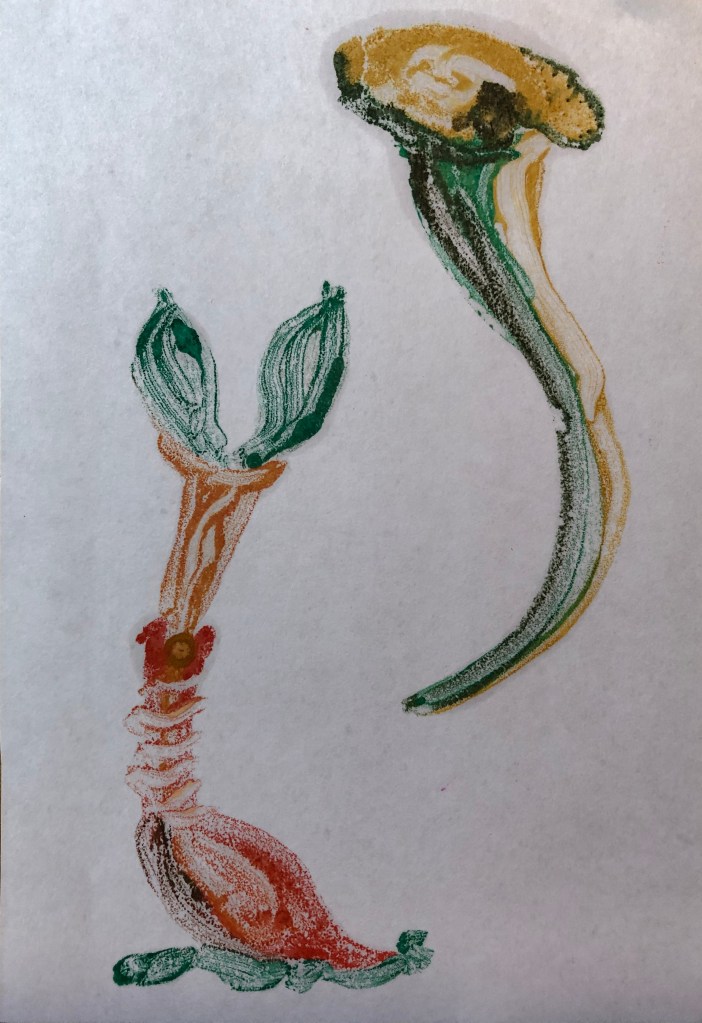
This was fun – didn’t really know what I was doing, used oil paint on glass with Zest-It solvent onto thin cartridge paper, trying different thicknesses of brush and varying marks. The process really does transfer the brushstrokes much better than I thought it would, and my attempts to add tone in the third image by having unbroken marks on one side and dotted marks on the other are at least a partial success – to be remembered……

I also thought the colour/pattern design aspect would lend itself to enamels, which I particularly enjoyed using in Part 2. I used Raqib Shaw’s method again of drawing some triangular diatoms (single celled organisms) from Haeckel, tracing them onto a small gessoed board which I had prepared with a matt black egg tempera ground, and drew over the tracing with gold acrylic liner. Once this was dry I filled in the diatoms with coloured enamels – I had no colour reference to work from, so just wanted the overall effect to be patterned, striking and shiny against the plain matt background. 

In the second session, the student groups took it in turns to show and talk about what we had done so far – my takeaway from this was the huge divergence in the artwork which resulted from a shared input.
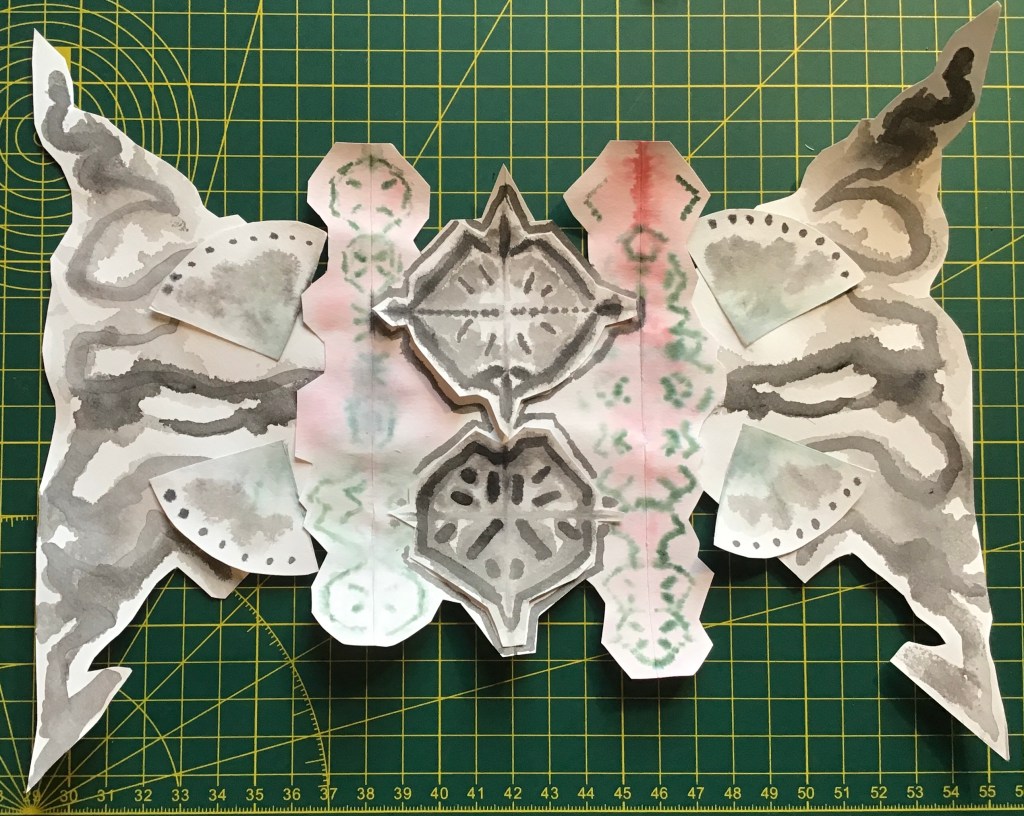
We then worked in the styles of Bruce Connor and Alexander Tovborg to create a potentially never-ending drawing based on gridded, folded squares and circles using the inkblot technique, cutting, joining, working into,  overlaying…..all based on careful observation of one natural thing and mark-making accordingly. Again, everyone’s was very different; I used two water-soluble felt pens, a lot of water  and, when these gave out, dilute black ink. Not sure what it was or where I was going with it, but it was fun.

As part of my background work on this topic, I had looked at www.botanicalmind.online and had been interested in the work of Philip Taaffe – see e.g.: (can’t seem to insert image, sorry)

Philip Taaffe, Lalibela Kabinett, 2008. © Philip Taaffe; Courtesy of the artist and Luhring Augustine, New York.

I suppose I envisaged the work I had produced as a result of these workshops to fit into a project a bit like this of Taaffe’s.

NOW WHAT?

A fanciful and a pragmatic takeaway:

  • Fanciful – I would have time to pursue and develop this investigation into natural forms and produce something in the style of Taaffe’s work – although making it my own
  • Pragmatic – To give myself permission to cut loose and play with form, design and pattern a little “just for fun”, even though it might not lead to anything finished.

Painting 1 (UPM); Part 3; Life drawing workshop on “Movement” with 2b or not 2B Collective, 9.12.20

WHAT?

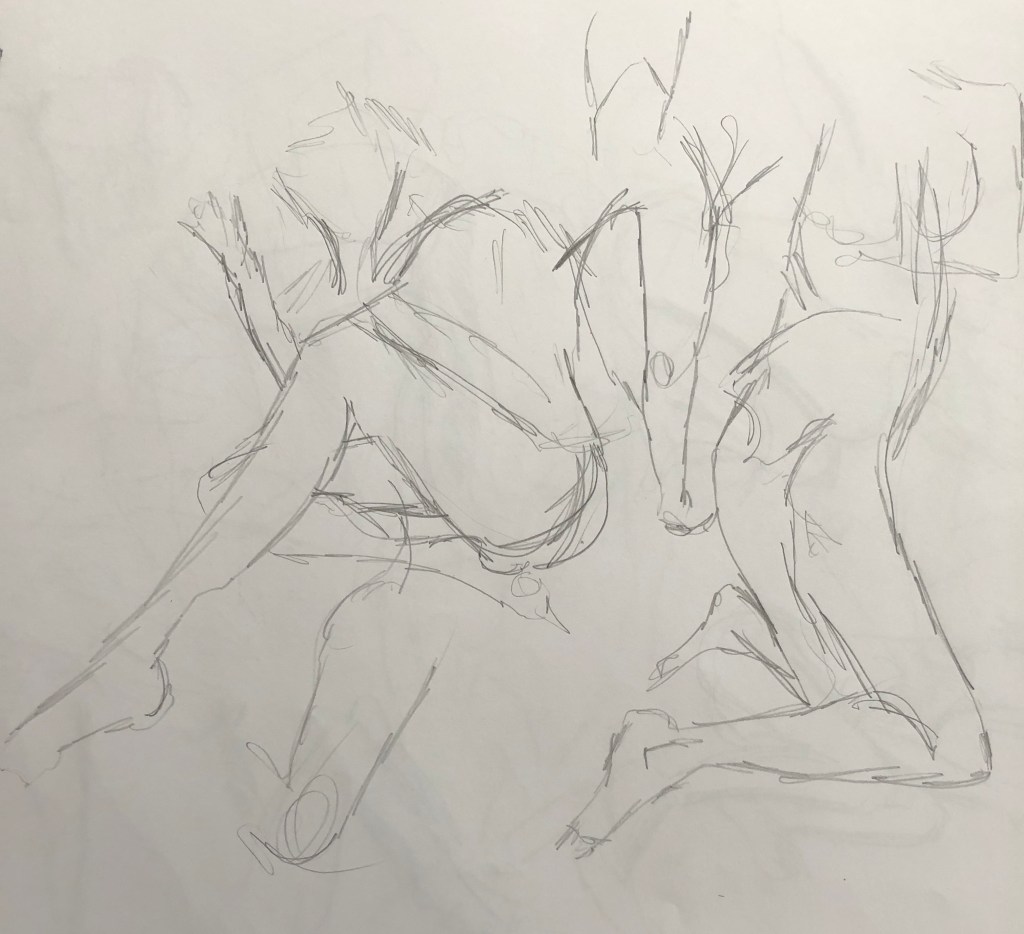
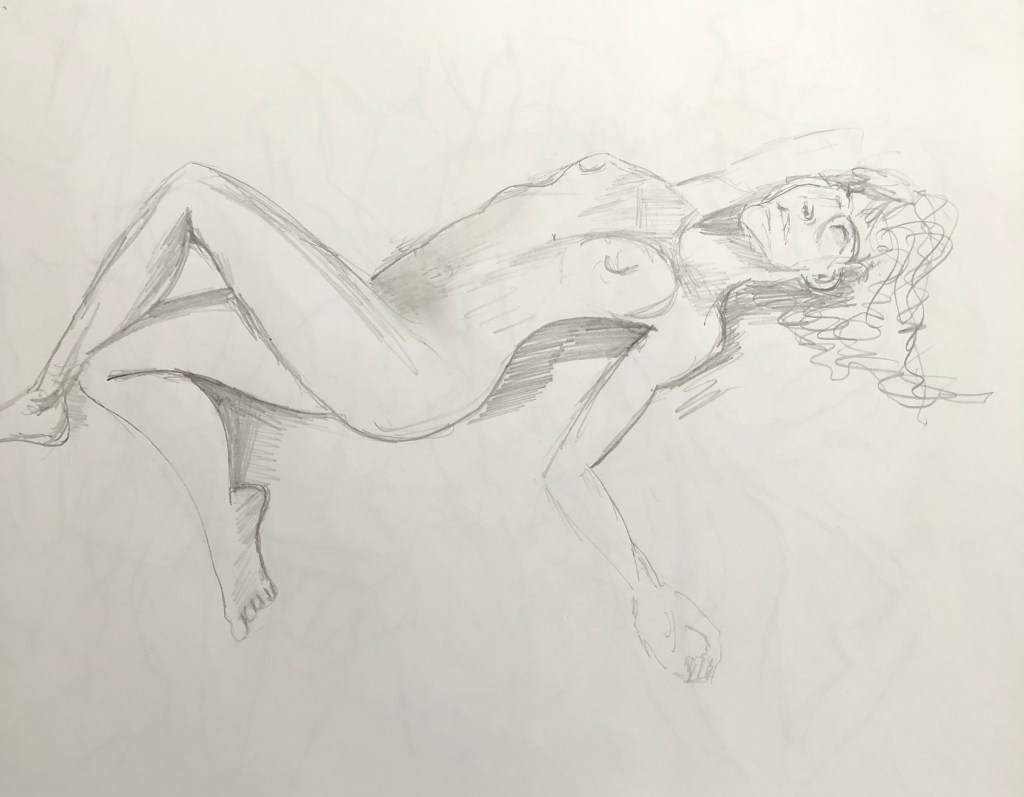
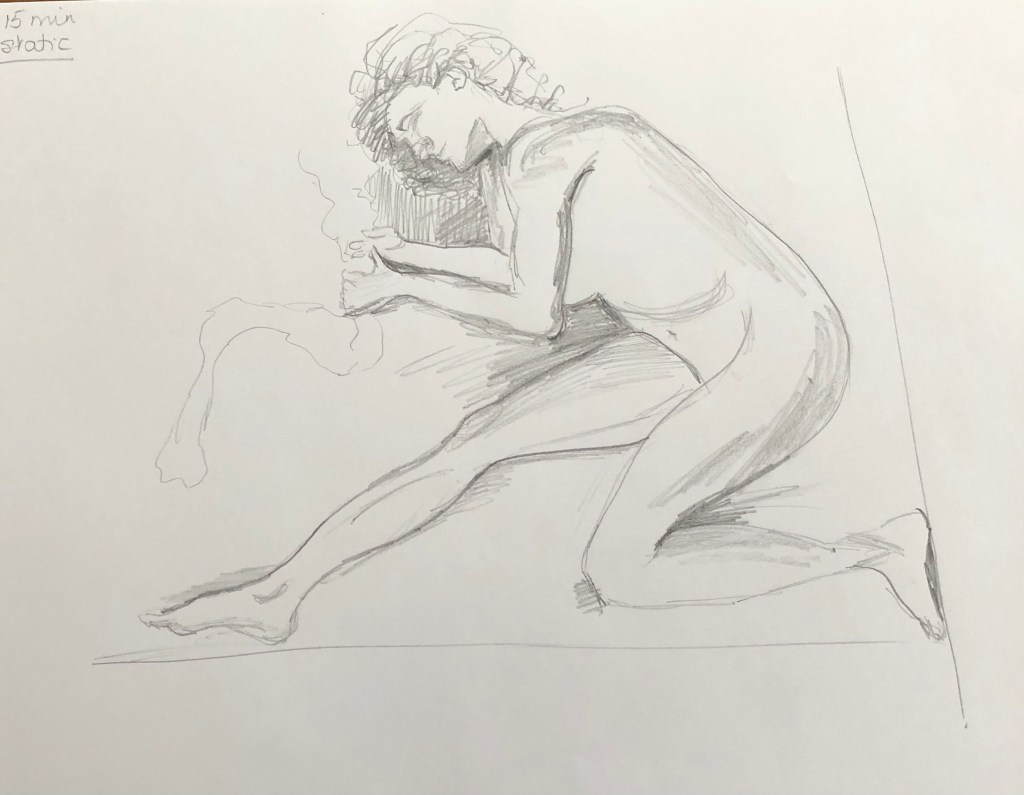
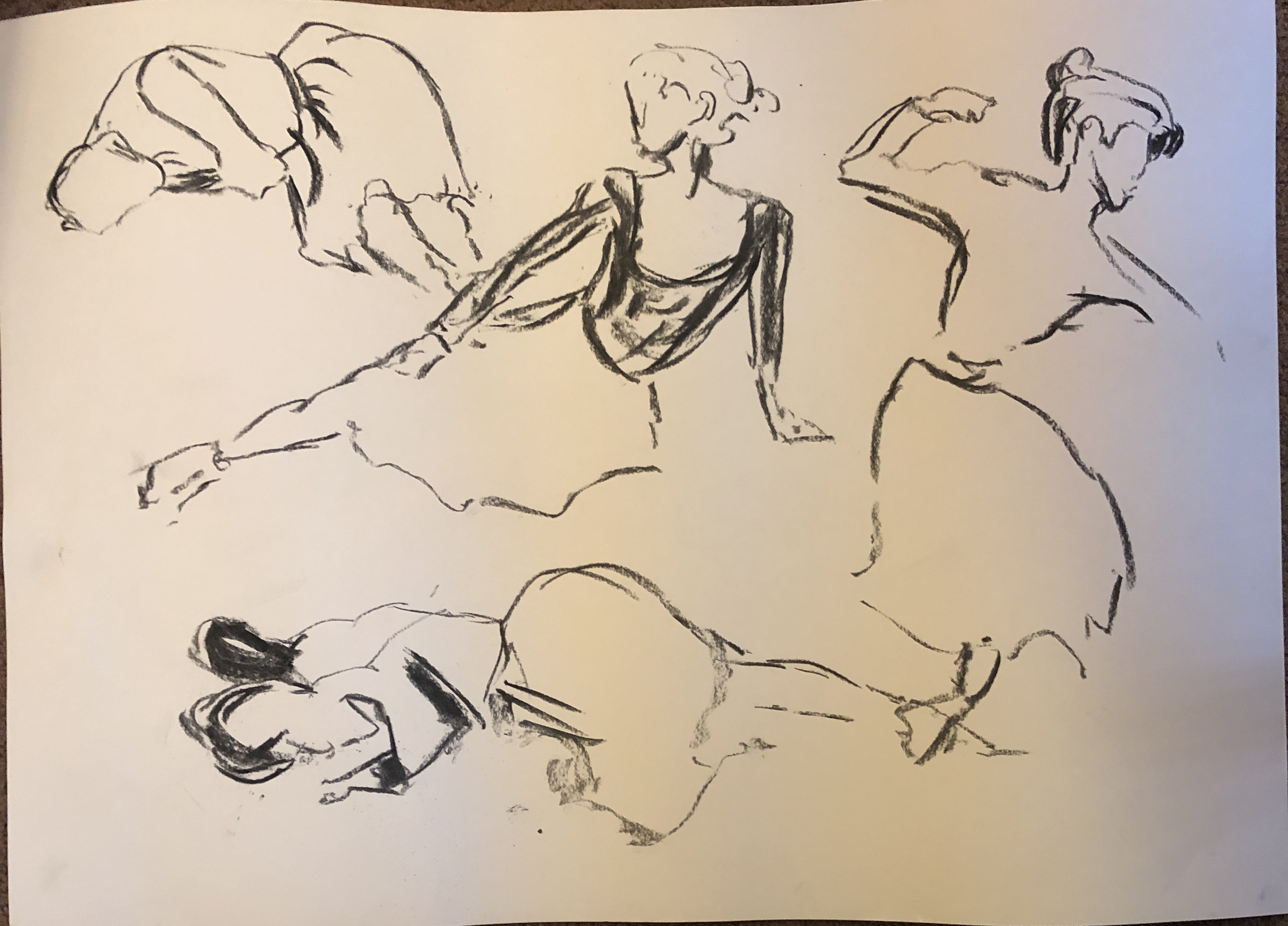
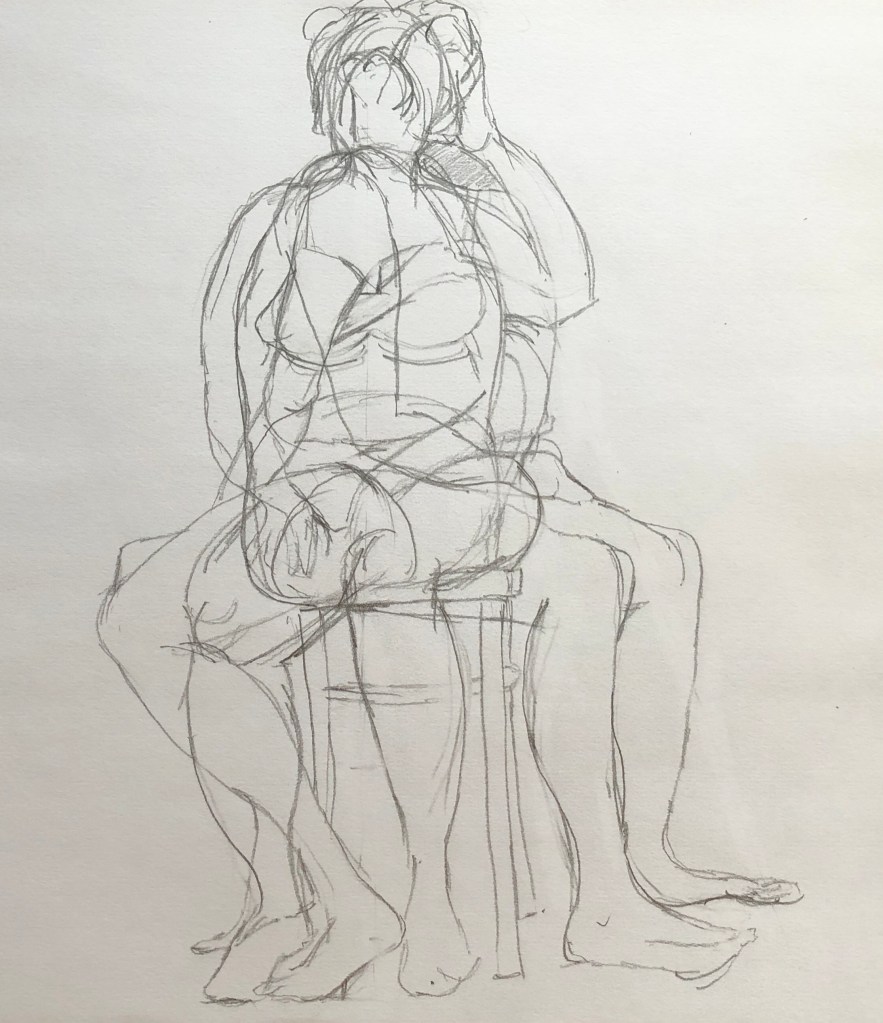
This 2-hour life-drawing session was arranged through the OCA, the model being a dancer from Argentina. She was excellent, produced a huge variety of poses with little prompting, and was good at holding them. We had several 1-minute poses, then 2-minute poses, then some moving poses of varying lengths, finally landing up with two 15 min static poses.

SO WHAT?

The pace of the workshop was fast; I had chosen an HB drawing pencil to start with and stuck with it throughout, working in an A3 cartridge paper sketchbook. I filled many pages, but a selection are shown here:

I was very aware of my tutor’s comments about my life drawing being tentative, so I tried to make more definite marks and to do quite a bit of drawing without looking at the page much. The pace was challenging and I found the moving poses unusual but soon learned to look for a line or a curve that interested me rather than even attempting to capture the whole figure. I was glad I had done the earlier St. Ives workshop on Jenny Saville, as this made me quite OK with piling drawings one on top of the other.

NOW WHAT?

My takeaway from this: 

  • Look at the figure more 
  • Pick out lines/curves/gestures I like
  • Focus on depicting them definitely

St. Ives School of Painting workshop – focus Edgar Degas – 5.12.20

WHAT?

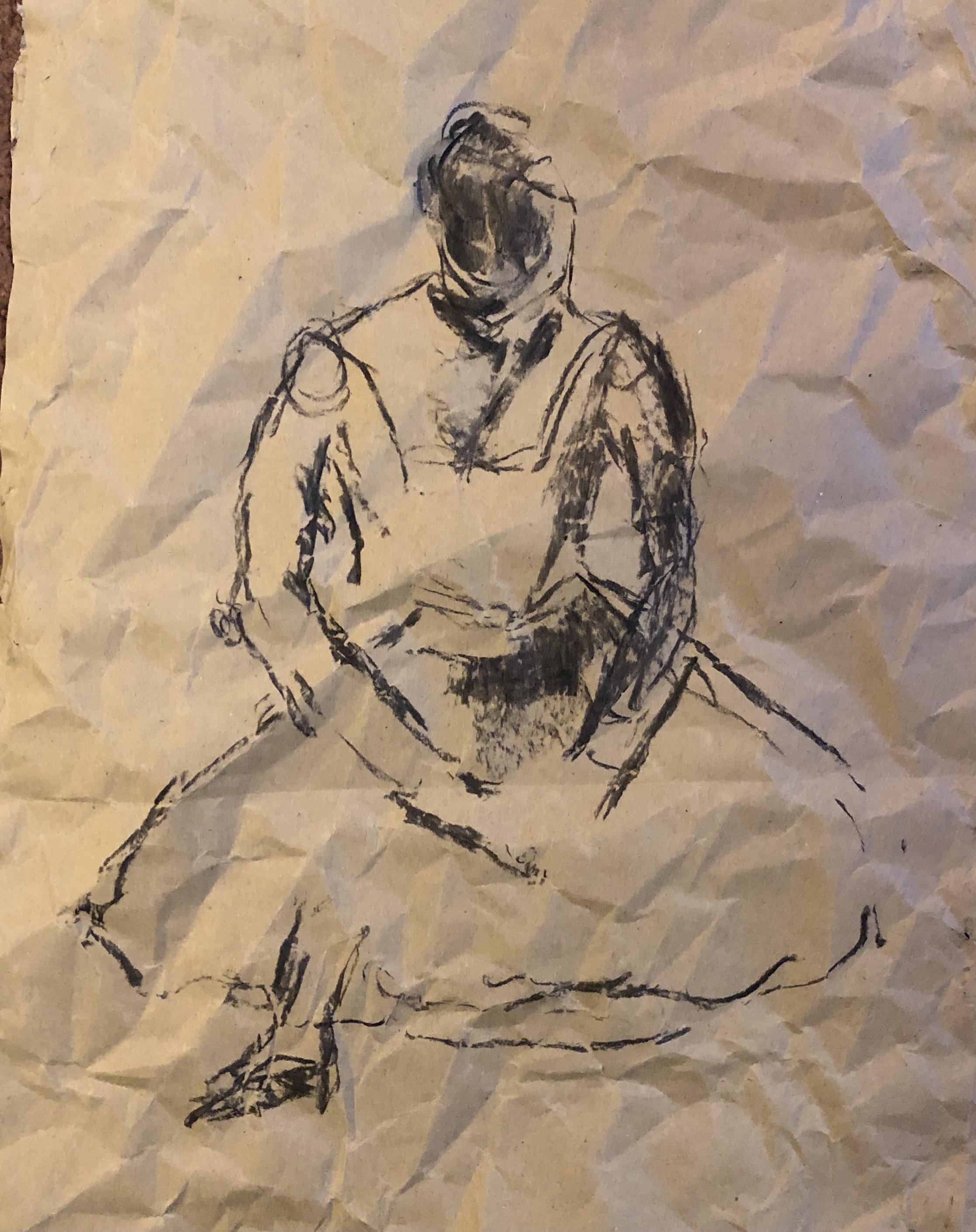
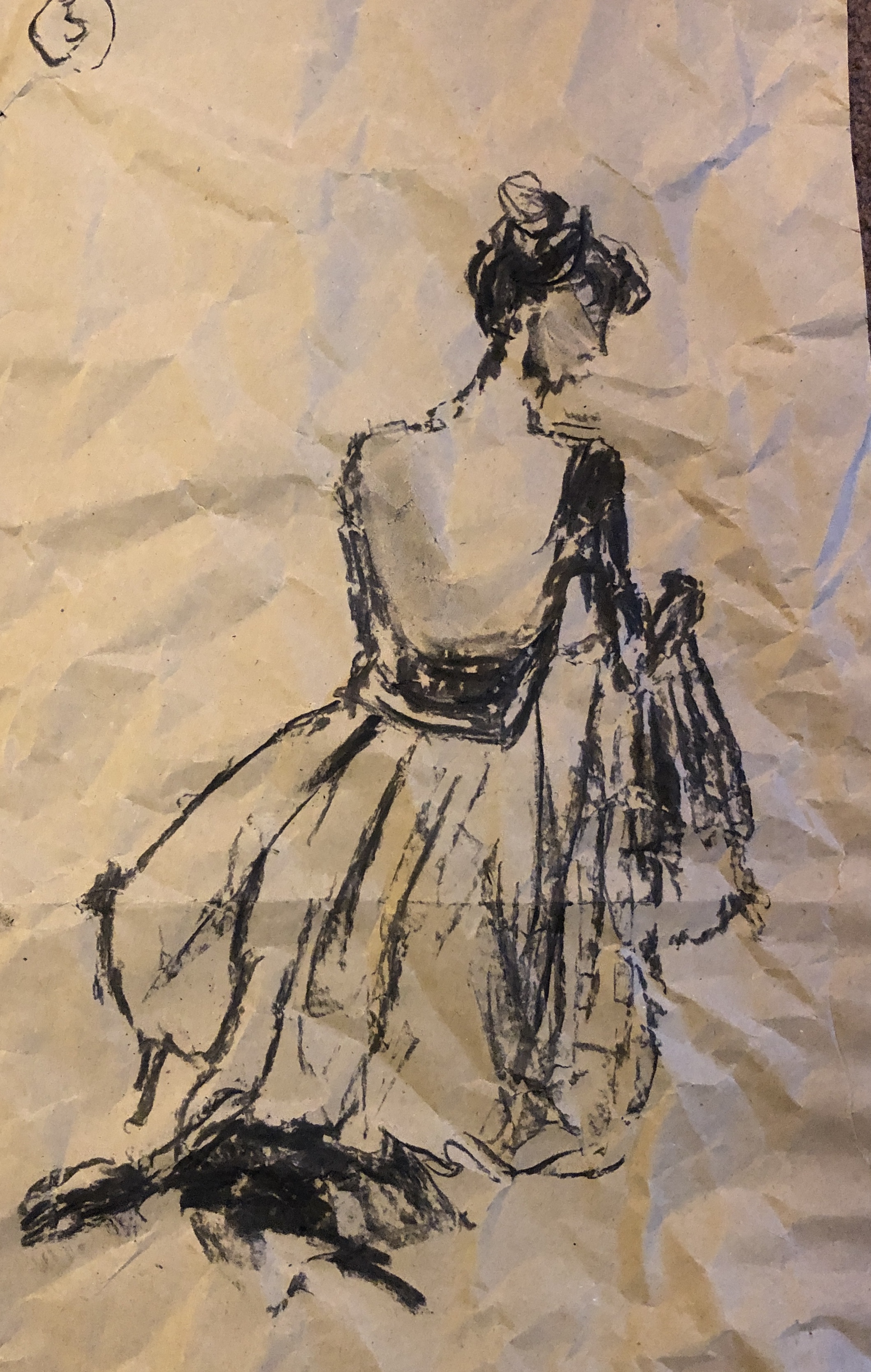
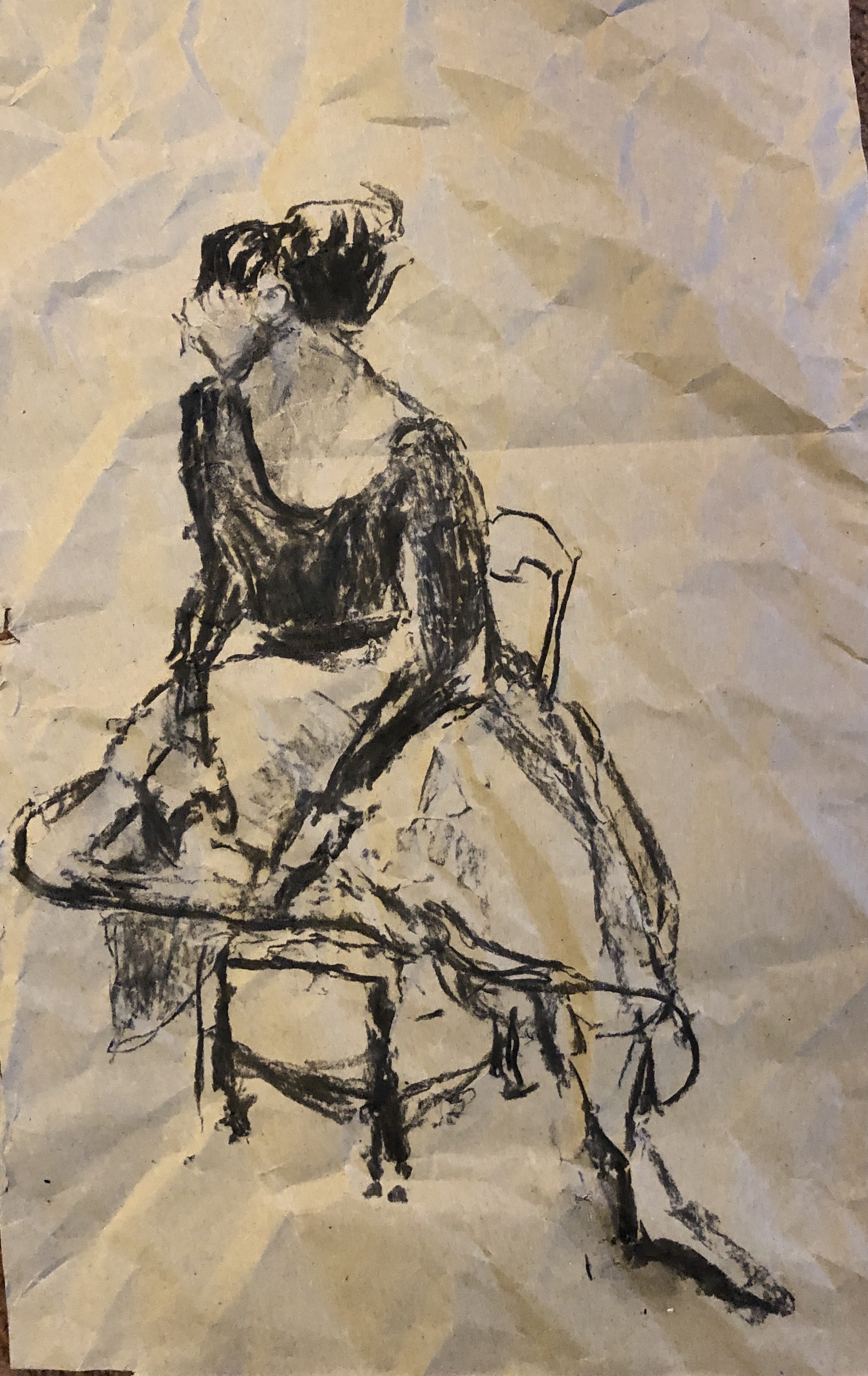
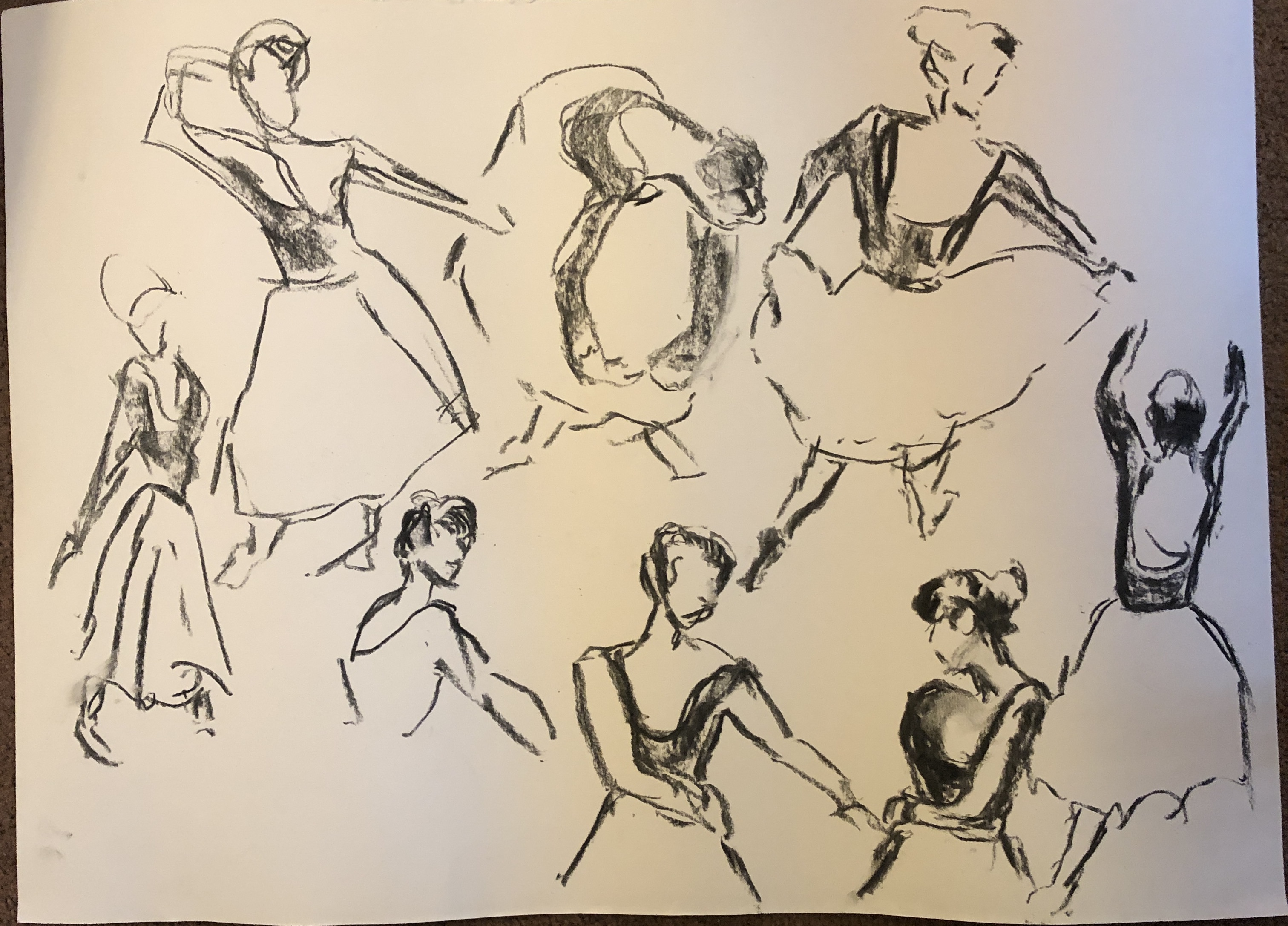
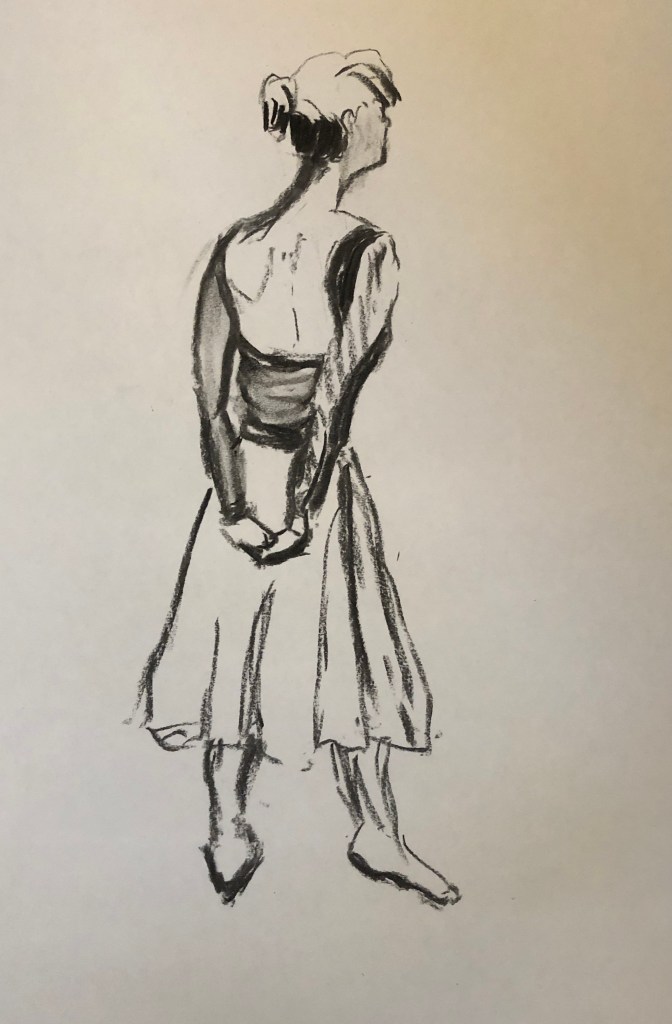
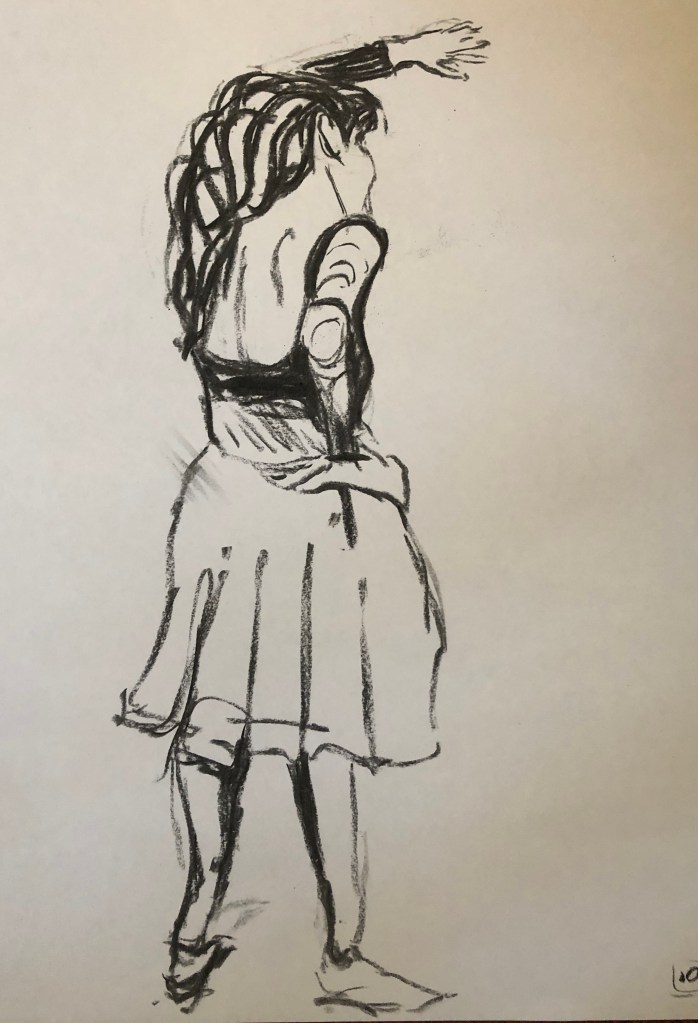
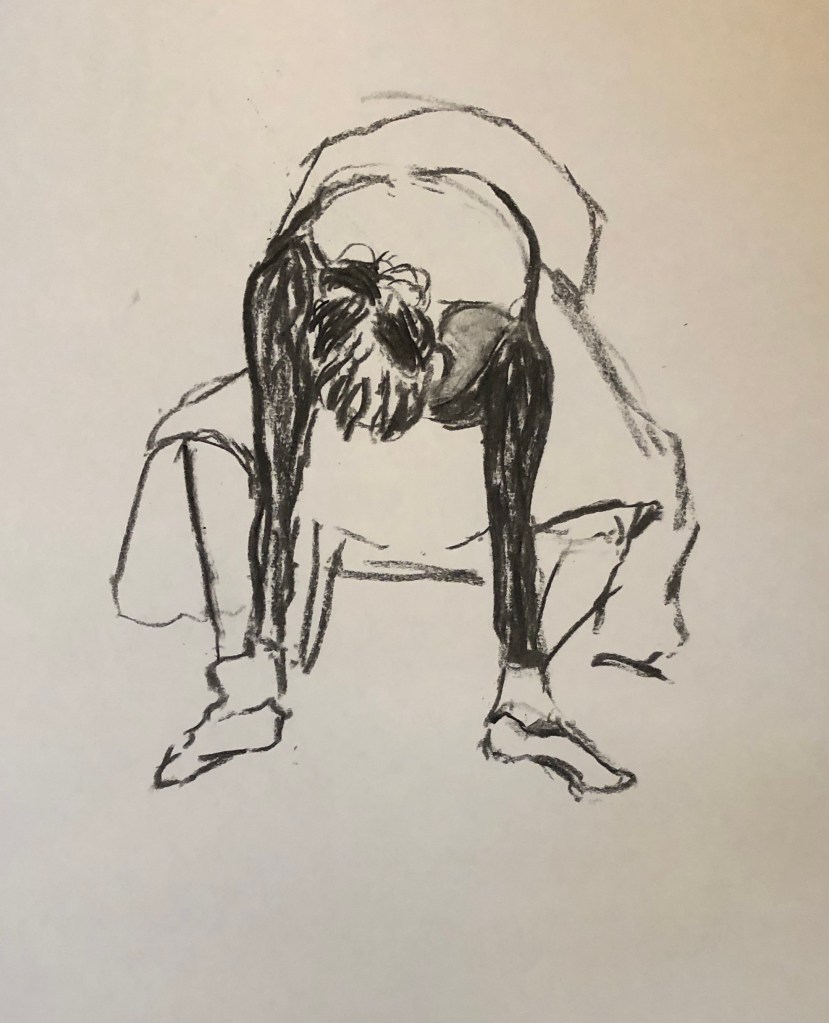
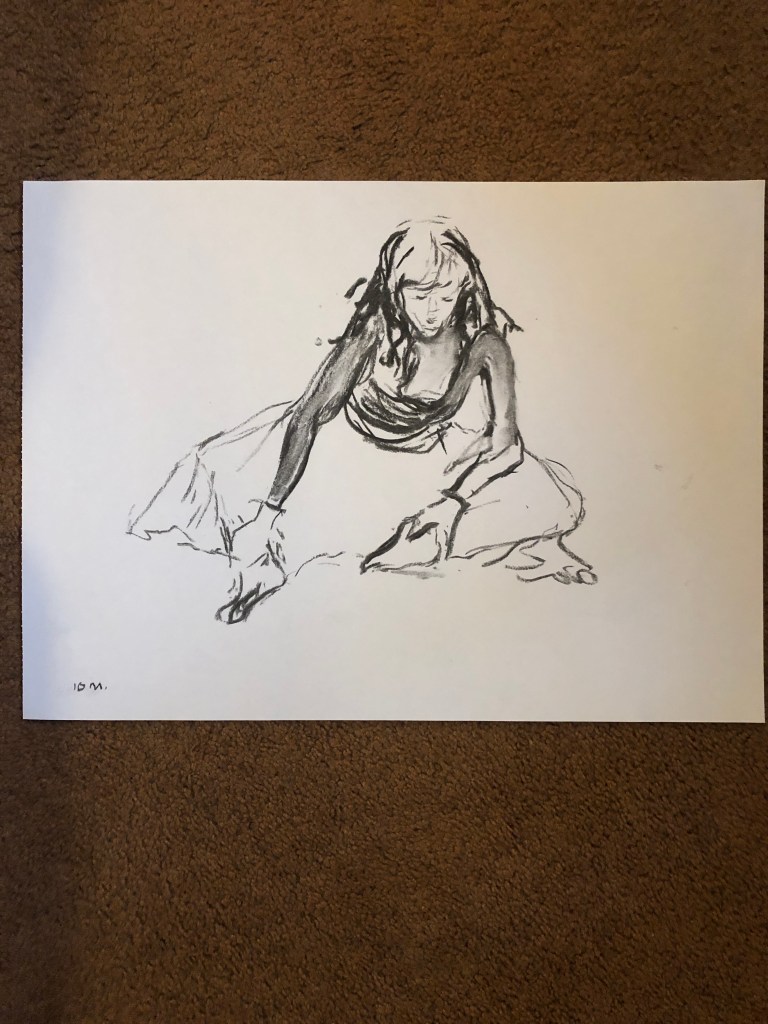
Two hour session with artist Tom Rickman focusing on drawing in the style of Degas to capture movement and dance poses. Model Kerry was a professional dancer and was excellent in her execution of and knowledge of poses often captured by Degas. It was recommended that we work in willow charcoal with a putty rubber and work on cartridge paper, with a suggestion that we also try brown paper. Tom drew alongside us and we could follow the progress of his drawings in split screen.

SO WHAT?

First session was a group of 5 minute poses to allow us to warm up and get our “eye” in. We were urged to just try and get the main structure in and add little bits of tone.

I tried these on brown packing paper from an Amazon package; however, this was a bit too creased up for me to be accurate, so I decided to move on to cartridge paper for the next exercise.

For the next exercise I used two A2 sheets of off-white cartridge paper. Music was put on and the model was invited to dance, periodically pausing when she felt she was in a position which she could hold for a minute or two at most before continuing the dance. Our challenge was to try and capture the moving (practically speaking, the temporarily posed) figure. It was indeed a challenging task, I caught some gestures better than others – I found that getting the spatial relationship between an ear (where I could see it) and its nearer shoulder right seemed to help enormously.

We had a break then for a group look at some Degas drawings which Tom talked us through, and a Q&A session. Some comments of Tom’s which resonated:

  • these sketches are just frozen moments but show incredible movement
  • It is vital to think about the dynamics and weight distribution of the model
  • Think about the personality of the model and the narrative of the drawing (what story does the viewer tell themselves as they look?)
  • Life drawing is a good exercise to make you confront your demons as it can’t be fudged
  • Grids and other devices have their place, but you can’t beat getting stuck in making marks, then seeing things in the marks you make, developing them, looking hard and correcting mistakes (which you can do if you start off light and loose)

Our final session was 4 x 10-minute drawings of the model holding poses specifically drawn by Degas. I did these on cartridge paper, one each on its own sheet of A3. As we had slightly longer for these drawings, we were encouraged to look carefully and think a little more about measuring and making sure we had body parts in the right place by dropping a line.

NOW WHAT?

Takeaways for me:

  • Remember the ear/shoulder relationship which I found helpful in defining the pose
  • Think about what is happening with the body under the clothes and where the model’s weight is being taken
  • Tom made a comment about “treating charcoal like paint and pushing it around” – not something I’d thought about before, but I think maybe I should

Painting 1 (UPM); St. Ives School of Painting Zoom session 21.11.20

WHAT?

This was a two-hour session led by Greg Humphries from the St. Ives School of Painting. The focus was life drawing based on the work of Jenny Saville, with a clothed model. We were encouraged to work as large as possible, ideally in charcoal; however on this occasion circumstances dictated my working at A3 using a mix of 4B and 8B pencils plus an eraser. I started with my left hand but found the task itself very difficult, so moved to my right to help myself out.

SO WHAT?

The first half of the session looked at JS’s way of drawing over existing drawings. First activity was three consecutive three-minute poses, and it was suggested that we draw on top of the first drawing for the second and third. I found it really difficult to ignore the lines of the first drawing when making the second, and when making the third, I probably cheated by turning my page through 90 degrees.

The next activity was similar, but each of the three poses was 15 min; three seated poses, first looking left, second straight on, third looking right. It was here I changed to my dominant hand to give myself a chance. We were encouraged to erase any lines which we didn’t want or which were incorrect as we went along – it was stressed that, if we became aware of error or inaccuracy, we didn’t “fudge” it, but should erase it and get it right. Greg was very good at modelling the process of measuring, and showed how he actually drew his “plumbline” in and marked off points against it – it was helpful to see this done in words of one syllable so I could really follow the process.

In any gaps while the model rested or changed position, we were encouraged to go in with the rubber to edit out unwanted lines, or to emphasise any lines which we particularly liked.

The second half of the session looked at the issue of foreshortening, which JS uses to great effect. Again, the process of measuring was modelled, Greg stressing how key this is in this situation, and also showing that the plumbline doesn’t have to be vertical but can be diagonal.

We were encouraged to spend quite a bit of time basically measuring everything against everything to get the composition accurate, before building up the tones.

NOW WHAT?

I found this a challenging but highly instructional session – it’s good to be told about things like plumblines and the importance of measuring, and even better to be walked through it step by step and be able to work alongside.

Takeaway points:

  • Plumblines really do work and they don’t have to be vertical
  • When drawing a highly foreshortened figure (or anything) it’s vital to measure carefully first, double check it and then trust your measurements, as halfway through it will look weird, only coming together at the end.

Painting 1 (UPM); Drawing workshop with Sarah Jaffrey – “Rulebreakers” – 20.11.20

WHAT?

This was a 90 min Zoom session with Sarah, who wanted us to free ourselves of the need to make detailed, exact copies of the work of famous artists, but rather to use their work as a jumping off point to finding our own way of working – as she said, to finding our own handwriting style.

SO WHAT?

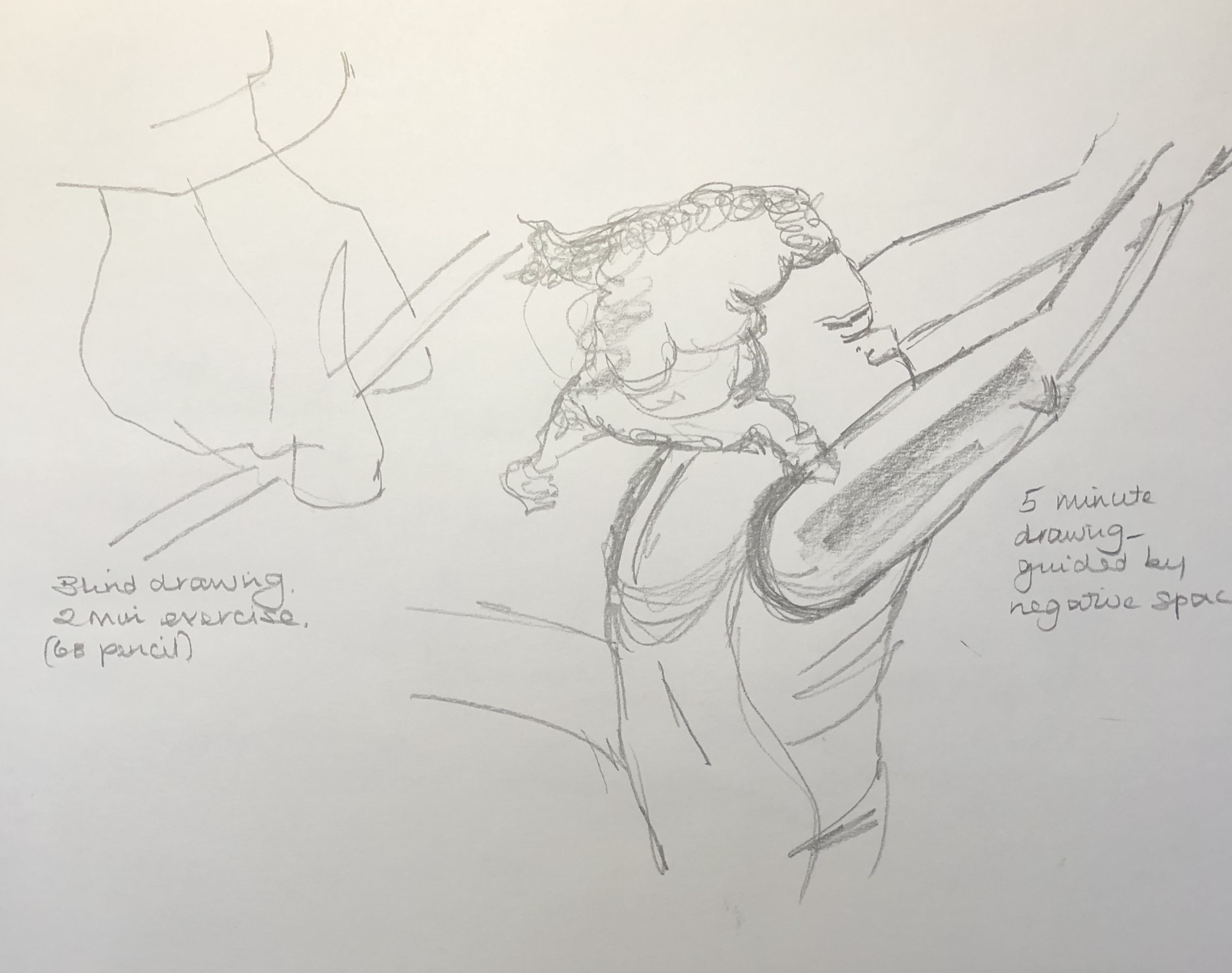
Throughout the drawing work today, I worked with my left, non-dominant hand using a 4B pencil.

We did several loosening-up exercises – often useful to do if you are blocked or haven’t worked for a while – blind drawings (based on work by Faith Ringgold), continuous line drawings (based on work by Gajin Fujita, who makes amazing images by cutting, reassembling, painting over with spray paint, his mother helping out and his brother adding gold leaf), mark-making from a very tightly cropped extract from an image (which turned out to be an extract from a Rembrandt etching).

We looked at mark-making masters, such as Rembrandt and Auerbach, as well as Goya, one of whose works was selected for us to try drawing upside down, focusing on the negative space:

We looked at work by Hokusai, who continues work across two framed spaces on opposing pages, and at Ithell Colquhoun’s experiments with automatism (drawing from out of your head) and superautomatism (refining drawings done from the imagination.

We had a go at Ekphrasis, which is the ancient Greek practice of describing an image only using words, using a drawing by Frances Macdonald as an example.

We also looked at Hadieh Shafie’s calligraphic paintings which use text as image, and a work by Minjung Kim which used burnt hanji (traditional Korean paper) arranged following perspectival lines to create a collaged image.

NOW WHAT?

An inspiring session with a great mix of ideas and references from known old masters right up to exciting present day artists using such a mix of practices.

My takeaways are:

  • This idea of “finding your handwriting” – I really like this handle, I’m going to hang onto it
  • Apparently the archival distinction between a print, a drawing and a painting: anything that needs “machinery” to make it is a print, and anything on paper (that’s not a print) is a drawing – the rest is painting! Who knew? So basically, no need to worry any more about how I categorise my work!

Painting 1 (UPM); National Gallery Zoom “Talk and Draw” session, 20.11.20

WHAT?

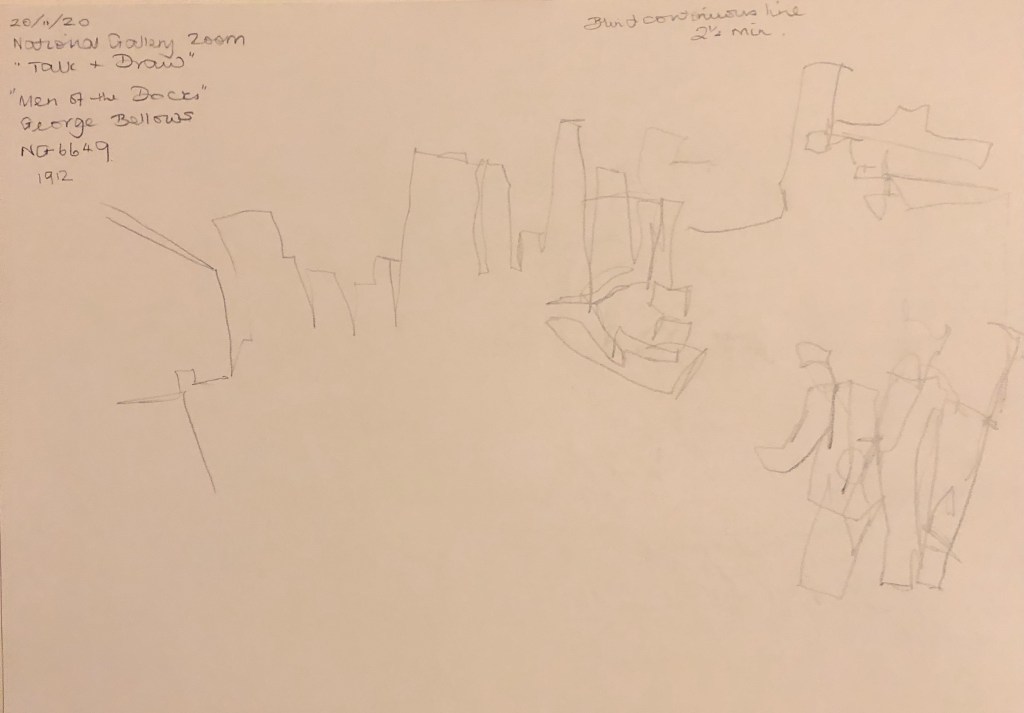
 This hour-long session (apparently attended by over 600 people around the world) focused on the 1912 painting by George Bellers (American) entitled “Men of the Docks”, part of the NG collection.

SO WHAT?

An informative summary was given of the artist’s training and the situation leading up to these gritty paintings done by a group of artists in New York at the start of the 20th century. We then moved on to a series of drawings:

  1. A blind continuous line drawing of the whole image in 2-and-a-half minutes:

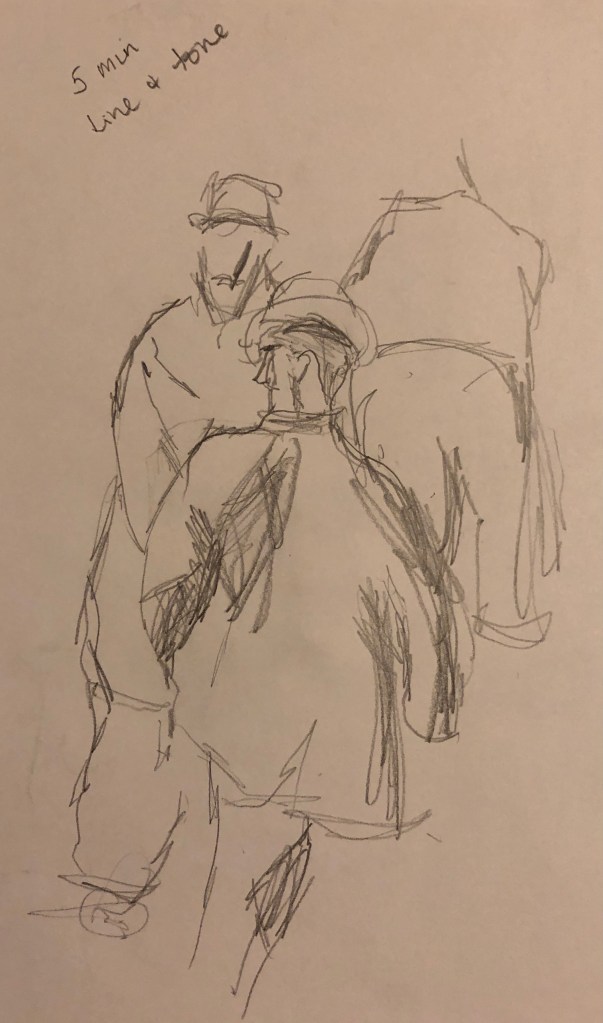
  1. A five minute look at a cropped section of the image, focusing on the group of workers in the bottom right, thinking about shapes and direction of strokes to indicate form:

(c)  Finally, a longer session (probably about 20 min) to tackle the whole image; we were urged to work with light marks to place the different elements before increasing the strength of the marks to bring out form, identifying the lightest and darkest areas. I used a 4B pencil throughout.

NOW WHAT?

  • Actually trying to draw a whole detailed painting in 20 min was quite a challenge. It helped to have had some time at the start to mentally walk through the painting together, getting the main features in one’s head. 
  • I worked loosely, using my non-dominant hand and trying to hold the pencil partway down, which I often forget to do. This helped me to vary the amount of “press” I applied to my marks, but I still feel that my marks lack some variety and control.

St. Ives School of Painting life drawing workshop 14.11.20

WHAT?

Attended this two-hour workshop, led by artist Hilary Jean Gibson, based around the work of Toulouse-Lautrec.

SO WHAT?

It was suggested that we work in pastels, chalk or crayon on packing paper as T-L often worked using these materials on packing cardboard (although sometimes he used oils) – I chose to use Conte crayons throughout, and worked on brown packing paper from an Amazon parcel. The workshop took the form of a powerpoint talk about T-L’s work interspersed with life drawing of a model replicating the spirit and poses of some of his models. The drawing sessions varied between 5, 10 and 15 min, with the final one being 20 min.

NOW WHAT?

  • It was great to get some life drawing done despite the lockdown!
  • Also useful to get tips on drawing from Hilary, as she worked on the poses herself alongside us. Some I knew, e.g. using the head to work out proportions, and benefits of blind continuous line drawing – but a key thing she does which I hadn’t really taken on board before was the idea of “hanging a plumbline” down constantly to get a sense of what should be under what.

The session has finally, after years of resistance, made me sign up to facebook so I could join the St. Ives Alumni group and see what’s going on there (so now I am following them and also the OCA fine art group).

Zoom Drawing workshop 30.10.20 with Sarah Jaffrey – “Appropriation and Narrative”

WHAT?

Sarah is an art historian, having worked for many years in the British Museum prints room.

SO WHAT?

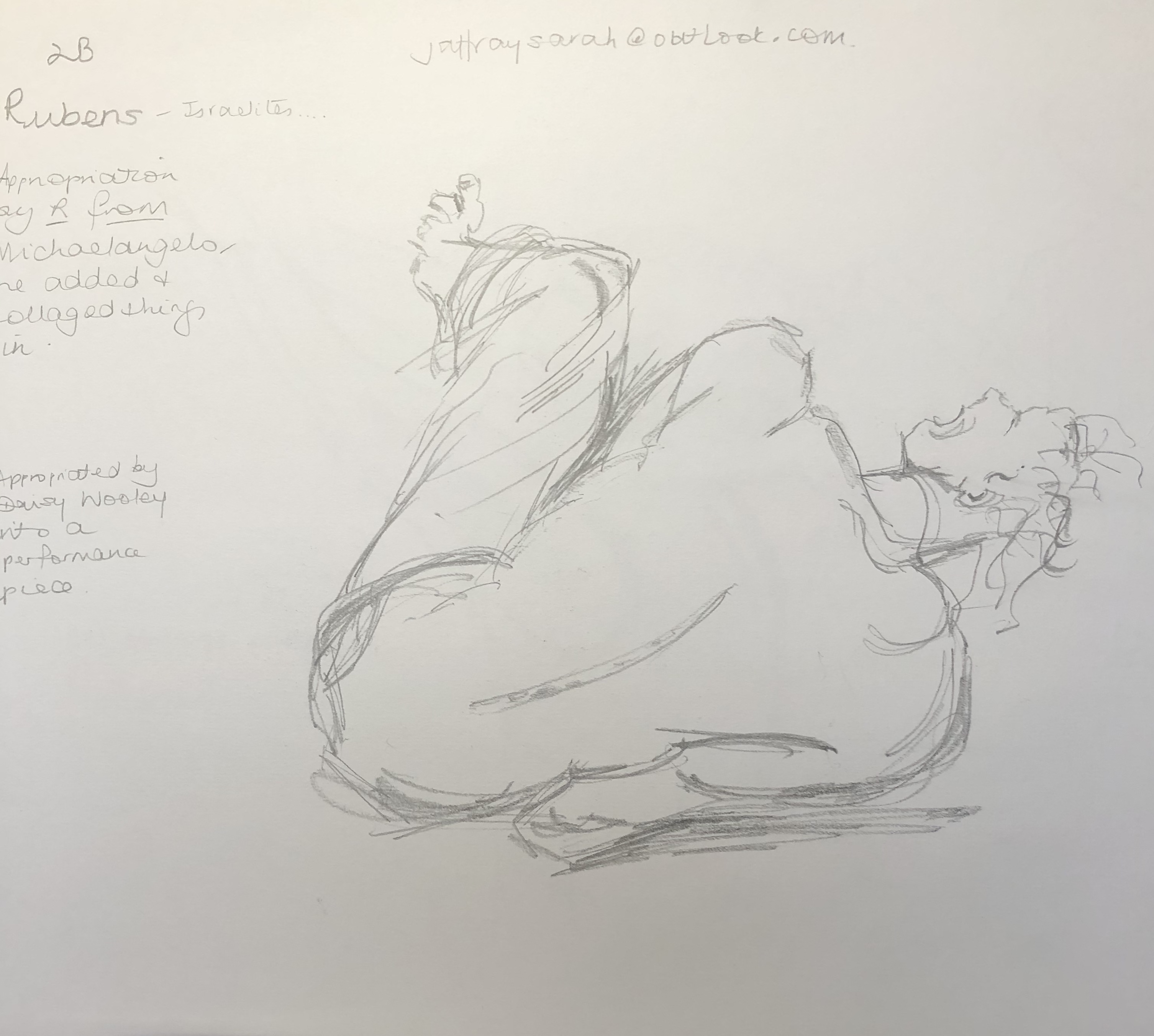
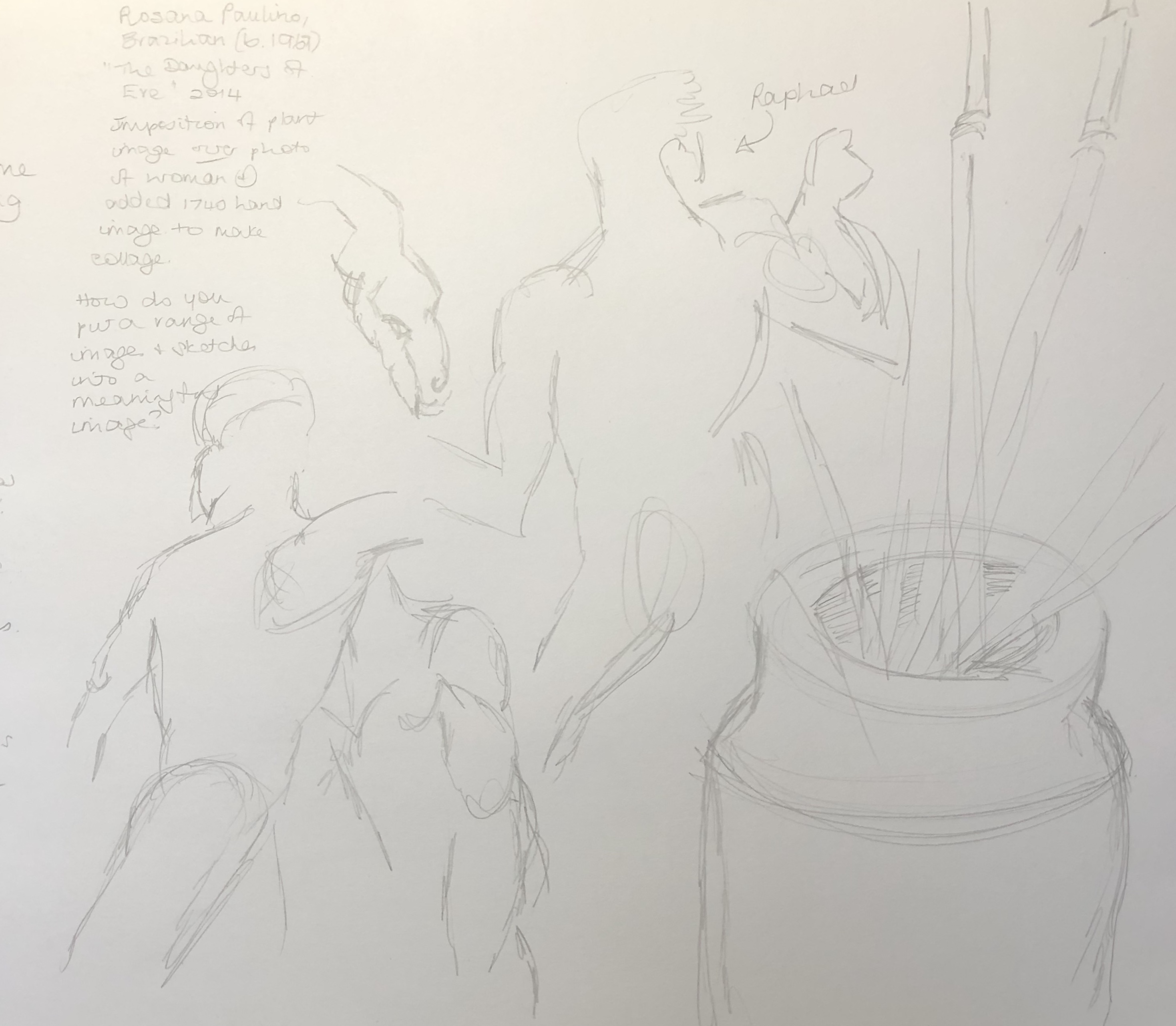
Sarah gave some short lecture sessions about use of existing artworks from the Old Masters to the present day, interspersed with some timed drawing exercises:

Points arising:

  • Appropriation is “taking something for one’s own use…”, but an acceptable/positive use would be to use another artist’s work to explore and develop a storyline of a narrative of your own.
  • Everyone has their own experiences, ideas and influences of other artists and cultures – these combinations will make your work unique
  • We are connecting, not competing, with other artists
  • Copying from or referencing is not making your work the lesser or inferior part of the partnership; we all generate work from within ourselves
  • You can copy directly to improve your skill base (as Michaelangelo did from Giotto, developing motifs which he used throughout his artistic life), but it is also good to draw from a picture, take bits and experiment, maybe combining it with other bits or sketches from other places and play around – this is not a waste of time, it’s where the creativity can happen
  • We looked at (and drew from) a range of different artists, including Michaelangelo, Rubens, Mireille Kassar and Kara Walker

NOW WHAT?

  • This talk reinforced the idea that there’s nothing new under the sun, but it’s what you do with/change/combine/interpret from what’s in front of you that makes your work different from everyone else’s.
  • I’d like to do more drawing from existing paintings, something I haven’t done much of hitherto, to try and build my visual vocabulary.

Zoom workshops with Dr Bryan Eccleshall; “Contamination/Curation”; 3rd and 24th October 2020

WHAT?

This workshop was open to OCA students of all disciplines, and ran over two Zoom sessions, with a curation task in between. We each had to attend prepared with two works which we regarded as finished.

The project was to work together in small groups to think how we could show our work together in a way that made sense and was interesting, and come up with a group proposal to make a 5-min professional pitch to a gallery manager for an exhibition.

Curation is a creative act – so think about how these things are going out into the world, and how they are affected by their neighbours (contamination). We could look for commonality, points of difference, or a point of view.

SO WHAT?

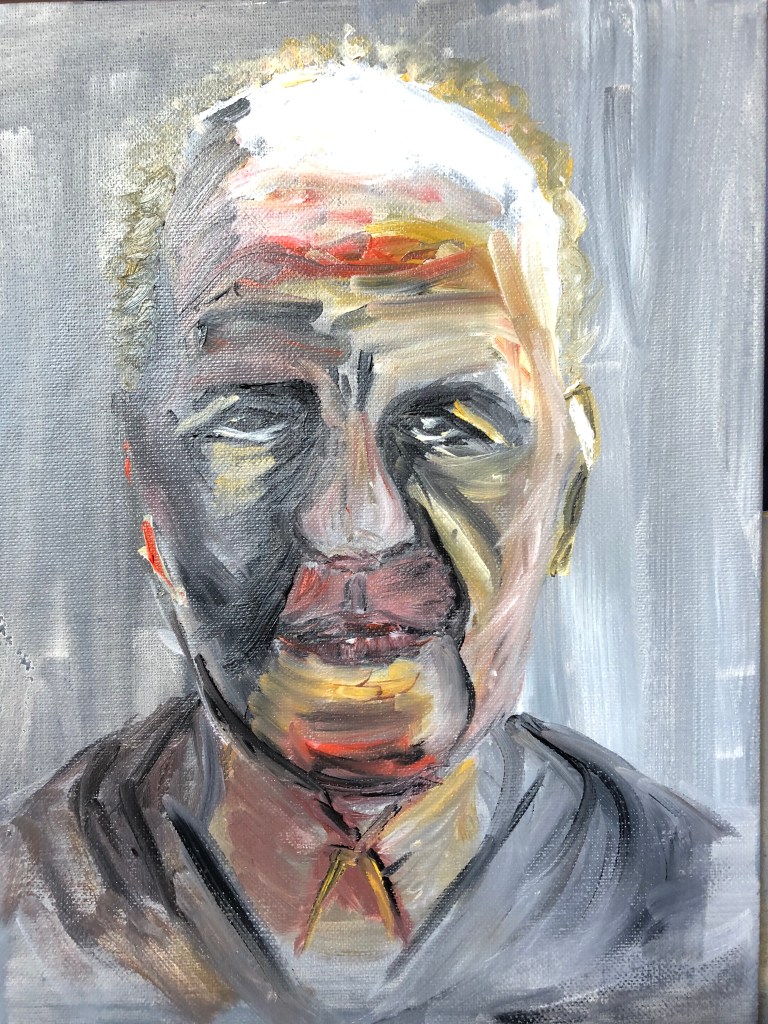
Being unsure of what we might be required to do, I chose two very different pieces – my portrait of Frank Auerbach and my painting of eggs on an eggbox in egg tempera.

We each had to show our works to our group, and then decide how to curate them.

My group- mates were:

  • Annalisa, a second-year student in drawing; her pieces were text-based, one about reading between the lines, and the other about how text could be changed by physical actions
  • Kathy, a first-year student on the same Painting module as me – her works were part of a series of self-portraits, investigating how the persona you show is often very different from how you think and feel inside
  • Thomas, a first-year photography student who put in a self portrait melded from his different personas, and also a video which he had submitted as an assignment on his reaction to the Covid lockdown

I felt my “eggbox” piece was a bit too frivolous and offered to change it, but fortunately they were keen to keep it in; discussion eventually took our theme round to “Vaccine”, and

 vaccines are based on eggs – so, far from being out on a limb, my eggbox became a central point of the whole exhibition. 

We collaborated via padlet, putting up our work and ideas, eventually coming up with a proposed exhibition layout. We had a separate group Zoom meeting to agree details and divide up jobs; I drew an exhibition plan and researched “Vaccine” in different languages, Kathy prepared an exhibition booklet and text, and Annalisa prepared a Powerpoint. We were ready to go!

On the day, all seven groups had prepared digital “pitches”, each with a different style and emphasis. Much useful discussion about curation, digital “nous” and other points from Bryan and others…..

  • Bryan: “Doing things because they look good is a good enough reason.”
  • Ours was a “constellation frame” in curation terms – we had made a frame of each artwork to stand or fall alone
  • Bringing a bit of theatre into an exhibition is no bad thing
  • You have to have confidence that your work will survive in the world
  • Causing some disorientation in the mind of the viewer is fine!
  • “Yes, and….” and “Yes and what if….?” are really good ways of collaborating; you surrender your work as raw material to the greater work
  • Be careful about including sound in an exhibition as it can be heard all over the exhibition unless you provide headphones or the gallery has sound cones
  • It was really useful to share skillsets and especially digital knowhow: three things for me in particular:
    • www.flipsnack.com – makes booklets – free unless you want to export pdf – maybe useful for submitting work for assessment?
    • OTTER – free – you speak and it transcribes
    • Stuff can be moved from a padlet into a Powerpoint and then exported into a video which you can upload to Vimeo for playing
  • It’s good to have images on a press release – make sure you state very clearly what your work IS, not just waffling about what it’s about
  • Episodic framing is another way to curate – over time
  • Using quotes from other people can be very effective IF it is done with subtlety
  • Subliminality of words flashing up too quickly to read them all can be a good tool
  • One group pitched a virtual exhibition based on cabinet of curiosities and Marcel Duchamps’ exhibition in a suitcase – Bryan suggested that, in this world where the blockbuster exhibition is on hold, could develop this idea so that you hire a suitcase of art to have in your house for, say, a month, keep any you want to buy and send the rest back.

NOW WHAT?

I learned a huge amount over these two sessions and the intervening work. Four big takeaways:

  • I am new to curation, but this is an aspect of an exhibition I shall pay attention to in future
  • First time I have collaborated with a group like this – it’s not so scary; you have to let go of any niggles about lack of contribution from some members and assume they have life/work issues which prevent them; be positive and affirmative
  • Doing things because they look good is a good enough reason
  • You have to have confidence that your work will survive in the world

Fine Art group discussion with Cheryl Huntbach, OCA Tutor, 30.9.20

WHAT?

As a stimulus for this Zoom discussion, the third in a series led by Cheryl on practice-led research, she asked us to watch two videos and look at the work of Jo Whittle and David Orme; they had been asked by the Harley Gallery to collaborate on an exhibition based on the Portland Collection and estate. To prepare for this, they were allowed access to the Collection and also taken around parts of the estate not usually open to the public, which included several tunnels in varying states of repair. Jo produced a huge number of varying works, including paintings, sculptures and ceramics, in response to this stimulus, inventing her own imaginary world called Do><ia (an anagram of a void) ; David also responded through collage, making what he called “souvenirs from an imaginary space”, and he also framed Jo’s work and curated everything they had produced into a coherent exhibition. It is called “Between Islands”, and is still showing at the Gallery until November; Cheryl has already been once and intends to go again. The videos can be seen on  https://www.harleygallery.co.uk/exhibition/between-islands-at-the-harley-gallery-nottinghamshire/

SO WHAT?

Discussion was interesting – the exhibition, it’s premise and the two artists’ responses to the brief offered much material for us to talk about, and each had taken different things from it, depending on their own interests and the point they had reached in their studies. Some points arising which chimed with me:

  • Cheryl said she had chosen this subject matter as practice-led research with a multilayered interdisciplinary approach, involving collaboration and curation; I don’t think she could have found a better example
  • Jo Whittle’s approach to the task gave us ideas for what we could do if we are a bit stuck in our practice, e.g. trying something different such as mapping or free writing, which might help to solidify our ideas and move them on – sometimes just a phrase is enough to set you on a new track
  • The framing of Jo’s paintings by David was revelatory – she had really thought about the function of a frame as part of the work rather than an annoying add-on at the end; they had used lush fabrics with drapes and little lips at the bottom of the painting to invite you to step into her world, e.g. a large velvet frame to set off the light from a painting on copper plate
  • Her small-scale paintings make people look – they intrigue and draw you in – adds intimacy
  • Different atmospheres that can be created in a landscape painting by deciding whether to include figures, or exclude them, or hint at their having been there but just left (we looked at the paintings of Anita Ree)
  • We could consider recording and documenting our work and curating is as we are making it, particularly in this age of digital assessment
  • We can think about responding to collections locally ourselves

NOW WHAT?

These videos and the discussion really chimed with me because:

  • Of where I am in my studies, i.e. Painting 1 Part 2 – looking at collections and also at painting on more unusual materials e.g. copper – it has been motivating and also inspiring to see what is possible
  • Looking forwards to another Zoom group meeting this weekend with OCA Tutor Bryan Eccleshall entitled “Contamination/Curation” – I have a little bit more insight into curation now, not really having considered it before
  • Listening to Jo and David and their bubbling excitement when presented with this commission with all the myriad possibilities it presented to them artistically was hugely inspiring – I felt a bit like that after having visited the “Cranach the Elder” exhibition at Compton Verney earlier this year, so keen to build what I had seen into my work. It’s like being given a big box of new toys. It’s an emotion to hold onto and try to apply to tasks which don’t immediately appeal – find a way in and around the task to find an aspect that does grab the interest.