Immediate reflections on Formative feedback – Assignment 1

Overall comments…

  • Really glad my tutor found the images to be a coherent whole
  • I can see what my tutor means by saying I could have pushed aspects like tools, gestures and grounds further – I did get a bit buried in working in the original artists’ styles and lost sight a bit of the main focus of my learning – although I think I did learn a lot from trying all those styles (just possibly not what I was supposed to be learning!)

Feedback on assignment….

Demonstration of technical and visual skills

Quality of outcome

Demonstration of creativity

  • NEXT ASSIGNMENT: note to self – make own work, not derived from other artists – use what I learn from them to create something completely my own

Sketchbooks….

Demonstration of technical and visual skills

Demonstration of creativity

  • I need to get some tone into my continuous line drawings, which are MUCH better when I keep them loose and flowing and don’t fall into my fussier default of broken scribbly lines
  • In other words, have confidence in my observation – look carefully, make bold clear lines – decisiveand economic are the watchwords
  • Think tone! – clear and unfussy

Research….

Context, reflective thinking, critical thinking, analysis

  • Interesting that tutor recommends “research into painters’ drawings” (my italics) – I have so far in Drawing 1 done drawings as ends in themselves and not really thought in terms of drawing for painting
  • I will practise drawing, adding tone, and lifting out with a rubber so that I can see how to be decisive and economic with my brushstrokes
  • See further blog posts for this work

Learning log…..

Context, reflective thinking, critical thinking, analysis

  • Need as a bit of a priority to look at colour mixing – will follow up guidance given. My experience thus far, prior to Part 1, was with watercolour, and a lot of mixing on the paper by dropping colours in – I do need a system to help me be more organised using a palette.
  • Tutor makes the point that I am not consistent in looking back to my learning points and using them….I was aware of this as a problem in Drawing 1 where I would hop from thing to thing; have tried to get better and follow things through, but obviously haven’t achieved this sufficiently.

SO, IMMEDIATE ACTIONS:

  • Look back over my evaluations to understand what I haven’t taken forward enough
  • Work on palette and colour mixing
  • Research recommended artists
  • Introduce tone to my drawings
  • Be more experimental with tools and materials
  • Remember: decisive and economic
Gallery visit – 16.9.20 – Pallant House, Chichester

WHAT?

We went to see the exhibition of Barnett Freedman’s work. I hadn’t known about him before, and was interested to learn about his background as an East End Jewish immigrant – I grew up in the East End (Cockney born and bred) and knew many people with similar stories, energy and drive.

SO WHAT?

The gallery’s emphasis seemed to be on his posters and book covers, familiar to many of a certain age. I was more interested in:

  • The process of lithography, which I hadn’t understood before but which he had seen a niche and made his own – incredibly time-consuming and involved, it seemed to me, but he had it down to a fine art.
  • His pop-up see-through scenes, which no-one else seemed to look at, but I found fascinating in their detail and his working out of the perspective.
  • His war work – he was appointed official war artist. For this he shed his stylised figures and painted individuals realistically – my favourite was a huge painting showing everyone who worked in a particular factory, by name, from the directors down to the ladies doing the lowliest jobs – each one named and obviously carefully observed.

They also had a great book shop – treated myself to books on Cezanne, Frank Auerbach and Maggi Hambling; Cezanne and Hambling being old favourites, and Auerbach because I had seen one of his works in the standing collection at the gallery, a nude lying on/sliding off a couch (didn’t note the details!!!), where the paint was so incredibly thick as to be sculptural – couldn’t take my eyes off it, just amazed it hadn’t all slid off the canvas under its own weight …so I need to learn a bit more about him.

NOW WHAT?

On the basis of what I’ve seen, I need to:

  • Get better at observing faces and the small differences from “standard” that make them into the likeness of an individual, not just a generic face (Freedman and Hambling both do this so well) – practise!!!
  • Read up about Frank Auerbach

Painting 1; Artist’s talk via Zoom – Gordon Dalton- 9.9.20

WHAT?

Talk recommended on Instagram about his work generally, and in particular a forthcoming exhibition (Covid-permitting) for his 50th birthday entitled “Dead Reckoning”.

SO WHAT?

  • Exhibition is so titled because he wants this to be a marker point for his work so far in his life; for him to take stock and set out a new direction for his work for the next 30 years, knowing he can always come back to this point and set off in another direction if he needs to
  • He has been on a roll in the last 5 years and produced work he likes – now he feels he almost needs to “unlearn” that so that his future work can develop and his practice can progress
  • He produces a lot of smaller works, which he says are really good for growing your “artistic muscle memory” (this struck a chord with me after just finishing a series of 20 small paintings of parts of people – going back to life drawing suddenly felt much easier!)
  • He produces larger works when he manages to get larger studio space – he currently has had free use of a large studio for 40 days (and nights) – he is absolutely grabbing this as an opportunity and painting all hours of the day and night to make the most of it
  • He has a strong work ethic – he and some colleagues had a mantra up in their shared space saying “PAINT HARD”
  • He believes that an art degree is a good thing as it makes you try things out which you otherwise wouldn’t do – it frees you up

NOW WHAT?

Three key messages I’ll take away from this:

  • Build up my artistic muscle memory repeatedly
  • Don’t be afraid to go a new way or try something new
  • Paint hard!!

Painting 1, Part 1; Life drawing group back on! (socially distanced)

WHAT?

Back to life drawing group today (7th Sept 2020) at a new bigger venue – Clearbrook Village Hall – very light, whole of one wall is a picture window – so we could spread out and social distance. Only issues: not having doors and windows open so the life model doesn’t freeze (it’s bracing up on the moor….), and I did try to wear a mask but it really does fog my glasses up horribly and I gave it up – so it’s a risk.

SO WHAT?

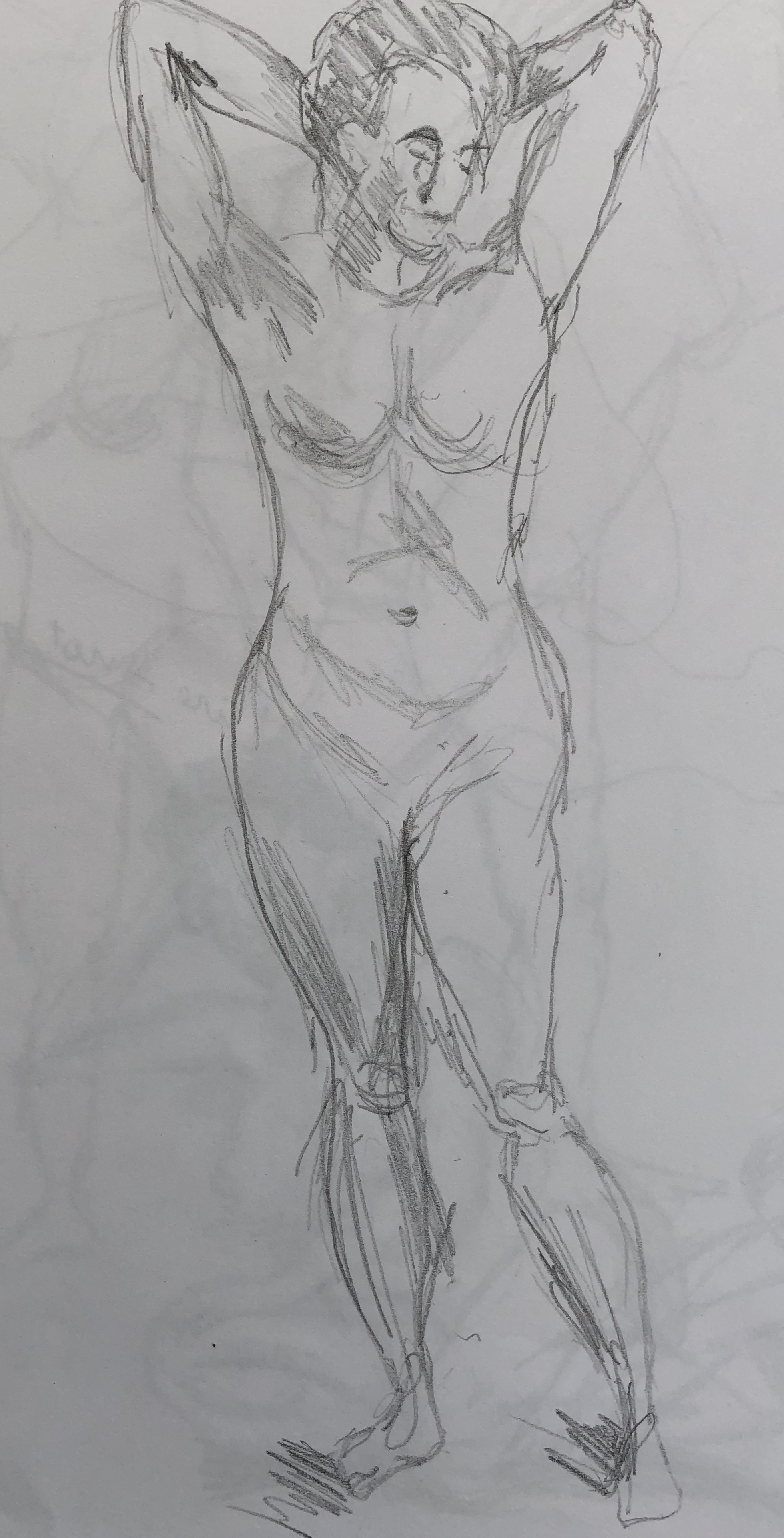
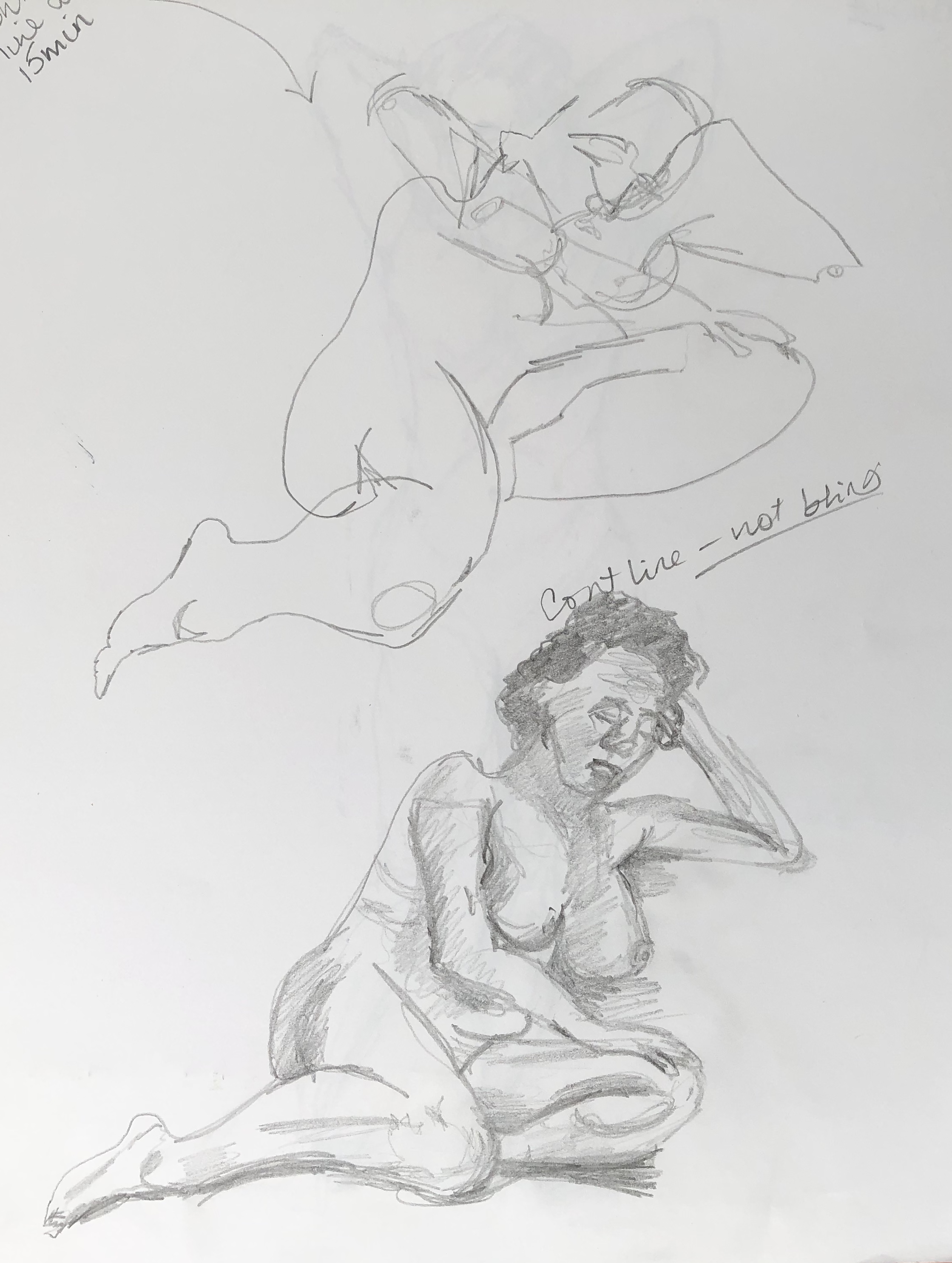
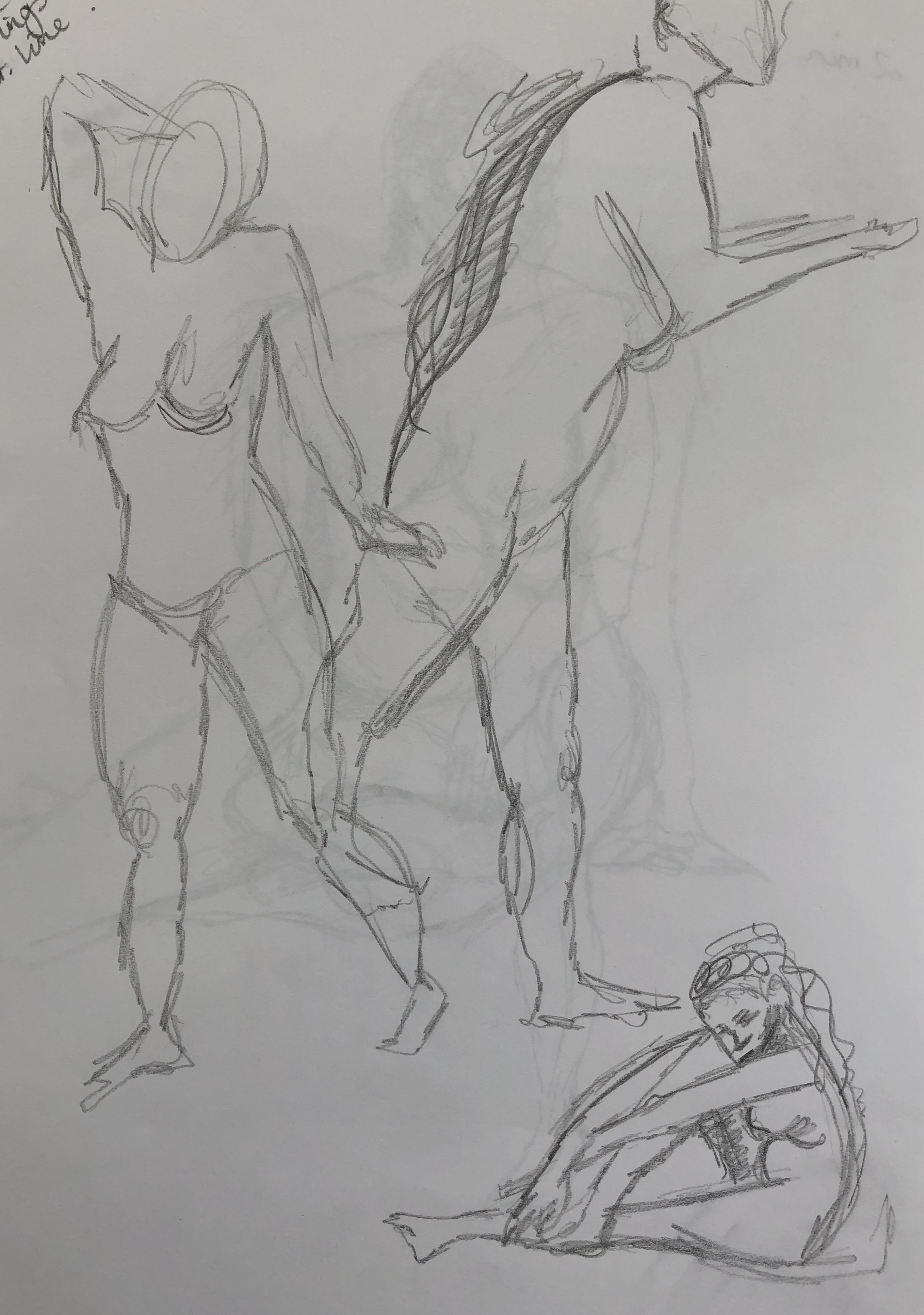
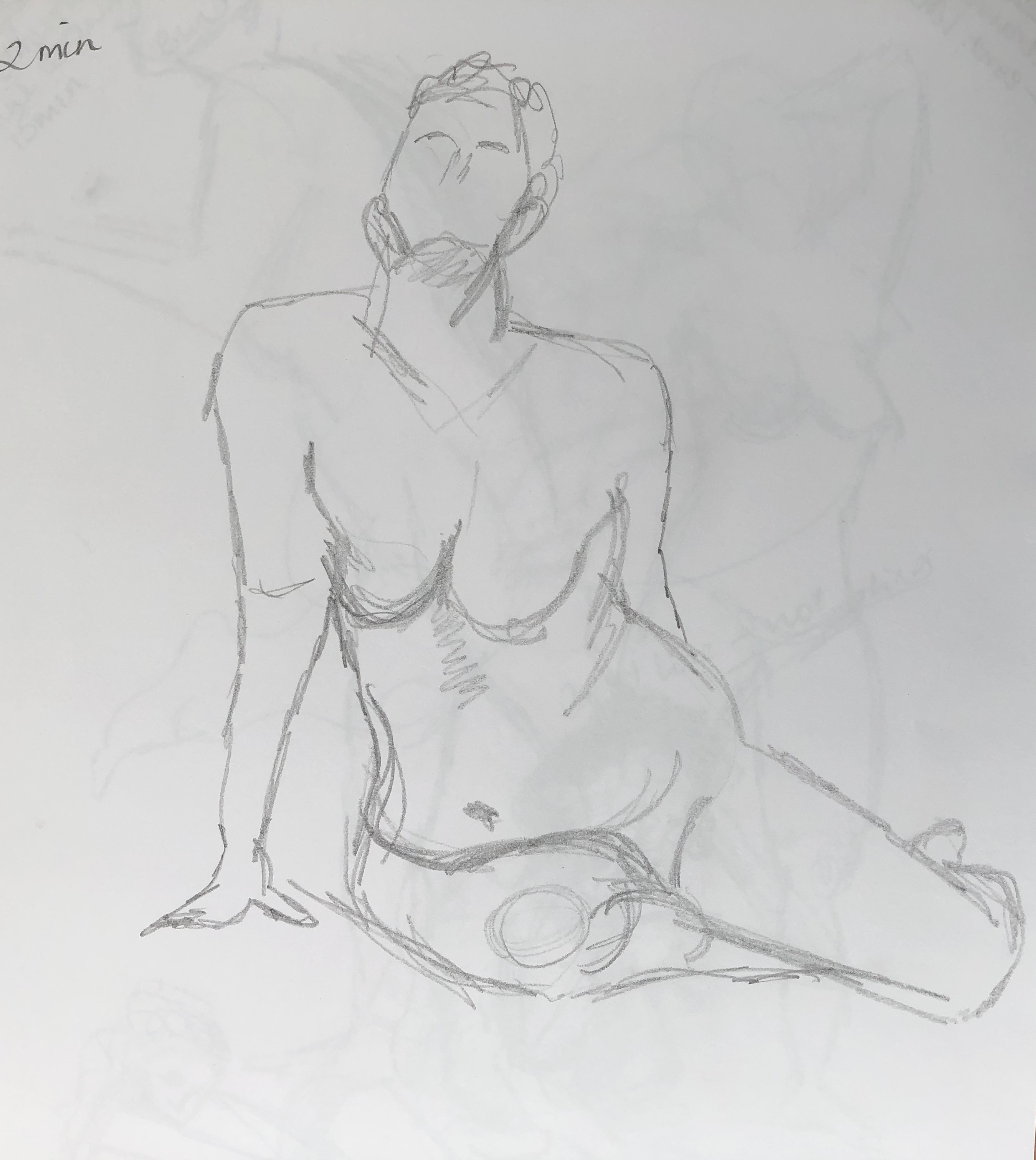
Got through several 2 min and 10 min sketches – tried to use some of the techniques I have been practising – continuous line drawing and blind drawing – although very tempting to return to the old scribbly style when up against the clock.

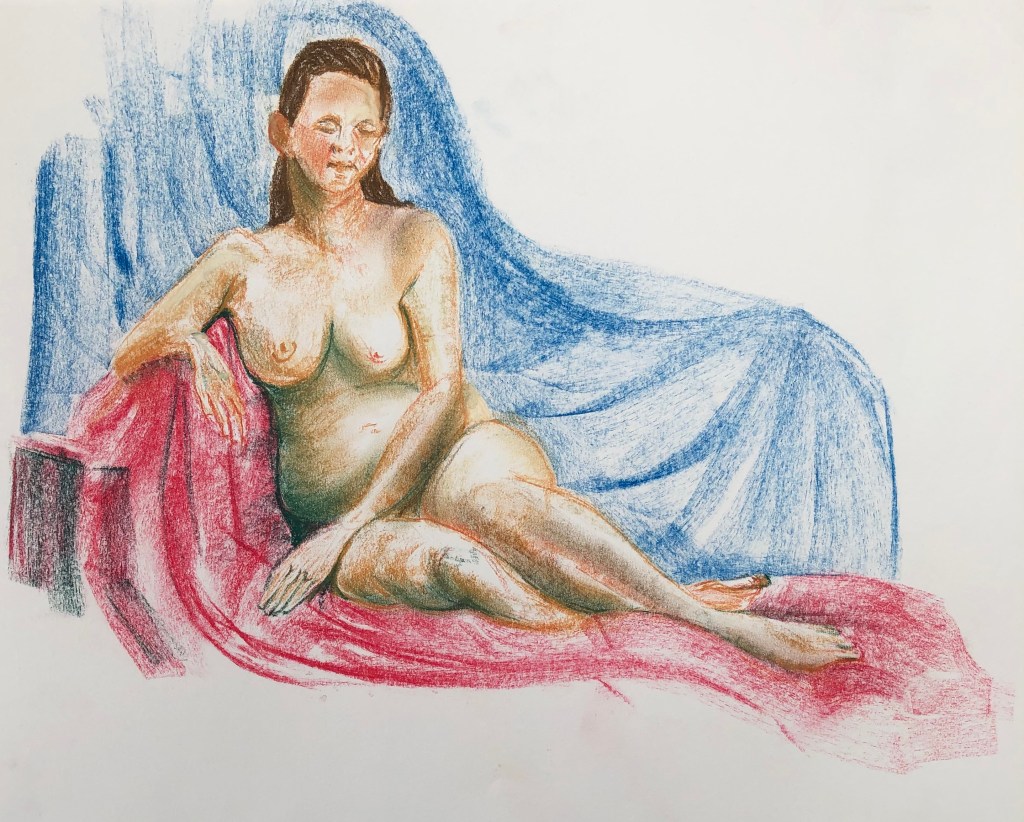
Also tried a Conte pastel painting for the longer pose, first I’ve done at life drawing…

NOW WHAT?

I have learned:

  • Continuous line drawing, especially blind, does work for quality of line – which I learned in my Assignment 1 prep – I must make more use of it in real life drawing
  • Faced with a box of multi-coloured Conte crayons, it’s tempting to go mad and throw the kitchen sink at a painting (which I will try one day, just to see what happens); however, a sticking to a few well chosen colours to harmonise your image is also a definite way forward (think I fell slightly between two stools here), so, take a minute to consider and size up the colours you are likely to want before diving in.

South West Group meeting, 22.8.20

WHAT?

We met by Zoom to have an informal chat, feedback on experiences of those who had gone for July assessment, and to decide the future of the group next year, as the committee are reaching the ends of their courses.

SO WHAT?

  • People had a universally good experience of the July assessment and said so long as you read the instructions carefully and follow them, there are no issues; recommended that we all get better at making videos of our work!!
  • Look to see if there is a course module chat room – some have them
  • Ask OCA tutors to put out some sort of list of what they would be prepared to put on online sessions about – Holly to get in touch with OCASA for this
  • Agreed that we would carry on with monthly Zoom meet-ups for now; those who had been part of the group for some time obviously miss the physical meet-ups but, on the other hand, those who find it difficult to get there are benefiting from Zoom. The meetings will be on the 2nd Saturday of the month and, as well as chat supporting each other through tricky times, we shall:
    • Invite a tutor to give us a talk on something,even if short
    • Share work
    • Share experiences e.g. gallery visits

NOW WHAT?

I only got into the group last November but have found the one physical meeting and the various Zoom meetings I’ve attended useful and informative – so glad that the group is keeping going in some form.

Painting 1; Exhibition visit – Lucas Cranach at Compton Verney, 11.8.20

WHAT?

First exhibition visit since coronavirus lockdown to Compton Verney gallery to see exhibition of Lucas Cranach the Elder’s work. We had an hour, in groups of 10, to look at two smaller rooms and a large gallery which was split into work by Cranach, and then more modern work by other artists inspired by Cranach.

SO WHAT?

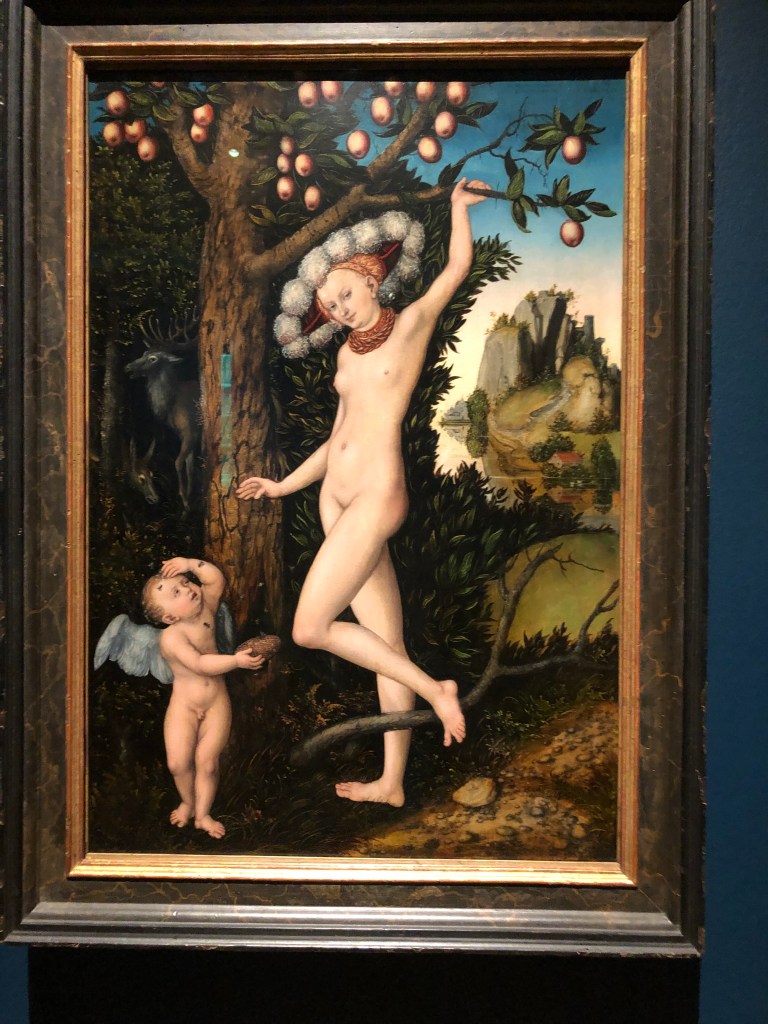
“Cupid Complaining to Venus”, 1525oil on wood. National Gallery, London.

This was one of my favourites, showing the elongated nude against the dark background standing on stones for which Cranach is known; Cupid’s aggrieved expression is very amusing. 

There were examples of reactions to Cranach’s work by, amongst others, Picasso; his German dealer, Daniel-Henry Kahnweiler, remarked that “…one of Picasso’s notable characteristics was the need to transform existing works of art”. 

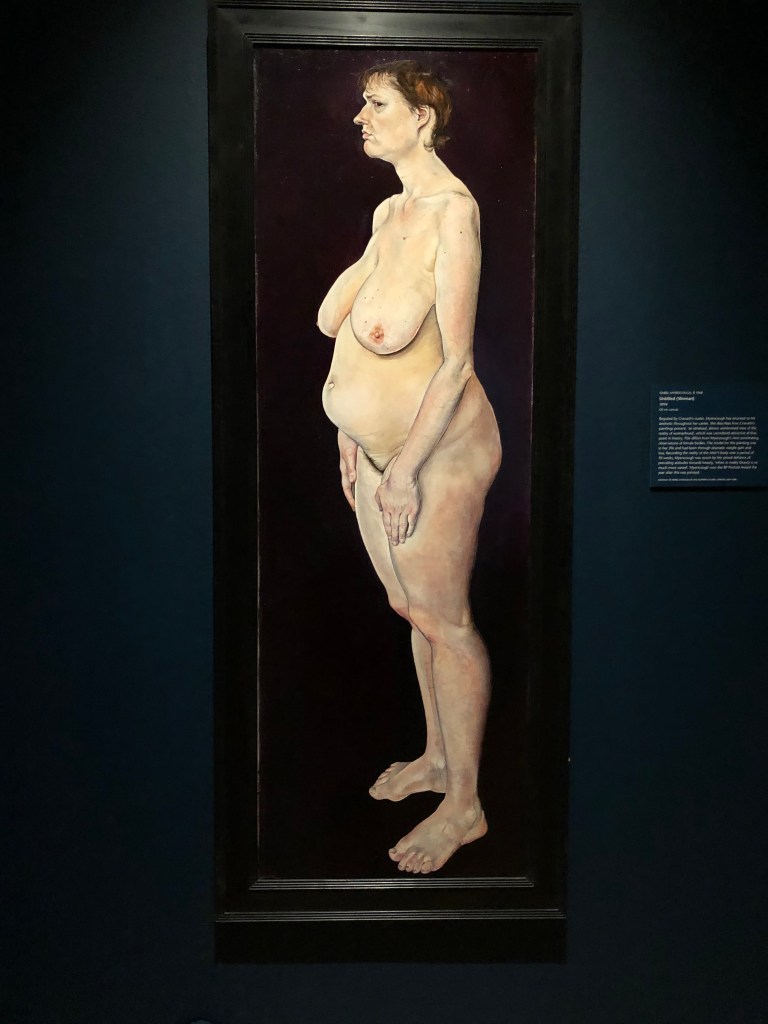
I was taken with the work of Ishbel Myerscough, for example “Untitled (Woman)”, 1994, oil on canvas. Flowers Gallery, London, New YorkShe has taken Cranach’s “motif” of a nude figure against a dark background, but her figures are representational rather than idealised.

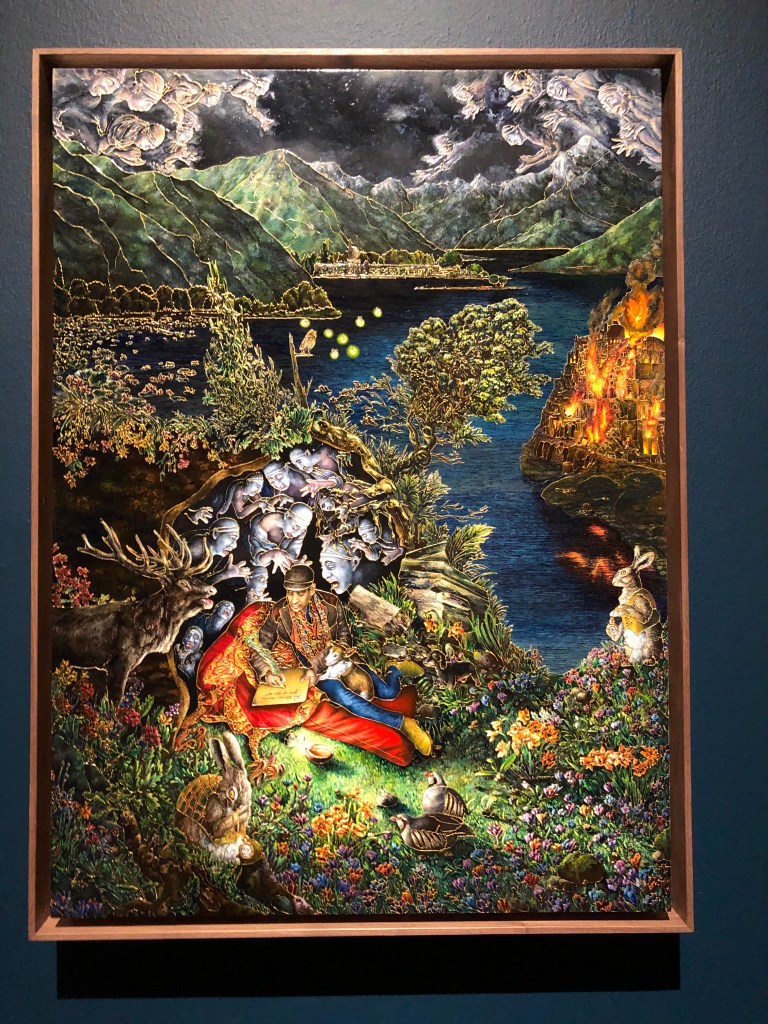
I also enjoyed the brightly coloured enamel paintings of Raqib Shaw, such as this example, “Exquisite Penance in Exile…after Cranach”, 2019-20, (based on Cranach’s painting The Penance of St. John Chrisostum), acrylic liner and enamel on aluminium. Raqib Shaw and White Cube.

Seen close up, these paintings are highly textured and reflective.

NOW WHAT?

This exhibition really brought home to me the way that many current and recent artists take the work of earlier masters and use them as a basis for their own work in so many different ways. 

I am going to try and use some of Cranach’s paintings as “found images” for use in the exercises in Part 1 of Painting 1.

On being critical – E of E group Zoom 25.7.20 with tutor Andrea Norrington

WHAT?

Interesting presentation by Andrea, an OCA photography tutor, on critique of own and others’ work.

SO WHAT?

Key points:

  • when selecting work for assessment, don’t rush,  live with your choice for a bit – but then be confident in your choice
  • Being critical should not be a negative process – it is letting you engage and move forward
  • There is a pdf from Plymouth University on critical thinking which is recommended reading
  • Journals are a really good source for peer review
  • Consider whether you have all the information you need to make a judgment, e.g. is this part of a larger work? Where is it exhibited and does that matter?
  • When giving criticism: DESCRIBE – what do you see? ANALYSE – how has it been done? INTERPRET – what does the audience get from it? JUDGMENT – now the audience knows the facts, what do they think? Ways forward?
  • Receiving criticism: jot down notes, don’t just focus on the negatives; if written, go through and highlight key points; ask questions if you don’t understand comments
  • The “third space” between the artist and the viewer (see TED talk extract – interrogate different points of view)

NOW WHAT?

  • Question!
  • Decide where you sit on what you’re reading/seeing

Painting 1; SW Group meeting 1/7/20 with tutor Cheryl Huntbach – “Research – Engaging with the process”

WHAT

This was an introductory Zoom workshop of a set of three focusing on research – how we go about it and what we do with it.

SO WHAT

Discussion raised the following points and possible resources:

  • Actually making work in an artist’s style is a good way of researching their work
  • Rushing to produce an “outcome” can lead to overlooking important things
  • Finding/making time for reflection is sometimes difficult but important
  • Interviews with contemporary artists are helpful
  • Useful resource from Ossian Ward: “Ways of looking: How to experience contemporary art”
  • Need to foster relationship between making/reflection/research. Research and making should be reciprocal, although research doesn’t have to drive making. Things might resonate on a subconscious level. 
  • Another resource: “Lines of Thought” – for enquiry on history of drawing

NOW WHAT

  • We were encouraged to go away and look at, and add to, what was on the group padlet.
  • TAKE AWAY POINT: USE DRAWING AS A RESEARCH TOOL – DON’T RUSH IN – STEP BACK AND TAKE TIME TO ENGAGE

“Building the unfamiliar with the unfamiliar in unfamiliar times” – South West Group meeting on Zoom with OCA tutor Neil Musson

(13.6.20)

WHAT?

Neil gave a presentation comprising many inspiring images of arrangements of objects using pattern and colour. He included, amongst others, examples of his own work as well as that of Andy Goldsworthy, Christo and Jeanne-Claude, and Cornelia Parker. For some of these artists their work had no deeper meaning – they were looking for immediate aesthetic impact – the “wow” factor. One aspect which appealed to me was “knolling” – arranging items in a grid – an example was the arrangement Neil and his partner had created just by trying to sort out their tools. Neil made the point that he regarded all these arrangements as drawings.

SO WHAT?

Our task was to make an assemblage with found objects in two hours and photograph it; our theme was “How are you feeling?”. We would then look at each other’s photos in turn, without knowing whose it was, and say, not what emotion we thought the artist was trying to convey, but what we saw and how it made us feel.

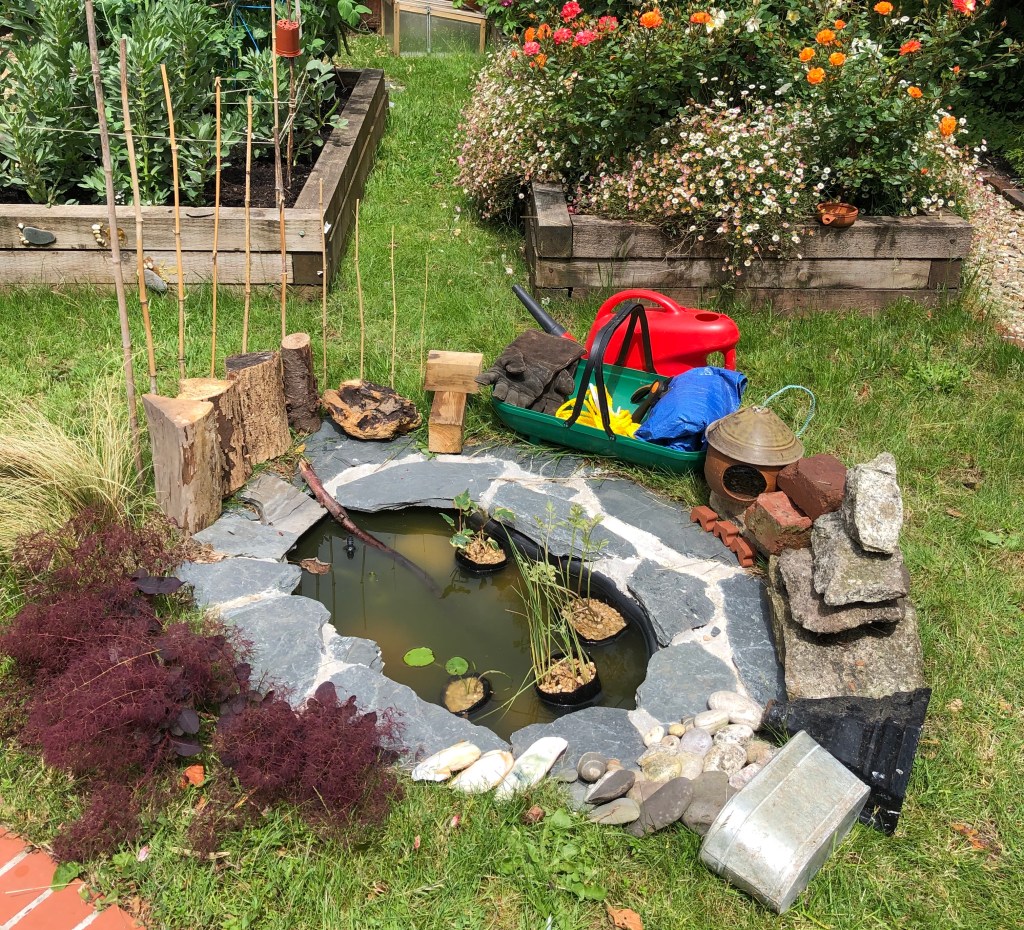
I was in the middle of a lot of writing, sorting and thinking about assessment, so wanted to remind myself that art was fun by making something playful. I collected a load of random stuff from around the garden and made an assemblage round our newly developed garden pond – I had been drawn to Neil’s knolling image and so decided to sort my objects by material, but then chose to arrange them, not in a grid, but around the pond perimeter. The overriding emotion it evoked in others was “calm”; I was pleased that they could all see how I had arranged my objects by material and texture to form a coherent whole.

NOW WHAT?

Four takeaway messages:

  • The notion of what is “temporary” – nothing is entirely temporary if it has been seen and appreciated as it will stick in the viewer’s memory
  • “Let your hands do the thinking – if you don’t know what to do, just do something”
  • The best way to respond to art is to start by describing what you see
  • The end result is not critical, it’s the process that’s important – so in my blog posts, I need to SAY WHAT I’VE LEARNED FROM THIS, NOT JUST WHAT I’VE MADE

Group meeting: London group 6.6.20 – “Creativity – A Little Magic” with tutor Hayley Lock

Notes on the first session

This was going to be a learning experience in three parts:

  • Today: extend our knowledge, and play
  • Space between: self directed play, possible collaboration, and making an artist’s publication
  • Three/four weeks – presentation and discussion of our work

Artist’s publication: research and make, either physically or digitally. OK if it doesn’t make sense!

Ideas and inspiration: see padlet for examples:

  • Michael Landy’s Nourishment series of portraits of flowers which are overlooked
  • Louise Bourgeois Cell (Eyes and Mirrors)
  • Paul Nash The Garden, 1914, watercolour. His work changed over time, but he spent a lot of his time immersed in nature
  • Richard Billingham Ray and Liz series, 1994 – his parents – insight into a dysfunctional family
  • Hieronymus Bosch The Garden of Earthly Delights, 1510 – depicts the possible and the impossible

Bauhaus Teaching: see pdf in Books

Learning and Unlearning, 1913-33.

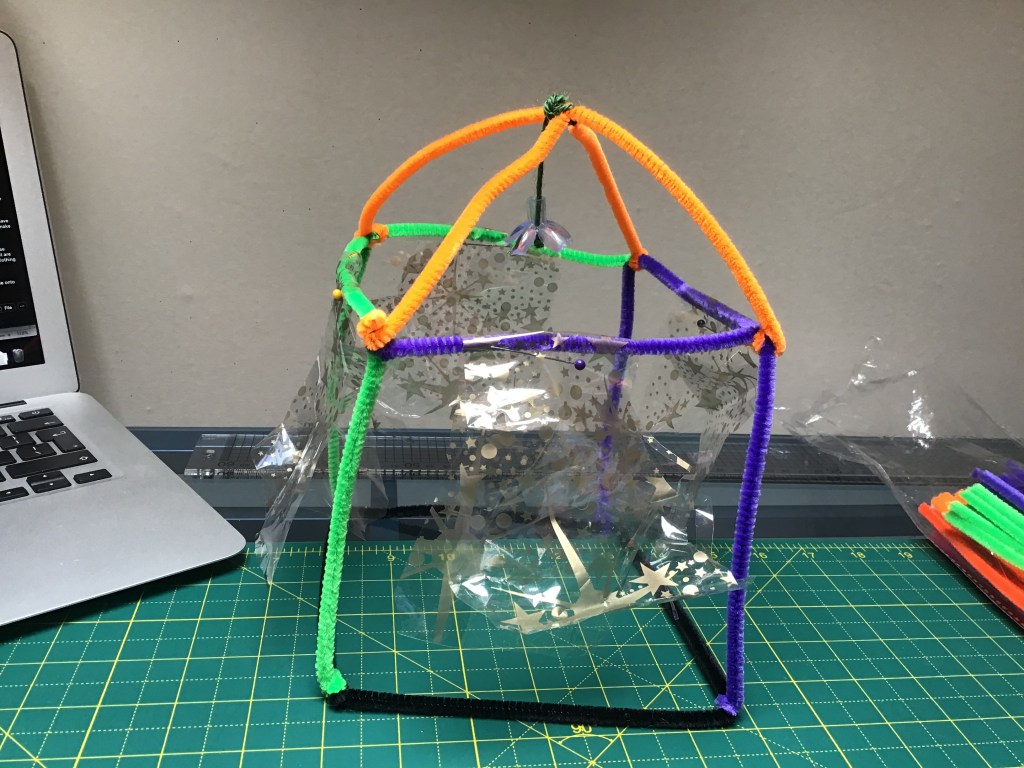
This text leads to our making: choose a found object of material and, working with the possibilities of the material, make a 3D thing, thinking about questions of scale where appropriate. We had 20 min.

I made a box out of pipe cleaners I had bought to incorporate into my home-made coronavirus masks – it turned into a house with cellophane curtains and a plastic flower lampshade.

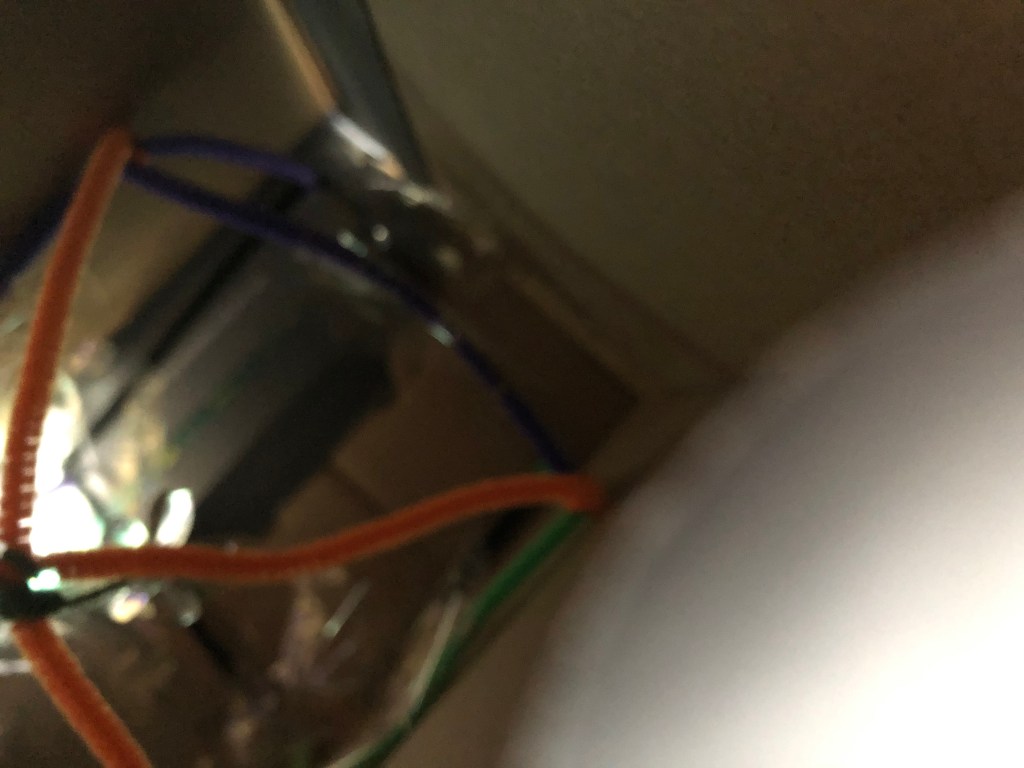
Next, we had to put our object in a box, mainly dark but lit somehow, and photograph it. I put mine in a shoe box and tried to light it through a slit in the box using the torch on my phone whilst photographing with my iPad…..and I can see now why I’m not doing a photography degree…

Everyone had to post their photos on the padlet. Many were experiencing technical difficulties and so we decided to adjourn to the in-between task: we could collaborate, appropriate, work together or alone, and create an artist’s publication, either physically or digitally. It needed to keep the same DIY vibe. We could look on the ICA website for examples, also the Whitechapel bookshop in London and “Printed Matter” based in New York.

My in-between work

I decided to work alone as I was not too confident in my digital skills for collaborating – and I have to confess that, when I started, I didn’t have too much of a clue what I was doing, so I began looking online at the websites Hayley had suggested, and soon became drawn into the wonderful world of artists’ publications which I hadn’t realised existed. It was also a good way to practise getting to grips with searching for things on the University Library – I hadn’t really made much use of this before as I had hitherto been going into the University of Plymouth library, but now this was closed, it was clear that I needed an alternative (I have also been attending the UCA library webinars every week, so was becoming increasingly aware there was a whole lot of stuff out there I was missing).

After a couple of days roaming the internet I decided to work on making an artist’s book, which is, I have discovered, definitely a thing.

I had been drawn to the Nourishment, 2002 series of drawings by Michael Landy, which were quite spare and delicate, and also to the idea of Paul Nash spending a lot of time immersed in nature. We have spent so much time in our garden during the lockdown and are acutely aware of just how fortunate we are in having that when others have been shut up in tower blocks; so I decided that my book would be a celebration of my garden.

I went for a zig-zag book format which is easy to make and display and, following Hayley’s instructions, tried to keep it as “DIY-vibe” as I could. I did my drawings quickly with a dip pen and Indian ink on cartridge paper, scanning the garden through the window and picking out features. The cover was part of an old Amazon box covered with a quick abstract design made from watercolours. I decided to cut into the pages a little with a craft knife to give the idea that, in the garden, one often looks through one thing to the next. I put the title on a label made from an offcut of the cover design and attached it with a scrap of garden raffia. Voila! I know it is dainty and rather girly, but looking at it in the future will, I think, always bring me back to this time and make me appreciate what a lifeline the garden has been.