Drawing 1; Part 4; Research point – Self-portraits

Tracey Emin:

Now she’s a very unusual one. I went right through all 259 pages of the book: 

“Tracey Emin love is what you want

Author

Ralph Rugoff 1957-

Hayward Gallery

Publisher

London : Hayward Publishing

Creation Date 2011”

…and I could not find a single drawn self-portrait of just her face. Her drawings of her body look quickly executed and her use of line is strong, almost visceral, but when it came to her face, this was either blank or very roughly indicated – as opposed to the rest of the body, especially genitalia, which are abundantly represented in the fashion of Gustave Courbet’s L’Origine du Monde, 1866 (which I saw a couple of years ago in the Musee d’Orsay – or maybe the Orangery – oh dear, premature senility – in Paris), and Egon Schiele was one of her influences. Possibly this is due to the title of the book, which was also the subject of an exhibition – the book suggests that in this exhibition, the artist is revisiting the trauma of her past in an attempt possibly to accept it and not be dominated by it.

Looking online I found a self portrait of her as a Little Owl, 2005, etching, which does bear an uncanny likeness!

***********

Lucien Freud and Paul Gaugin: see my notes in my blog post on trip to the London Galleries in January 2020 – the exhibition on Freud’s self-portraits was a masterclass in drilling into the soul – total determination to see everything there was to see and commit it to paper in bold brushstrokes. I found Gaugin rather the opposite – bold confident strokes in his drawings, yes, but his depictions felt flat and shallow and he often depicted himself as a character, almost caricature, rather than himself.

************

I found an absolute gem of a book: Kinneir, Joan (ed), The Artist by Himself, 1980. Granada Publishing Ltd, Herts and London. The book consists of self-portraits by famous artists both current (e.g. Hockney) and historical – back to Durer in the 1400s. Accompanying each image is a text written by the artist him/herself – extracts from letters, diaries, exhibition notes and so on – which give an insight into the mind of the artist at or about the time when the self portrait was made. Absolutely fascinating. I had a go at copying several of the self-portraits – see my A4 sketchbook – just to experience drawing using their styles. I fondly imagine my own personal style is a bit of Odilon Redon with a splash of Egon Schiele…….

**************
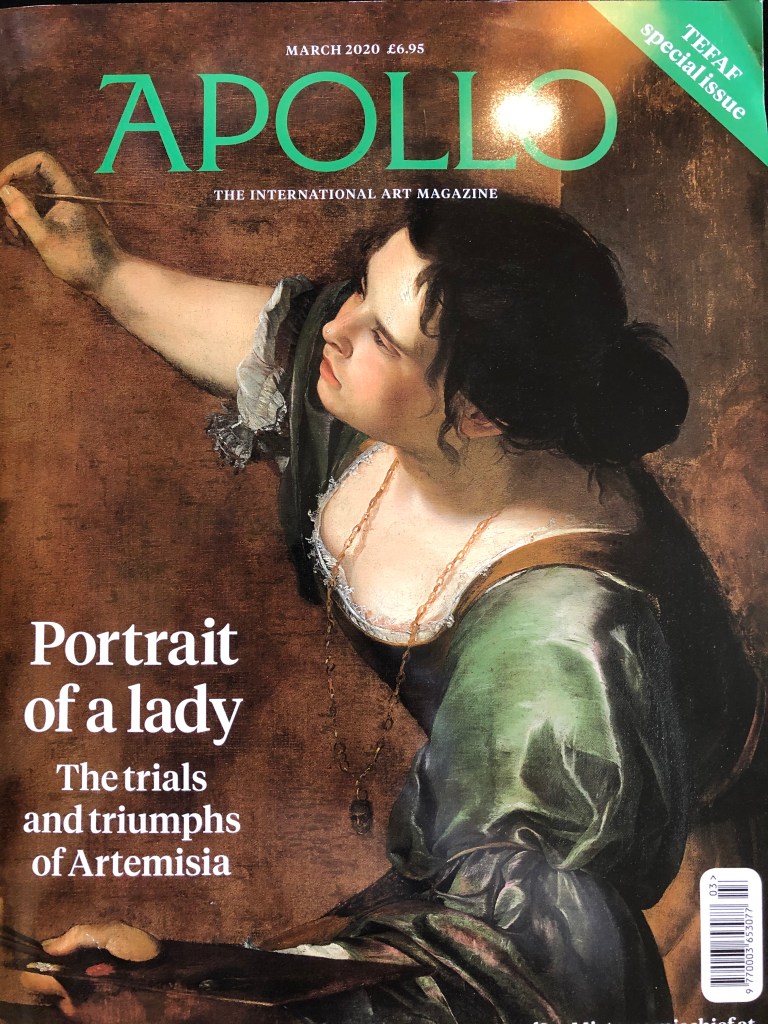
There is an interesting article in March 2020’s Apollo magazine by Breeze Barrington entitled “Becoming Artemesia” – all about Artemisia Gentileschi, as a preface to the National Gallery’s exhibition of her work in April-July 2020 (nationalgallery.org.uk). She had, as Barrington describes, “..a penchant for self-portraiture..” – I really liked her Self-Portrait as the Allegory of Painting (la Pittura), c. 1638-39, oil on canvas, Royal Collection – contrary to many of her other character paintings where she gazes placidly out of the frame dressed up in real Lucy Worsley-style – this is an action shot painted from an unusual angle – as is her Judith beheading Holofernes, c.1613-14, oil on canvas, Uffizi Galleries, Florence.

***************

On the subject of good books, another interesting one I found is by Borzello, Frances, Seeing Ourselves – Women’s Self-Portraits, 1998. Harry N. Abrams, Inc., New York. This traces the history of self-portraiture by women from the 16th century to the end of the 20th century. The older paintings are in the style of their times – many conforming to the mores of the day, with a few, e.g. Anna Dorothea Therbusch, Self Portrait, 1762, oil on canvas, Staatsgalerie, Stuttgart, showing herself warts and all – short-sighted and middle aged.

Berthe Morisot had a lovely use of light and line in her unfinished Self Portrait with her daughter Julie, 1885, oil on canvas, private collection.

The twentieth century opens up a whole new chapter in women’s art. 
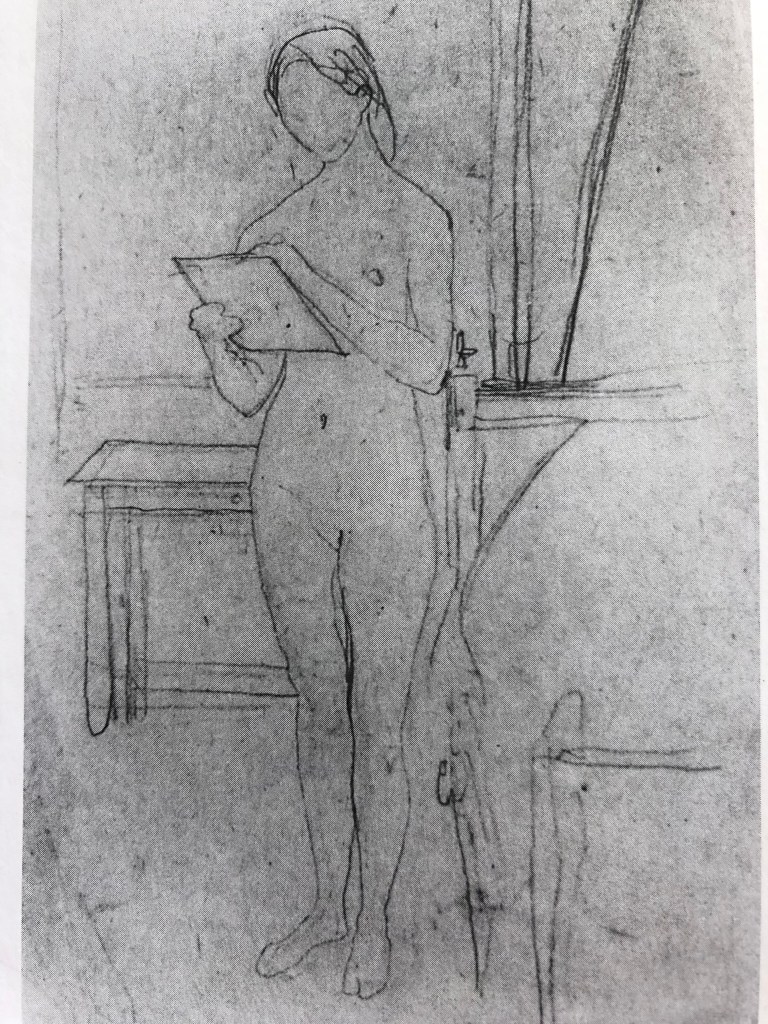
Gwen John shows an enviable confidence in her clear and simple line drawing, Self-Portrait Nude, Sketching, 1908-9, pencil on paper, National Museum and Galleries of Wales, Cardiff – obviously the result of much, much practice – no hesitant scribbly lines here.

Laura Knight’s Self portrait, 1913, oil on canvas, The National Portrait Gallery, London, which depicted herself looking at 2 nude female models, is a statement of intent.
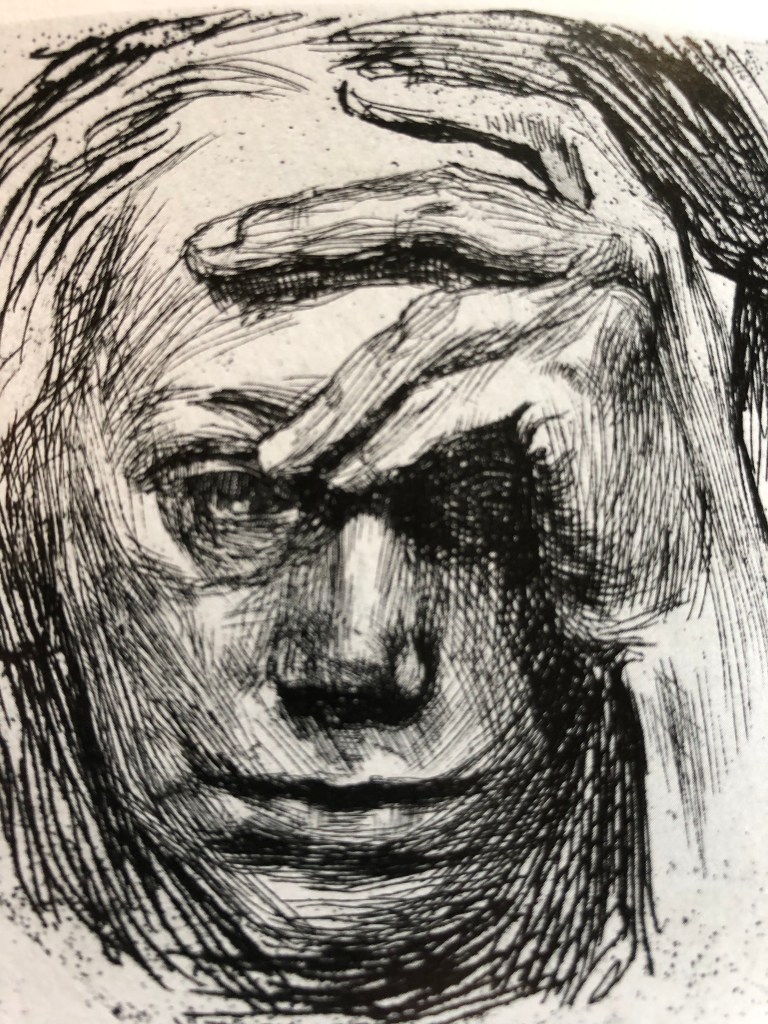
Kathe Kollwitz, of course, portrays herself with strong directional lines and some dramatic cross-hatching in Self Portrait, 1910, etching, Fine Arts Museum of San Francisco. 

And Helene Schjerfbeck depicts herself almost disappearing in the skull-like An Old Woman Painter, 1945, oil on canvas, private collection, Sweden.

Strange and otherworldly shapes and surreal images start to appear under the hands of the likes of Leonora Carrington, Kay Sage and Louise Bourgeois.

Alice Neal, in Nude Self-Portrait, 1980, oil on canvas, Robert Miller Gallery, New York, bravely bares all at 80 in a clear and lively painting.

Demonstration at West Devon Art Group on 19.2.20 by Jackie Lowman, mixed media artist

Jackie is a local artist who runs many workshops on her mixed media method of working – see her work on www.drawntothevalley.co.uk

She creates a textured background on board or canvas using leave, lichen, eggshells, tissue paper, seeds, old maps and newspaper articles, etc, which she glues onto the ground, seals edges with textured paste and then covers with gesso, often in several thin coats to make sure that this textured base is completely watertight. She then adds colour loosely in an fairly impressionistic style via acrylic inks which she spreads with a dropper and water spray of a wetted brush.

She likes to be quite free in her work and will sometimes change a picture completely if she sees a “better” image in it.

A completed picture of a Cornish hedge and lane
Works in progress!

Fine art group critique session with Helen Rousseau, 19.2.20

We were quite a small group today which allowed us to have breakout groups of 3 or 4 people, enabling us to look at a range of work with very differing styles and to have a bit of a conversation. It was interesting the way Helen asked us to present our work initially without an explanation and just invited the others to say what they saw – this was easier in some cases than in others. Helen pointed out that, if you eventually put your work out into the wider world, it must stand on its own and speak for itself – you can’t always be there to speak for it. Everyone seems to be pushing the boundaries and trying to use either unusual materials, or more usual media but applied in a different way, so I am glad to be reminded of this – in my current Part 4 work on life drawing, it is very easy just to snatch up the standard charcoal stick by default.

In a discussion on whether a work is finished, it was helpful to hear that others had a similar experience to mine, of a tutor feeling that the final piece submitted for assignment was overworked and quicker, freer work was thought to be as good, if not preferable.

Drawing 1; Part 4; Research point – Underlying structure of the body

From an online article by Jess Righthand, October 18, 2010, The Anatomy of Renaissance Art, www.smithsonianmag.com, it seems that anatomical science studies were the main source of inspiration for many artists. She says that artists such as Leonardo and Michaelangelo would watch physicians at work to learn the muscle and bone structure of the body in return for drawn illustrations for their medical texts; some, e.g. Titian, were allowed to participate in dissections in exchange for such illustrations.

 *****************

Notes on TV programme: 

The Beauty of Anatomy – BBC – shown Feb 2020

Galen – 2nd century- the 4 humours – these ideas were followed up to the Renaissance – importance to him is the relationship between organs – he liked to investigate and observe for himself.

French book made for Simon Vostre – 1498 – a book of hours including anatomical illustrations – connecting parts of the body with the planets, explaining when it was good to bleed patients.

Anatomy and theology were closely linked in the Middle Ages.

Fifteenth century in Italy – public dissections took place – Leonardo took anatomical art in a new direction – representing nature rationally. His drawings are now held at Windsor Castle.  He tried to work out how the body worked from his close observation and accurate drawing. He claimed to have dissected 30 corpses by the end of his life.

In Florence, he dissected bodies in order to allow him to reassemble them as a perfect work of art. 

*****************************

Contemporary artist Vanessa Ruiz has tried to take medical illustrations to the people. Her blog, www.streetanatomy.com, and her TEDMED YouTube video “The spellbinding art of human anatomy” bring anatomical art right up to date and showcases the work of street artists and tattooists, amongst others. Some of the “exploding” anatomical images, such as those of San Paulo illustrator Pedro Henrique Ferreira, feel a bit gross to me, but Michael Reedy’s work (e.g. La Guerre (2016),  hat oak, watercolour, coloured pencil, acrylic paint, glitter, gouache and glow in the dark paint) is often humorous (as well as taking the prize for the most media incorporated into one painting, I should think).

**********************

In a recent talk at the Tavistock Group of Artists given by Colin Pethick on “La Belle Epoche” – see separate blog post – he referred us to the art of Henry Tonks, right at the end of the period being studied. Tonks was a surgeon and worked alongside Gillies in the reconstruction of faces of airmen and soldiers horrifically injured in the First World War – Tonks would record their faces in his art – see for example the Science Museum blog post (www.blog.sciencemuseum.org.uk) by Stephanie Millard of 23rd June 2016 entitled “Exposing the face of war”. One seems even more aware of the structures of the face when they are out of place, as graphically depicted by Tonks – art as message.

Drawing 1; Part 4; Tavistock Group of Artists, 10.2.20 – talk by Colin Pethick entitled “La Belle Epoche – The golden age of portrait painting?”

Colin Pethick is a local artist – see his website, www.colinpethick.com

He gave an entertaining and highly knowledgeable illustrated lecture on La Belle Epoche, the period roughly between the 1890s and the end of the First World War – see my notes in A6 notebook 1. He had promised us that he would introduce us to painters we might not have come across before, and this was certainly true in my case, starting with Charles Durand who ran the Ecole des Beaux-Arts in Paris, which was the place to study portraiture at the time, and one of whose star pupils was Singer Sargent. He went on to talk about the way Sargent was the talk of the town but later became eclipsed by portrait painters with a loose, freer style who focused on the key parts of the painting and left other parts suggested by a well-chosen brush stroke rather than minutely depicted. He extolled the virtues of Jules Bastien-Lepage, pioneer of the square brush method, who taught James Guthrie (one of the Glasgow boys) and Stanhope Forbes of the Newlyn School. He sent us to look for the work of Cecilia Beaux The Amsterdam Joffers, Anders Zorn, Giovanni Boldin, Ilya Repin (especially – he did that wonderful portrait of Musorgsky just before he died, 1881, The State Tretyakov Gallery, Russia), Sir William Orpen, Sorolla (well, at least I knew about him!), and Henry Tonks…

He went on to talk about his experience as one of the contestants on Sky TV’s Portrait Painter of the Year programme – highly entertaining, and although he didn’t win his heat, he was pleased that the sitter selected his painting to keep.

Finally, he took general questions, amongst which was….so what do we need to do now to get our portraits current and noticed? He talked about how difficult this was, taking the example of Sargent who was initially feted and copied, but then people got fed up with his work because he didn’t come up with anything “new”. He said that the modern portrait painters didn’t try to just get a likeness, they tried to go past a superficial likeness, almost through it, to show more than was apparent on the outside. He himself, when painting, does virtually no underdrawing (although he might have done preparatory studies) – he just marks in the mid line and the eyeline and then tries to “find” the person in the paint. Interesting.

His final bit of advice: if you want to get good at portraiture, draw or paint a head a day without fail. Also interesting, although a little daunting.

Drawing 1; Part 4; Review of a BBC TV programme – The Story of the Nude 2.2.20

Notes made during the programme:

Emblematic of western culture? – 2 and a half thousand years ago in Ancient Greece. The images of athletic bodies: makes were power, women weakness. Praxiteles – started off the male gaze?

Medieval – Adam and Eve – nudity equated with vice and sin and the fall from grace. Christianity gave the nude a shameful aspect in the European tradition.

Italy – Renaissance – rediscovering the nude as celebrating the power and potential of humanity eg Michaelangelo’s David (although soon after unveiling, his manhood was covered by a fig leaf – too much of an eyeful! Patrons of art at that time wanted to show their link with the beautiful classical world. Four years later, Michaelangelo created the Sistine Chapel surrounded by male nudes. Sister Wendy – the height of beauty was a young male body – she said they were all thinking, beauty was not enough!

Andrew Graham’s-Dixon thought the male figures were not always recognised as spiritual- Christian message being drowned out by the erotic. 

Interpretation always changing.

Women still a vessel, men showed power.

Sam Roddick’s interpretation of Boticelli’s Venus – first Renaissance enchantress – inspiration for 21st century women – Venus is not ashamed but sexually celebratory. Is she way off the mark though? 

Baroque – nude driven underground – commissioned for private viewing, usually by men, eg Velasquez’ Rokeby Venus. Artists creating pictures to be consumed by the male gaze.

Rococo – Boucher – Resting Girl – “not interested in character – he loved painting flesh” – but also “an amazing painting of its time” – Louise Buck

19th century – Goya – The clothed Maha and the naked Maha. She is not painted as a goddess but as herself, and she looks out at us frankly and without embarrassment. At that time nude was still sculptural – but this is frank, shows pubic hair – as if she has caught us out in the act of looking at her. 

1863 – Manet’s Le dejeuner Sur l’herbe – broke all the rules – “in your face” nude painting that challenged the history of nude painting – a new chapter in art painting. She is challenging us and accusing us – unsettling the men who looked at her and making them feel uncomfortable about their slightly dodgy habits. 

Not changed till 1970s – only about 20-30 nudes have been seen by their artists as people – all the rest were objects to be looked out and consumed –  John Berger.

2001 – Kirsty Walke explored The Knight Errant by Millais – he originally painted the woman looking in a completely different direction, looking at the knight rather than away. 

Courbet’s nudes designed to titillate – “great haunches and buttocks””! Modern presenter saying we present art better now!

Freud tried to explain the nudes power on the male psyche.

1907 – Picasso – Les demoiselles d’Avignon – now we have moved on from seeing things like this as tribal art – Robert Hughes was saying that tribal masks in a nude was shocking – violent abstraction.

Modern art – the artist’s intent is important, the body is there to be acted upon.

Where is there left for the nude to go? – Lucian Freud – “as far as I’m concerned, the paint is the person”.

Jenny Saville – “ jarring and displacing”? – challenges the viewer to think about their assumptions about the women painted and the way they view them. 

What’s next – how can the nude stay relevant?

***************

So, what did I take from this?

  • It was useful to revise some of the key points in the history of the Nude – I had previously not clocked the Goya painting, so good to have this pointed out.
  • Interesting to see that the two up-to-the-minutes artists quoted were Lucien Freud, whose self-portraits I saw last month at the Royal Academy (see blog post on the London Galleries) and was blown away by; and Jenny Saville whom I struggle to get on board with – really too much flesh – but know she is admired by other students on the course I have talked with in online group sessions – Felicity was definitely one.
  • The challenge of “what next” – that’s down to us students – very exciting (although slightly worrying since I’m really struggling with noses and ears…)

Drawing 1; Fine Art Group “virtual studio” morning, 1.2.20, with tutor Caroline Wright

We had four hours this morning to get together. After initial introductions we had a substantial period of time to work on a project; then we got together with another student as a pair to share and discuss our work; bit more time to work; then we got together at the end when each student had a chance to show what they’d done and one or two other students were invited by name to comment thereon.

My work today was on Part 4, Project 6, Ex 1 – studying and drawing loads of ears, noses, eyes, etc, to make a kind of bank to which I can refer. I started with noses, which are really weird things when you look at them in isolation, rather discombobulating, so I switched to ears – which turn out to be even more unworldly. I was using the Unsplash site to generate images of heads, so tried to make sure I had some seen from the side and some face-on. I started off with a 2B pencil but, with my left hand, the fine control was not there so I switched to an HB Nitram stick which is much more forgiving of what I am able to do.

Part-way through this, I had a conversation with fellow-student David. His task was really out there – he is doing Drawing 2, and had to do a drawing with a pencil attached to the end of a 4-foot long bamboo stick. Wow. He decided to work standing up and walking around – he had had a practice run the day before and was visibly refining his procedure and control over his mark-making as he went. He drew an orchid onto A1 wallpaper, and his medium was a Pierre Noire Conte which he sharpened to a prodigious point – although it had worn to a sharp chisel edge by the time he spoke to me. He managed to produce a very recognisable line drawing of the orchid, and was now concentrating on adding tone. Hope my shoulder is better before I get onto that!!

He recommended www.proko.com for videos showing how to draw facial features, and also a text by Andrew Loomis from the 1950s which he says has some really helpful demonstrations of facial drawings to work through.

Caroline the tutor pitched in then to offer me some advice about drawing the face (or indeed anything) – she recommended running your hands over e.g. the eyes, nose, chin etc – feel the planes and the sweeps, which will help in the drawing of gestures. She clearly believes in constantly returning to the object you are drawing for reference – she posted this quote for us to consider from the book “Mute objects of expression” by Francis Ponge, 1976, Archipelago Books:

BANKS OF THE LOIRE

Roanne, May 24, 1941

From now on, may nothing ever cause me to go back on my resolve: never sacrifice the object of my study in order to enhance some verbal turn discovered on the subject, nor piece together any such discoveries in a poem. Always go back to the object itself, to its raw quality, its difference: particularly its difference from what I’ve (just then) written about it. May my work be one of continual rectification of expression on behalf of the raw object (with no a priori concern about the form of that expression). Therefore, writing about the Loire from a place along the banks of the river, I must constantly immerse my eyes and mind in it. Any time they dry up over an expression, dip them back into the waters of the river. Recognize the greater right of the object, its inalienable right, in relation to any poem… No poem ever being free from absolute judgment a minima on the part of the poem’s object, nor from accusation of counterfeit.

She herself was working alongside us during this session on a commission she had been given to make some artworks for public exhibition representing the River Cam,  and today she was making some smaller prints from photos she had taken of the water whilst actually swimming in the Cam – it felt quite special to have her working with us, and gave her an idea of our experience of the session so she could judge timings, I guess.

After a bit more work we got together, took it in turns to show our work, and were called on individually to comment on a piece – good practice in looking carefully but quickly and analysing on the hoof.

A useful session – see A3 sketchbook and separate blog post (eventually) on Project 6 Ex 1.

Drawing 1; Part 4; Notes on art group demo by Richard Woodgate

31.1.20

This afternoon the Whitchurch art group had a session with Richard Woodgate, a local artist who runs a gallery in the Ox Yard at Buckland Abbey, a nearby National Trust property – “The Woodgates’ Gallery” – see www.nationaltrust.org.uk.

Richard comes to us fairly regularly; his specialism is atmospheric landscapes and he generally runs a paint-along session on a theme we have requested, e.g. clouds or trees. Today was a little different however in that he picked up on various odd queries which we had made along the way, and dealt with them. Three aspects were covered, all of which were useful to me:

  1. Putting figures into a landscape. He talked about tops of heads being roughly at the same height on a level landscape (ie, not looking up or down on the scene), so that all you then do is change the size of the figure. Dots and smudges in one colour for distance – slightly bigger blobs and a bit of colour variation for mid ground, and then heads, bodies, stronger colours for foreground. He doesn’t do feet, but rather grounds the figures with a bit of shadow – see experiments in my A4 sketchbook.
  2. Someone had sent him a very bucolic photo of a local stream with trees and fields and asked how he would turn it into a painting. He demonstrated by showing how he works things through quite meticulously in his sketchbook, trying out compositions and making notes on colour choices and what does and doesn’t work. He explains his choices on moving features of the landscape, or removing some bits altogether, or combining them with another photo or sketch very well, and stresses the importance of planning a picture before starting – I don’t think I do nearly enough of that.
  3. Someone had asked about making greens. Richard’s palette only contains shades of red, blue and yellow, and he mixes all the colours he needs from these. He showed us how to make a colour chart – see A4 sketchbook. He says that colours need to look fresh so you should only mix two (this is watercolours he is talking about) – more leads to mud. He emphasises the importance of taking the time and trouble to really get to know your colours well and what they can and cannot do – that way you identify gaps in your palette and know what to go and buy, rather than buying all sorts of ready mixed colours that you don’t need. He showed us one of his colour charts where he mixes various reds and blues to make greys – he calls this his “50 shades of grey” chart – boom boom!

Group meeting with Dan Robinson on Productive Time – 20.1.20

I joined this meeting about half an hour in, unfortunately, as I had a hospital consultation which couldn’t be missed.

When I joined, I think it must have been into group members’ presentation time. Useful snippets gleaned:

  • Karl Schmidt-Rottluff’s ink still lifes – bright and vibrant
  • Croquis Cafe – I have not seen this before, so had a look a one of the videos on Vimeo – feels very slightly creepy, but might be useful for Part 4 sketches
  • Work of Josephine Halvorson – brought up in response to Emma (student) showing her paintings done on a walk – JH has done a similar sort of thing

Other interesting points:

  • David’s sketchbooks of repetitive drawings and how these led him to simplification and almost abstraction; he got the idea for some of this from Kaupelis (recommended text)
  • Felicity’s discussion of a photograph as being taken in a split second, and how the painter (painting from the photo) nevertheless aims to impart much more information than which is therein. It was pointed out that even minimal information, e.g. date or title, can change the way the viewer sees it.

My contribution to the discussion when it was my turn to start was based on:

  • the research material we had been given on the work of Sol Lewitt
  • The emailed suggestion for discussing artist books as methodology and questions around singular ”final piece” versus sketchbook experiment and process.

I, like David, had done several repeated sketches of one subject and had found that, as I got to know it, I was able to simplify it, adapt it, and felt moved to experiment with different ways to represent it. I am also learning how to make books. I wondered therefore whether a handmade book charting an investigation into ways of looking at, drawing and representing a particular subject, without having a finished final drawing or painting, could still be regarded as “a work of art”. After some discussion, basically the jury’s out – so I might try it and see.

Demonstration to Tavistock Group of Artists on 13.1.20 by Iain Grant

Iain is a local artist involved in many local art groups; he has experimented with many materials and styles, and sells a lot of his work in local exhibitions and galleries.

Today he was demonstrating in pastels, in a particular style – what he calls “dark sky, white cottage”. He brought some examples of his work, and the style certainly is very  eye catching – he doesn’t claim by any means to have invented it, and indeed I have seen similar paintings on various websites, as well as owning a painting by John Piper in this mould. However, it was good to watch someone create something like this from scratch.

He worked from a photograph of a cottage he knows well in the Scottish Islands.

He likes his paper to have plenty of tooth so that he does not need to use fixative; he recommends Pastelmat by Clairefontaine, and also Colourfix, which is Australian (this latter manufacturer also produces  pastel primer which can be used on more or less anything, and can be mixed with a little acrylic paint if you want a coloured ground). His favourite pastel manufacturer is Sennelier, but he also uses a lot of Unison.

The technique I learned was rubbing the pastel into the paper using the heel of your hand – he suggests you can also cover the drawing with glassine and repeat, helps to obviate the need for fixative.

His key bit of advice: make confident marks even if you don’t feel confident, they look better. This is important for me and something I have discovered for myself only recently, since having been forced into using my left hand by virtue of a broken right shoulder – big clear left-handed marks have more impact than my little tentative and scribbling right-handed style. Every cloud…..

Iain’s pastel painting created this evening: