Drawing 1; Part 5; John Virtue

What and So What?

John Virtue was an artist unknown to me before I started this course; however, as soon as I was directed to look at his work, it struck a chord with me. I liked his black-and-white images – no muddying of the waters with colour – and the organised core of me enjoyed his earlier tessellated works (which satisfy my innate need to prepare grids and charts) as well as his later, looser drawings with their repetitive quality born from his repeated study of the same area.

Unable to get to the university library during lockdown to find the books I had taken out on him before, an internet trawl revealed a new retrospective of his work – Paul Moorhouse, (2019), John Virtue, Albion RidingHouse, Oxford and London – and so I treated myself to a copy. It is a weighty tome but I have been fascinated reading it, and it contains a large number of reproductions of his artwork, which are otherwise tricky to track down online. The book follows his life and work in chronological order, looking at how he worked to develop and grow a style, or styles, which are his own. Any quotes which follow are from this book.

His method of working is almost ritualistic and it is based on repeated regular walks in/to a particular site – “These repeated walks, and indeed the wider progression from one place to another, underpin his artistic development.” He walks, he looks, he sketches, and brings his sketches back to work into and work from; however, these sketches are often unrecognizable, scribbly, and are intended more to remind him of a moment or experience than as an actual topographical record, and it is that experience which he aims to record in his completed works – “So it’s about being in a place, about movement within the place. The landscape presents me with a foundation…a structure, and that structure allows me to take all kinds of liberties to get some actuality.”

In his early work he would walk a particular location, sketching as he went, then would work into these sketches at home with pen and line, creating dense images. He started pinning these up on the wall until it eventually occurred to him to arrange them into a grid, which was a bit of a Eureka! moment for him – “Instead of a single view, a completely different evocation of the subject evolved. This presented the same motif from different positions. As the eye traverses a surface of different images, there is a sense of moving around and through space, as if seeing a particular place from successive positions. Experiencing the works in that way echoed the walks….”
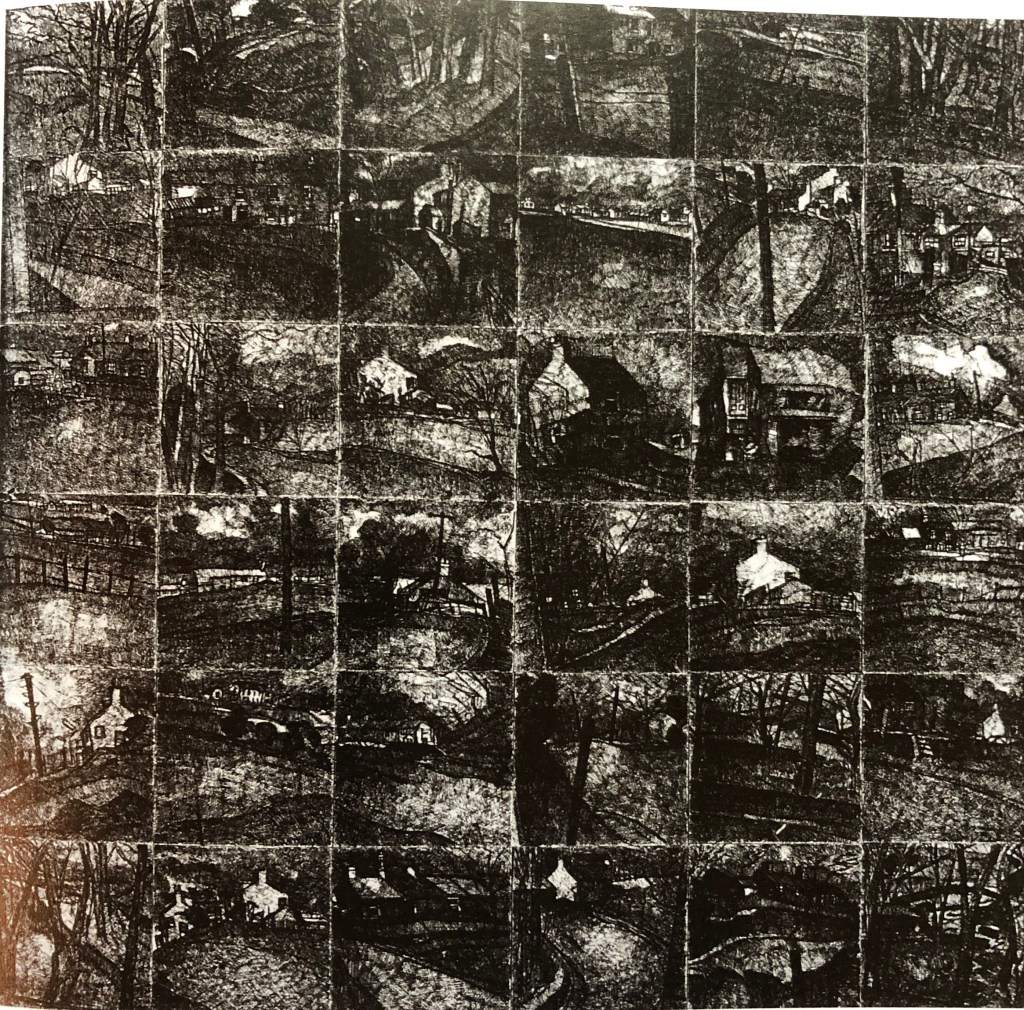
This example is Landscape No 10, 1982-83, black ink, shellac, pencil and charcoal on acid-free paper, laid on board, 110x110cm. Private collection, UK.

It depicts his walk at Green Haworth, which was the first site depicted in his new method.

He then moved to South Tawton in Devon and began another series of walks, experimenting with his grids and layouts in different configurations and sometimes dropping or dribbling white gouache over the drawings. A few become less frantically dark, such as this example, Landscape No. 133, 1990-91, black ink, shellac, acrylic, emulsion, gouache, pencil and charcoal on acid-free paper, laid on board, 98 x 97cm, private.
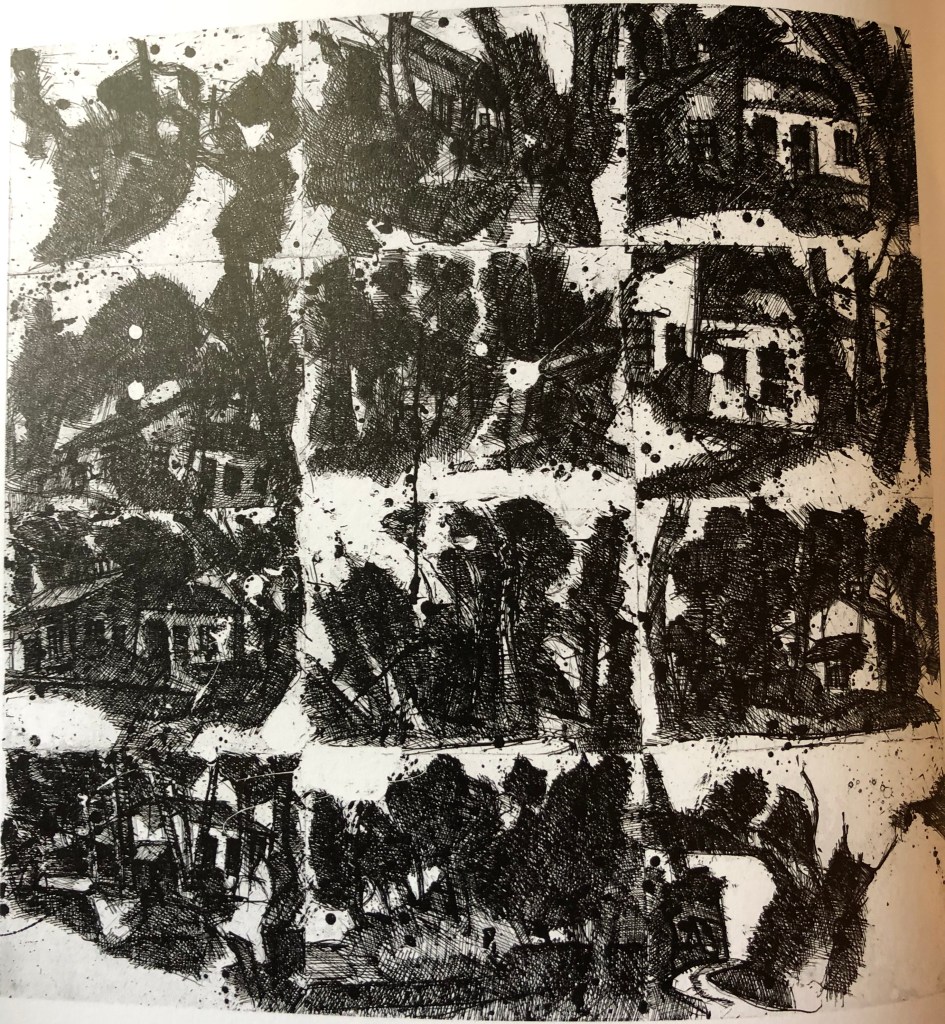
Subsequently he moved to Exeter and began to walk the Exe estuary, where he could often walk without meeting a soul – but he is still not walking for contemplative pleasure – “Wherever he is based, the ritual that he establishes provides a structure that focuses his experiences. It wrests the flux of passing time into an order and, through drawings made at regular intervals during the course of the walks, a succession of transient moments can be arrested and preserved.”
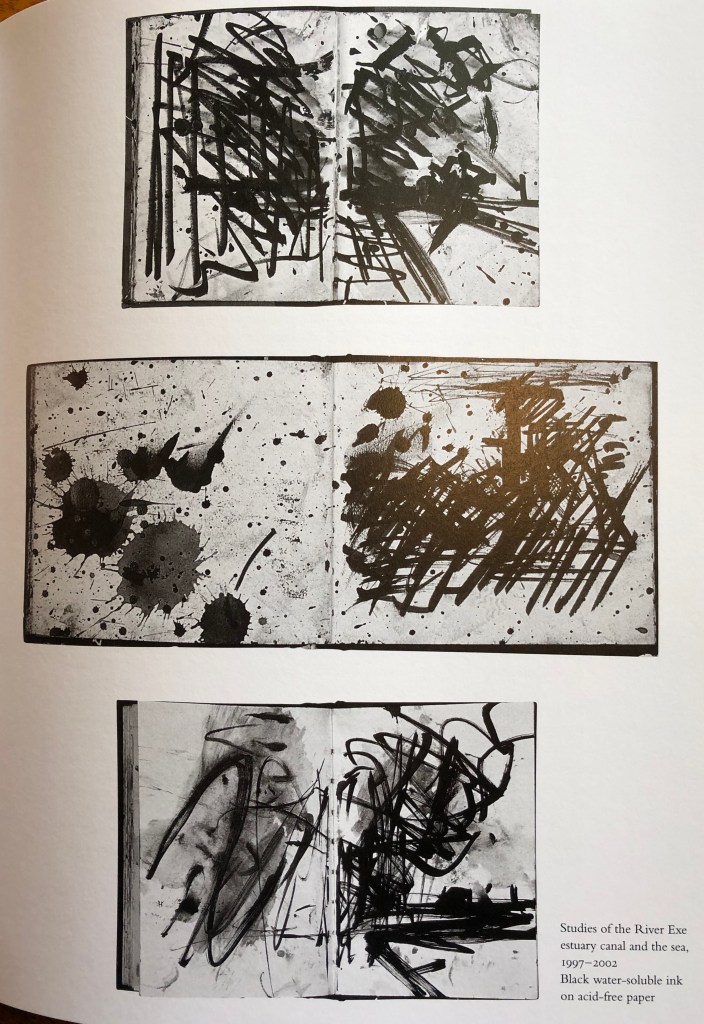
These extracts from his sketchbooks – Studies of the River Exe estuary canal and sea, 1997-2002, black water-soluble ink on acid free paper – give an idea of the sorts of marks he was making (and give me hope that my more scribbly pages in my own sketchbook are not completely out of the way).


It was here that his method of working changed – he still amassed huge quantities of drawings, but used them to try and create a single image, usually large and now on canvas, that encompasses these experiences.
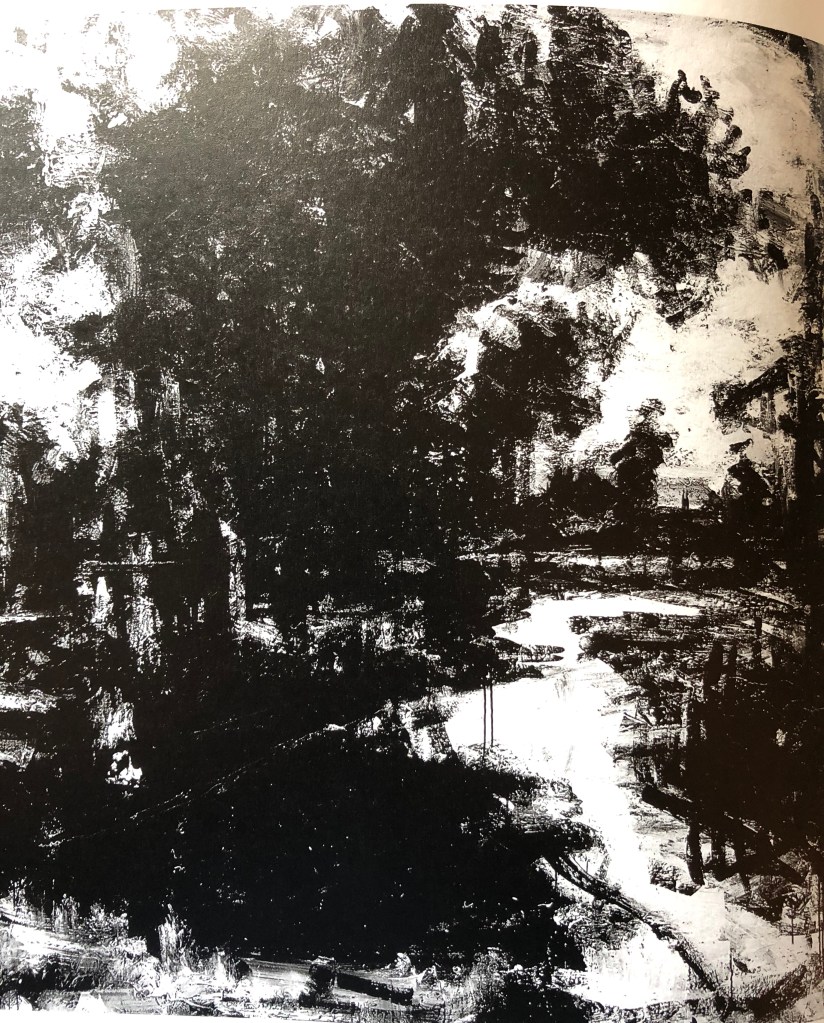
Many of them are hard to read at first and look almost abstract – but he always includes the church tower – often extremely small – but this one part of the picture seems to pull the rest into focus and make it understandable. One of the more figurative examples is Landscape No. 657, 2002, black ink, shellac, acrylic and emulsion on canvas, 183 x 183cm. Private collection, USA.

Virtue moved on to create other series, notably a group of London drawings which were the outcome of his time as Associate Artist with the National Gallery; his routine continued, but his walk now had to start at 6 a.m. to avoid the rush hour!

Now What?

Hopefully what’s gone before has given an idea of my enthusiasm for John Virtue’s work. There are two strands that I want to have a go at developing – the large and loose ink drawings, and the tessellated presentation, to see if either of these is where I want to go for a final outcome to this investigation.

Large and loose ink drawings:

I started this off with the Fine Art Group studio day on 25.4.20 (for details of which, see separate blog post), but just include first effort here for the sake of completeness:
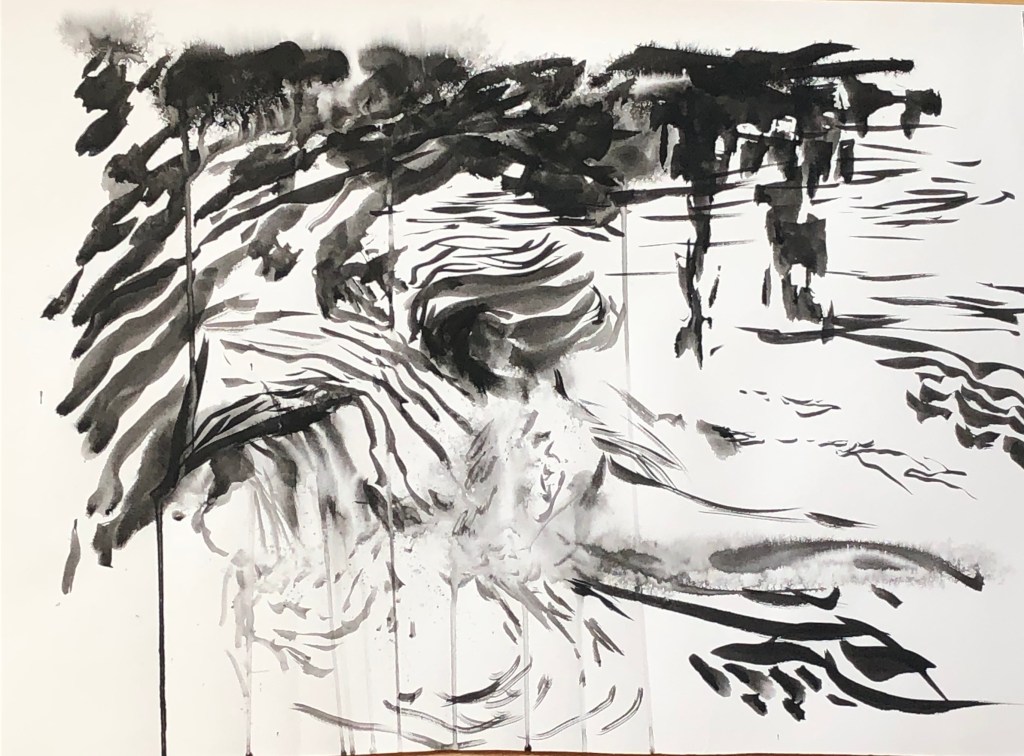
This was drawn without a particular reference point in mind, but was derived from my experiences walking along our little stretch of the Tavy, staring at and sketching the movements of the river which, because of the time we usually walk (and a regular time of day for walking was one of Virtue’s key ritual aspects), is usually backed by a dark bank and reflections, the sun coming more or less straight into our eyes from across the water.

I extended this experimentation further by dropping black Brusho into water dribbled and sprayed onto thin packing paper (see also the reference to Alison Churchill’s work in the Studio day blog post); once the water and Brusho had been applied, I picked up the board and moved it around to encourage the direction of particular dribbles. I also thought I would try dropping white ink in from a Derwent Graphix marker but this proved a little unreliable and was also tearing the thin paper, so I moved to dilute white gouache for my dribbling and swirling.
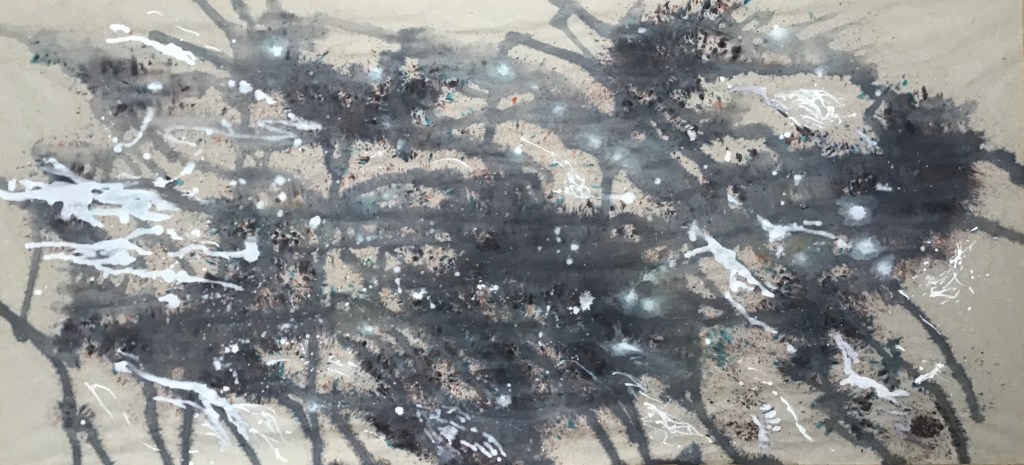
The effects are interesting….it definitely looks like fluid movement, and the white dropped into wet has given the impression of those sunlit sparkles you get on particular peaks or troughs. To be experimented with more, I think….

Tessellation:

I’ve had one go at this so far. I made a series of 2 min rough sketches (my husband helpfully timed me) with a sepia Pitt drawing pen in my A5 sketchbook as we walked. Frugal habits run deep and I had not thought to put them on separate pages so that I could tessellate them – doh! – so I drew myself a grid on A3 rough watercolour paper and copied the sketches into the grid – same pen. John Virtue worked into his with black line, but I decided instead to try ink washes in a limited set of colours – Pebeo Colorex Green Gold and a little FW blue acrylic ink – I wanted them to harmonise with each other as part of the same set. I have various places where I stop and draw (as per John Virtue) – from top left to bottom right, the weir, the lookout, the pylon, the beach, the fishermen’s steps, the bridge, the leat, the tributaries and the salmon leap.
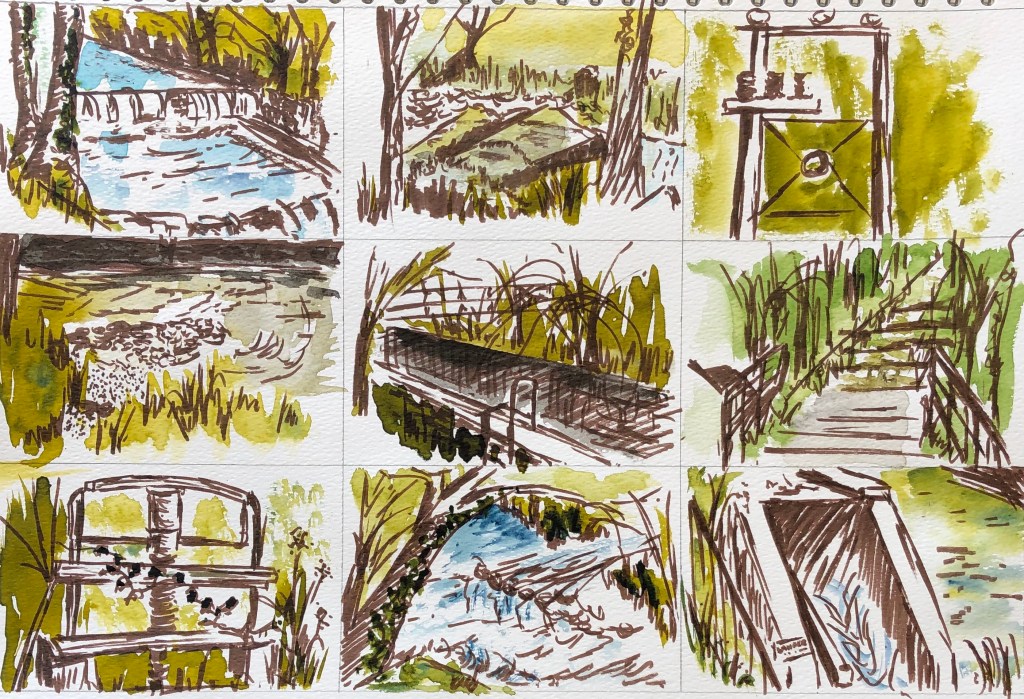
I think they are effective as a group, although I just drew them in as they came in my book, and so didn’t try moving them around to see which was the optimum visual arrangement – something to experiment with. Somehow the colour makes them look more like a group of individual drawings rather than parts of a whole, as in Virtue’s homogenised black-and-white …so plenty of things to try out.

Demonstration at West Devon Art Group on 19.2.20 by Jackie Lowman, mixed media artist

Jackie is a local artist who runs many workshops on her mixed media method of working – see her work on www.drawntothevalley.co.uk

She creates a textured background on board or canvas using leave, lichen, eggshells, tissue paper, seeds, old maps and newspaper articles, etc, which she glues onto the ground, seals edges with textured paste and then covers with gesso, often in several thin coats to make sure that this textured base is completely watertight. She then adds colour loosely in an fairly impressionistic style via acrylic inks which she spreads with a dropper and water spray of a wetted brush.

She likes to be quite free in her work and will sometimes change a picture completely if she sees a “better” image in it.

A completed picture of a Cornish hedge and lane
Works in progress!

DRAWING 1; ASSIGNMENT 3

I need to preface these notes with an explanation:

Three days ago I tripped over a kerb (rushing to a local art exhibition, annoyingly) and landed on my shoulder – was taken to hospital by ambulance, and it turns out that I have a complex multiple fracture. It’s very painful, so I am on morphine for it, and I am waiting for an operation to see if it can be fixed or, if not, to replace it. It’s my right arm and, wouldn’t you know I am very strongly right-handed, am finding it very difficult to do anything with my left – it is taking hours to type this!

In view of all this, I have decided to submit my Part 3 work to my tutor (I had already completed all of it apart from the last two exercises in Project 5) along with my plan and such preliminary work as I had done prior to the injury, and hope that this might prove enough.

Preliminary work

  • Thinking that I would need to spend quite a while in situ doing drawings in a cold wet November, I did a set of rapid, rough A3 sketches in pen from windows in my house, all showing buildings, tree etc, as well as allowing for the demonstration of linear, angular or aerial perspective
  • Sketch 1 was looking down from the attic window of our 3-storey house at the road, a small group of houses across the way, and a hill with trees behind – all flanked by gable roofs . Sorry – my daughter took the photos of the sketches for me, not the way I usually take them and I can’t turn them – so this needs to go round a quarter left.

  • Sketch 2 was the view from our first floor bay window looking down on next-door’s porch roof and driveway, across to next door’s bay window and then on down a windy road which forks then disappears into trees

Sketch 3 is looking out from a different first floor window into our garden, onto the garden wall,  down a side road with a lane off, making a z-shape – again, the photo needs to turn a quarter left.

The final sketch is from the ground floor study window – the view (of the houses opposite and along and background woods) is nicely  framed by the dark garden wall and shrubs, trees at the side and looping right overhead, with central focus of a much-pruned beech. 

Plan

After attending the South West group meeting, listening to speakers there, reflecting on Lydia Halcrow’s work (see separate blog post), thinking about series pictures (e.g. John Virtue, David Hockney) I decided not to choose just one of these sketches to work up for the assignment, but to present them all as a tessellated group. Lydia, John Virtue and some of the photography students at the meetings were all trying to represent a journey as a series of images; I thought of mine as offering a series of potential setting-off points, depending on which image you chose to jump into – a bit like the beginning of JRR Tolkein’s The Hobbit, where Bilbo Baggins was promised an adventure by just stepping onto the road outside his door, the particular adventure being determined by which way he chose to turn.

I intended to work up each image on A3 so that, when assembled, the total would be the required size. I was going to simplify each image quite considerably (as I had done in Project 5 in a set of drawings of the Church – see sketchbooks) and intended to work quite loosely on pastel paper with some pieces of gesso-coated newspaper – in the style of the church example here.

My medium would be mainly inks (applied with both brush and pen), plus some charcoal and Conte crayons – not necessarily monotone, but a limited palette of 2 or 3 colours at most.

Drawing 1; Part 3 – Expanse; Project 4 – Perspective; Exercise 3 – Aerial or atmospheric perspective

I used photos of landscapes which went to a far distant horizon so I could really try and get the hang of this.

First up was a couple of views of St. Ives. The top drawing is a sunrise over Porthminster Beach to the distant headland by Godrevy lighthouse (of Virginia Woolf’s “To the Lighthouse” fame). The photo I worked from was taken from a hotel balcony, which has given it a rather “Titanic” feel. I worked with water-soluble pens in a limited range of colours – three blues, a yellow and a flesh-colour just to get the orangey cloud colour.  I think it’s quite effective as an image, but the thing with felt pens is that it’s quite difficult to fade the colour in the distance – the colours more or less are what they are. I also had a photo over the roofs of St. Ives taken from the upstairs cafe in Tate St. Ives, so couldn’t resist a take-off of the Barnes-Graham illustration in the notes. Again a limited palette of water-soluble pens – black, yellow, light green and brick-red, together with a drawing pen for thin-line details. I kept detail to a minimum for all but the closest buildings, just suggesting the far buildings with a few lines, and added a bit of colour to the roofs of the near buildings to depict that classic greeny-orangey-yellow of St. Ives. I had indicated the clouds in black felt pen so put an experimental wash of water over these and was delighted with the resultant purplish result which I have then pulled down over bits of the town. Great fun.

Next up was an image of the cliffs off Fistral Beach at Newquay. I wanted to try oil pastels for this, and worked quite quickly. 

By blending and overlaying the colours I have managed to get the changes in the sea colour (hazy blue to dark then to greenish blue coming from back to front), and the grain of the paper in my sketchbook gave quite an interesting broken effect of light reflecting from the water. However, that same effect rather did for my sky, which on that day was cloudy and actually rather a strange completely flat matt grey-blue, and I couldn’t get that flatness on this paper with this medium. A passing co-painter at my art group suggested that I put a watercolour wash over it; didn’t have watercolours with me, so I did a quick re-drawing in pastel and tried a wash using the water-soluble pens, but still not right – think I should actually not have attempted the sky in pastel at all, and just used a wash.

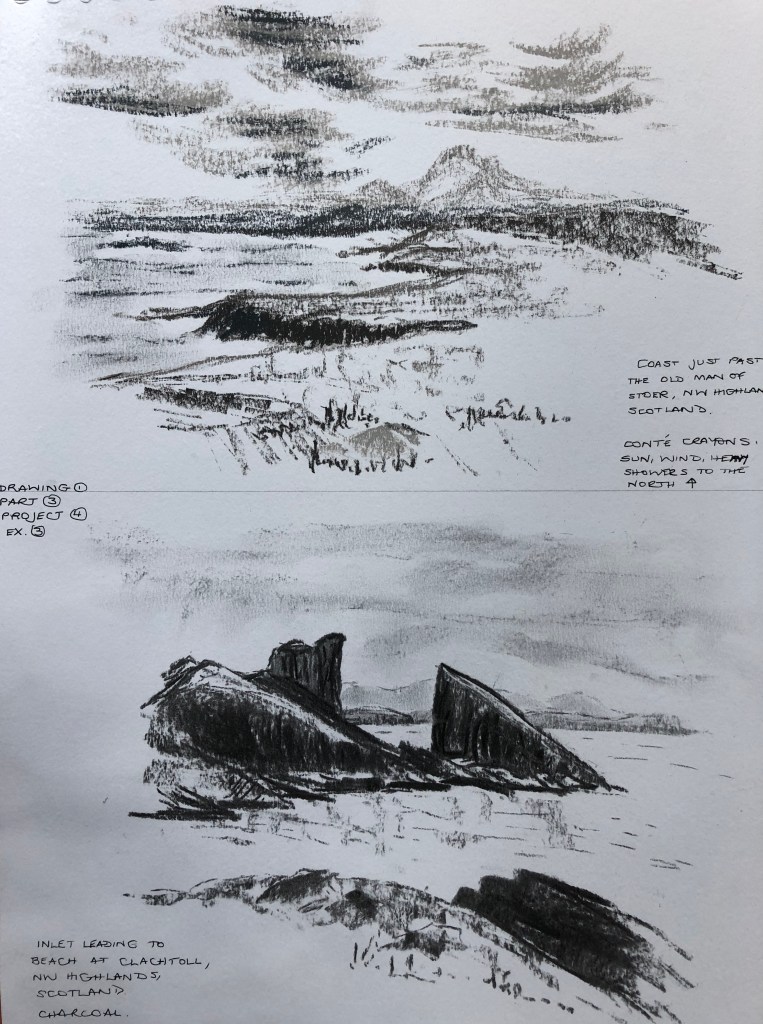
Finally, I tried a couple of photos from our trip in May up to the far North-West Coast of Scotland. Everything is quite dramatic up there – white beaches, black cliffs, looming mountains in the distance wherever you look – so this seemed a good opportunity to experiment with monochrome. The first drawing was done in Conte crayon using shades of grey. I have tried to vary the darkness of a single crayon so that the darkest dark is reserved for the nearest cliffs. The clouds were actually touching the far mountains on this particular day, so I hope I have caught that distant melding of cloud and land.

The final drawing has turned out to be my favourite of the lot, and probably the most effective in showing great distance. The drawing was done in charcoal with nothing else apart from the odd smudge with a finger. The near really dark rocks frame the entrance to the white sand beach of Clachtoll (“Broken Rock”), and by decreasing size and intensity I have tried to show the distant headlands and then the far mountains behind – they are quite hard to spot on this photograph – perhaps I have made them too faint – but they show up better on the original.

TAKE AWAY POINTS from this exercise:

  • Mediums with “pre-fixed” colours e.g. felt pens, oil pastels, can make it tricky to fade the distance, especially if you have a limited range
  • How is my support helping/hindering? – consider!
  • Charcoal gives real drama and makes an almost infinite variety of depth possible
  • Maybe therefore use a combination of charcoal for drama/depth, with ink/pen for detail and crispness? – try this combination out in the exercises in Project 5

Drawing 1; Part 3 – Expanse; Project 2 – Landscape; Research point – Landscape artists of different eras

Albrecht Durer

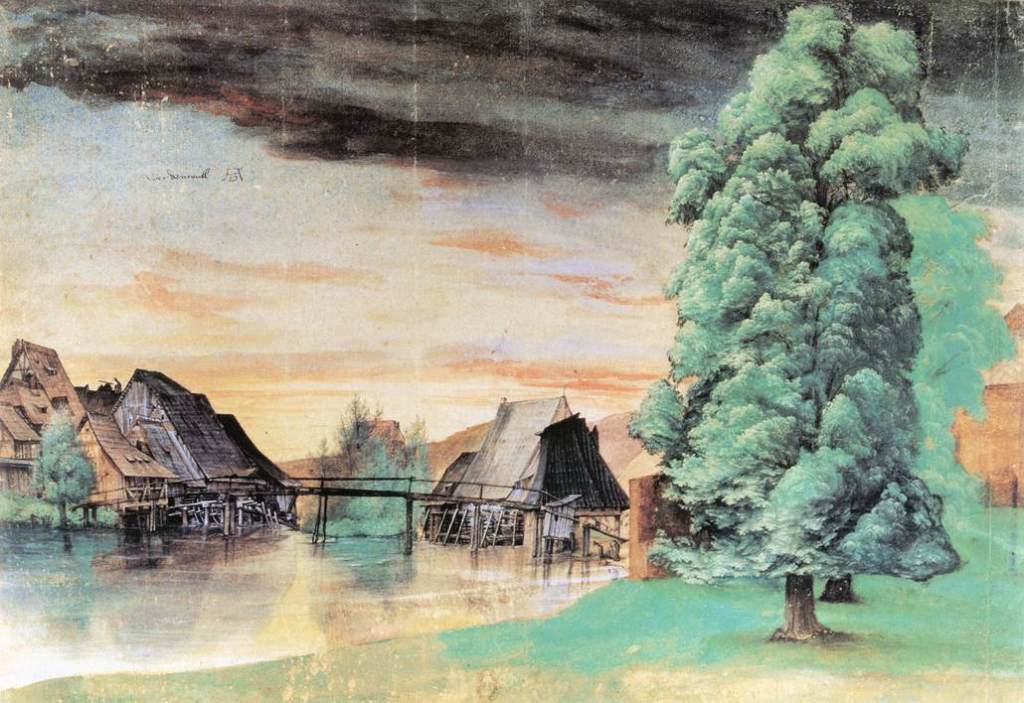
In Silver & Smith, 2011, The Essential Durer, University of Pennsylvania Press, reference is made to how central drawing was to Durer’s practice, and how he would draw every day regardless of the other work in which he was currently engaged, and this must have supported the accuracy and detail of his etching and engraving work in particular. His drawing materials were wide-ranging; basically all the materials we have been encouraged to use in the course so far with the exception, interestingly, of red chalk, which he is not known to have employed. It is said that his choice of drawing medium was always suited to the subject and that for natural subjects including landscapes he would use a brush (allowing for wide sweeps) and watercolour and body colour. His breadth of choice of subject matter is very wide, and no doubt partially dictated by the religious upheavals and scientific blossoming of this day, but apart from his print work he is also known for his watercolour landscapes including weather effects such as The Willow Mill:

Albrecht Dürer, The Willow Mill, 1498 or after 1506, watercolour, bodycolour, pen and ink on paper, 25.3 x 36.7 cm. , Bibliotheque Nationale, Paris

I particularly liked this one for it’s sky and it’s foreground tree, both of which I feel I am “working towards” being able to produce.

However, a lot of his landscape work in his etchings and engravings seems to be as the background to a foreground human event, either real or imagined; I watched a video on YouTube about the etching: Durer, 1518; Landscape with Cannonput up by the Clark Art Institute, Williamstown, Massachusetts, in which a huge amount of background landscape detail is put into a scene populated by numerous figures as well as said cannon.

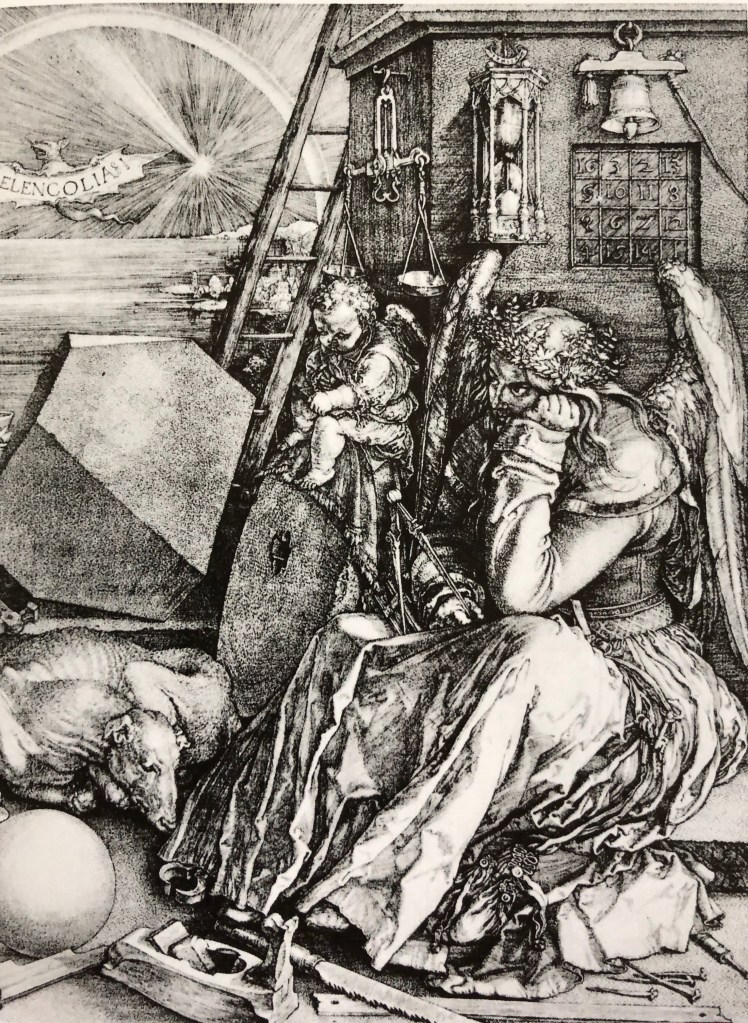
 I was fascinated also by the engraving: Durer, 1514; Melancolia I which, as pointed out by Hockney & Gayford in their 2016 work A History of Pictures, Thames and Hudson, contains a massive amount of hatching detail – just look, for example, at that calendar on the rear wall!

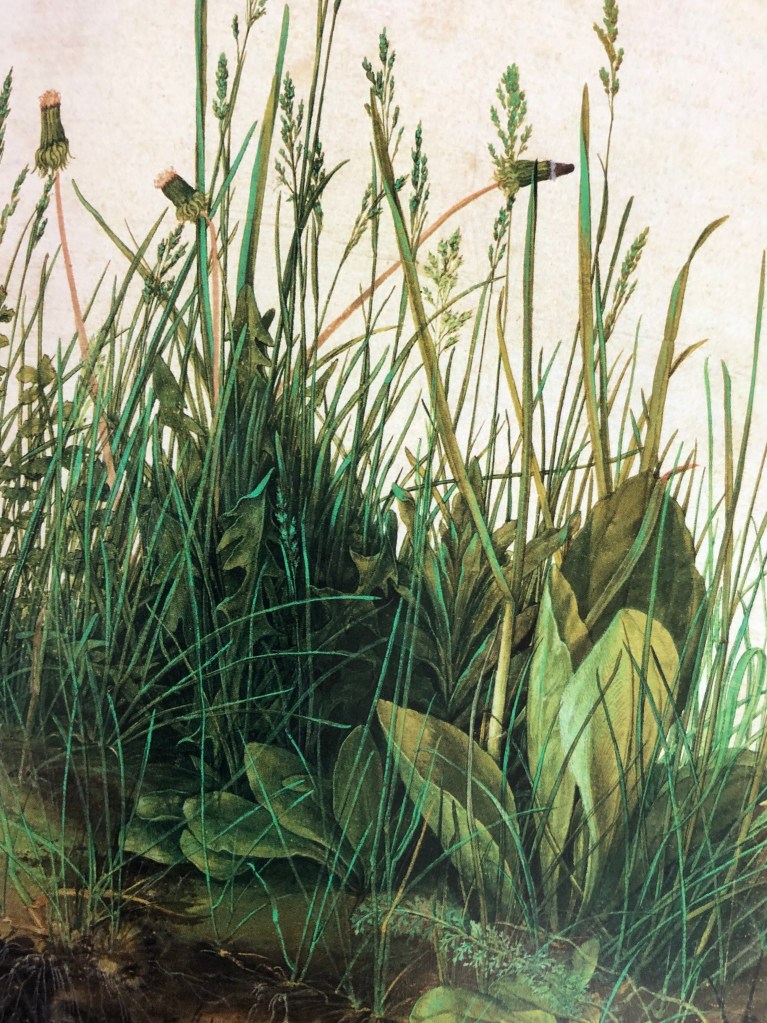
I was also attracted to Durer’s 1503 work, The Large Piece of Turf, watercolour and gouache on paper, Grafische Sammlung Albertina, Vienna – so fresh, looks as if it were painted yesterday. According to de Botton & Armstrong, Art as Therapy, Phaidon, “..Durer hoped that, having looked at his work, one would head outside and do what he had originally done: to look with great care and devotion at some significant aspect of the natural world.” 

Well, it’s done it for me.

Claude Lorrain

Claude became famous for his works evoking “nostalgic beauty” (E.H. Gombrich, 1988, The Story of Art, Phaidon). He likes, as de Botton & Armstrong (see above) suggest, “…glimpsing a horizon through a cluster of trees,,,” – and his trees are certainly very lifelike. Gombrich says “It was Claude who first opened people’s eyes to the sublime beauty of nature, and for nearly a century after his death travellers used to judge a piece of real scenery against his standards. According to Franny Moyle, 2016 in The Extraordinary Life and Momentous Times of JMW Turner, Penguin, Turner was exposed to Claude’s print works as a child and, as an adult and already established artist he showed that he admired Claude’s work and tried to emulate something of his grand style.

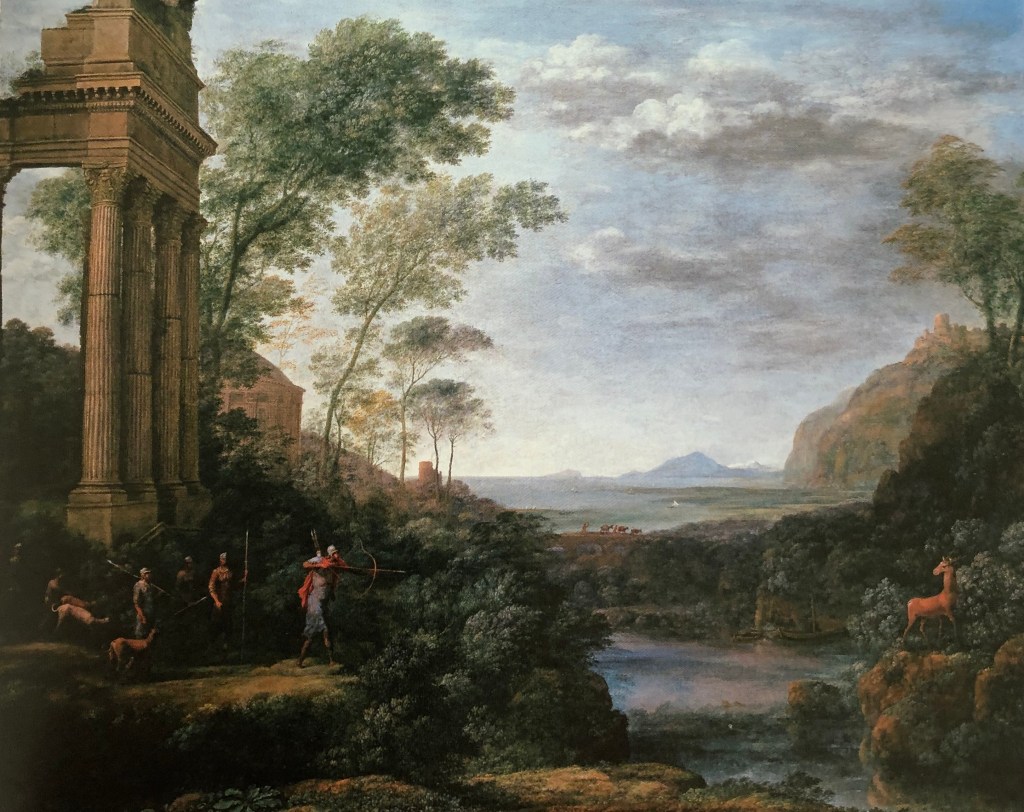
Hockney and Grayling (see above) point out the beauty of Claude’s composition, saying that his paintings were very theatrical: “His placing of trees or architecture on the right and left and the deep space in the middle is very much like a set behind a proscenium arch” – an example seen here in Claude’s 1682 painting, Landscape with Ascanius shooting the stag of Sylvia, oil on canvas, Ashmolean Museum.

I think this last remark chimes with me – I can appreciate the complete virtuosity of Claude’s rendition of trees, clouds and the like, but his paintings overall don’t particularly appeal to me as they feel very posed. I also have a horrible feeling that, if I sat down to paint “a landscape”, my initial attempts at composition would be very similar – something I must bear in mind.

L.S.Lowry

I think of Lowry initially as a set of stick figures in grim Northern industrial streets with no trees or gardens, or coming out of mills. His L.S. Lowry, Industrial Landscape 1955. Tate. © The estate of L.S. Lowrywas rather different, an apparently invented view which for some reason immediately brought JMW Turner’s “Fighting Temeraire” to mind. Interestingly, thevarious art books I havehere do not show Lowry at all in their indexes, which invites one to think that either they are old (which they aren’t – at least some), or they are snobbish or they find Lowry’s work difficult to use to illustrate a point. The online article where I found the above image, www.tate.org.uk, is part of the promotion for an exhibition of Lowry’s work in 2013, and says that it aims to argue for Lowry’s place as “..Britain’s pre-eminent painter of the industrial city” ; it goes on to list the paintings to be shown, but does not do much more to make the argument. Maybe they assume that the paintings speak for themselves? – I’m not sure…

In an online article by Jeanette Winterson from The Guardian, 13th June 2013   it quotes Lowry as saying: ““It would be about four o’clock and perhaps there was some peculiar condition of the atmosphere or something. But as I got to the top of the steps I saw the Acme Mill; a great square red block with the cottages running in rows right up to it – and suddenly I knew what I had to paint.” She describes him as “popular, but unfashionable – a deadly combination in the art world”, but she finds the rather repetitive nature of his paintings fascinating, showing what happens to people when they have to deal day-in-day-out with repetitive machines. I found her article brought him to life a bit for me and made me see the point of his flat paintings (she urges us to look for the flash of colour in the flowers in an upstairs window as a sign that the humans are secretly fighting back against the machines) – but I’m not sure that I would want to paint in his style.

George Shaw

I hadn’t come across George Shaw before, and I can see that, in a way, he is the natural successor of Lowry. My initial reactions to his landscape paintings were, I suppose, surprise – he paints realistically, yet why does he paint the landscapes he chooses? Apparently he paints in Humbrol modelling paint, which gives his pictures a modelled sheen – almost as if he were trying to preserve the crashingly mundane scenes around him for posterity, as images to be valued because they represented his life and environment exactly as he saw it. I found an interesting review of his exhibition at the Holborne Museum in Bath written by Johnathan Jones published in the Guardian on 7th February 2019 , very much trying to set Shaw as a product of the dreadful Brexit times we are all going through. This extract caught my eye:

“Yet his meditation on what the art historian Nikolaus Pevsner called “the Englishness of English art”goes deeper than that. Shaw revisits the landscape art of Gainsboroughand Constable that is so often taken as quintessentially British, or English. He haunts the same kinds of woodlands they did and shares their eye for nature; the trees in his paintings have such vivid personalities they can stand in for the absent people. Blossoming in spring or bereft in winter with black finger-like branches twisting against the sky, they are witnesses to his state of mind.

And what a troubled state of mind it is. John Constablesaid he was inspired to paint by his “boyhood scenes”, and so is Shaw. But while Constable grew up in the Suffolk countryside that his paintings immortalise, Shaw grew up in the 1970s and 80s on Tile Hill estate on the outskirts of Coventry. This is the place he obsessively paints. He depicts the house where he lived as a child, a tree he could see out of his window, and woods close to the houses. Tile Hill was designed as a pastoral blend of nature and modern planning. As it has decayed before Shaw’s eyes, it has become a monstrous landscape of disillusion and betrayal.”

In an extract from a statement by Shaw in 2002 I found on www.tate.org.uk, when he was talking about his series of pictures called “The Passion”, he said:

“I started to make these paintings out of a kind of mourning for the person I used to be: an enthusiastic, passionate teenager who read art books and novels and poems and biographies and watched films and TV and listened to music and dreamed. They are paintings of places that were familiar to me in my childhood and adolescence, places in which I found myself alone and thoughtful. They are places in which I forgot things. … I paint the paintings of all the times and all the thoughts I lack the language to describe.”

Many of his paintings do have that kind of “bemoaning lost youth” initial feel. However, many of his works seem to me to have a light corner or patch of sunshine somewhere or other which possibly points to a more cheerful, less morbidly fatalistic view of life….(just like Lowry with his flowers in the window)?

Sarah Woodfine

Sarah was another contemporary artist whose work I hadn’t come across before. I read a brief biography of her on the Wimbledon College of Arts website (www.arts.ac.uk). It talks about her “heavy and precise” pencil drawing, which combines with her chosen subject matter to “explore imaginary worlds that sit between the familiar and fantastical.”

A picture of hers which I was particularly drawn to (pun!!!) showed a black background with a full moon in one corner and a small caravan in front of what might be fence posts, or might be a stone circle – I can’t immediately find the name or reference for this – but it is a very striking image constructed out of a white circle, a whitish caravan and a few white lines, from which one could develop all sorts of stories.

I did like the recent work she had done using pencil on paper and a range of materials such as steel, perspex and MDF (see details of this work on the Danielle Arnaud gallery website, www.daniellearnaud.com), e.g. Untitled (Branch) II  2015  pencil on roll of Saunders Waterford paper, steel and perspex, apparently incorporating the careful looking and recording advocated by Albrecht Durer and Vija Celmins.

TAKE AWAY POINTS:

  • The artists that I most relate to from those I have looked at here are Albrecht Durer and Sarah Woodfine; some of their work I find rather fantastical and weird, but their look-see-record ethos (which chimes in also with Vija Celmins’ approach) is to be developed
  • From my rather unexpectedly adverse reaction to Claude (which I did have beforereading Hockney and Gayford, honestly…), I need to think more carefully about compositions other than the traditional which first present themselves

An introduction to me as artist

Welcome to my learning log.

How do I feel about my decision to study the arts? 

I always felt that I wasted some of the opportunities available to me at university as a teenager, and thought I should like to do another degree in later life and do it better. Art has been a go-to hobby throughout my adult life, although I have had no particular training in it, and hitherto had limited time to indulge in it, but it is the thing I feel most interested in developing and have the potential to get better at. I have been retired for just over two years and have loved the freedom to do nothing, but have just started to think that I want something a bit more, so it seemed the right time to make the leap. I have joined three local art groups down here in Tavistock since retiring, all very different; I have tinkered with various media and techniques, and I can now turn out a vaguely acceptable picture from a photo, but recognise that this is very limited and I want to create my own original art.