I was drawn to Jane Callister’s work by her use of bright, strong colours, the sense of dramatic movement she gets in her pictures, and the sci-fi/fantasy nature of her subject matter.
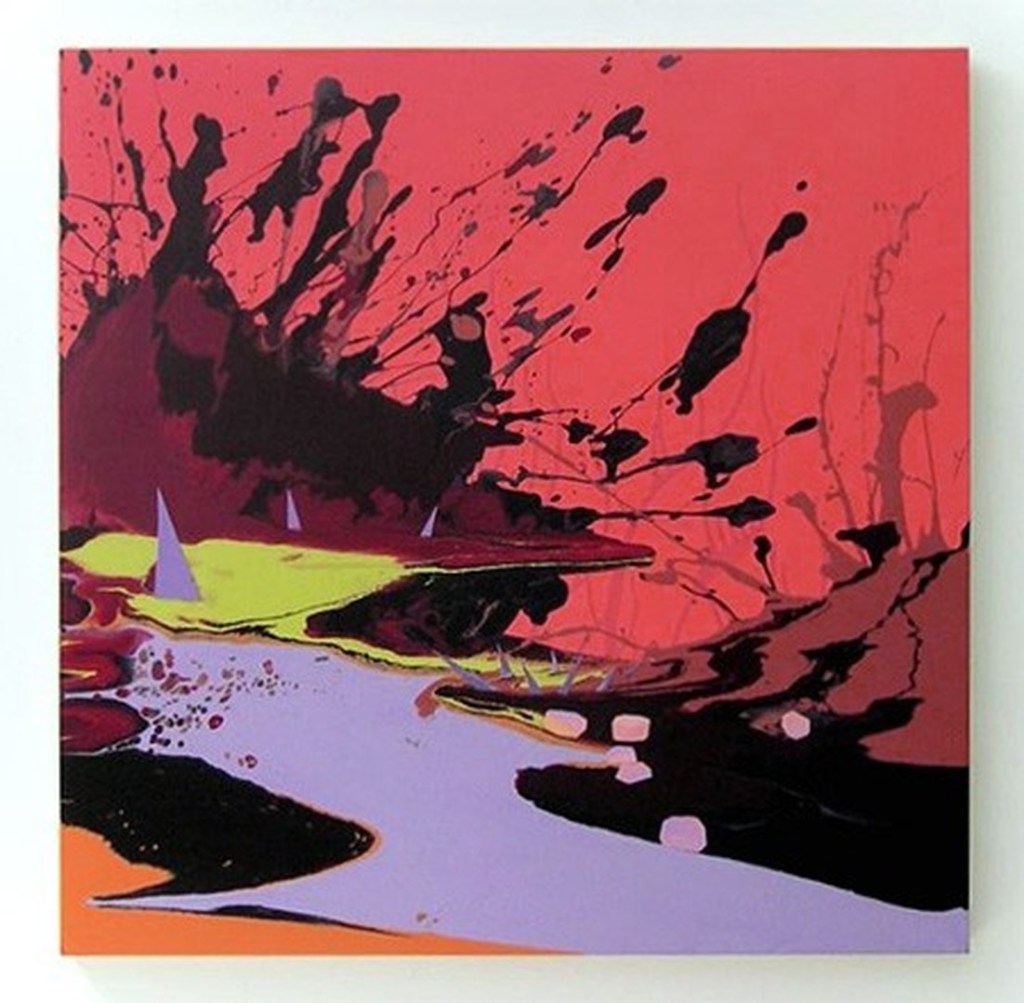
The first painting which I chose to look at was “Marshland”, 2006, acrylic on canvas, 36 x 36 in. APT collection, Santa Barbara, California, USA.
The painting makes me feel, alive, awake, immediately engaged in trying to read things into the image and construct a story around it; some kind of fantasy quest – as if the hero has to cross the swamp to reach the distant forbidding mountain. The first thing my eye goes to is actually that pop of startling and unexpected yellow in the mid-ground, followed rapidly by the lilac marshland running diagonally across the image, pulling you in along the course the hero has to follow. The use of such startling colours seems to imply the unnatural nature of these hazards – backed up by the red sky and the splashes of dark, which to me are like eruptions and serve to emphasise that this is not a good place to be. The title is, I feel, a little at odds with the image – if I’d been told I was going to look at a painting called “Marshland” I should have imagined quite a gloomy palette of colours, predominantly green and brown – I think the title gives the viewer cause to pause and look more carefully at the image, re-assessing their expectations. The artist has painted in acrylic on a large square canvas, rather than a traditional “landscape” rectangular format – to me this serves (in the story I have already half-written in my head) as a limiting factor, as if to say to the protagonist “Look, this is the way you have to go – no good looking around to the sides, there’s nothing for you there – this is the only way.” The painting is held in the APT (Artist Pension Trust) collection, who have the “largest global collection of contemporary art” (from www.mutualart.com), whose curatorial team are skilled in supporting artists with high potential. The painting was made in 2006, the same decade as the Lord of the Rings series of films were released, and I think that juxtaposition and currency of fantasy films has just possibly fed into the artist’s work? – it’s clearly influenced my reading of it, anyway!
I had been asked to look at Jane Callister’s work as an example of an artist with a slick flat style. I therefore decided to have a go at painting in this style, simplifying the image rather than trying an exact copy, and specifically focusing on producing flat layers of colour.
SO WHAT?
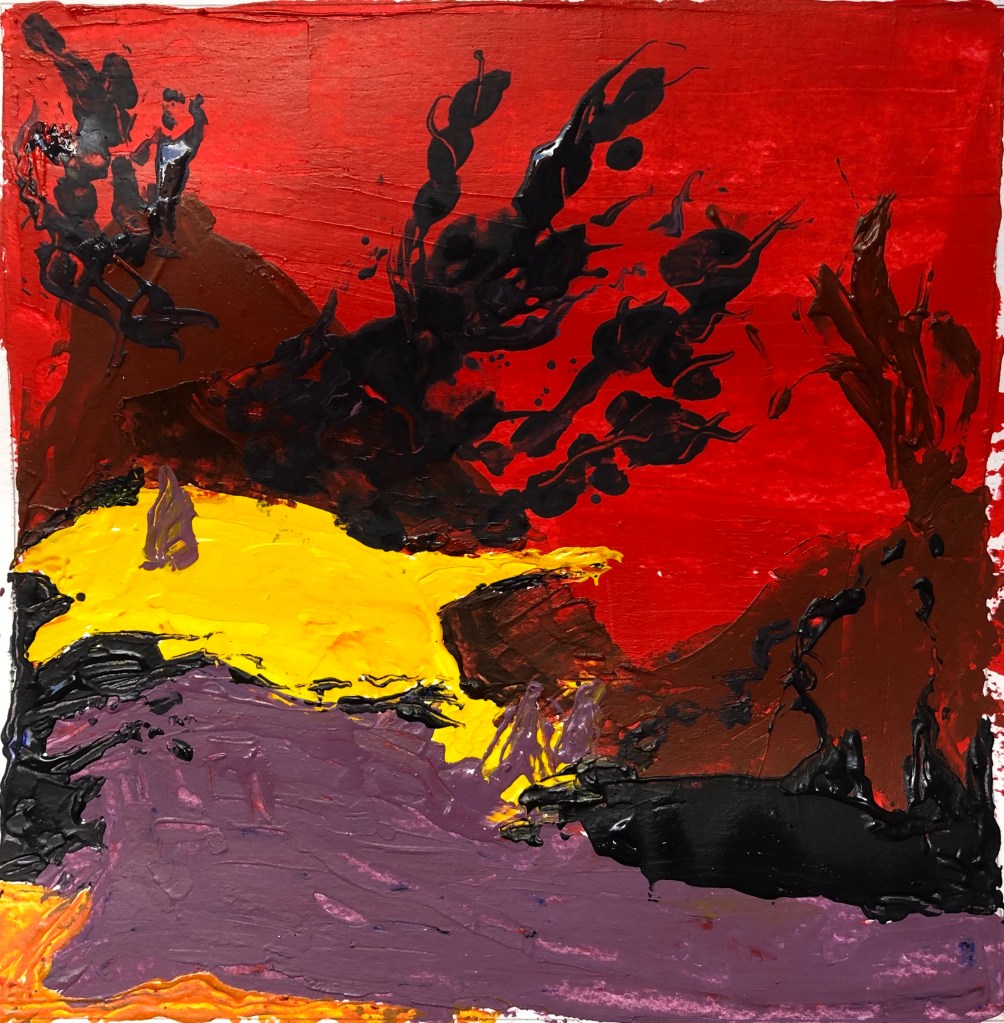
First attempt was with egg tempera – never used this before so I was very excited to try it out. I had the three primary colours plus black and white. I used some flat and round bristle brushes and worked in my multi-media sketchbook (250gsm paper) at 7 x 7 in. The red was applied in several fairly dilute layers; the yellow seemed a very strong colour and was applied more or less out of the tube with a few brushstrokes. The mauve was mixed using red, blue and lots of white and put on with broad flat strokes using a wider brush. The black was trailed, dabbed and splashed.
My second attempt was again in my sketchbook in a 7 x 7 in square, this time using some very old System 3 acrylics. I felt the brushstrokes had been noticeable in the egg tempera version so I thought I’d try a palette knife, seeking a much flatter finish. Again I had the primary colours, this time plus white and burnt umber. I applied the paint with even strokes with the knife to start with, and this gave a slightly flatter effect; however, when I tried this with smaller areas of colour, even with a small knife, all semblance of a flat surface went out of the window. So, huge respect to Jane Callister – I thought this would be really easy but it wasn’t.
NOW WHAT?
The “flatness” of the paint sections was my success criterion.
The egg tempera version ended up having the more even painting of the two, although the brush strokes were evident both in the layered washes and the thicker, less dilute mauve sections. I worked quite quickly, but have now read that egg tempera is a slower process. I am going to try using it again to respond to another of Jane’s pictures, but this time I shall:
work more slowly, letting layers dry in between and building the picture up more gradually
continue to use brushes, but try sables for a softer stroke
vary the direction of my strokes between layers to try and give better coverage and hence a more uniform finish
The acrylic version was my first attempt at painting in acrylic using a palette knife in this way – I feel the image I have produced has energy, but it has ended up the antithesis of my success criterion, and it should have been better because it is the medium Jane herself used to create the original. Again, I shall repeat this medium when responding to Jane’s next painting, but this time I shall:
stick with the palette knife for another try but also use brushes
work bigger so I am not trying to paint lots of tiny areas with a knife
Build the work up in sections, allowing drying time, so that the paint does not move where I don’t want it to
IMAGE 2
WHAT?
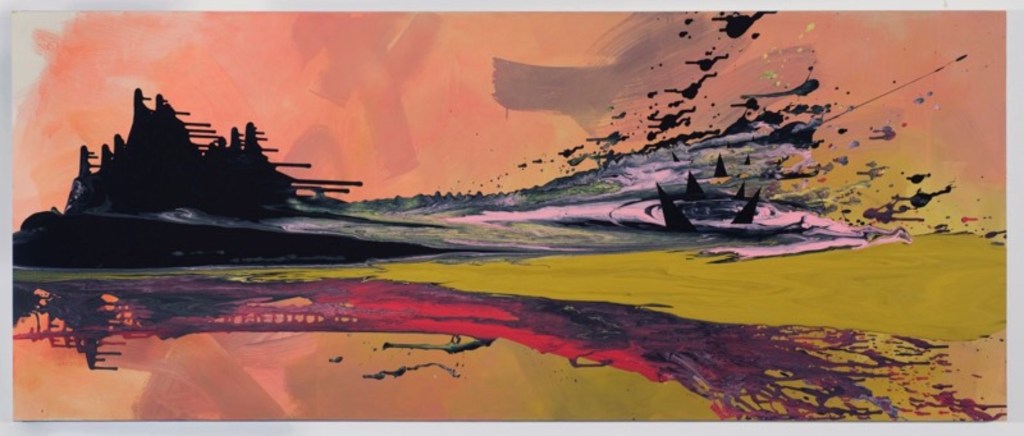
The next image that really appealed to me was “Expelled”, 2009-10 , acrylic on canvas, 38 x 92.125 in, also in the APT collection (see above). A very long painting!
Again, the initial impression was that the picture told a story – there was a lot going on which made me look. At first it seemed related to the “Marshland” fantasy tale – maybe the black section on the left, where I was drawn to look first, was an evil castle – but this time I tried to have the title in my mind as I was looking, and soon, a different interpretation emerged: a sinking battleship on the left and, on the right, a maelstrom with circling sharks. Do you hope to be saved by clinging to the sinking ship, or are you expelled into the waters to take your chance with the sharks?
In this painting Jane goes for a similar combination of brooding blacks contrasted with vivid, almost lurid, colours. The choice of shape is very different, however – the width is well over twice the height, suggesting to me that the expelling is a very emphatic process.
There is more detail in this image in terms of intermingled streaks of colour, but again, I am not going to try for a copy, but rather use it as a starting point to create a simplified version, focusing in particular on the production of flat areas of colour.
SO WHAT?
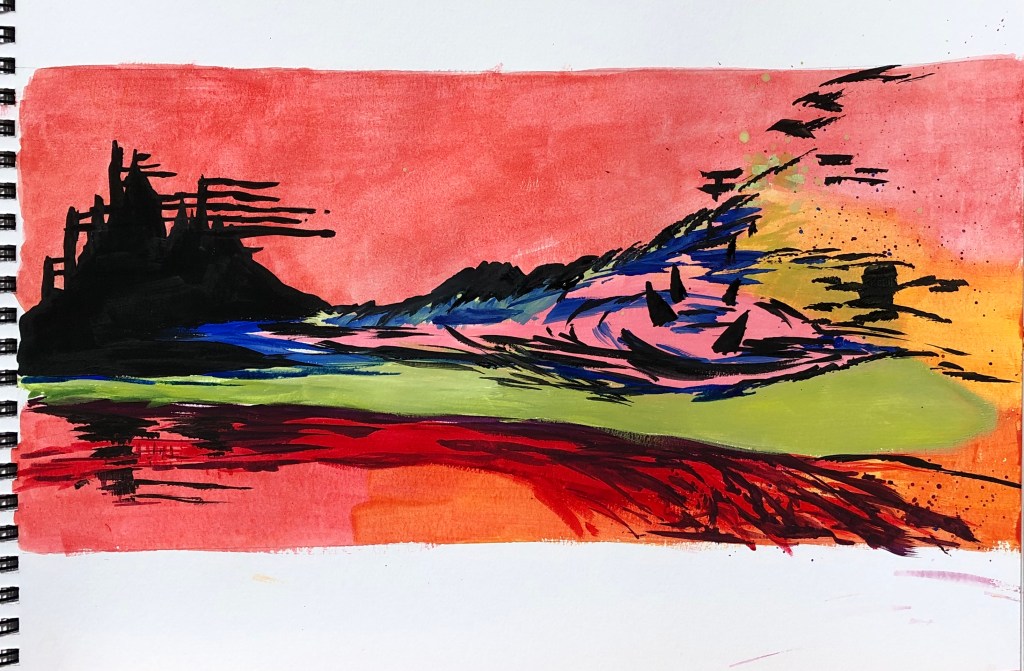
First attempt using egg tempera was on A3 mixed media paper, ruled off to be more in proportion to Jane Callister’s painting. A more even application of paint was tried by using repeated layers of paint with varying directions of brush stroke, using a soft-haired half-inch flat throughout.
This is the egg tempera version.
I moved on to the acrylic version, using some tubes of old Pebeo acrylics from my daughter, several of which had pearlescent colours; I chose some of these to create a lurid, garish effect. I also worked again with the soft-haired flat as I had liked the flexibility of brush stroke possible. I used mixed media paper but decided to work on the title of the painting by making my version very long, joining two pieces with sticky paper – I wanted to convey the effect of expelling. This was the mid-stage, before adding the black – I used several layers of watery paint, gradually building up until the last layer was straight from the tube. I have changed the pink “blob” from a whirlpool into the thing which was being expelled.
The black was initially added with a palette knife, then abandoned for a soft size 6 round brush, and only brought back in for the streaks. So, softer brushes better for flat, even coverage; knives better for gestural marks. What did work well was using cut-out templates for the “shark-fin” rocks; my tutor advised me to try masking for crisp edges.
NOW WHAT?
I’ve learned that:
Both media (egg tempera and acrylic) are best applied in layers, thin working up to thick, with varying direction of brush strokes, if your aim is to get even areas of colour; palette knives better for gestural marks
Black contrasted with strong bright colours can create dramatic images
Joining paper with sticky tape for painting does not always go well
I have a preference for pictures which I can read a story into – something to take forward into my own art?
The title of a piece (to which I had not previously given much thought) can create quite an effect on the way the viewer sees the image
I need to experiment with the streaks and splodges which Jane Callister achieves – didn’t do too much work on these as it wasn’t my focus, suspect she might tip the board and let the paint run?
Wide ranging discussion; some important points, in no particular order:
Get onto Instagram and follow contemporary artists (e.g. Claire Wood) – look for #WIP
Keep eye on discussion forum on OCA
Get onto email group by contacting help@oca.ac.uk and asking to be moved over
Masking is an important technique for clear-cut edges
Useful primary colour combo: Naples yellow, cobalt blue and alizarin crimson
Initial research activity: look up the artists suggested, write a couple of bullet points about their work – “rate” them internally then pick the highest to focus on – remember you are looking at their work as an artist, rather than a layperson – show you have made a decision rather than gone with a whim
Lose the flowery language – notes and bullet points are fine in learning log – it is not a discursive document, it is a log of my learning. Good to include open questions. OK to write in my usual style, BUT THEN EDIT! Go through and highlight words/phrases referring to:
Process (e.g. tension)
Materials (e.g. wet. rough)
Context (artists, ideas) – keep these and then ditch the rest!
Using sketchbooks – not the same as in Drawing 1 – need to keep an eye on myself, make sure I am still looking hard at things and maintaining my skills – this is function of sketchbook
Have a look at Edgezine for more advanced examples of work
When submitting assignment include focused reflection including:
What will I take forward
What questions do I have
What do I want from my work (what do I like/not like)
Assignment 1 – 14th September (written feedback elected)
This was an introductory Zoom workshop of a set of three focusing on research – how we go about it and what we do with it.
SO WHAT
Discussion raised the following points and possible resources:
Actually making work in an artist’s style is a good way of researching their work
Rushing to produce an “outcome” can lead to overlooking important things
Finding/making time for reflection is sometimes difficult but important
Interviews with contemporary artists are helpful
Useful resource from Ossian Ward: “Ways of looking: How to experience contemporary art”
Need to foster relationship between making/reflection/research. Research and making should be reciprocal, although research doesn’t have to drive making. Things might resonate on a subconscious level.
Another resource: “Lines of Thought” – for enquiry on history of drawing
NOW WHAT
We were encouraged to go away and look at, and add to, what was on the group padlet.
TAKE AWAY POINT: USE DRAWING AS A RESEARCH TOOL – DON’T RUSH IN – STEP BACK AND TAKE TIME TO ENGAGE
I appreciate my tutor’s “well done” for keeping going with the course after breaking my shoulder. I agree with her analysis of the effects of this accident on my art, which has been to make me more free and experimental, and less fixated on everything being neat and perfect.
Looking forward to assessment I can appreciate that I need to think hard about how I demonstrate that I have met the assessment criteria; I need to be much more overtly reflective, critical and analytical about what I have done. Less narrative, more critique!!
Feedback on assignment
Final piece:
I was relieved that my tutor agreed that my final outcome constituted a drawing!
I have re-drafted my blog post about the assignment to be clearer about my working choices and the reasons for them, including explanations of how my research fed into my work
Virtue inspired piece:
Again, I have rewritten my blog post, explaining my choices and reasons and linking more clearly to my research.
Sketchbooks
I have updated my blog post to make it clear that all the drawings were made on site, and to explain my annotations
I have to say that, when doing on-site drawings, I haven’t been posing myself questions, but rather just making jottings about, light, colour, etc – this is something I need to develop in the future
The techniques developed for my final piece are not included in my sketchbook – in future, I must remember to make a record of my process rather than just photographing the final results.
Research
In my revised blog posts I have tried to do better at explaining how my research into my various artists has specifically fed into my final pieces, rather than just taking this as read.
I can see the point about shorter, more focused blog posts about an artist – have to confess I got completely buried in all aspects of John Virtue’s work, although in the end I have not used them all
Learning Logs or Blogs/Critical Essays
Artist statement:
My first draft was absolutely a statement of intent as I had no idea where the investigation would end up. I have now redrafted the statement to talk more about the final work and what I want the viewer to see, and a little less about how I got there, and the statement is a little more concise as a result.
Reflections
This aspect of my work is the biggest take-away for me. I think that, up until now, I have used my blog more as a diary of my work and my learning; it has been very chatty and contains the wrong balance of narrative to analysis. From the very beginning of my next unit, I shall know to be much more reflective and specifically critical, making sure I say clearly what will evidence the learning outcomes – so that it becomes more of a log of my learning and less an amiably rambling letter
I had a go at using the what?so what?now what format. It felt a bit forced at first, but my tutor has helpfully given me some examples to work through using some existing blog posts, and I feel that light is dawning, and I am beginning to see how this will support my reflective practice in future – I hope some evidence of this can be seen in my revised blog posts.
Suggested reading/viewing
My tutor has suggested looking up some different reflective models, to see if they would help me.
I found a useful article:
“Reflective Writing: Taking time to invest in your work” on Explore#WeAreOCA, by Ryan Holiday, posted on 4/6/20, which included an adaptation of the Gibbs Reflection model into a Review/Action model. The article also contains a helpful link to a padlet which includes, amongst other things, the slides for Zoom lecture which had been delivered in Feb 2020 on this subject. This had a rolling diagram of a “plan – act – observe – reflect – revised plan…” model which rings bells for me from teacher planning meetings of a previous life.
I did go through a stage in my blog of setting myself action points, and I think I did act upon them, but what was lacking was making time for a formal review.
I think I am beginning to get my head around the Rolfe “What? So what? Now what?” model and, if I can train myself up to use the “now what” to reflect back on my “what”, then this will serve me well as a future structure for my blog posts.
Pointers
I really need now to give some serious thought to the learning outcomes and assessment criteria and look carefully at all my work throughout Drawing 1 to select pieces which show what I have achieved, and to show in my written extracts that I have reflected clearly and effectively.
Neil gave a presentation comprising many inspiring images of arrangements of objects using pattern and colour. He included, amongst others, examples of his own work as well as that of Andy Goldsworthy, Christo and Jeanne-Claude, and Cornelia Parker. For some of these artists their work had no deeper meaning – they were looking for immediate aesthetic impact – the “wow” factor. One aspect which appealed to me was “knolling” – arranging items in a grid – an example was the arrangement Neil and his partner had created just by trying to sort out their tools. Neil made the point that he regarded all these arrangements as drawings.
SO WHAT?
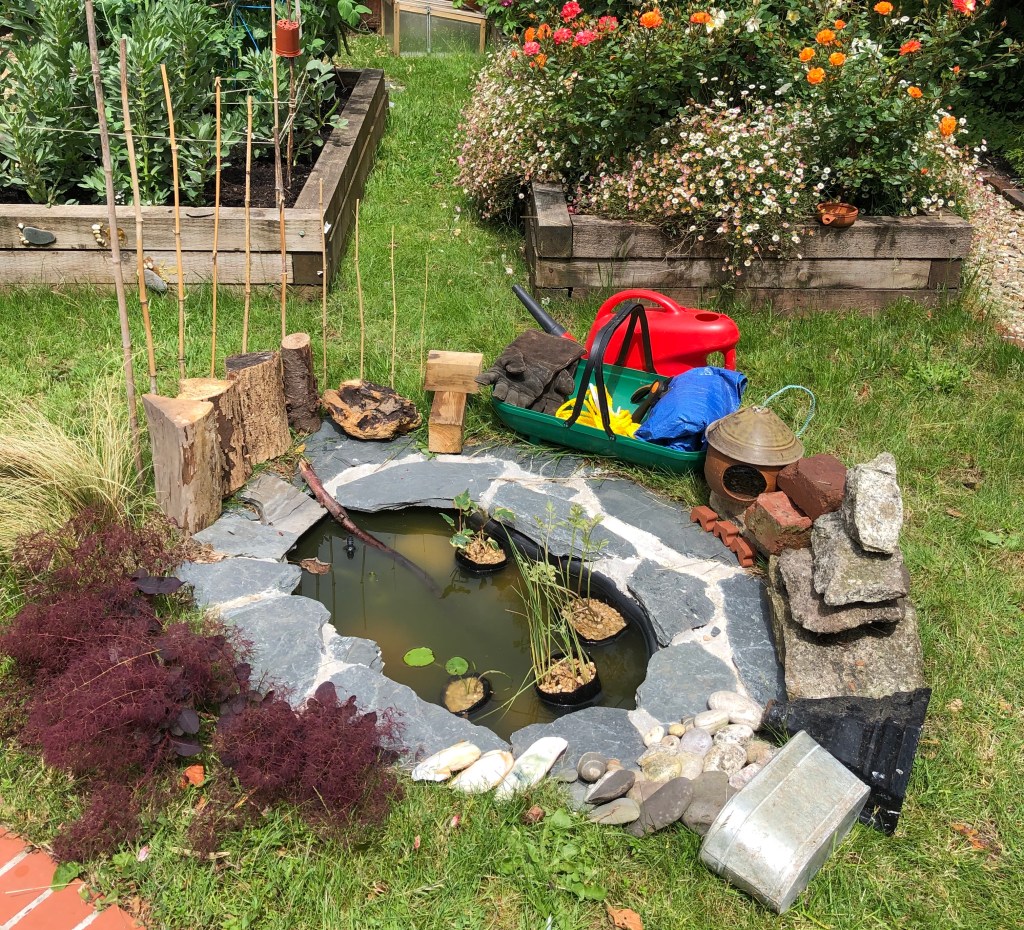
Our task was to make an assemblage with found objects in two hours and photograph it; our theme was “How are you feeling?”. We would then look at each other’s photos in turn, without knowing whose it was, and say, not what emotion we thought the artist was trying to convey, but what we saw and how it made us feel.
I was in the middle of a lot of writing, sorting and thinking about assessment, so wanted to remind myself that art was fun by making something playful. I collected a load of random stuff from around the garden and made an assemblage round our newly developed garden pond – I had been drawn to Neil’s knolling image and so decided to sort my objects by material, but then chose to arrange them, not in a grid, but around the pond perimeter. The overriding emotion it evoked in others was “calm”; I was pleased that they could all see how I had arranged my objects by material and texture to form a coherent whole.
NOW WHAT?
Four takeaway messages:
The notion of what is “temporary” – nothing is entirely temporary if it has been seen and appreciated as it will stick in the viewer’s memory
“Let your hands do the thinking – if you don’t know what to do, just do something”
The best way to respond to art is to start by describing what you see
The end result is not critical, it’s the process that’s important – so in my blog posts, I need to SAY WHAT I’VE LEARNED FROM THIS, NOT JUST WHAT I’VE MADE
This was going to be a learning experience in three parts:
Today: extend our knowledge, and play
Space between: self directed play, possible collaboration, and making an artist’s publication
Three/four weeks – presentation and discussion of our work
Artist’s publication: research and make, either physically or digitally. OK if it doesn’t make sense!
Ideas and inspiration: see padlet for examples:
Michael Landy’s Nourishment series of portraits of flowers which are overlooked
Louise Bourgeois Cell (Eyes and Mirrors)
Paul Nash The Garden, 1914, watercolour. His work changed over time, but he spent a lot of his time immersed in nature
Richard Billingham Ray and Liz series, 1994 – his parents – insight into a dysfunctional family
Hieronymus Bosch The Garden of Earthly Delights, 1510 – depicts the possible and the impossible
Bauhaus Teaching: see pdf in Books
Learning and Unlearning, 1913-33.
This text leads to our making: choose a found object of material and, working with the possibilities of the material, make a 3D thing, thinking about questions of scale where appropriate. We had 20 min.
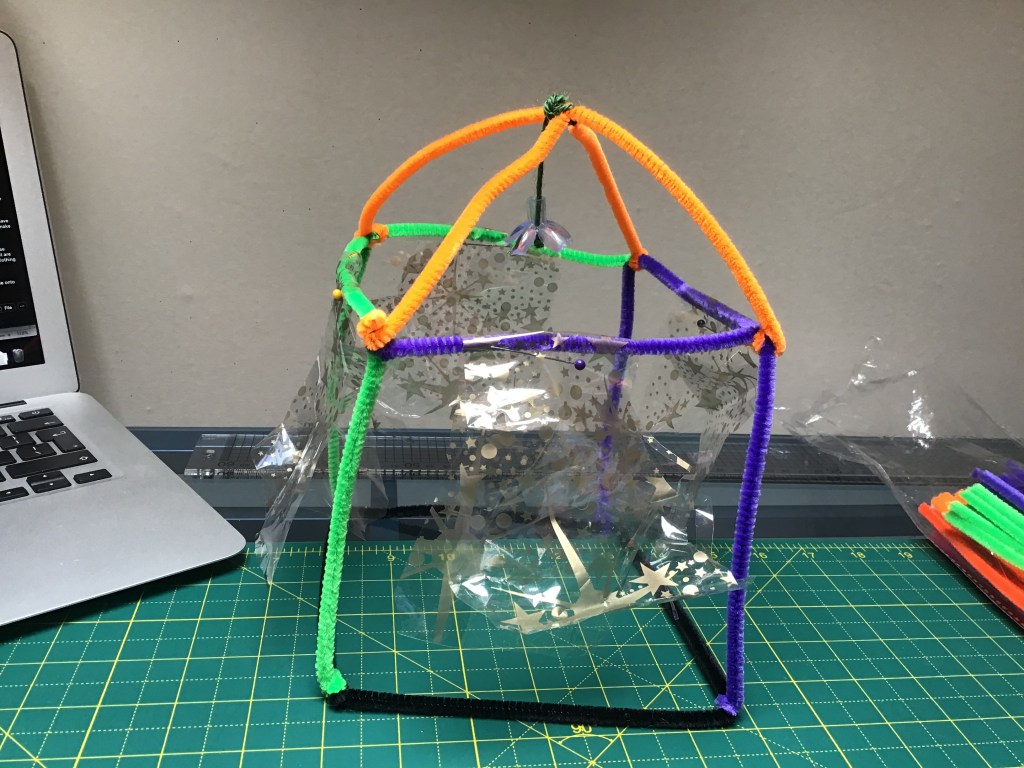
I made a box out of pipe cleaners I had bought to incorporate into my home-made coronavirus masks – it turned into a house with cellophane curtains and a plastic flower lampshade.
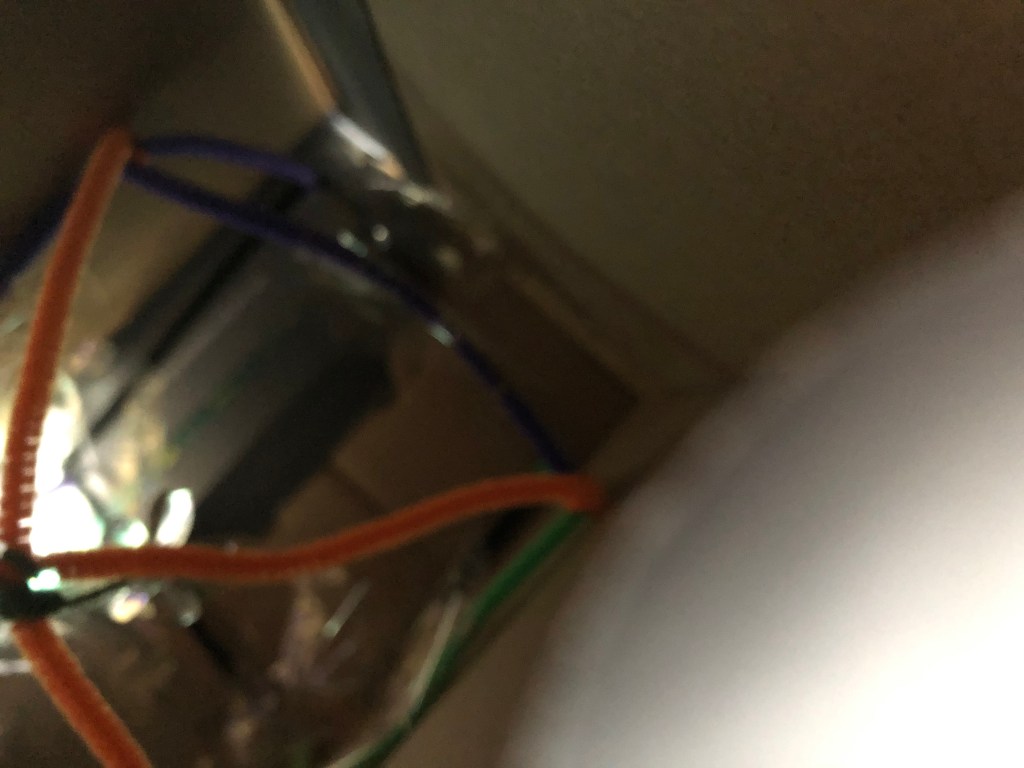
Next, we had to put our object in a box, mainly dark but lit somehow, and photograph it. I put mine in a shoe box and tried to light it through a slit in the box using the torch on my phone whilst photographing with my iPad…..and I can see now why I’m not doing a photography degree…
Everyone had to post their photos on the padlet. Many were experiencing technical difficulties and so we decided to adjourn to the in-between task: we could collaborate, appropriate, work together or alone, and create an artist’s publication, either physically or digitally. It needed to keep the same DIY vibe. We could look on the ICA website for examples, also the Whitechapel bookshop in London and “Printed Matter” based in New York.
My in-between work
I decided to work alone as I was not too confident in my digital skills for collaborating – and I have to confess that, when I started, I didn’t have too much of a clue what I was doing, so I began looking online at the websites Hayley had suggested, and soon became drawn into the wonderful world of artists’ publications which I hadn’t realised existed. It was also a good way to practise getting to grips with searching for things on the University Library – I hadn’t really made much use of this before as I had hitherto been going into the University of Plymouth library, but now this was closed, it was clear that I needed an alternative (I have also been attending the UCA library webinars every week, so was becoming increasingly aware there was a whole lot of stuff out there I was missing).
After a couple of days roaming the internet I decided to work on making an artist’s book, which is, I have discovered, definitely a thing.
I had been drawn to the Nourishment, 2002series of drawings by Michael Landy, which were quite spare and delicate, and also to the idea of Paul Nash spending a lot of time immersed in nature. We have spent so much time in our garden during the lockdown and are acutely aware of just how fortunate we are in having that when others have been shut up in tower blocks; so I decided that my book would be a celebration of my garden.
I went for a zig-zag book format which is easy to make and display and, following Hayley’s instructions, tried to keep it as “DIY-vibe” as I could. I did my drawings quickly with a dip pen and Indian ink on cartridge paper, scanning the garden through the window and picking out features. The cover was part of an old Amazon box covered with a quick abstract design made from watercolours. I decided to cut into the pages a little with a craft knife to give the idea that, in the garden, one often looks through one thing to the next. I put the title on a label made from an offcut of the cover design and attached it with a scrap of garden raffia. Voila! I know it is dainty and rather girly, but looking at it in the future will, I think, always bring me back to this time and make me appreciate what a lifeline the garden has been.
Using drawing to answer the question: “What is this river?”
During the coronavirus restrictions, my husband and I have been taking our daily walk in a small local wood running along the bank of the River Tavy, one of the fastest rivers in England. The wood forms part of an abandoned railway line, hence it is straight and flat – but it’s also tranquil and little frequented.
I have been looking at the work of Professor Jem Southam who tried, by photographing the River Exe, to answer the question “What is a river?”. He soon decided it seemed “an impossible task…a quagmire of a problem…”*. I agreed, and so have limited my investigation to this one stretch of the Tavy. I wanted to find a way to capture the essence of this river in drawing.
Much like Jem Southam, I was not sure at the outset what form my final work would take, although I had some initial idea of a series of drawings. I knew I wanted to work mainly with ink, and to immerse myself in pushing the medium to see what could be achieved. I also wanted to develop my use of line and gesture to convey texture and form and to experiment with temporary marks.
The walk offered many distractions – damselflies, dippers, ducklings…. – but it became clear that the essentials of the river involved the water, banks and river-bed. Like Vija Celmins with her Ocean** drawings, I found myself fascinated by the water and its movement, wondering how to depict its infinite variation. I experimented with ways of conveying its character, both representational and also more abstract, doing many ink sketches on-site.
John Virtue, and David Hockney with his iPad drawings, had both recorded a landscape (and in Virtue’s case, a repeated walk***) through tessellated images, and I decided that a tessellated series might allow me to depict both the horizontal layering down through the water from the surface, with its reflections and movement patterns, to the river bed, but also the vertical layering experienced as one walked alongside the river and observed its different moods.
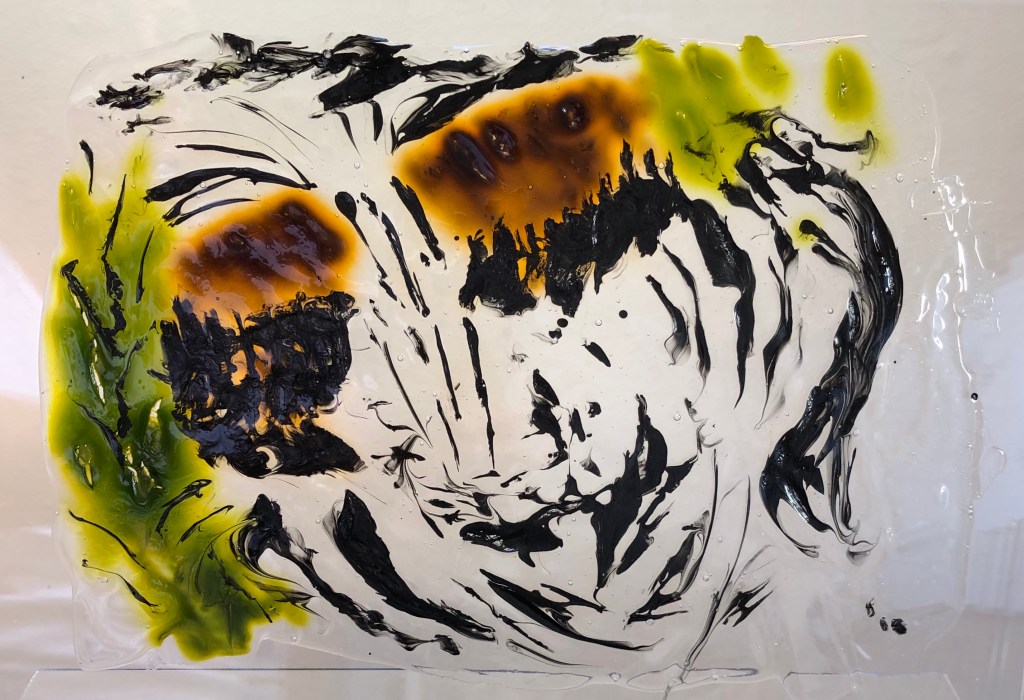
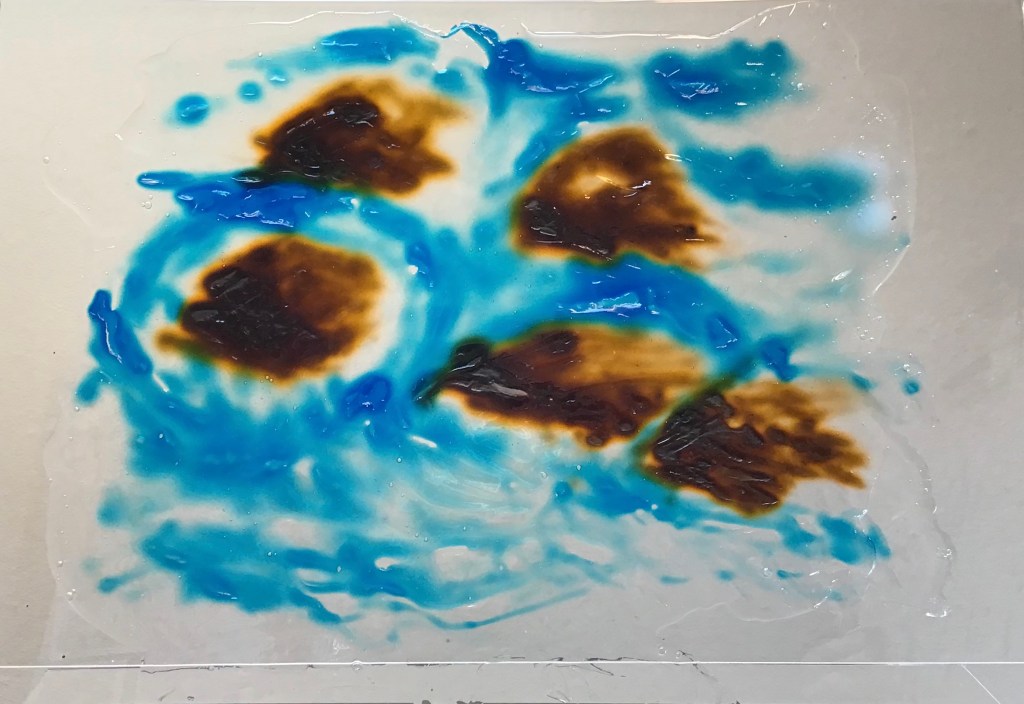
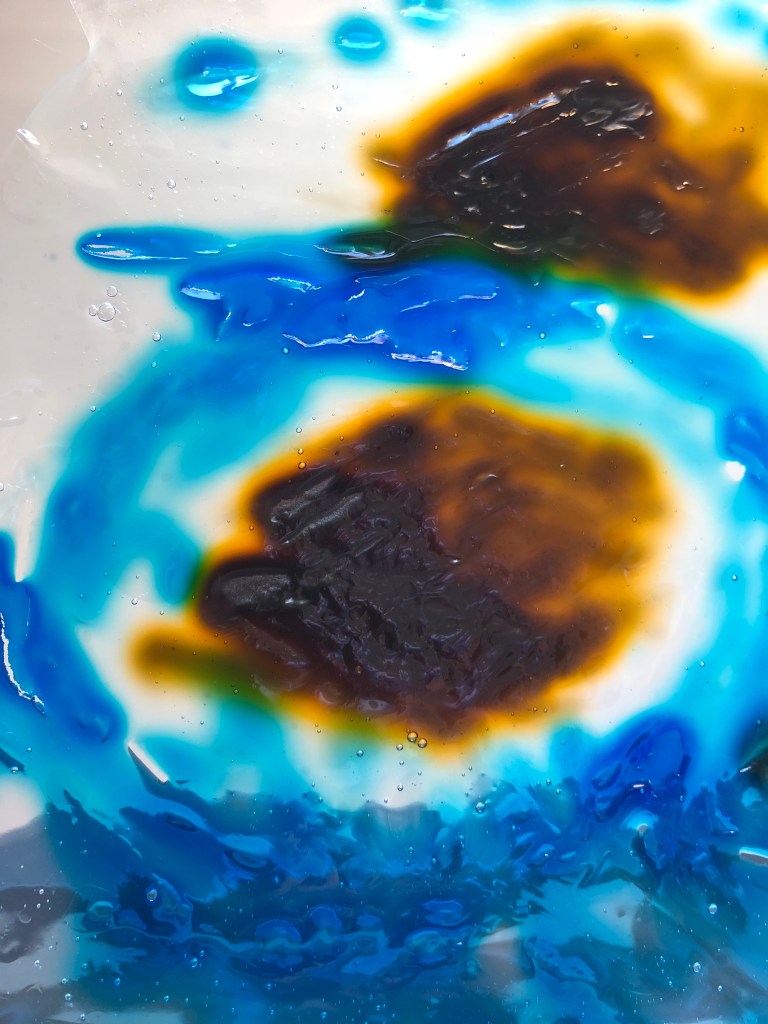
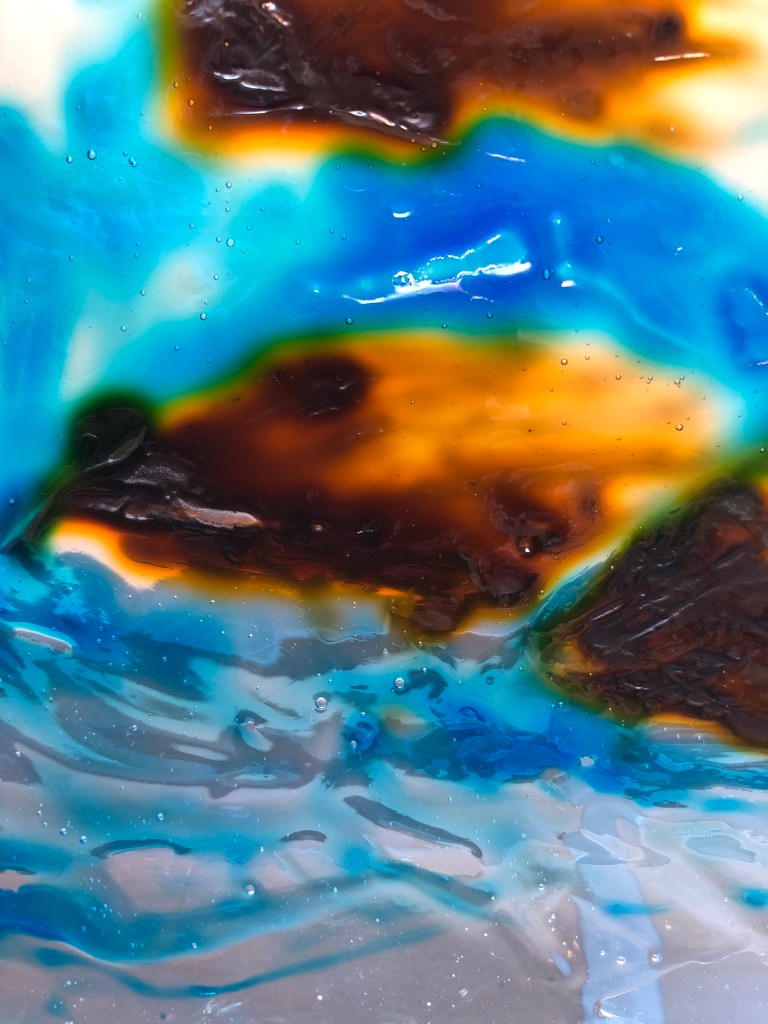
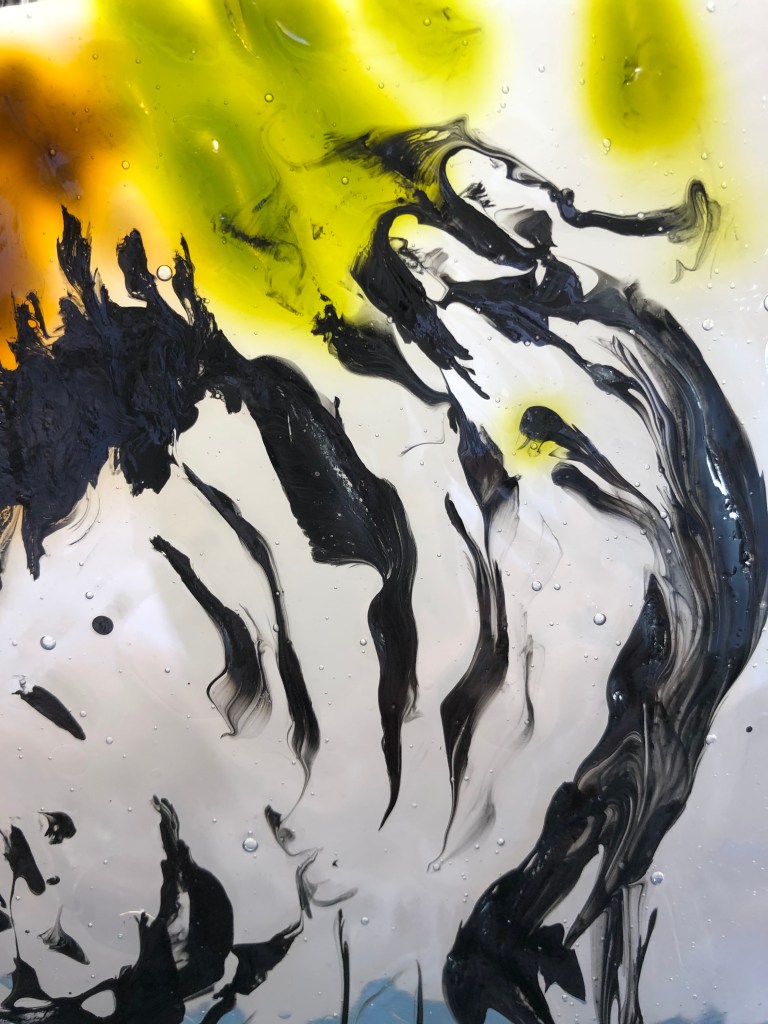
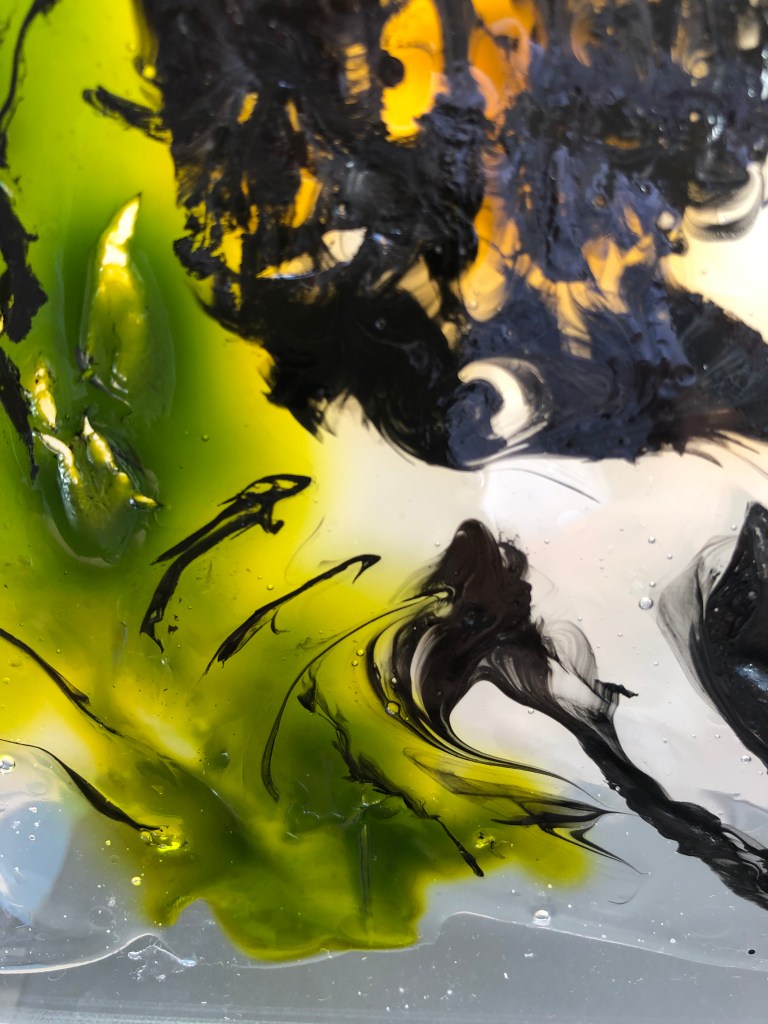
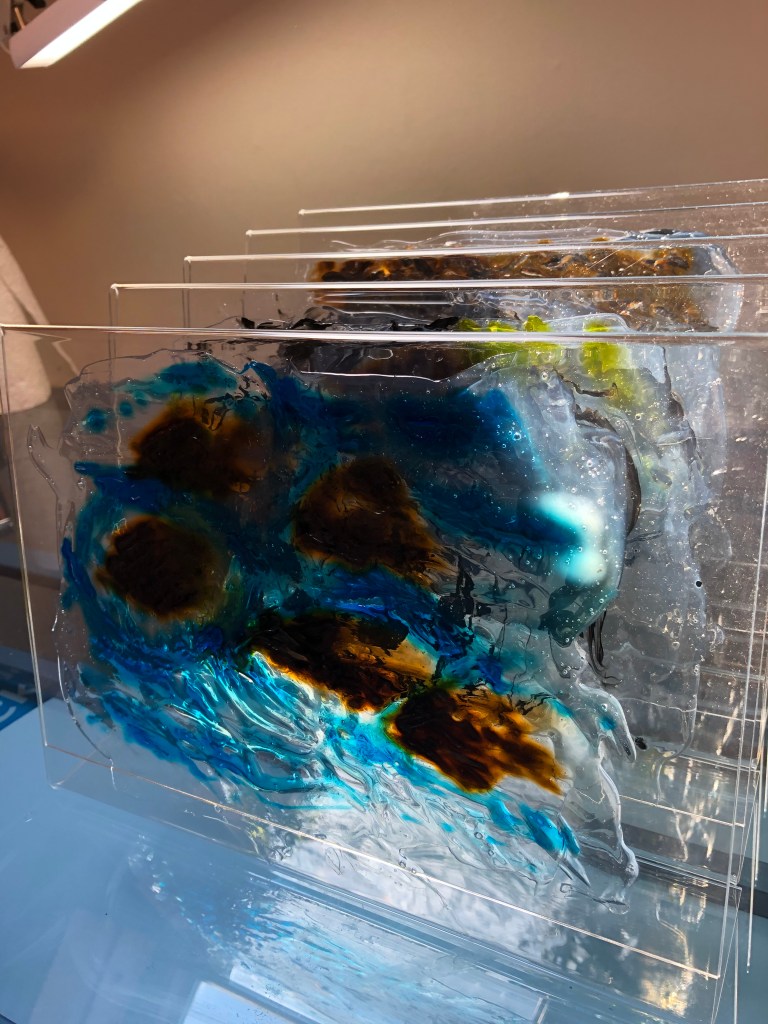
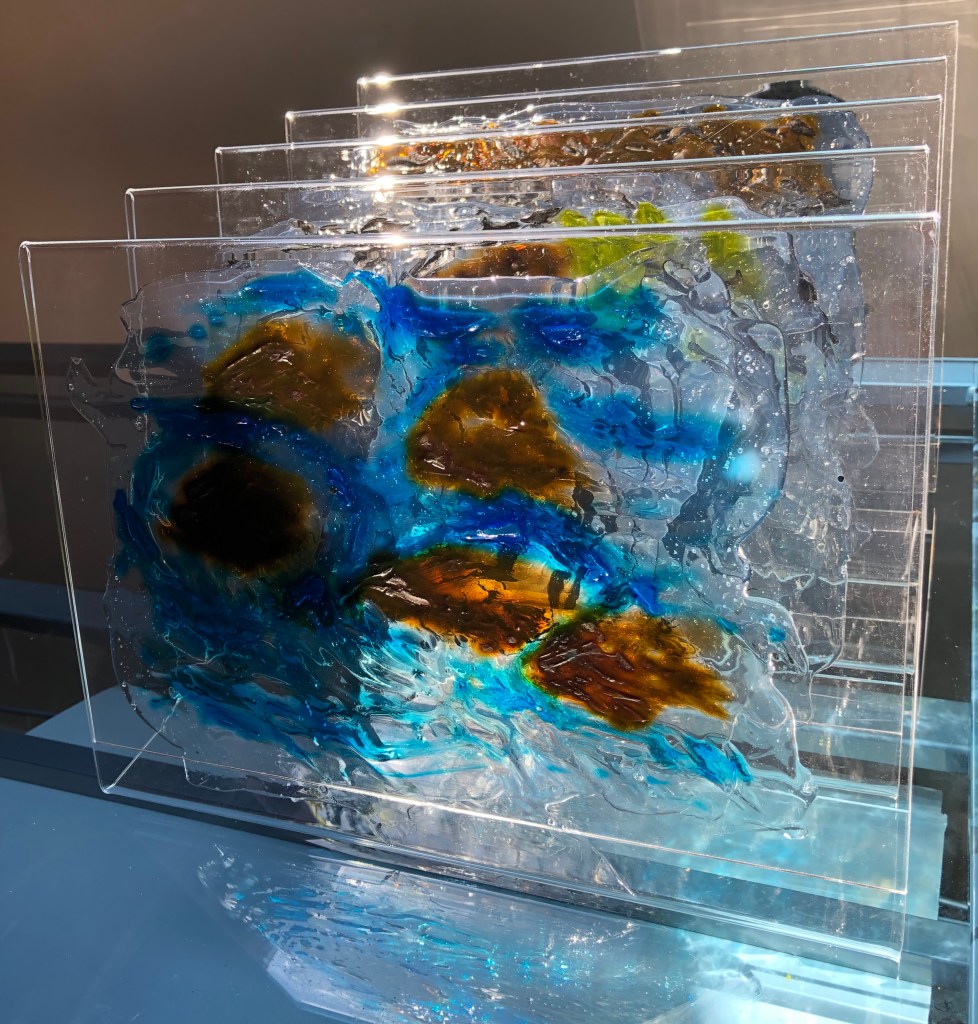
I needed a transparent support to be able to put this layering idea into practice, and experiments led me to do a series of drawings with ink, using a palette knife, into wet Mod Podge glue. The glue takes the ink, does its own thing with it, and sets to a transparent sheet with the ink embedded inside. I mounted the drawings individually on vertical perspex stands, tessellated one behind the next, so they can be looked through, and the viewer gets the feeling of passing through one drawing to the next, as if they were walking along the river.
A liquid medium into a liquid support to depict a liquid – the essence of the river.
*Jem Southam, ‘What is a River?’, unpublished essay, 2011, unpaginated
**Vija Celmins, “Ocean”, 1975, Tate
***John Virtue, “Landscape No.10”, ink, shellac, pencil and charcoal on paper, private, UK
To recap where my investigation into a way of capturing the essence of a stretch of the River Tavy in drawing had led me:
Four key artists led me down four paths –
Vija Celmins, with her fascinating Ocean pictures (see separate blog post), had made me really, really look at the movement of water. I instantly became so hooked on this that I knew this had to be a major part of my outcome. She also liked to take a medium and push it to its limits; I had originally started out thinking I should like to go back to using ink amongst other media, but this medium became my focus and I knew this had to be in my outcome. So, an ink drawing of water…
Albrecht Durer, whose forensic observation skills are to die for, along with his ability to produce an atmospheric and evocative image using black line; I knew I wanted to do some of this.
John Virtue, who had evolved a method of working peculiar to himself, moving from large tessellations of small, tight ink drawings to huge semi-abstract ink drawings with wide expressive gestures, whilst still incorporating small sections of detail. Both these styles appealed to me – small careful drawing I wanted to improve (see Durer), but I also wanted gestural marks to be more of a feature of my work.
David Hockney slightly surprised me by being here, but has ended up being central to my outcome. The section of his work which I have seen (Pompidou Centre, Paris – see blog post) and been attracted to is his iPad drawings and his way of presenting images in tessellated sections. I wanted to do this (tessellated sections) in my outcome although I wasn’t sure how. In the meantime I tried some iPad drawings for myself and became rather fixated on the concept of drawings done in translucent layers; it struck me more and more that this is what a river is – you move down through layers (river bed/water/surface/reflections on surface/movement of surface) but also along through layers as the river comes at you in different “chunks” as you walk beside it – a clear bit, a slow bit, rapids, an overhung bit…….
I ended up pairing the influences of John Virtue and Albrecht Durer in one outcome – see separate blog post on this.
In the meantime, after puzzling over my tessellated sections of translucent layers, I hit on something which I used to use at school back when I was an infant teacher – glitter in PVA.
SO WHAT?
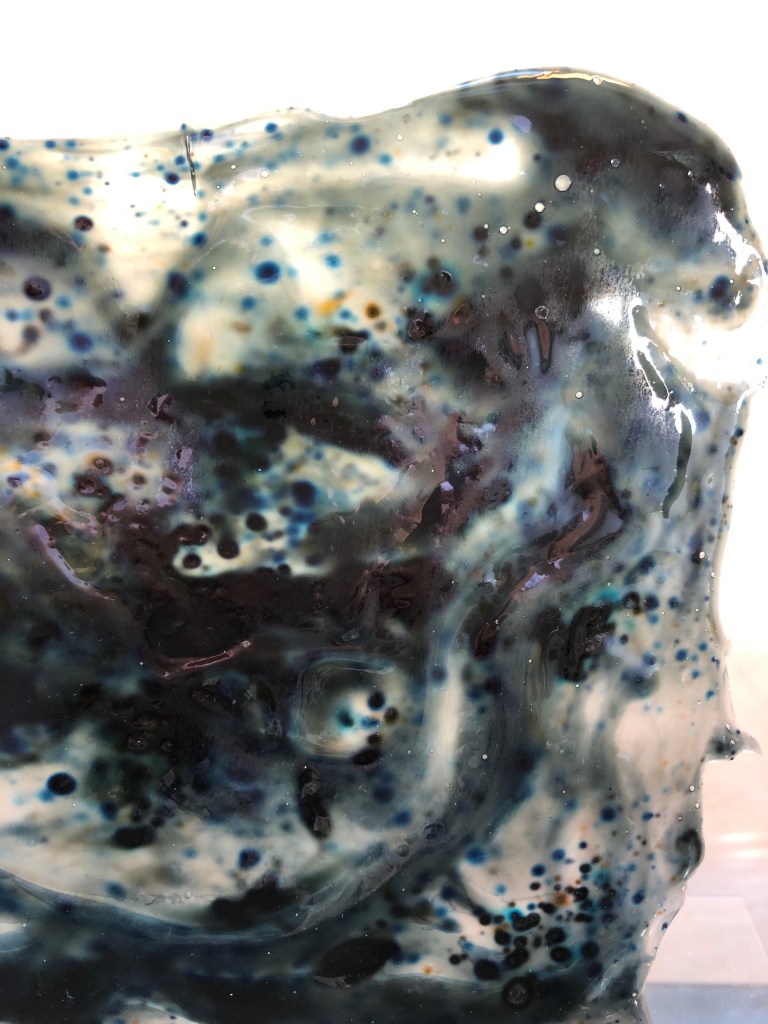
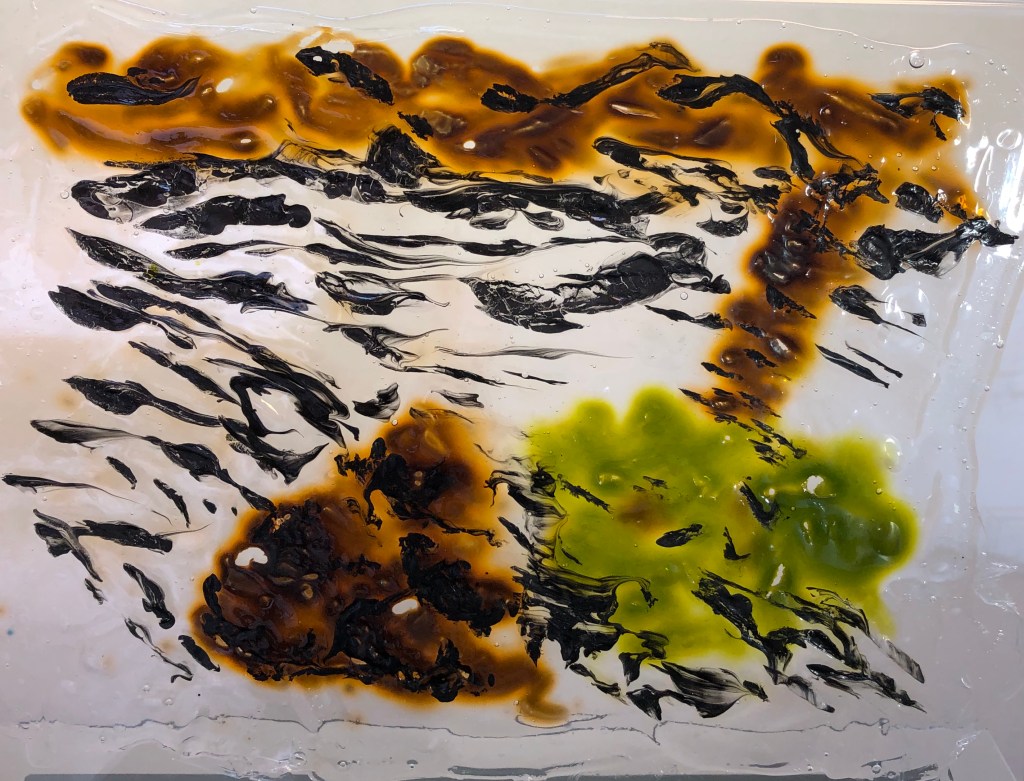
I laid out rough rectangles of Mod Podge glue, which is thick, white, opaque and gloopy, onto multi-punch pockets using a large palette knife. Straight away, I drew into the wet glue using inks applied with a small palette knife (enabling a wide range of strokes depending on whether one uses the edge, the point or the flat face) – effectively going back to my old preferred medium of ink-and-a-stick from the early days of the course. I drew areas of water representing different parts of the river, quite quickly; bold application seemed best, as any attempt to work on marks once applied just stirred the ink into the glue and made it homogenous, which was not what I wanted.
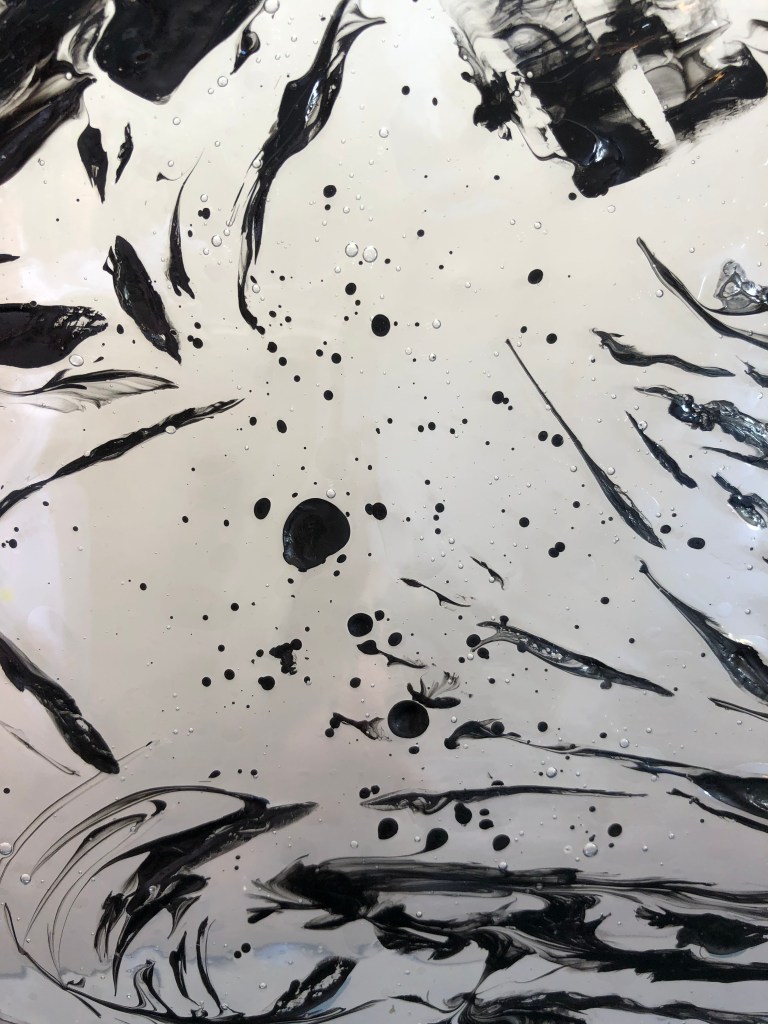
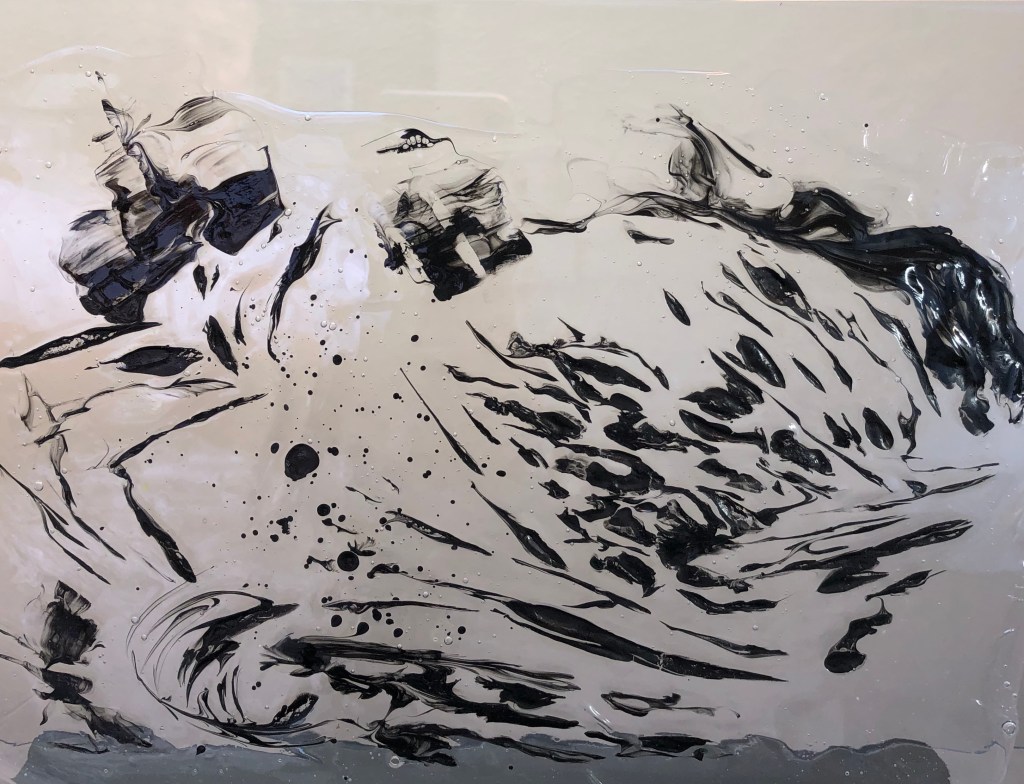
This was the first drawing: broad, curving strokes with the flat of the knife, which I emphasised by judicial sprays of water to make it flow, adding a few specks of black Brusho to create sparkles. In this drawing I was hoping that the movement of the ink across the liquid medium would give the effect of the slowly circling water (I had experimented with this earlier when I looked at Alison Churchill’s work on moving water – www.alisonchurchill.uk). I wanted it to “pull” the viewer into the drawing in a slightly hypnotic way.
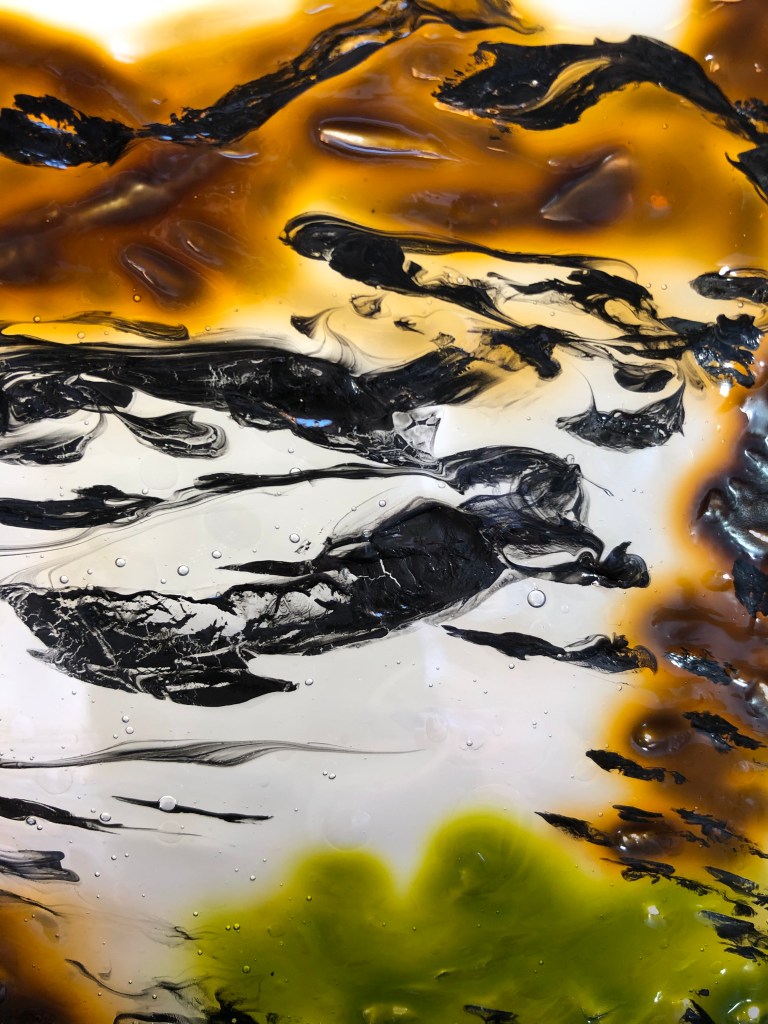
This was my second drawing: I tried to establish the dark faces of the weir rocks using bold dabs with the flat of the knife, then used the side of the knife to draw the movement of the water as it came through the gap, using flicking marks to show how the water fell. Here I was working on varying my marks, as I had done in my work on Durer.
In my third drawing I used a variety of strokes and flicks, mainly with the edge and point of the knife, to demonstrate a range of small movements of the water surface; I also used the flat of the knife in a dragging motion for a wider section of flatter, stiller water near the top. I wanted to have one drawing which was completely devoted to the depiction of the water surface with no distractions, as this was what had initially caught my attention. Even though the marks are deliberate, they are quite loose, as I had practised when looking at John Virtue’s work; but they have been carefully observed over a long period (see notes on Vija Celmins)
The fourth drawing was, I think the least successful. I used wide curving strokes with the flat of the knife across the top to depict a tangle of tree roots along the far bank, which was effective. I then tried to put in some protruding rocks in the foreground and show the reflection of a tree, broken up slightly by ripples, and for this I drew with the edge of the knife using parallel close horizontal stokes; however, the glue seems to have taken these and merged them into a mass, so that the reflection of the tree looks very solid and frankly rather child-like, which I didn’t want. However, bits of it had worked, so I decided to include it as it was the one piece which was dedicated to reflections.
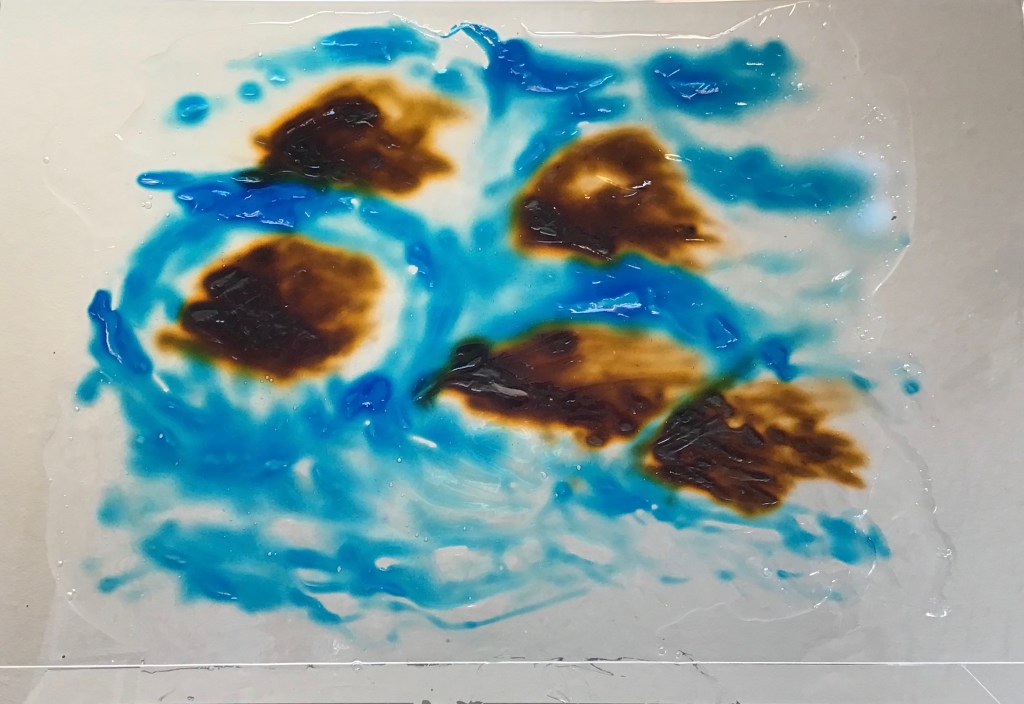
Having observed the fact that the coloured (Colorex) inks I was using seemed to spread far more than the black Indian ink, I tried to allow for this in my final drawing of the mini-rapids, by trying to be careful to preserve some areas of white around the rocks to indicate bubbles as I drew the blue ink through the glue with wide, gestural strokes. I think this was a more effective technique with this particular ink; it harked back to my experiments with wax crayon resist earlier in my investigation, where my focus had been to preserve the white areas.
It was interesting to watch the effect of time on the drawings, as the fluid glue had its own part to play in subtly changing the marks I had made before it started to set. All the drawings were done from memory, based on the many sketches I had done and hours of close observation I had spent.
I carefully peeled my drawings from their multi-punch pockets and then had to decide how I would present them. I particularly wanted them to be displayed as a vertical sequence, as if one was walking along the river bank and happened upon each scene in turn, as I very much wanted this outcome to replicate my walking experience. I thought about somehow suspending or mounting them, which seemed easier, although the mount would have to be completely transparent; in the end I applied each to its own clear Perspex vertical stand (these are simple restaurant menu stands from Amazon); thus each was a drawing on its own, but I (or the viewer) could also move the drawings around in combinations, one in front of the other, to convey the idea of layers. Tessellated sections, as I had wanted, but rather different to what I had first envisaged.
Below are some photos of individual drawings, combinations and close ups; I have also made a short film to show the final piece as it is hard to appreciate from still photos, and will send the link separately.
NOW WHAT?
My aim was to find some way to convey the “essence” of the river, and I personally feel that I have done that – a fellow-student said to me recently in an online group meeting, “You are the first viewer of and reactor to your work”, and I have taken this as my benchmark to know whether/when I had reached my goal.
I also wanted to give the viewer a sense of walking along the river and almost “passing through” my drawings, one after the other.
The individual drawings have taken on a life of their own; they are not quite as I first drew them, as I had chosen to essentially draw with a traditional liquid medium into a non-traditional liquid support; but I was ready to try letting go and embracing the outcome.
I have created a series of drawings which combine coherently to give the viewer a sense of the separateness-and-yet-one-ness of a place
I have drawn on my research into the work of both historic and contemporary artists and shown elements of their styles in my drawings
If I repeated this method of working in future, I would take photographs as I went along to document to process so the viewer could compare the initial marks to the final outcome
I feel I have pushed at the edges of what “drawing” is by my use of a liquid non-traditional support and the production of a deliberately layered outcome













 Sue J's blog