Iain is a local artist involved in many local art groups; he has experimented with many materials and styles, and sells a lot of his work in local exhibitions and galleries.
Today he was demonstrating in pastels, in a particular style – what he calls “dark sky, white cottage”. He brought some examples of his work, and the style certainly is very eye catching – he doesn’t claim by any means to have invented it, and indeed I have seen similar paintings on various websites, as well as owning a painting by John Piper in this mould. However, it was good to watch someone create something like this from scratch.
He worked from a photograph of a cottage he knows well in the Scottish Islands.
He likes his paper to have plenty of tooth so that he does not need to use fixative; he recommends Pastelmat by Clairefontaine, and also Colourfix, which is Australian (this latter manufacturer also produces pastel primer which can be used on more or less anything, and can be mixed with a little acrylic paint if you want a coloured ground). His favourite pastel manufacturer is Sennelier, but he also uses a lot of Unison.
The technique I learned was rubbing the pastel into the paper using the heel of your hand – he suggests you can also cover the drawing with glassine and repeat, helps to obviate the need for fixative.
His key bit of advice: make confident marks even if you don’t feel confident, they look better. This is important for me and something I have discovered for myself only recently, since having been forced into using my left hand by virtue of a broken right shoulder – big clear left-handed marks have more impact than my little tentative and scribbling right-handed style. Every cloud…..
We went on our annual culture fest to London 6-10 January this year, trying to walk the tightrope of visiting as many exhibitions as possible without getting brain freeze.
Tate Britain – William Blake
This is quite brain freezing by the time you get even halfway round – I noticed several people pausing and looking around, taking a deep breath and clearly thinking Oh my goodness – there’s more!?
I don’t think I’ve ever seen a body of work quite like this. It spans Blake’s life, and he was prolific, meticulous, talented……and yet his art didn’t seem to me to develop and grow. His figures, whether drawn or painted or printed, are all in the same mould – tall, highly muscled, thick-necked, either nude or diaphanously clad, with straight Roman noses and pointed chins, staring dark eyes and often dark open mouths. Females and angelic types have hugely long thighs; heroic looking men have thick, muscular thighs. His favourite of all appears to be the man with the flowing beard, who at some stage in each series (he painted loads of series telling stories, some intelligible, others less so) is bound to feature sitting staring out of the picture full face with his knees tucked up under his chin. Gestures are sweeping, bodies are either oddly contorted or else gracefully flowing. He often drew or painted to illustrate a text, which is meticulously written, often tiny.
The only sets of pictures where individuals seem to depart from his “standard” faces are (a) the Chaucer series, where one can easily pick out particular characters, and (b) his late pictures of his visions, such as The Flea.
It was all so, so strange – one felt compelled to get to the end and give it all one’s full attention, and yet there was a feeling of drowning in it and disappearing into his, obviously brilliant, yet surely disturbed, psyche. But his influence on artists to follow, whether consciously or unconsciously, is there for those who look – surely Byrne Jones was attracted by the tall, sweeping ladies with the slightly bowed heads; Ronnie Mackintosh by the symmetrical angels in The angels hovering over the body of Christ in the sepulchre, c.1805, ink, watercolour on paper; Gaudier Brzeska in his more twisted forms?
Royal Academy – Lucian Freud self portraits
Inspiration!
The progression here was so startling – from line to paint, sort-of-good-ok to wonderful.
The drawings at first were average art student standard but grew in confidence as he started to experiment with composition, often having himself peering into drawings rather than being the obvious subject, and his use of varied mark making became an object lesson. An oddity was his facial proportion; his eyes were often set way above halfway up, making the top of his head seem artificially flattened or squashed – surely not a mis-seeing as his seeing becomes his superpower?
As soon as he jumps to painting, the oddity of proportion disappears. His experiments with watercolour are interesting as he does achieve lights and darks and gradations of colour, but the oils are what blows you away. The “seeing superpower” is highlighted by the way he works – a quick scrappy charcoal sketch, and then straight in with the painting which appears to grow out fully formed from the centre – the complete opposite of the advice I’ve always been given about working all parts of the image at once for harmony and continuity. Uncanny. Sheer brilliance. Unusually though, he never puts highlights in the eyes, making them seem like wells of dark, which all adds to the compelling quality of the images.
Royal Academy – Laura Knight
This was just a one-room exhibition, but was of great interest to me as it featured many of her drawings and sketchbooks from her interest in life drawings of circus performers, dancers etc – hence very relevant to my current work on Drawing 1 Part 4. At first it seemed to me as if she had two styles of sketching which was a little confusing – but I think it’s because, when she has a moderately static scene in front of her, she has time to put in shading (which she often does quite heavily – see e.g. Figures by the pool, c 1959, black biro in a sketchbook, Royal Academy of Arts, London), whereas when the subject is highly mobile, she focuses a lot of information into clean single lines (e.g. Drawing of ballet dancers, c. 1930s, pen and ink on paper, Royal Academy, London – about which she says: “..found the value of what I call rhythm, repetition of line, accented beat and cross rhythm, as in music”.) Lots of useful similar examples to be found in Valentine & Wickham, 2019, Laura Knight, A working life. Royal Academy of Arts, London.
National Gallery – Paul Gaugin – Portraits
When this exhibition was first reviewed in the national press, it seemed as though the gallery was very anti Gaugin’s attitudes and morals on the basis that he had taken advantage of young girls in Tahiti – and so I went with a positive mindset, determined to form my own opinions. I have never been completely sure about Gaugin anyway, he has always been in my mind the less talented half of the short-lived partnership with Van Gogh. The way the exhibition notes were written harped on rather about how frankly self-obsessed Gaugin was, how he was forever depressed about his lack of commercial success, etc, which did little to bolster my opinion of him – it felt they were showing his works almost in spite of themselves.
So, what of his actual work? Bright colours abound, and nearly every painting had a main pair of colours which were complementaries; blue and orange dominated, but there was also much red and green, and only a smattering of purple and yellow, although this was the dominant pairing on one of my favourites, Woman of the Mango, 1892, oil on canvas, Baltimore Museum of Art. He is a capable draughtsman, although there was not too much simple drawing to go on; my favourite was of a sketch of a face, or parts thereof, which he executes in very clear bold lines, and in which he was practising a nose which I could then identify about three paintings along – so he obviously did use drawing to work through tricky bits. His drawings of his erstwhile friend, Meijir de Haan (1889-90) and L’Arlesienne, Madame Ginoux, 1888, depict strong characters with a few bold confident lines. In his early days his paintings shimmered and had the short dabbed directional brushstrokes of Van Gogh, and I preferred those – for example, Interior with Aline, 1881, oil on canvas, private collection; and his still lifes are very Cezanne-like, e.g. Still Life with Profile of Laval, 1886, oil on canvas, Indianapolis Museum of Art. I suppose the later paintings feel as if they lack life because they look very flat, being painted apparently in thin washes; it seems that he disapproved of Van Gogh’s habit of applying paint thickly. And yet, by far my favourite painting in the whole exhibition is the last one, rendered shortly before his death; it is a self-portrait (Self portrait, 1903, oil on canvas, Kunstmuseum, Basel), looking directly out, no side, no weird objects in the background, no assumption of a character, no artifice, no bright colours (although he returned in a muted way to his apparent favourites, orange and blue) and I thought – here is the man – shame he didn’t do loads more of this.
National Portrait Gallery – Pre-Raphaelite Sisters
This was a spur of the moment afternoon visit after the Gaugin in the morning – we wondered if we had the brainspace and concentration to do it justice, but it was as a well constructed exhibition with (good from my point of view) several excellent portrait drawings which have illustrated to me only too plainly just what can be achieved with graphite, charcoal and chalk. Back to the drawing board, then….
A couple which blew me away by the way of illustration are both by Dante Gabriel Rossetti;
Fanny Cornforth, 1874, coloured chalks on paper, Birmingham Museums and Art Gallery
Christina Rossetti, 1866, coloured chalk on paper, private collection.
British Museum – inspired by the East
This exhibition looked at the effects of Islamic art from about 1500 upon us in the West. It explores the fascination we had with the Ottoman (Turkey etc) and Sarafid (Iran) empires (and indeed their gradually growing interest in us) and how this was fed by artists who went out and drew and painted somewhat idealised scenes, and of course, other artists who never left their studio but drew from a jumbled mismatched set of objects acquired from dealers. Some great drawings from life by Delacroix, but slightly disappointed by Ingres who totally invented harem odalisque drawings as Westerners were not allowed access and they therefore used their imaginations and used this as a bit of an excuse for female nude life drawings (in fairness, he was by no means alone in this, but I had thought better of him). Interestingly, the image on the publicity material which had drawn me in in the first place, a beautiful turquoise ceramic decorated vase, turned out to be 1800s European and based on the revival of ceramic, enamelling and glassware skills inspired by the Oriental Islamic craze. Stand out object by far for me was a set of 4 decorated tiles from 1500 – all the Western replicas and offshoots were around, but couldn’t match it for brilliance and sheer joyousness.
British Museum – Kathe Kollwitz
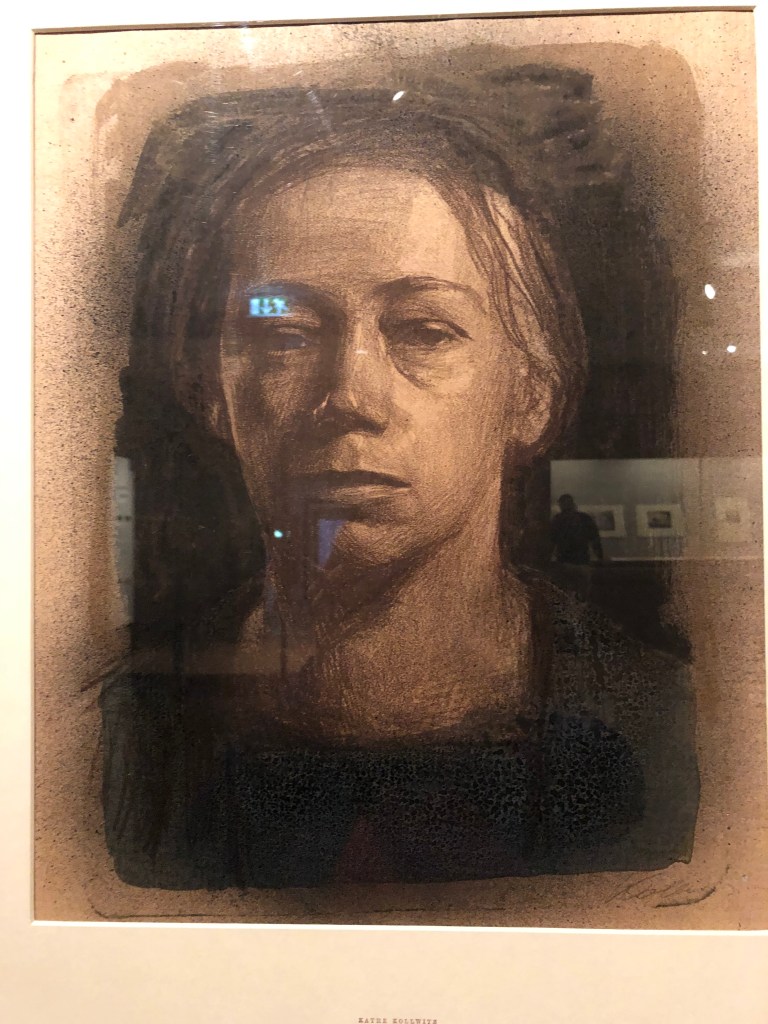
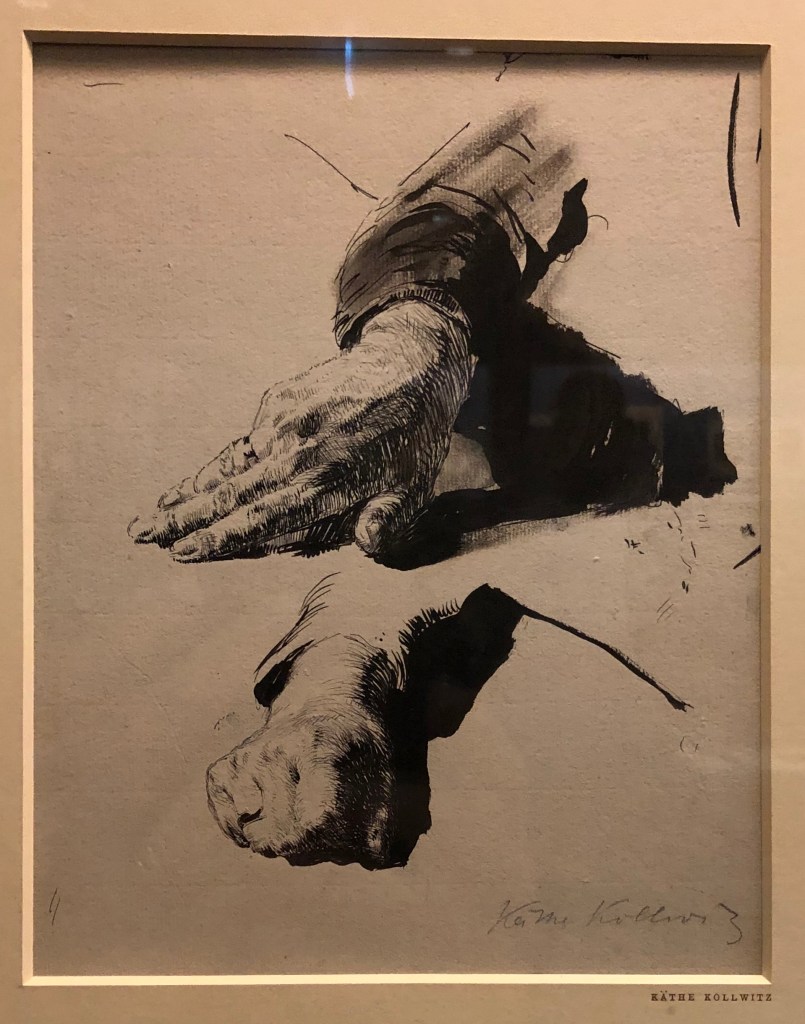
Unexpected and only open for two more days! I hadn’t known that this German artist of prints and etchings. Much of her work on show related to the First World War and was rather harrowing, as was her work on the death of a child (she had lost her son Peter) and, very self-indulgently, I wasn’t feeling in the mood for being harrowed. But there were a few excellent life drawings and portraits which drew my attention – specifically……
Self portrait in full face, 1904, crayon and brush lithograph in three colours overworked with black wash, British Museum
Studies of the artist’s left hand (or her right hand drawn as a mirror reflection) 1891, pen, black ink and wash, British Museum.
British Museum – Pushing Paper
I had already purchased the book accompanying this small exhibition (Seligman, Isabel (ed.)(2019), Pushing Paper, Contemporary drawing from 1970 to now, Thames and Hudson Ltd, London) so had an idea of what to expect, although art is almost invariably much more striking in real life, and that proved to be the case here.
Several pieces one ‘gets the hang of’ better, for example: David Nash’s Wooden Boulder, 1981, black-and-white photograph with graphite, charcoal and gouache on cream card – in the book I hadn’t appreciated the map-like quality of the drawings, which stand out much more in the (much larger) original – maps in drawings always appeal to me for some reason, think I must try them out for myself… My favourite after looking round though was still the image they have chosen for the back cover – Minjung Kim’s Mountain, 2009, ink on hanji paper – a demonstration of how knowledge and experience of materials and supports can make or break a drawing.
Today at the life drawing class in Tavistock, our model unaccountably failed to appear, and so we took turns drawing each other; and, since it was a cold and blustery day, serendipitously, nearly everyone was wearing a baggy jumper and/or trousers. A day made in heaven specifically for this exercise, I thought….
I am still unable to tackle life drawing with my dominant right hand, so am sticking with the left, using big expressive strokes and my trusty 3B pencil. I am gradually growing in confidence with life drawing, thanks to:
This now being my fourth session
My trip to London for a whistle-stop tour of as many exhibitions featuring portraits/people as my brain could accommodate (see separate blog post)
Reading a book acquired on voyage – Legaspi, Chris (2020), Life Drawing for Artists, Quarto Publishing Group USA Inc. – only partway through it, but it has confirmed that my big sweeping strokes are a useful thing, and made me understand the structure of a life drawing class and the point of all the different-length poses.
We did quite a few drawings today which can be seen in my A3 sketchbook, but I have photographed three to talk about here.
This gentleman had a big chunky fleece-type jumper and he adopted a helpful slouchy pose clutching his coffee mug which let the jumper fall into lots of folds. All the poses today were about 15/20 min as none of us are professional models so didn’t want to tackle anything unduly long or awkward and difficult to maintain, but this gave me time to get the overall structure of the figure in, practise placing the “crosshairs” on the face
(a term acquired from my book – basically identifying the horizontal and vertical mid lines), and then concentrated on the folds of the jumper and how they gave definition to the torso and arms.
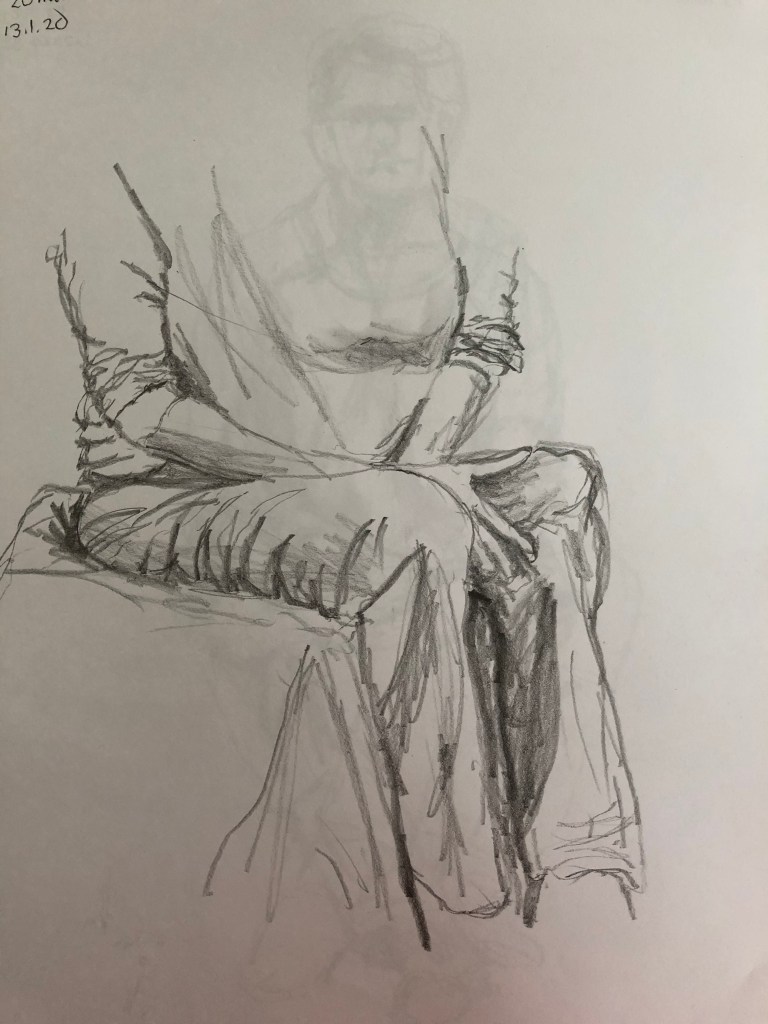
My next attempt was a slightly older lady who again had a baggy jumper, this time with the sleeves rolled up, and who also sported some fairly loose trousers which bunched up in some places and hung or flowed in others. I focused on the midpoint where she had tucked her right arm and hand between her knees – so I began with that hand and worked my way outwards. The direction of the creases does add a three-dimensional quality to a flat drawing. I am also trying to sketch in just a few folds from the cloth on which the models sit – just a few fold lines hopefully give structure to the seat and make more sense of the sitting position.
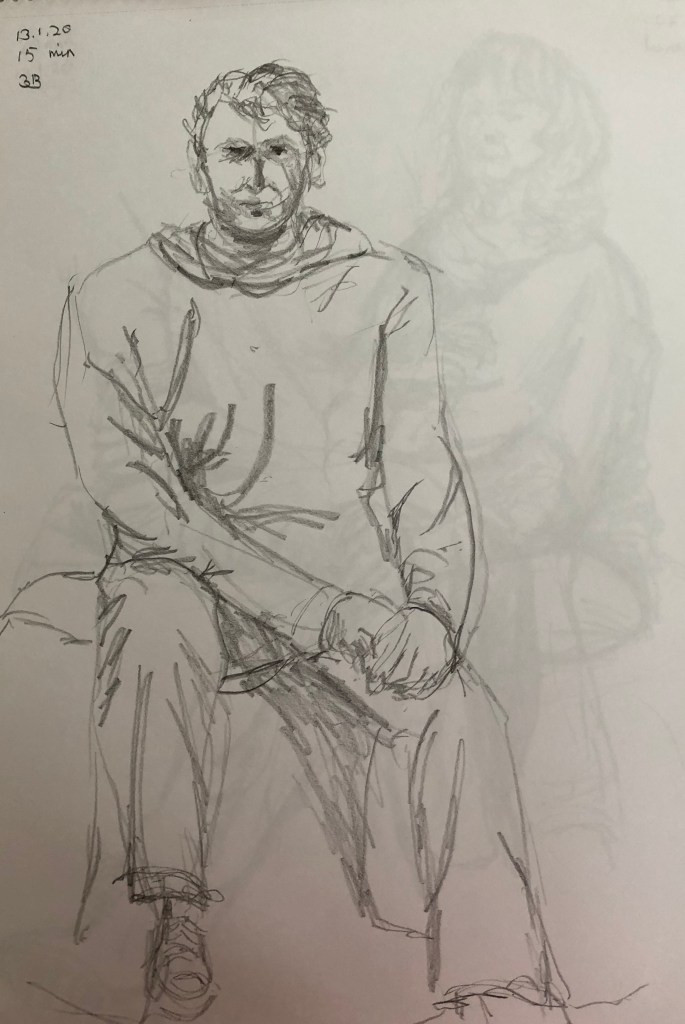
My third drawing to be discussed here is of a younger man wearing a chunky hoodie and thick jeans. I was lucky to have him facing full on for this sketch so hoped to use long bold lines for the folds in order to give structure to the whole form – I wanted to get the whole body as all the other poses today had been three-quarters on to me.
I think I have managed to catch something of his bulk; I think my attempts this time at depicting his “perch” have been slightly muddling with the trousers confused with the fall of the backcloth – but I was pleased with the way I had caught his right leg which was facing me straight on, foreshortening the thigh to virtually nothing..
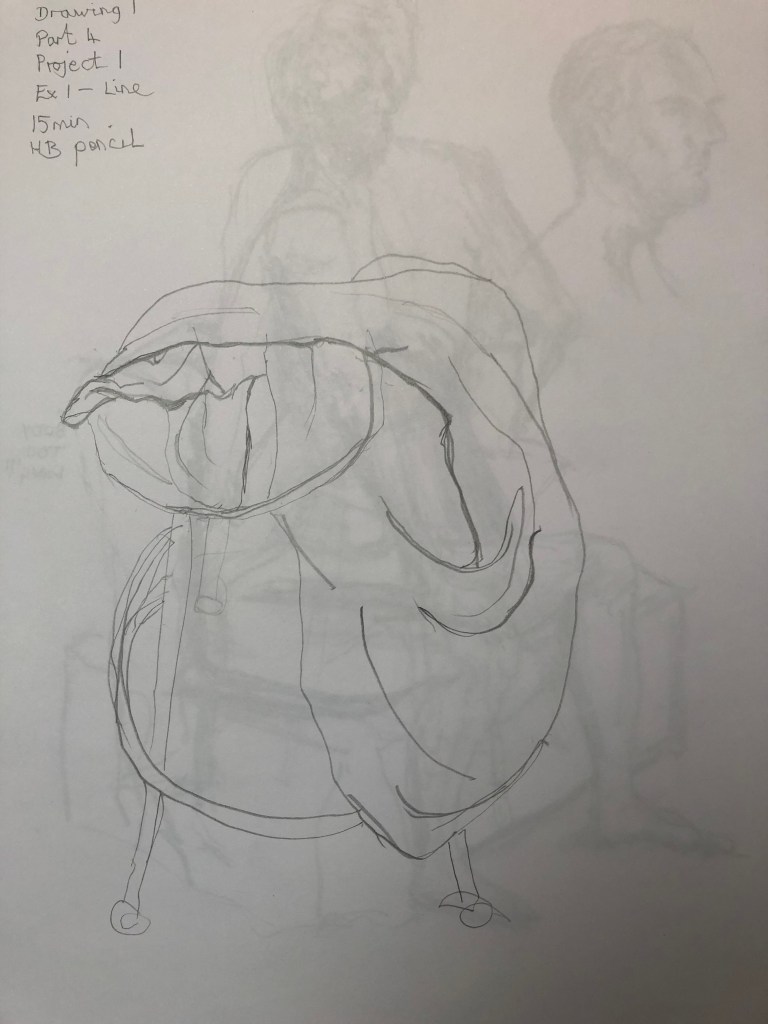
Well, this was a bit of a challenge for my left-handed drawing – but I decided to embrace the advice I was given at the recent Zoom critique session, to loosen up and see what other things could be achieved with the non-dominant hand. I threw a bath towel in a heap on a stool and started in…
First up was the 15 min line drawing, which I decided to render in my trusty HB pencil. This was always going to be a struggle as I am finding it difficult to place and control lines with accuracy – and so it proved. However, sweeping lines are easiest for me – drawing with the whole arm almost, rather than hand, wrist and forearm, and so the outline is reasonably representative of the towel. I found it more difficult to represent all the inner folds, as much because it was tricky keeping track of them as it was drawing them with control.
Afraid this is also a fairly duff photo as the work on the reverse of the page shows through – however, after 15 min work, I think the viewer might just about grasp that it’s a drawing of some piled-up fabric.
Next was the 15 min tone drawing – I went for charcoal pencils for this as it gave me more flexibility to use the pencils on their side for wide sweeps of tone and blending.
I think this is more successful (as in, more recognisable), although I found myself going back and marking in some lines just to try and keep track of where I was.
I found the big sweeps and folds easier to represent and to make 3D than the really convoluted overlapping folds in the middle, which are a bit of a jumble and the surfaces are hard to follow.
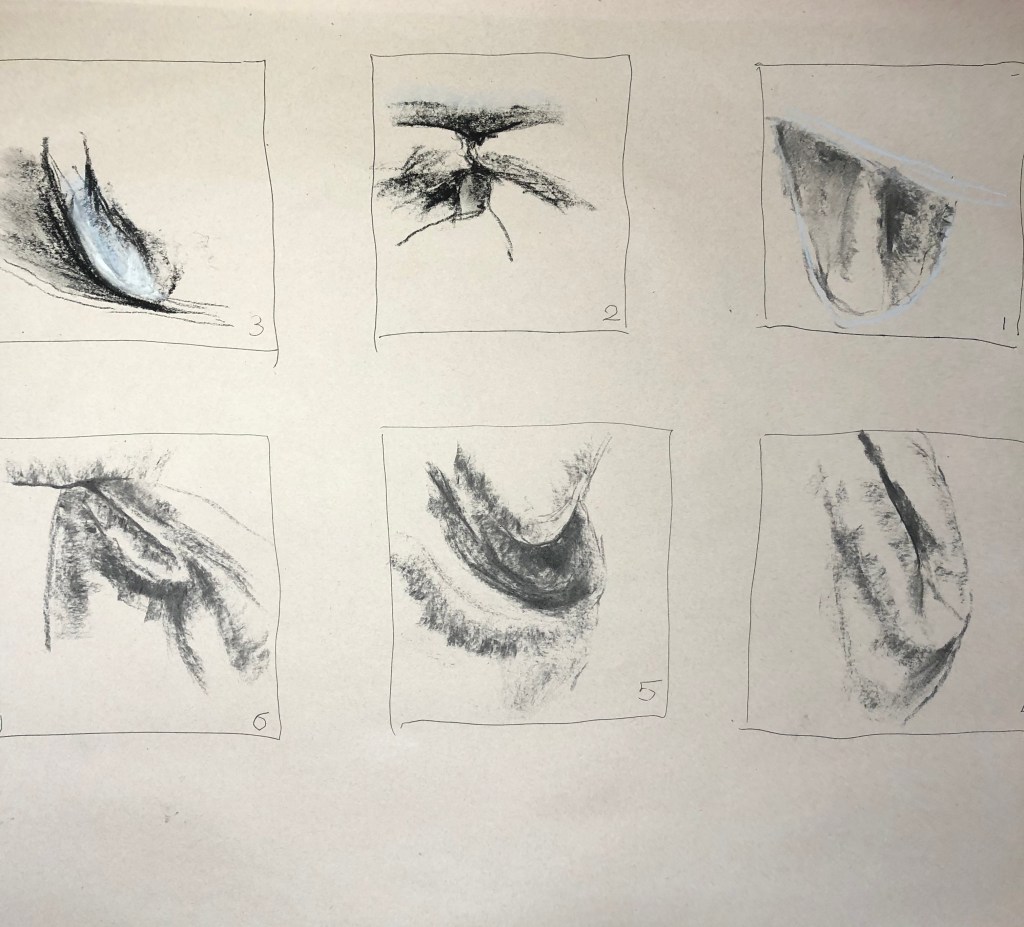
Moving on to the 5 min studies of small areas of the fabric, I felt the need to work (a) bigger, and (b) on paper that wasn’t white, so I opted for a sheet of fawn/grey sugar paper. I’m afraid that, because of the whole left-handed drawing thing, I worked the boxes from right to left, so they are numbered slightly counter-intuitively. My plan was to work in Conte crayons and charcoal, putting in the darks with the black, and the lights with the grey/white crayons.
I tried this out with the first three (moving top right through to top left), but I found it hard to get any sort of likeness, and was despairing slightly of being able to get the hang of this.
Moving down, I decided to simplify by really focusing in on just one fold, and also just used charcoal. This was much more successful and whilst by no means the finished article, these lower three look much more 3D and also more representative of the “feel” of the towelling fabric.
Well, I had already started on the second research point about the history of the nude, so have been made to confront issues that, in my naivety, I hadn’t really recognised before – see blog post on that research. So I’m going to keep this blog post as a document of my own personal feelings and reactions to drawing people – an aspect of art that I had always shied away from.
Last week I attended my first life session with a local group. The booked model had phoned in unwell that morning and replacements could not be found; hence we agreed to do a few 15 min sketches of members (all clothed) and then, as I have a broken shoulder and am struggling to draw left-handed, I volunteered to sit for a longer session after coffee. The experiences of being on opposite sides of the drawing board were quite different:
Sketching class members (strangers or passing acquaintances) was surprisingly forensic – initial qualms about rendering the sitter in a politely flattering light were dispelled once I discovered that we didn’t really go round and look at each others’ work, and I was soon blocking in heavy jowls, bags under the eyes, rolls of fat and double chins with the best of them. You soon lose yourself in the moment and it is as if it is only you and the model in the room; you are locked in a joint endeavour. Being compelled to work left-handed is, I think, going to be at least partially beneficial – I am unable to produce a reliably accurate line, so am being forced to look for shapes and blocks of tone.
Acting as model (clothed) made me focus straight away on comfort, especially that of my smashed shoulder, so I was quick to establish myself in a slouchy but supportive position which I felt I would be able to maintain – unlike the class members who had preceded me who all adopted a smart, straight-backed, pull-your-stomach-in pose, gazing heroically into the far distance. And, once they are all drawing, you forget about them completely; it is like entering a wide empty hall in your mind with many doors – you can push against one door and start thinking about x, then return to the hall, enter another door and start thinking about y – whilst all the time leaving a small part of your brain in charge of remembering to check that you are still looking at the same spot on the floor whilst remaining relaxed and not forming a rictus-like stare. Time flew by and the agreed 40-min limit came way before I anticipated. I was tempted into glancing at the drawing of the group organiser (a local artist called Scott Russell – see his page on www.cargocollective.com) – he had gone for a portrait rather than full body, and I did think he had ‘caught’ my likeness – gratifying, although bringing home to roost the chubby cheeks (no, I’m sure they’re not jowls) I seem to have grown of late…
In this week’s life class we had a proper nude model, a young-ish lady whom the group had not hired before. She was, however, clearly experienced in the job, and generated her own poses without being asked (although she was happy to adjust them slightly if asked). She did three shorter poses and then two extended poses, one lying flat and head hanging slightly backwards, the other a sitting/reclining position. Her professional matter-of-fact manner made it feel not at all weird to be drawing her – it felt like a job of work for all of us. She did not obviously go round and look at our pictures of her, but when I said to her after the first of the longer poses “Gosh, that was really difficult ,” she came over to look at my drawing and remarked that I had had a very tricky angle to cope with – so I wonder if she draws herself.
Well, over the last few days there has been a huge string of arguments on the oca dr4drs email about life drawing classes and the sexual exploitation of models – going on to denigrate artists such as Schiele (whose drawing style I had found very compelling for its use of line), along with Gaugin and Freud, both of whose exhibitions I had been looking forward to seeing early in the New Year. So when I turned up this week at life drawing to find we had a male nude model, I paid particular attention both to my reactions and to his attitude. Ours is a mixed class. Our model was obviously experienced, like last week’s lady, suggesting his own poses and yet being open to slight moderations as requested by class members. He was happy to come round and chat in-between times, covering up in the breaks, and staying afterwards to join us for a glass of mulled wine (last session before Christmas). I observed my own reaction – at first slightly self-conscious because of my own self-awareness – but in no time at all one is totally absorbed in trying to render the pose, as everyone else seemed to be. Certainly, for me, the problem of getting the human form down on paper is the thing, and it seems to be so for the other members of the class, although of course you can’t tell what is going on in people’s heads, and are never going to be able to legislate for that – but there was nothing overtly sexual about any of it. The model was paid, was stressing his availability to come back another time, and appeared relaxed and comfortable with the situation throughout.
This took place between 6-8.50 pm – there were 6 students plus Helen the tutor. After introductions and explanations of the working of the software, we had a “quick” reaction to each others’ work, followed by more in-depth critique, first with a partner and then the group as a whole.
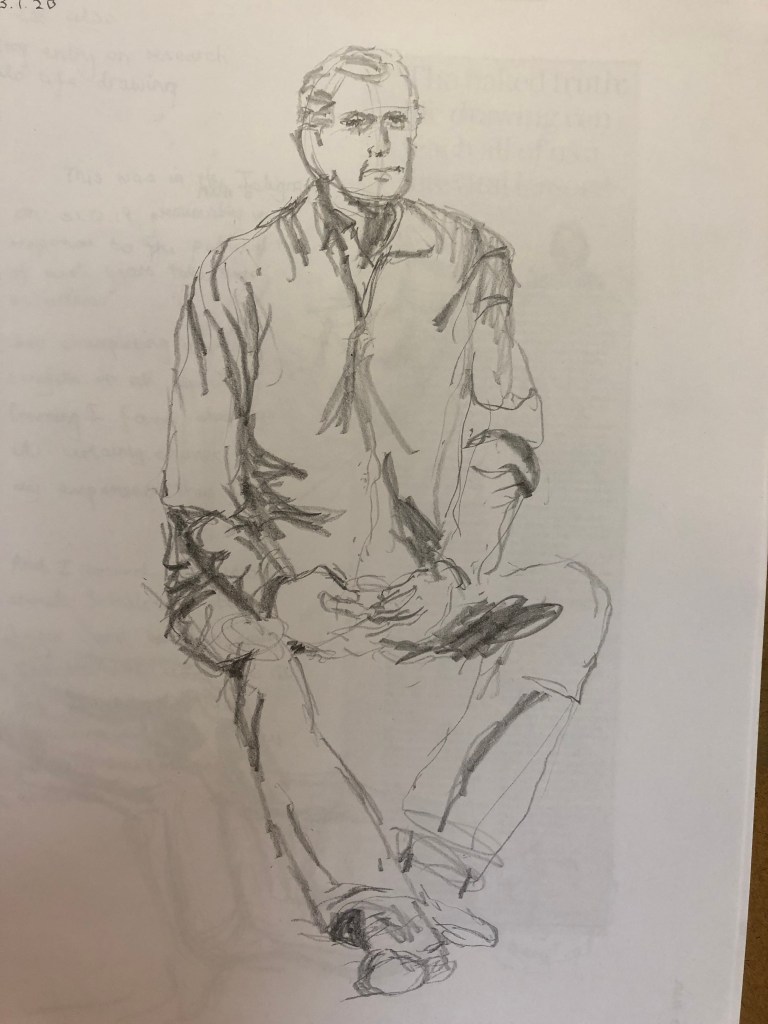
My piece was this 15 min sketch from a recent life drawing class. I am currently labouring under the handicap of a broken right shoulder (yes, I’m right-handed, wouldn’t you know…) so am having to draw, very inaccurately, with my left hand.
Immediate responses to the “quick” showing were:
Solid strength mood
Balanced
Perched, roughness
Uncomfortable
Both subjects solid
Strong position
An interesting and helpful discussion among the group followed my showing of my work (presented by my work partner for the evening, Felicity): if one lets go of – is freed from – the possibility/necessity of getting a drawing “right”, as I am having to do – where can you go? What other representations are there? What actually is right? – what other things can one convey apart from photographic accuracy? I confirmed that the experience is certainly making me observe much better, in order to give myself the best chance, and I am almost being forced to look much more in terms of shapes and their relation to one another. This conversation very much reflects a comment from my own tutor in response to my plight, who said she frequently advises students to work for a while with their non-dominant hand for these same reasons.
Other people’s work was diverse and we were all at very different points along the pathway, which afforded those further along to give the benefit of some nuts and bolts advice to those less advanced. We had a sculpture, a set of drawings, a large drawing telling a story, a still life and a portrait. Points for me to come out of these other discussions:
It can be helpful to work on several versions of a subject at the same time, allowing one to compare/contrast
Look for work of these artists, admired by other group members:
Jenny Saville (have done so – reminiscent of Freud?)
Maria Lassnig (have done so by looking at report of retrospective in 2016 at Tate Liverpool – apparently this was linked with work by Francis Bacon, and I can see why)
A defining characteristic of a fine art student is the ability to be critical (not quite sure how well I have achieved that by my slightly throwaway remarks above – must try harder).
Other points:
Need to install Chrome on laptop in hope of making Zoom work – it didn’t like Safari.
I have experimented more with the materials I had said I wanted to improve – notably charcoal, Conte crayons and inks. I have given some thought to my support, as suggested by my tutor, and have started working on coloured grounds (paint, charcoal, pastel, newspaper and gesso). Compositional skills still need to enter my consciousness a bit more, but I am feeling much more confident with perspective and feel I have some quick-check tools to support me.
Quality of outcome
Although I was unable to physically complete my Assignment 3 piece in time due to injury, I am pleased that I had worked out what I hope is a clear and coherent plan for it which was based on my learning throughout this part. Something to work on for the future, I think, would be pulling out the salient points and not including every detail – I have tried it in bits, but know I need to do it much more.
Demonstration of creativity
Having taken “developing expressivity” as my target for this Part, I feel I have given myself permission to let rip a bit (within the limits of being a Capricorn) and to follow areas and try little experiments which were interesting to me, whether or not on the tick-list of exercises. Having said that, I have really enjoyed this Part, I felt it was well-constructed and I can’t pass a window, a tree, a cloud or a corner now without immediately thinking how I would draw it.
Context reflection
I have found the suggested research in this Part much more helpful and less scattergun (or maybe that has just been down to my approach to it). I have tried to follow up on and develop points and ideas I have mentioned in my blog, and am starting to feel that it is ok to use parts of another artist’s ideas or examples without having to sign up hook, line and sinker.
I need to preface these notes with an explanation:
Three days ago I tripped over a kerb (rushing to a local art exhibition, annoyingly) and landed on my shoulder – was taken to hospital by ambulance, and it turns out that I have a complex multiple fracture. It’s very painful, so I am on morphine for it, and I am waiting for an operation to see if it can be fixed or, if not, to replace it. It’s my right arm and, wouldn’t you know I am very strongly right-handed, am finding it very difficult to do anything with my left – it is taking hours to type this!
In view of all this, I have decided to submit my Part 3 work to my tutor (I had already completed all of it apart from the last two exercises in Project 5) along with my plan and such preliminary work as I had done prior to the injury, and hope that this might prove enough.
Preliminary work
Thinking that I would need to spend quite a while in situ doing drawings in a cold wet November, I did a set of rapid, rough A3 sketches in pen from windows in my house, all showing buildings, tree etc, as well as allowing for the demonstration of linear, angular or aerial perspective
Sketch 1 was looking down from the attic window of our 3-storey house at the road, a small group of houses across the way, and a hill with trees behind – all flanked by gable roofs . Sorry – my daughter took the photos of the sketches for me, not the way I usually take them and I can’t turn them – so this needs to go round a quarter left.
Sketch 2 was the view from our first floor bay window looking down on next-door’s porch roof and driveway, across to next door’s bay window and then on down a windy road which forks then disappears into trees
Sketch 3 is looking out from a different first floor window into our garden, onto the garden wall, down a side road with a lane off, making a z-shape – again, the photo needs to turn a quarter left.
The final sketch is from the ground floor study window – the view (of the houses opposite and along and background woods) is nicely framed by the dark garden wall and shrubs, trees at the side and looping right overhead, with central focus of a much-pruned beech.
Plan
After attending the South West group meeting, listening to speakers there, reflecting on Lydia Halcrow’s work (see separate blog post), thinking about series pictures (e.g. John Virtue, David Hockney) I decided not to choose just one of these sketches to work up for the assignment, but to present them all as a tessellated group. Lydia, John Virtue and some of the photography students at the meetings were all trying to represent a journey as a series of images; I thought of mine as offering a series of potential setting-off points, depending on which image you chose to jump into – a bit like the beginning of JRR Tolkein’s The Hobbit, where Bilbo Baggins was promised an adventure by just stepping onto the road outside his door, the particular adventure being determined by which way he chose to turn.
I intended to work up each image on A3 so that, when assembled, the total would be the required size. I was going to simplify each image quite considerably (as I had done in Project 5 in a set of drawings of the Church – see sketchbooks) and intended to work quite loosely on pastel paper with some pieces of gesso-coated newspaper – in the style of the church example here.
My medium would be mainly inks (applied with both brush and pen), plus some charcoal and Conte crayons – not necessarily monotone, but a limited palette of 2 or 3 colours at most.
We were asked not to go into precise details about this in our blogs as the work Lydia shared was part of her still-to-be-published doctoral thesis. Suffice to say that I took from it her interest in recording walks in different media and forms. She too (see earlier blog notes on John Virtue, Rob Dudley, Emma Carter) talked about making work “responding to a place” rather than “a painting of a place”; she referenced some of John Virtue’s early work – small paintings of his postal round which he assembled as a tessellation (e.g. Landscape No 87, 1988). For more detail, see handwritten notes in my A4 hardback sketchbook.
Group discussion on working outside – problems and solutions
Lack of confidence – persevere – try drawing with others – take limited kit – work simply and smallish
Lone worker safety protocols, e.g. tell people where you’re going
Put the jacket of a book round your sketchbook when drawing people, e.g. in a cafe
People don’t bother you so much if you look as if you belong at what you’re doing (consider a yellow vest!)
Note how you’re feeling when you are working – this can become part of the work
Don’t let your mind limit you with worries about what might happen – give yourself permission to be there, and think in advance about what you might say if spoken to or challenged
Give yourself permission to go out and either draw or just look and get ideas – ‘how will I do this? ‘- rather than ‘what stops me?’
Critiques of work with a particular focus
Well, I was first up – guaranteed to get over nerves! I had already done some sketches thinking towards Assignment 3, and had initially intended to ask the group which sketch best fit the brief. However…having listened to Lydia this morning and thought about her references to John Virtue’s work, as well as her own, I had a bit of a lightbulb moment – so I read the group the brief, showed them all the sketches from different views, and then asked them if they thought it would be ok to present the pictures as a series. Their response was very positive – they felt the idea of multiple images was fine; the work didn’t need to be pristine and finished; I should be experimental with my support and materials (I showed them my ink and pen sketch on gesso-ed newspaper as an indication of where I was thinking of taking this – group thoroughly approved.)
See handwritten notes in A4 sketchbook for more details on others’ work – difficult for me to type with one left hand! – see notes on Assignment 3 for explanation.
Emma Carter-Bromfield is a South Devon artist working in acrylics and oils – see her website, www.emmasisland.com.
I took notes on her demonstration (see hardback A4 sketchbook) and don’t propose to regurgitate them here. What struck me about her painting was her freedom alongside her apparent enjoyment, almost need, to do it. As with several other painters I have experienced recently (e.g. Rob Dudley, John Virtue, see blog posts) she is aiming to capture the spirit and essence of a part of the world she loves, rather than trying to represent a particular fixed view.
This was as far as she got in the time available – quite something given the size of the canvas – enough to provide real inspiration.





 Sue J's blog