Drawing 1; Part 3 – Expanse; Project 2 – Landscape; Research point – Vija Celmins

I watched the video a few times – at first I didn’t quite “get” her, having not come across her work before – she reminded me the first time of Bridget Riley and her meticulous line drawings – but actually the more I watched, the more I thought that this was completely wrong, and Vija is more someone who looks at something for a long time and then takes great care to record what she sees; even though the viewer may take her image in “in a flash”, she hopes that they will then consider it at length and think about what it means. She interestingly makes a contrast between “drawing” and “using pencil and paper as my medium”, which chimed with a biography of JMW Turner I had been reading (Moyle, Franny, 2016: The Extraordinary Life and Momentous Times of JMW Turner. Penguin) in which the old definition of works classified as “drawings” included watercolour paintings – so I guess that Vija is saying that she is creating works with pencil and paper which might be considered as paintings? – anyway, obviously a fine line (pun!) and not something to get bogged down with, I think.

She describes the point of her detailed drawing/painting of an object as “…not to mimic it but to show an attention span and thoroughness…”, going on to say that she presents images (which she calls “little areas”) for people to pass by or stop and look at. I’m not quite sure why, but this resonated with me today when I had done a drawing of a rose my husband had brought in from the garden; it was quite a detailed pencil drawing, I was pleased with it, but even more pleased today (two days later) when I moved the vase and all the petals fell off – I felt as if I had shown that rose the same attention span and thoroughness as Vija does, and that was somehow a good thing as it was preserved in a different way.

I also found another video and a lot of information about Vija’s life and work on the Tate website (www.tate.org.uk) where she talks more about the time she takes to create a careful image; she says, “I’d like you to be able to scrutinise it and relive the making of it” – and one very much does with the Ocean Surface pictures in particular, I think. 

It all seems quite a meditative process for her. I tried to get into this same zone with my cloud drawings – it seemed a bit of a dichotomy at first as I felt pressured to work quickly because the cloud either wasn’t there for long, or it was changing, or I was moving….but I have found myself now staring at clouds quite a bit, not necessarily when drawing them (just as well the neighbours think I’m a bit eccentric anyway…..) and am coming to understand that they follow their own rules and patterns which can be studied, learned and then applied at will to create new clouds from the imagination. This is quite a big thing for me – I have never been any good at drawing from my imagination, probably because I have only recently got into the mindset of looking as an artist – so to find something I might be able to make a real fist of drawing realistically out of my head gives one quite a kick.
Drawing 1; Part 3 – Expanse; Project 2 – Landscape; Exercise 2 – Sketchbook walk

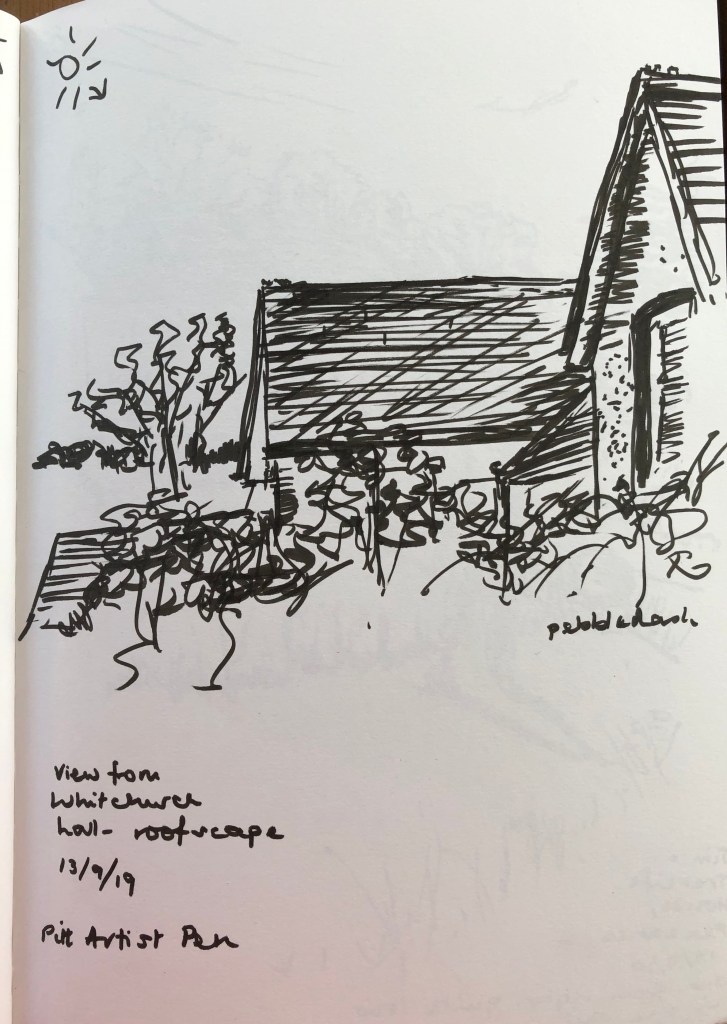
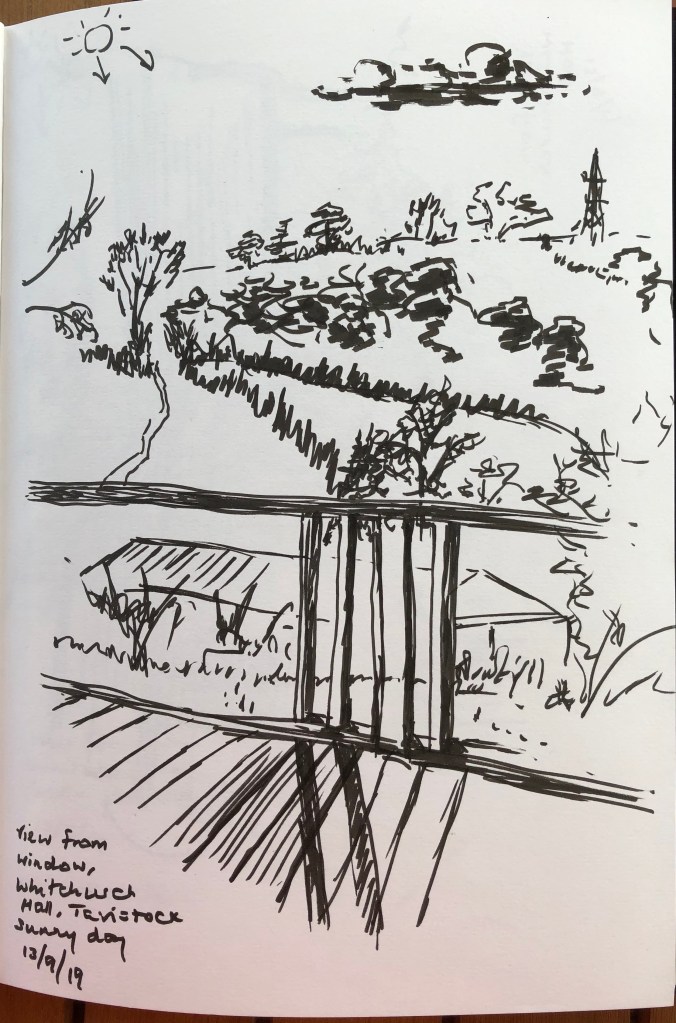
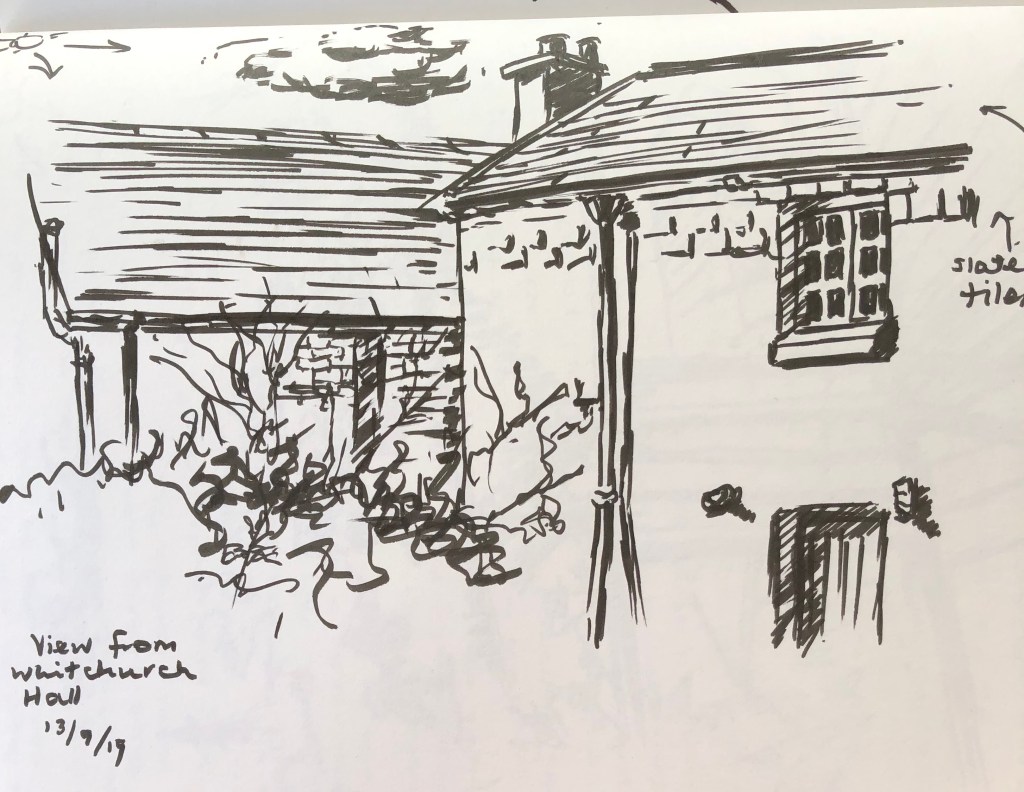
This was not so much a walk as a Friday afternoon session at Whitchurch art group. The hall we use is set on the edge of the village and has windows on four sides – I thought this would be perfect for trying to get all four pictures done in one 2-hour afternoon session (allowing time for tea, chats and looking at each others’ work).

I started off with this view through the fence (foreground), over someone’s garden with greenhouse (midground) and away to the distant hills. I decided to work throughout this exercise in a fat Pitt drawing pen, the idea being that I wouldn’t get too bogged down with fiddly details. The pen was good for expressive sweeping marks, lovely scribbly hedges and dark patches for the “negative space” part of the trees; less good for the detail of the fence – but I think I’ve got enough of that in to convey the fact that it’s a fence casting shadows, so OK. Notice that I’m also trying to work my clouds in!

My next view was from the opposite direction, which was basically one half of a slate-hung cottage with an older stone building behind and a hedge in front. I have tried to note here the shadows (e.g. of the drainpipe on the wall) and the various textures, as well as get to grips with the perspective (i.e. lines leaning the right way).

The next view was effectively between both of the earlier views – I wanted to get the “procession” of roofs in. Again, I looked to notice tone (shadows) and make quick notes about the surface texture.

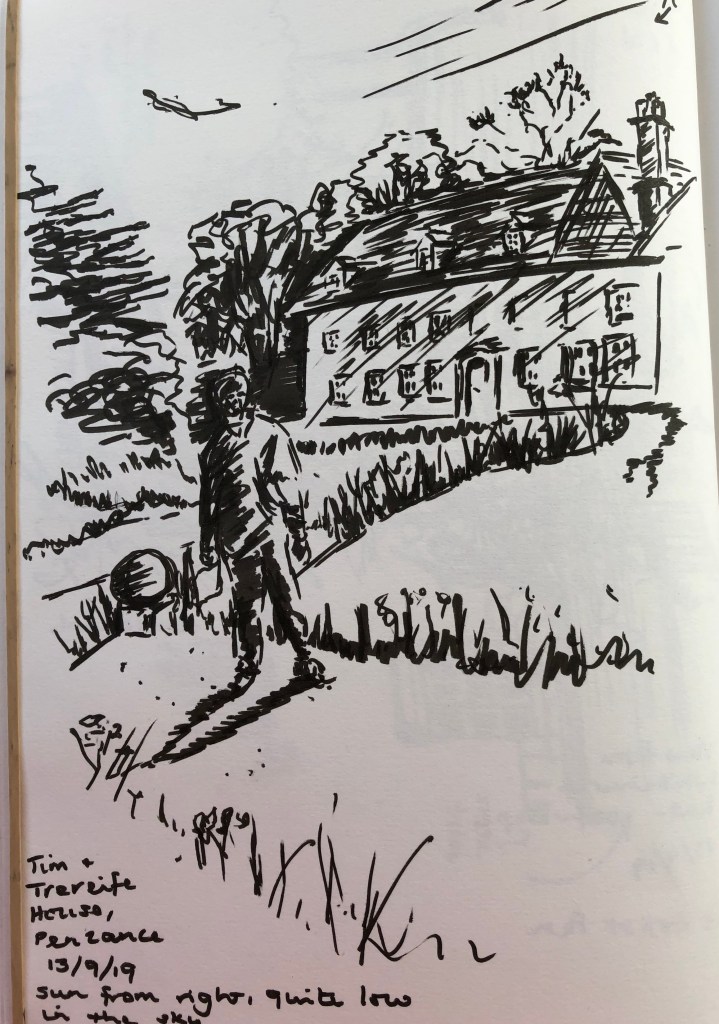
I went to the windows on the far side of the building; these have shrubs/trees growing right outside them, and I had hoped to be able to see the view behind through the foliage – but not to be, I’m afraid. So I turned to a photo on my phone of a recent stay at a rather crumbling but characterful old stately home near Penzance just which had started offering B&B as a means of paying its way – we stayed there recently, and I took a photo of my husband in the gardens in front of the house in late afternoon light – strong, dark shadows. The brush pen was great for the really dark darks, but a bit clumpy for mid- and light shadows so I think some of the bits of detail I did put in have become slightly unclear.

TAKE AWAY POINTS:

  • I enjoyed the fast sketching – need to do lots more to get better at going “big picture” and getting down the main details
  • I need to remember to step away part-way through a drawing and look at perspective – I am getting better, and slightly more confident, at seeing which way the lines lean when near to the horizontal (something I have struggled with and am still not 100% accurate), but I haven’t got that tapering into the distance, e.g. the house in the 4th drawing doesn’t taper, and I can see that clear as day now from my photo of it – need to get better at seeing it at the time!

Drawing 1; Part 3 – Expanse; Project 2 – Landscape; Exercise 1 – cloud formations and tone

This has been overall a fun if slightly frustrating exercise; fun because it was quite free, and frustrating because, whenever I thought I had a bit of time for cloud drawing, it seemed to be either unremittingly sunny or else the sky was a uniform greyish-white accompanied by rain in varying degrees. Often I would see an interesting cloud formation when I was on the way somewhere – so there has been some shameless drawing from photos, both mine and those of others.

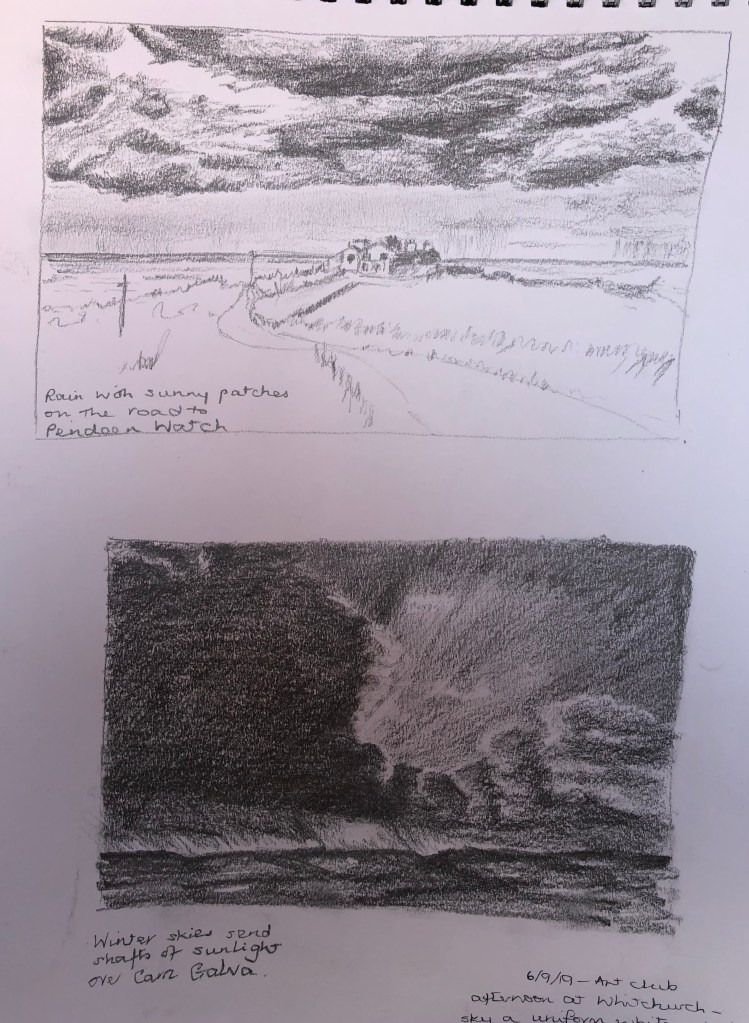
Dramatic stormy clouds (other than the uniformly grey variety) have come from books – but I have chosen images which exemplify real dramatic scenes which I have seen to have a go at: the lowering clouds which seem to process over you into the distance (where it is still raining), but lit by a sunny moment; and the massive evening stormy cloud passing away, allowing light from a setting sun to show around.

I did both of these with a chunky 2B pencil – this was generally fine for the task, although I did struggle to get the darkest darks quite as intense as I wanted.

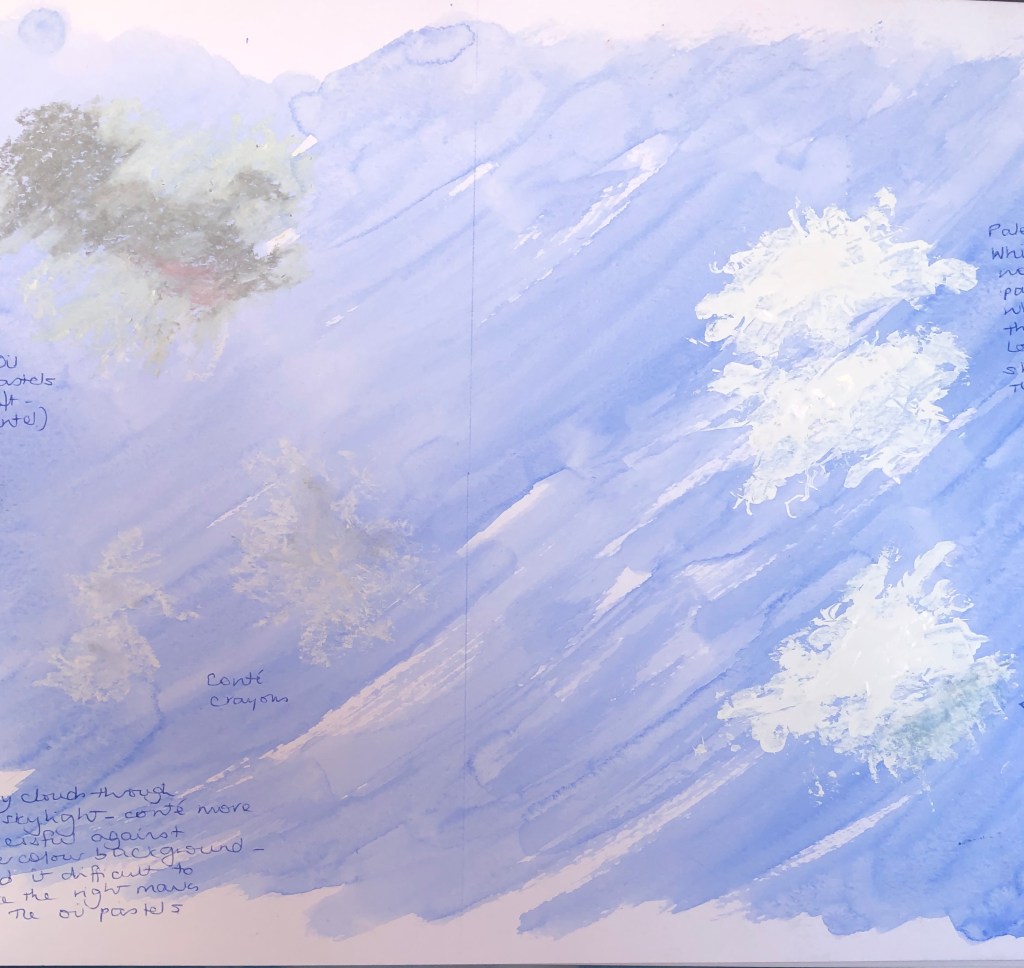
Wispy sunny-day clouds directly overhead have proven more of a challenge than you would have thought. These are generally darker towards the centre where the thickness is greatest. I had a go at using blue watercolour paint on a white ground to try and paint the cloud in as negative shapes, with variable success (see notes in A4 sketchbook). Then I experimented with different media over a blue watercolour wash (see here), where I found the most successful media were white and grey Conte crayons (lower left), and white gouache applied with a palette knife and my finger (right).

I was on the lookout for interesting composite cloud formations (as I had seen depicted in pictures by Alfred Munnings – see notes in A4 sketchbook and blogpost on a weekend in West Cornwall). These often seemed to appear towards late afternoon/evening – I snapped a couple of interesting skies and tried drawing them from my photos.

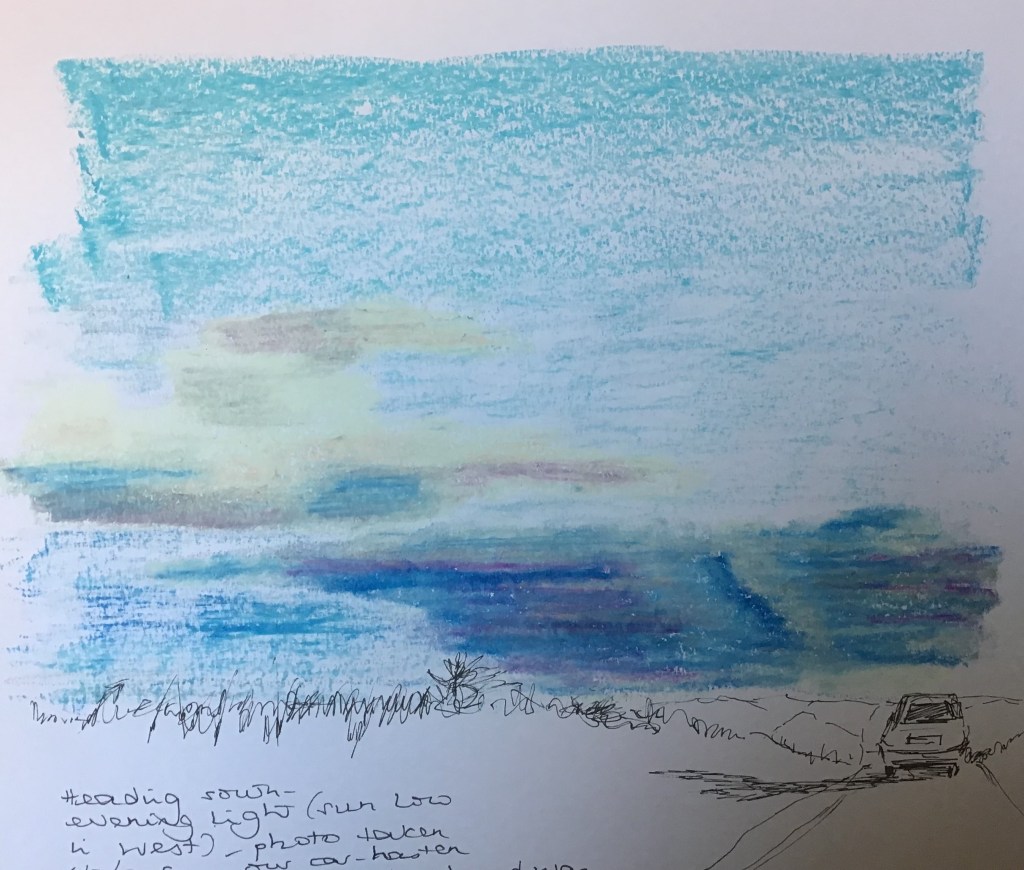
I was determined that oil pastels would be good for this rather dramatic sky taken from our car about to crest a hill. I tried an overlaying technique (loose darks first, then circular strokes with the white crayon – this linked with the Vila Celmins research, as this is the same stroke I used for my tree foliage – and then I repeated the circular strokes with a paper torchon). I became rather absorbed in the process rather than the outcome and the dark clouds on the right ended up a bit odd; but on the other hand I was quite pleased with the billowing quality of the lighter clouds on the left.

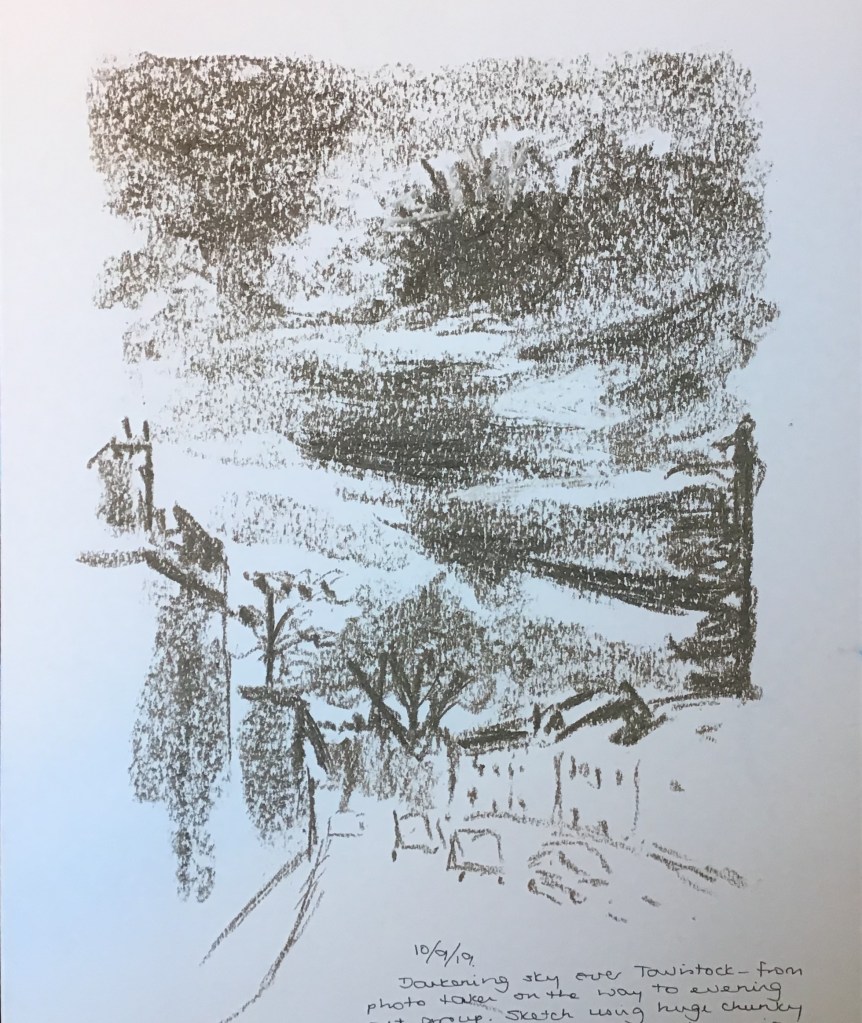
This was a quick 10-min sketch of a dramatic sky I saw as I walked through Tavistock to my art group meeting yesterday evening. The sketch is done with a huge chunky graphite stick which was new to me – great for big areas using the flat end, but also sharp edges for lines and emphasis. Enormously enjoyable!

Drawing 1; Part 3 – Expanse PERSPECTIVE!

This week, at this term’s opening meeting of the Tavistock Group of Artists, one of our members (Ian Pethers RMS, SBA) gave a quick talk and demonstration on the basics of perspective. Key things for me to remember from this:

  • “Art does not follow rules, rules follow art” (although it is good to know the rules, so you know what you are disregarding!)
  • The horizon moves with the viewer – if two people are looking at a view, their horizons will be different (unless they are of identical height)
  • He demonstrated using pen on a board which had a pin through the middle to which a string was attached – the pin was the vanishing point, around which he constructed an entire street scene using the string as a guide to the angle of the lines – brilliantly simple, works for my brain! He pointed out how things change as they become more distant, eg it’s not far before you can’t see the actual window glass, only the facing edge of the window recess.
  • Drawing e.g. tiles on a floor using guide lines – these will be fractionally curved as they near the viewer, due to the movement of the head/eyes

Drawing 1; Part 3 – Expanse; Project 2 – Landscape; Exercise 1 – Cloud formations and tone – A weekend in the far West of Cornwall

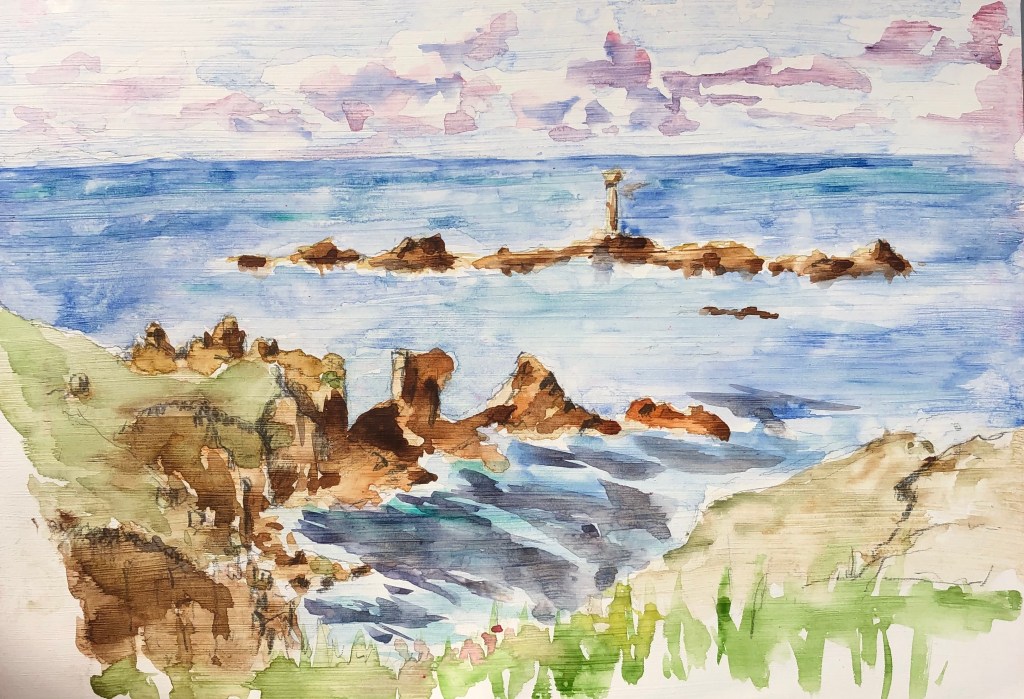
We (my husband and I) went and stayed outside Penzance last weekend to take part in an event jointly organised by the Newlyn School of Art and the National Trust – we were trying to set a world record for the number of people painting along a stretch of footpath between Sennen and Land’s End – see photo of extract from the Daily Telegraph. We were each given a board to paint on, and this was backed in fluorescent pink; a drone went back and forward along the path, which we had to hold over our head as the drone approached – a very unusual method of counting!

It was a lovely day, with a brisk wind to blow one’s board all over the place and lots of scudding clouds in a blue sky – not to mention a choice all along the coast of stunning views, although naturally I chose to try the  Longships Lighthouse at Land’s End.

The surface of the board had been primed so this made for a very interesting watercolour painting experience – this was the medium I had brought for ease of carrying but, of course, the paint sat on the surface rather than being absorbed, leading to some rather unpredictable but fascinating effects. We had a great time! – here is my effort (note the clouds) and my husband holding up our paintings:

Whilst down there we managed some other arty activities, notably:

  • Visit to Penlee Art Gallery in Penzance to see an exhibition of the work of Alfred Munnings and his contemporaries done whilst in Cornwall, mainly centred around the Lamorna group. I made some sketches of the way these artists had tackled the representation of clouds in their paintings – see notes in my hardback A4 sketchbook.
  • Visit to the Kurt Jackson Foundation in St Just-in-Penwith to see his most recent exhibition based around Frenchman’s Creek. This was a real study in how to paint the same place over and over, and yet create a very different image every time due to variations in viewpoint, weather, time of day, tide, etc. A real chance to observe one professional artist’s methods of rendering massed trees and clouds, and also a study in the careful use of small areas of bright light to lift a picture – see again my A4 hardback sketchbook.

Drawing 1; Part 3 – Expanse; Project 1 – Trees; Project 3 – Study of several trees

Along the road from us is an old Victorian cemetery – it stopped being used years ago and is now a blue-plaqued monument – but it has lovely old trees, some huge, largely untended, interspersed with rambling grassy paths and crumbling headstones, statues and mausolea. It is caught between the road and a steep embankment of the old railway line, so everything seems close-packed and tumbling over itself. Seemed like a good place to draw trees!

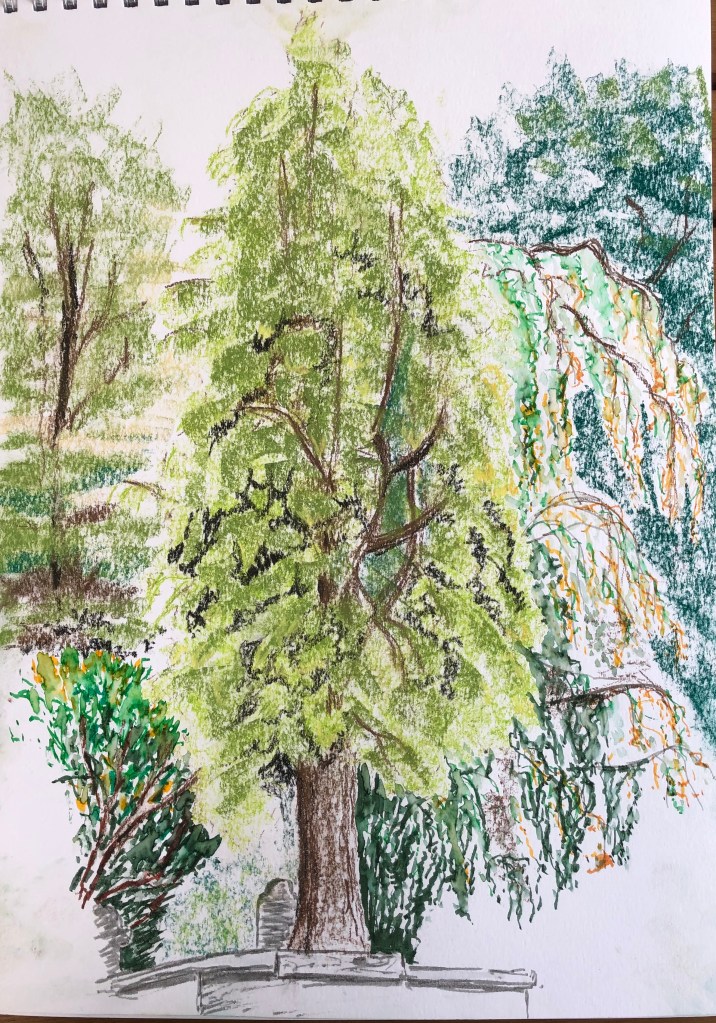
I set off with my large sketchbook, pencils, Conte crayons and water-soluble pens. No-one is ever in the cemetery so it was a bit creepy wandering around, and I was greeted joyfully by a black cat who became my constant companion. I eventually found a small clearing dominated by a fir tree and, behind it, a massive weeping birch. The sun was behind them so their edges seemed to be lit up – doesn’t show up terribly well in the photo which I took to try and capture the light, but the effect was much more marked to the naked eye, particularly as the sunlight trickled through the birch branches and leaves.

I settled down against the boundary wall, ably assisted by my feline friend who kept climbing over me, trying to get into my rucksack before finally deciding to use it as a bed, and batting at my sketchpad – this is my excuse for some rather random “jogged” lines.

The fir and the big background trees (which I think are sycamore) lent themselves to big gestural sweeps with the side of a broken Conte crayon, before working in the light/dark contrasts. The weeping birch and the laurel to the left of the fir tree seemed better represented by the water-soluble pens, which were good for the trailing curtains of branches of the birch and the strong individual shapes of the laurel leaves.

The overall effect feels much more lively than the sedate and elegant original. However, I think I have managed to catch the character of the different trees through my choice of media and the different marks that these encourage.

Reflections overall:

  • Techniques used to distinguish trees – think I have covered this above, particularly the differing mark-making and the choice of medium
  • Conveying mass of foliage and spaces between – the fir and background trees were depicted with big wristy sweeps with the side of a crayon. The birch and the laurel were drawn with pen; long trailing marks for the birch, short punchy marks for the laurel – then some water brushed over both in places.
  • Light on different parts of the tree:
    • The fir was light around the edges in many places (I left these fairly airy) with some heavy shadows which I tried to indicate using negative drawing – didn’t do this everywhere, just enough to give the viewer the idea of how it went
    • The birch I found tricky – the light shining through it, especially towards the top, made it look quite ethereal, and I tried suggesting this by leaving spaces. I have to admit it looks slightly odd; but I did look carefully and really couldn’t see the dark background between branches due to the intensity of the reflected light from the myriad leaves – so maybe I should have found a different way of representing all those leaves (watercolour and much thinner pen? – not sure, feel this might quickly become overworked…hmmm..)
    • The laurel was almost universally dark apart from tiny patches of sunlight reflected off odd leaves – I have tried to indicate this using colour (yellow)
  • Have I selected and simplified? I think in this drawing I have been forced to by the sheer weight of foliage – I’ve manages to look at patterns in the foliage without getting hung up on each individual leaf.

Drawing 1; Part 3 – Expanse; Project 1 – Trees; Exercise 2 – observational study of an individual tree

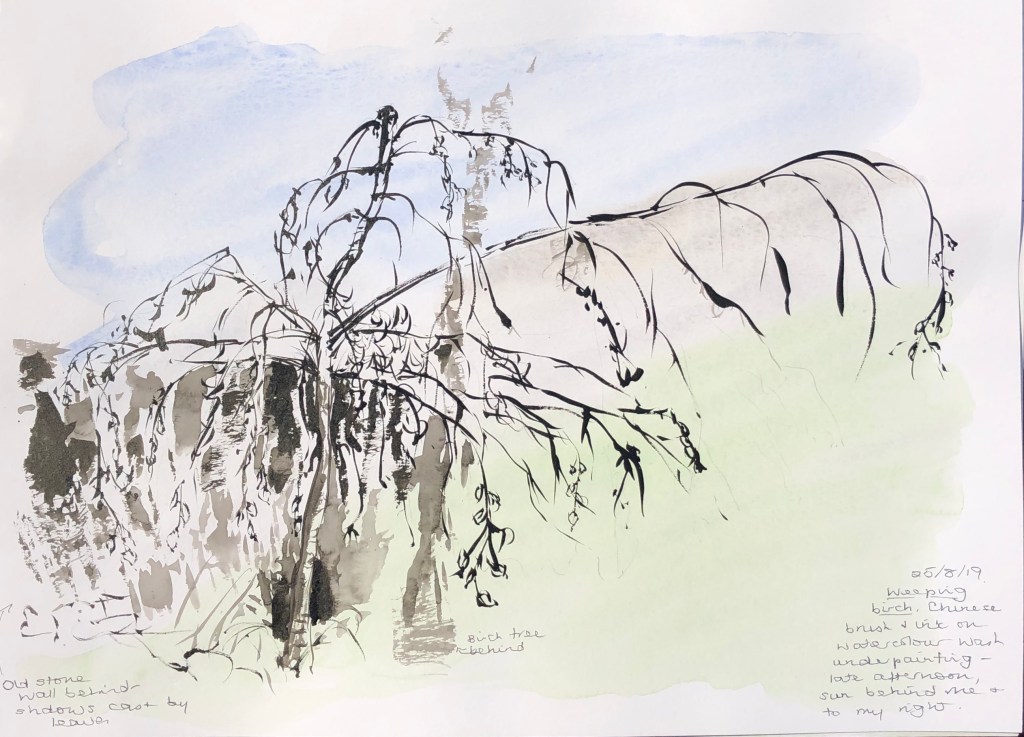
I want to try using the Chinese brushes and ink more, so I decided to have a go at a weeping birch tree in my garden. This little tree is surrounded by maple and beech trees which have overshadowed and squashed it rather until the only way it could grow was out over the path, which it has in fact now done very markedly. We cut back some of the beech and maple around it this summer, removing one of the beeches altogether, so the little birch now stands in a bit of space and has thrived as a result, even though it is still wider than it is high because of its previous fight for light. My husband is threatening to trim the branches that overhang the path now, so thought I had better catch the shape for posterity!

My tutor suggested that I thought more about my support in this Part, so I laid down a light coloured wash underneath the drawing before starting in with the brush and ink. 

I think I have captured the unusually extreme shape of the tree well, and the Chinese brush was the perfect tool for those lovely elegant sweeping branches; the leaves were trickier, so I have just suggested their shape at the ends of a couple of the branches. I think I spoilt it slightly by trying to fill in a bit of the contrasting dark of the wall and shadow behind – possibly a different medium was called for there – and I definitely think the wash could have been a little more intense – it is literally wishy-washy. Live and learn.

I also tried a small study of a section of mossy trunk of the apple tree outside our morning room window, which I stare at every day.

Again, I used the Chinese brush and ink, trying to follow the mantra I acquired from D.N. Naylor, 2016; Drawing Masterclass – Trees; Search Press Ltd, of SHAPE → FORM → TEXTURE; I am still terrible at getting sucked into fiddly details very early on which then throws the whole of the rest of the drawing out of kilter, so I am trying to hold this little formula in my head.

I’m getting better at controlling the darkness of the ink, and the point of a Chinese brush is absolutely lovely to draw with when you need a delicate line – but I’m still not always getting there, still quite thick and blobby sometimes, must remember not to have so much ink/water in the brush.

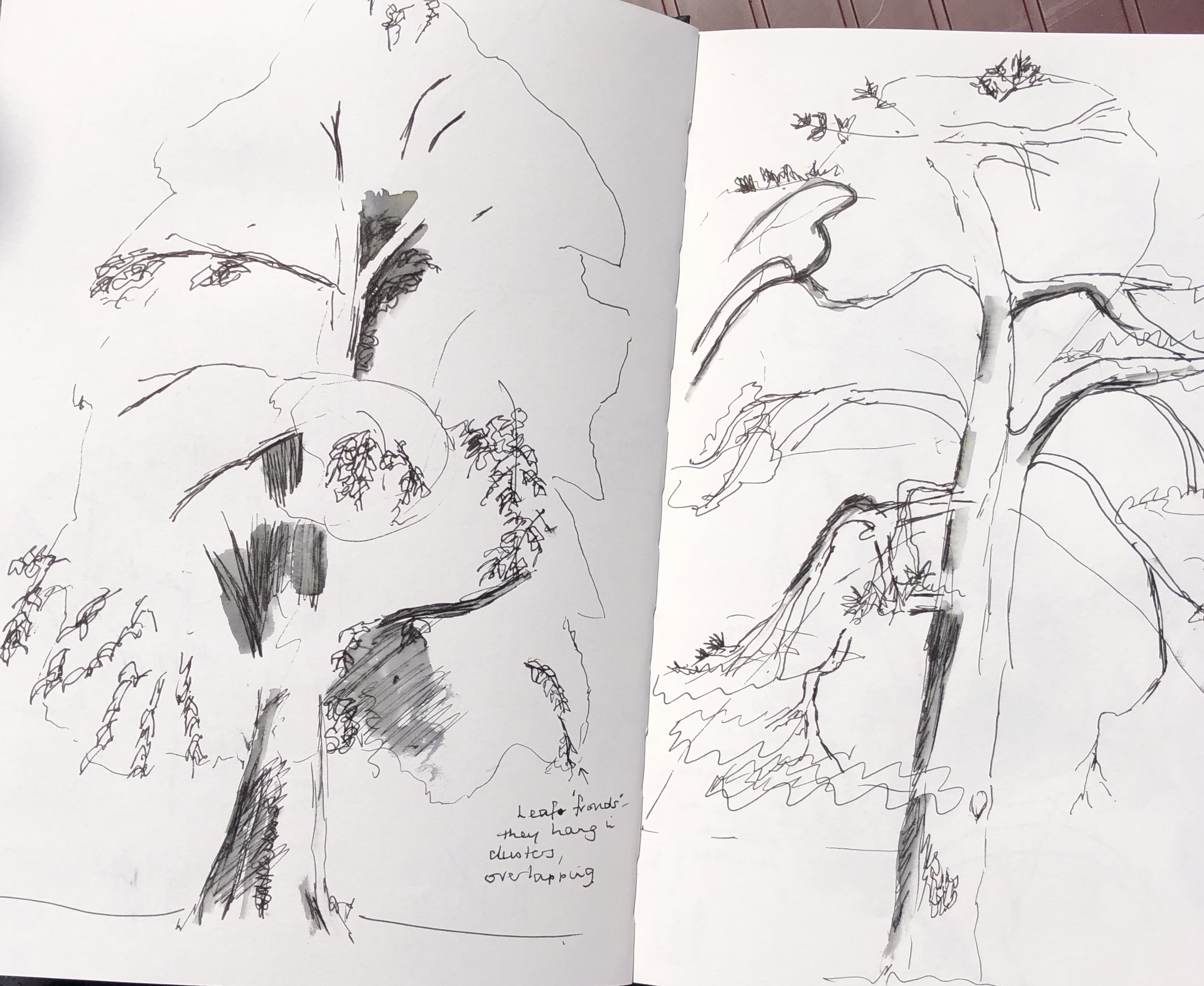
Drawing 1; Part 3; Project 1 – Trees; Exercise 1

I love trees but they have never been my favourite thing to draw due to what has always appeared to me to be un-tackle-able complexity – I was always getting bogged down in finicky details and – dare I say it – not seeing the wood for the trees.

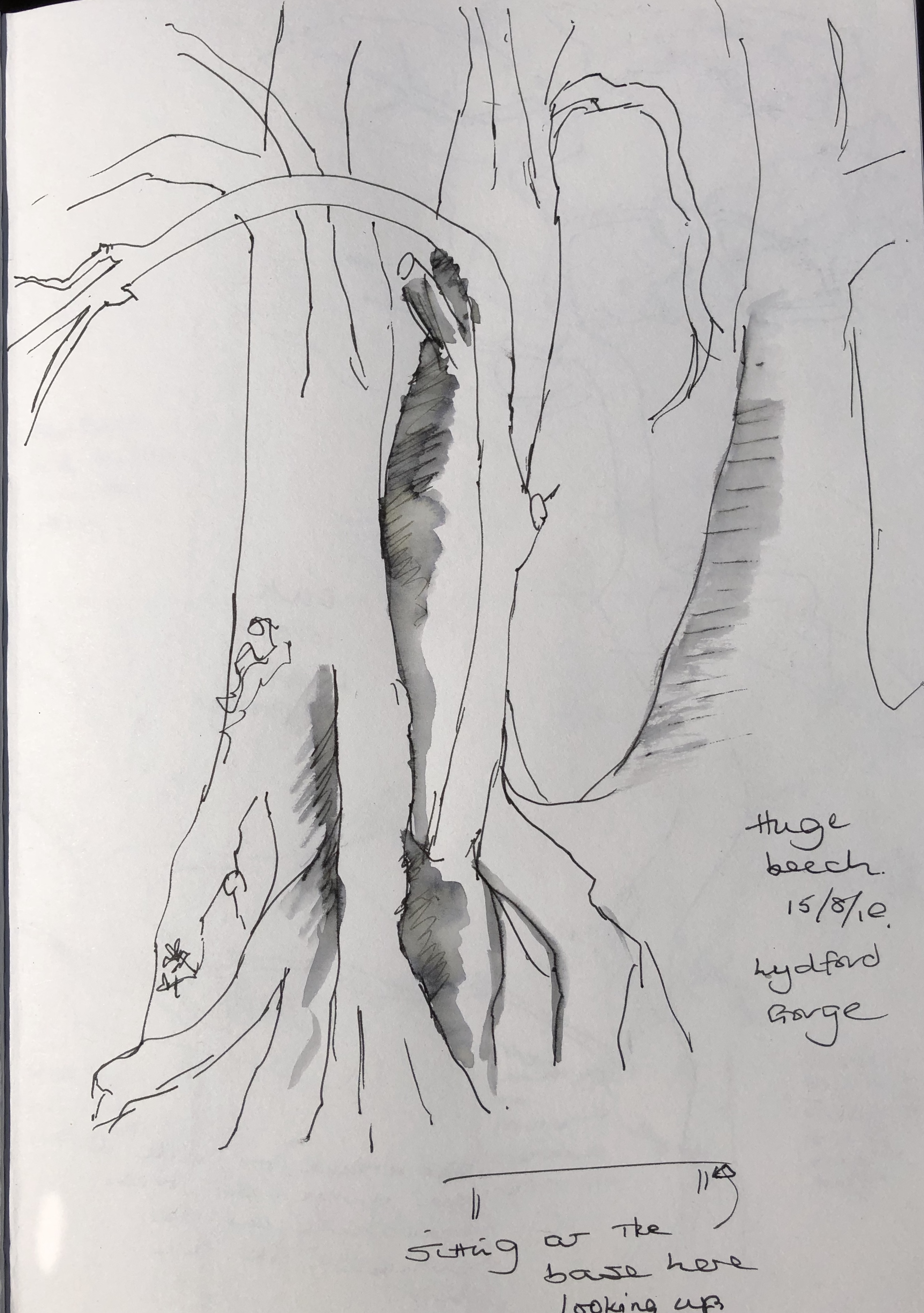
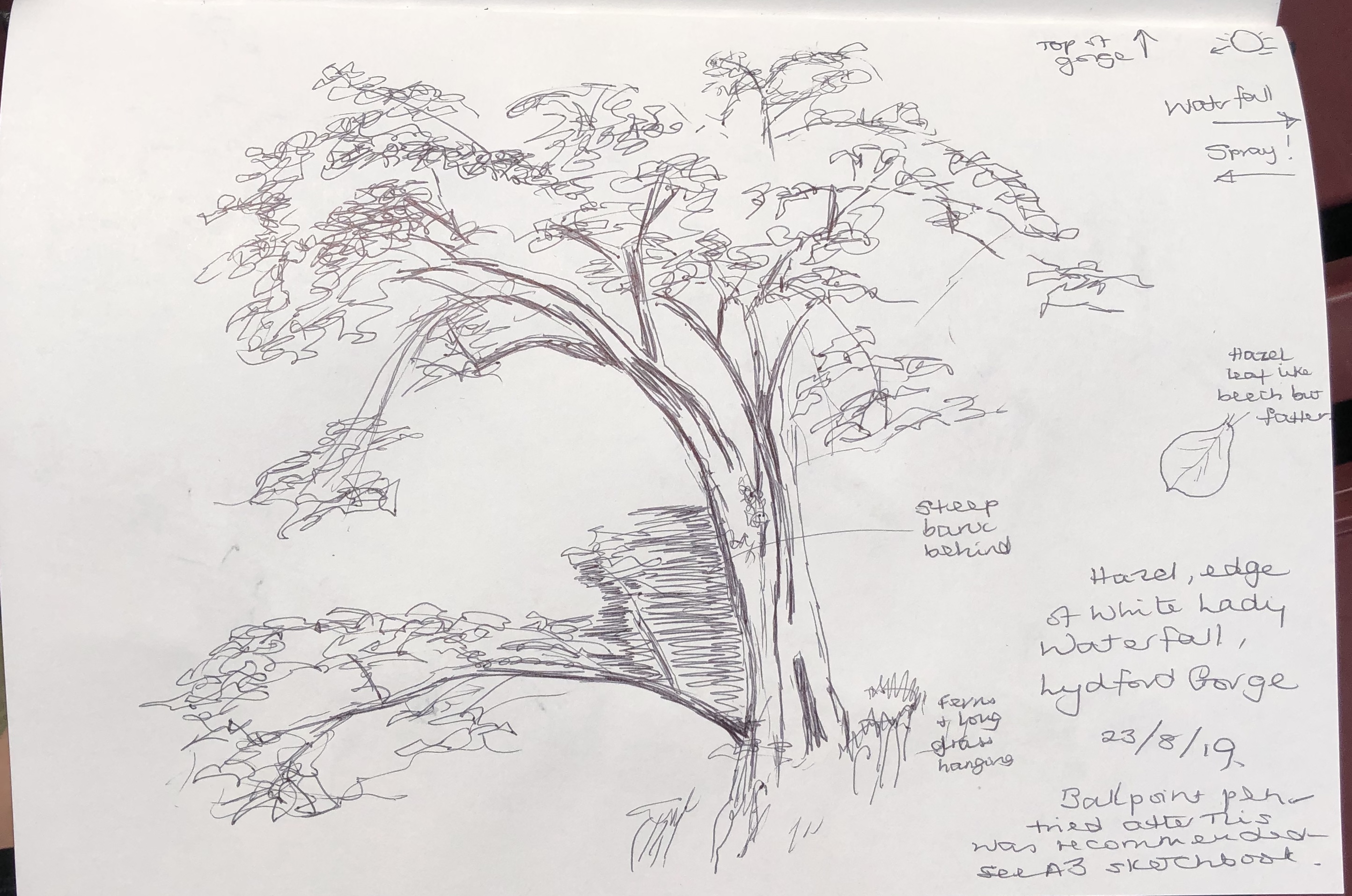
I did a couple of basic line drawings whist out on a walk (see a giant beech tree, above, which towered way above us), trying to keep it simple, before setting off to do some drawings as suggested in the text.

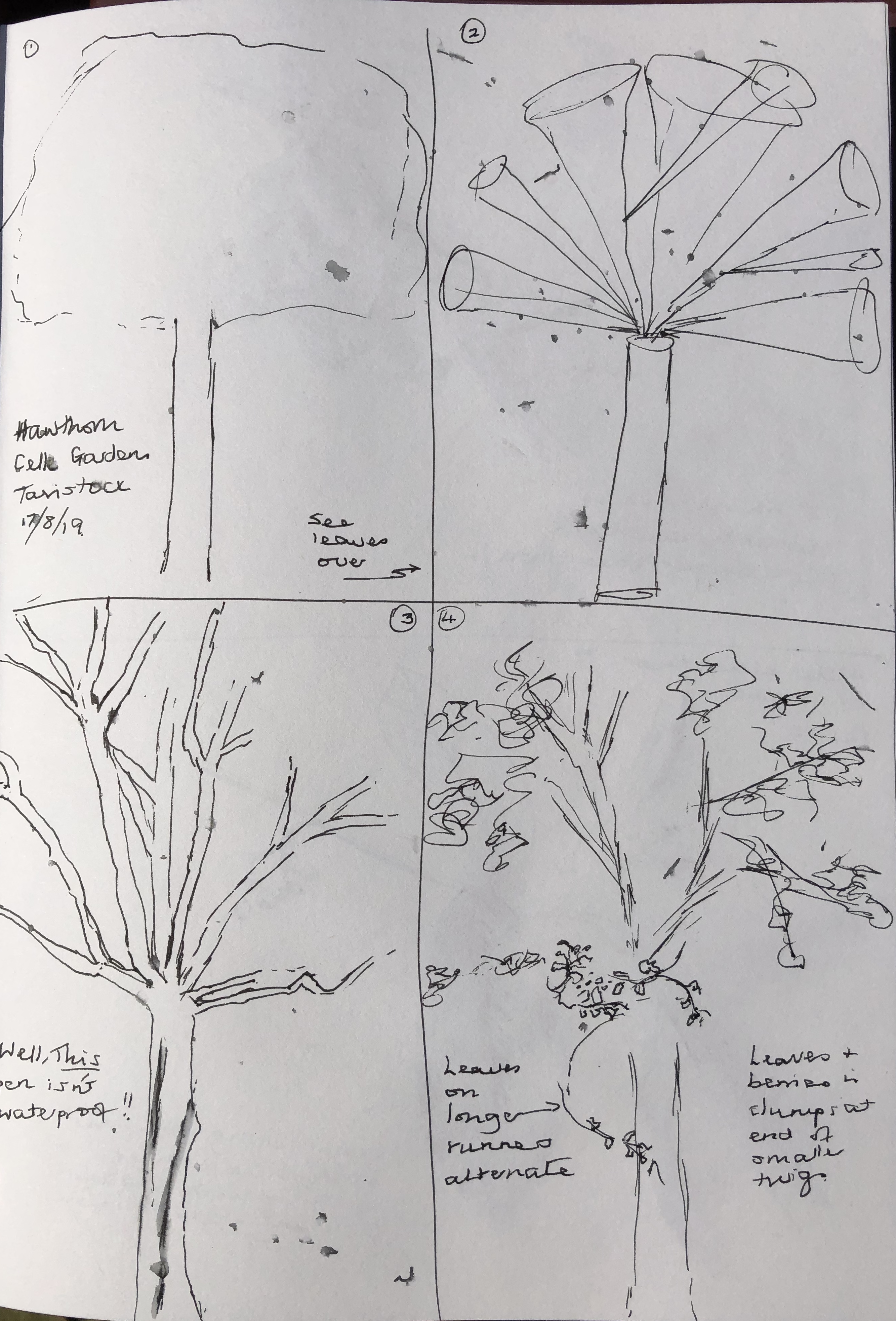
Results were variable, and I have to say that, at first, I couldn’t see the point of starting again each time, and wasn’t quite sure how to do the fourth suggested step about shading in foliage masses, doing side studies of foliage etc to help me..

After doing a few of these I decided to cut to the chase and just do all the steps on one drawing, although I confess I did sometimes miss out the “basic 

shapes” one, and it all started to make a bit more sense…..

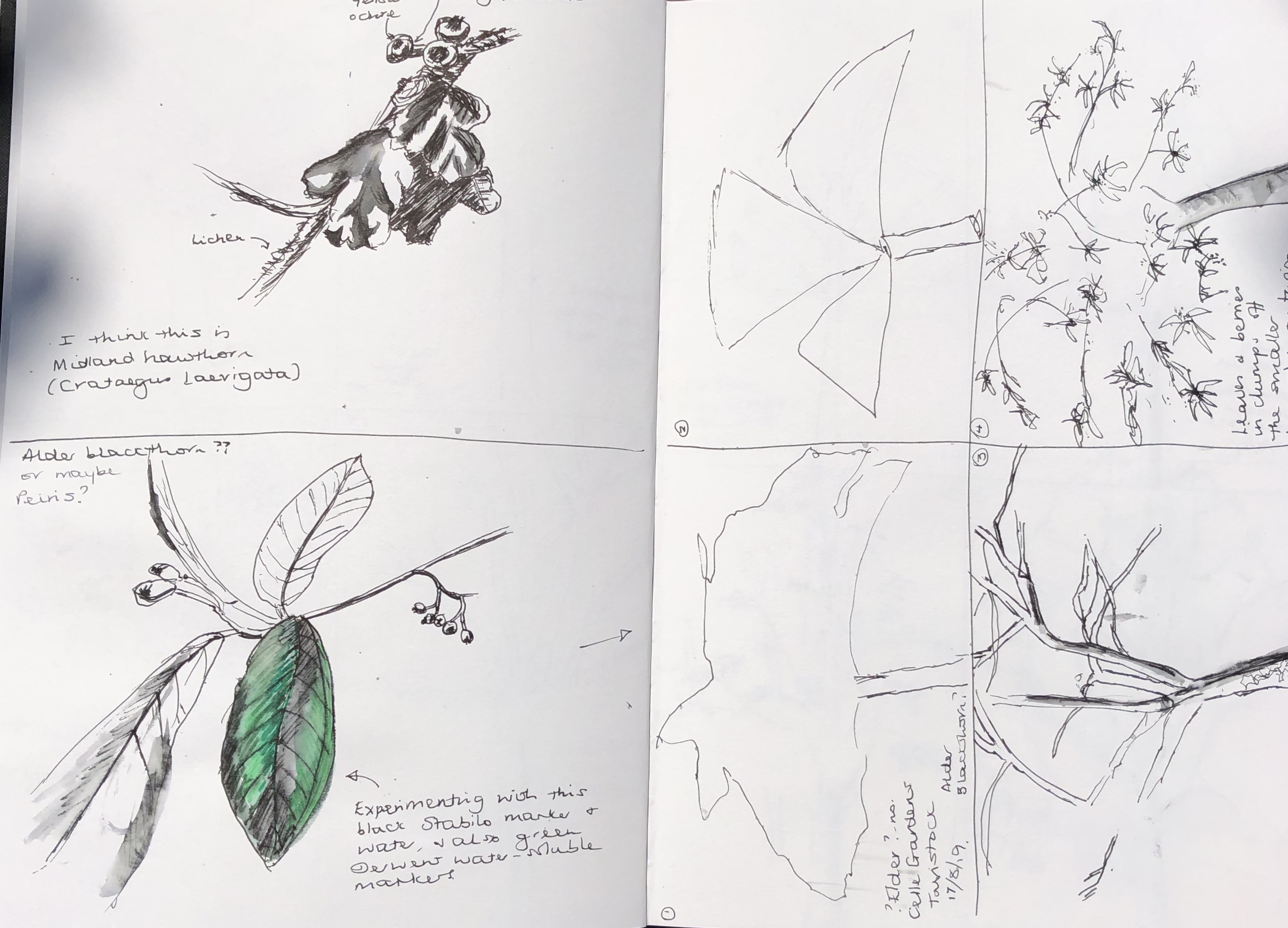
I experimented a bit with mark-making to convey the essential nature of the leaves (rounded, spiky, clumped, single, etc) and now feel more comfortable with my basic formula for rendering a rapid sketch of a single tree:

  • Look
  • Rough measurement, e.g. twice as tall as it’s wide
  • Light broken marks of basic overall shape
  • Draw in trunk and a few branches that you can see
  • Indicate leaf masses, and make shapes of individual leaves clearer at edges
  • Quick check for light direction and darks

I say a rapid sketch……but to get a clear view of the hazel tree (above), which was growing at the base of the White Lady waterfall at Lydford Gorge in Devon, I had to sit on rocks just at the base of the waterfall, and was rather rudely asked to move on by a charming European gentleman tourist because I had been there “so long!” and he was waiting to take a photograph of the waterfall. I can’t think how the presence of a local artist in his picture would in any way have detracted from it, but there you are…..

Drawing 1; Part 2 – Intimacy; Research – Positive and negative space

Patrick Caulfield – Fruit Display

1996

Acrylic on canvas

Waddington Galleries, London and The Saatchi Gallery, London

Not sure I’m reading this one right, but it was one that I liked because his use of the fruit shadow twice makes me think that someone is going to walk through the yellow door, thinking it’s all OK because they can see the shadow of the fruit and yes, there it is – but then suddenly the second darker shadow jumps out behind them, as if it’s been lying in wait. 

Yes, I know I should take more water with it…..

Gary Hume – Four feet in the Garden

1995

Glass paint on aluminium

Arts Council Collection, South Bank Centre, London

This one appealed to me as it reminds me of one of those “optical illusion” pictures – is it a picture of feet, or is it a picture of two old crones with long noses and warty chins facing each other?

Not sure it’s something I’d immediately be tempted to have a go at myself, although admittedly the image does draw you in and make you take a good look at it and ponder.

Gary Hume – The Flowered Hat

2002

Gloss paint on aluminium

The artist and Jay Jopling/White Cube, London

This one, however, is something which did appeal to me as a style which I might think about trying to develop. It’s called “The Flowered Hat”, but to me it also looks like a flower arrangement on a white tablecloth with long lacy curtains behind.

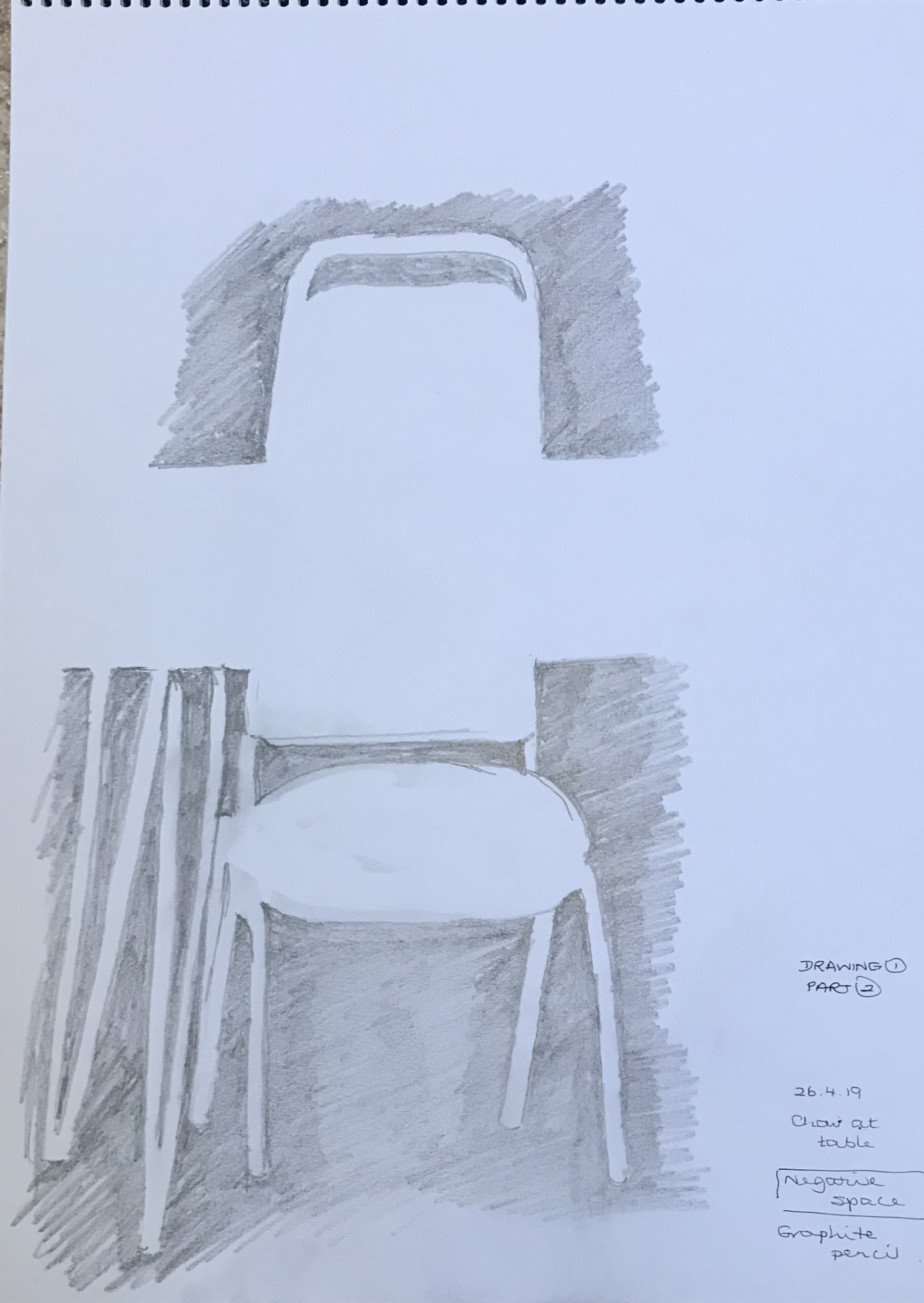
At this point I thought I ought to try and get my head around negative space. As always, I went in at the deep end and thought I would try a negative space version of Van Gogh’s Sunflowers, thinking to do something a bit Flowered Hat-y. Needless to say, I found it really difficult to look at the spaces rather than the flowers, but actually the complex subject broke the negative spaces down into small manageable bits so that, although the proportion is out in places, the overall effect is recognisable, I think, although I was so traumatised by the concentration needed that I didn’t get anywhere near adapting it to be Hume-like. Instead, I tried something a whole lot easier – a chair and table – more within my capabilities. Quit while you’re ahead.

Negative space is something I’m struggling to get to grips with example-wise; a lot of the things I have found have been in old printed posters (e.g. those by William Nicholson and James Pryde, who signed themselves J&W Beggarstaff after the name they had seen on an old sack – see article in my cuttings folder about the recent exhibition of their work at the Fitzwilliam Museum, Cambridge, May-August 2019), or in work like linocuts (see e.g. article by Rosemary Waugh on the work of Paul Catherall as seen in Artists & Illustrators magazine, November 2018, pg. 56-9).

I thought this image (by Kinska from My Opera House exhibition, 4th July-22nd September 2019 at Now Gallery, taken from Aesthetica Magazine, June/July 2019, issue 89, www.aestheticamagazine.com) showed how clever our brains are at interpreting minimal images (the black on the right clearly being intended as her hair, whereas the black on the right is just space);  but then I looked at a similar (but different) image by her from the pages about her exhibition on www.nowgallery.co.uk, where this wasn’t the case and the space on both sides of her face look like hair just by being a slightly different shape…..clearly our brains are very nuanced and bring a lot of extraneous knowledge to their interpretation of images!

But there is hope for me yet on my understanding and use of negative space – it’s gradually seeping into my psyche. The other day I was down by the River Tavy with the granddaughter – she was busy skimming stones, falling in the water, etc while I thought I’d do a really quick scribbled sketch of the view down the river. It was late afternoon/early evening and the sun was shining down through the leaves, making some really bright, almost gleaming, whilst other bits of the view were in dark shadow. I was struggling to depict this when I had my eureka moment – just scribble in the dark shadowy negative spaces! And it worked (see above)…even if very scribbly…but at least I can see what I meant….

Drawing 1; Part 2 – Intimacy; Project 4 – At home; Exercise 3 – Material differences

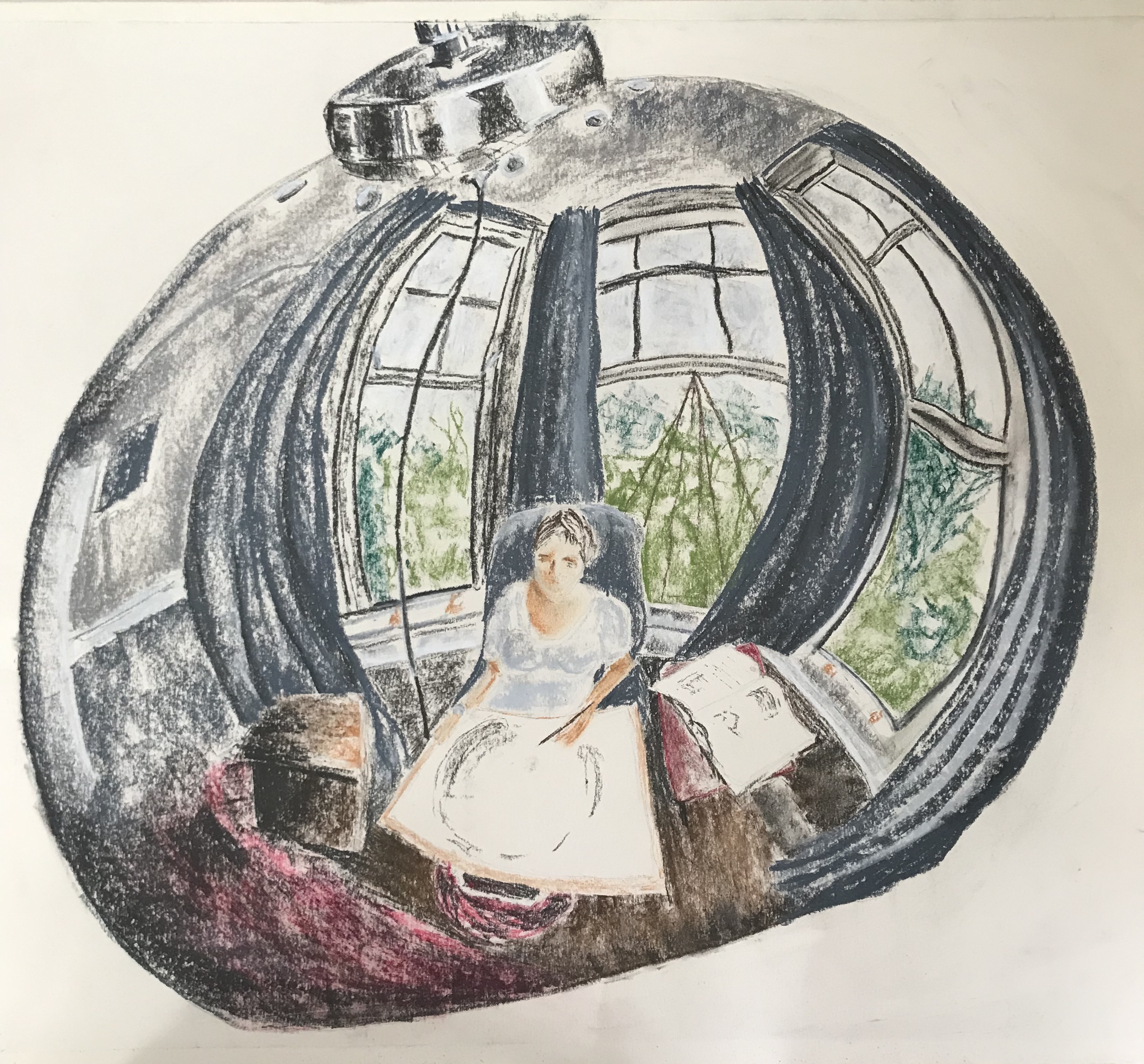
I agonised for a while over the choice of material for this picture. Had the format been smaller (A4 or less) I think I would have gone for something I felt confident with, such as ink with a light wash. However, I had been asked to work on a large scale and, on looking carefully at my subject, the reflections in the curved metal were very slightly “fuzzy” and not always true, i.e. small dents in the metal caused various distortions and wobbly lines. I decided to go for Conte crayons, as they would give the varied and “un-crisp” lines I was after. I had originally intended to work just with the greyscale crayons and add a tiny bit of watercolour or ink wash for the blues, reds and greens; however, when I got to that stage, it felt more appropriate to stay with the crayons…so, another change of mind!

I have to say, I am really pleased with the outcome, it is better than I had hoped for or envisaged. There are of course lots of niggles – e.g. the lamp is not quite symmetrical despite my best efforts (I drew it in 2H pencil and rubbed it out about 15 times!!) – but I think the overall effect is striking and I hope it draws the viewer in to try and identify details. 

I was concerned that I had chickened out a bit of tackling my bete noir, perspective, but this image had other challenges thrown up by the convex surface, mainly because nothing was quite where you thought it would be. In several places, I found that the curvature really exaggerated the perspective, thus helping me out. A real learning curve! Terrible pun, apologies.