Drawing 1 Part 1 Project 2 Exercise 3 – shadow using lines and marks

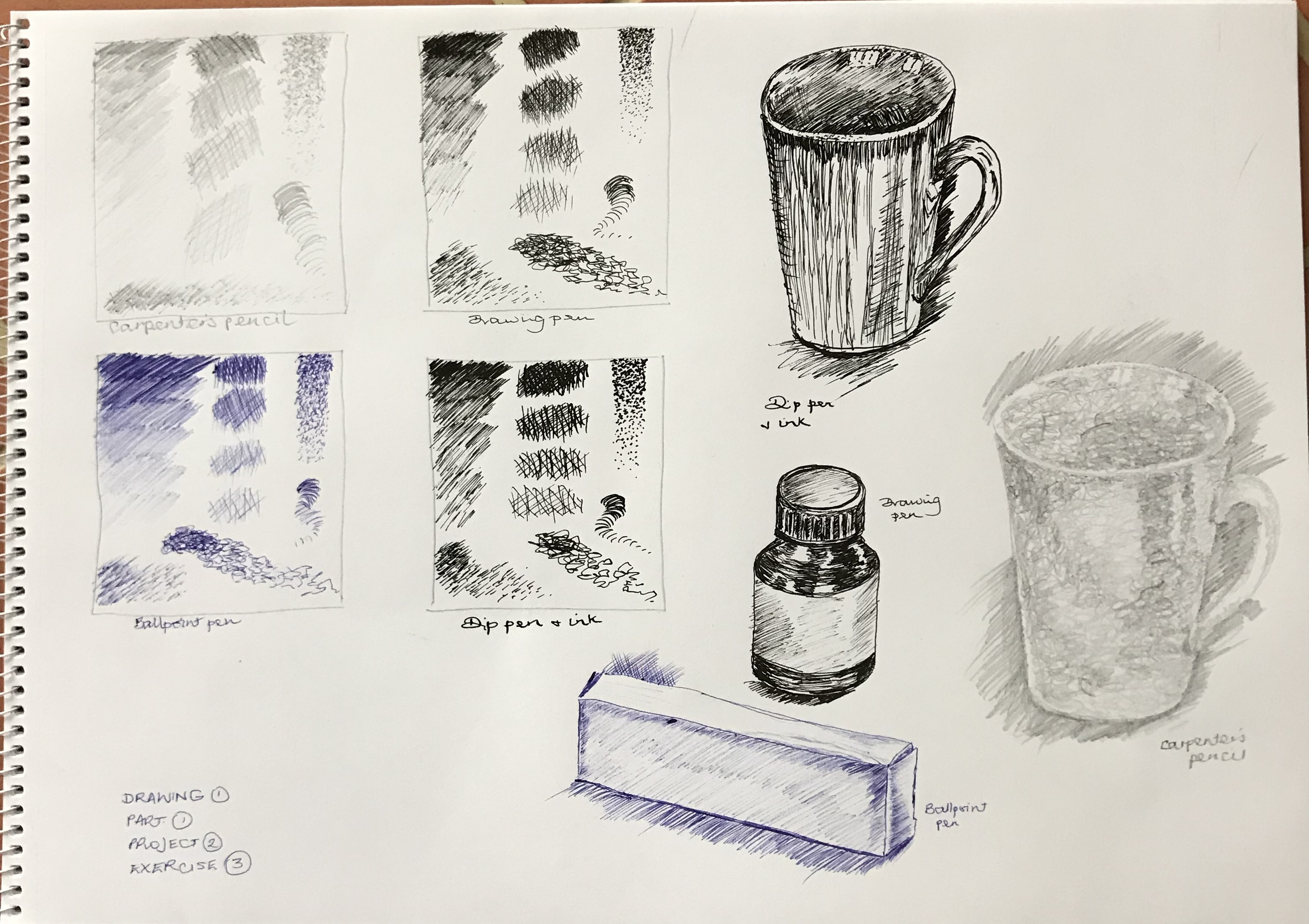
I’ve had a go at shading exercises in boxes or strips like this before, but it was good to revisit and to compare side-by-side the effects which can be achieved using different media. As well as lines and dots I added in a scribbly stroke which I have seen demonstrated at an art group (by local artist Ian Pethers – see www.glenrockstudios.co.ukand  www.drawntothevalley.co.uk/artists/detail/ian–pethers/); I have hitherto used this to some effect in landscape drawings.

I had a go at the mug, a curved shape, using straight hatching lines with a dip pen, some quite long, some very short – not a complete success – I’ve got the lights and darks but not much of a mid-tone. Then I tried the same mug using my scribble stroke; the carpenter’s pencil I was using doesn’t allow much variety of tone by way of pressure, so you have to do it with increased coverage – at close quarters the effect is frankly weird, it looks like a mug made of wool, but at a distance I prefer it to the pen-and-ink version, I think I’ve achieved more gradations of tone.

Next I tried the box in ballpoint pen. I quite often sketch in ballpoint pen when I’m out and about, usually because it’s all I can find in my handbag or pocket – it is good for hatching, but with the downside of the occasional blob. I made my life difficult by drawing my charcoal box, which had a strong black and white design, so much squinting was needed to pick out the bits which really were dark – but I’m pleased with the effect, I do feel I’ve made it 3D.

The bottle of black ink was the last and the quickest drawing (near the end of our allotted art group time) and I wondered if I’d made the same mistake as with the charcoal box – but no, the shiny plastic of the lid and the glass bottle showed clear lights and darks. I used curved lines for the curved surface and I feel that this is the most 3D of all the drawings (even though slightly wonky).

So, what have I learned from this? 

  • Vary the shading mark according to the shape and texture of the object you are shading
  • Look carefully where a light comes up against a dark – is it actually a straight transition from one to the other, or should there be a mid tone in between?
Drawing 1 Part 1 Project 2 Exercise 2 – observing shadow using blocks of tone

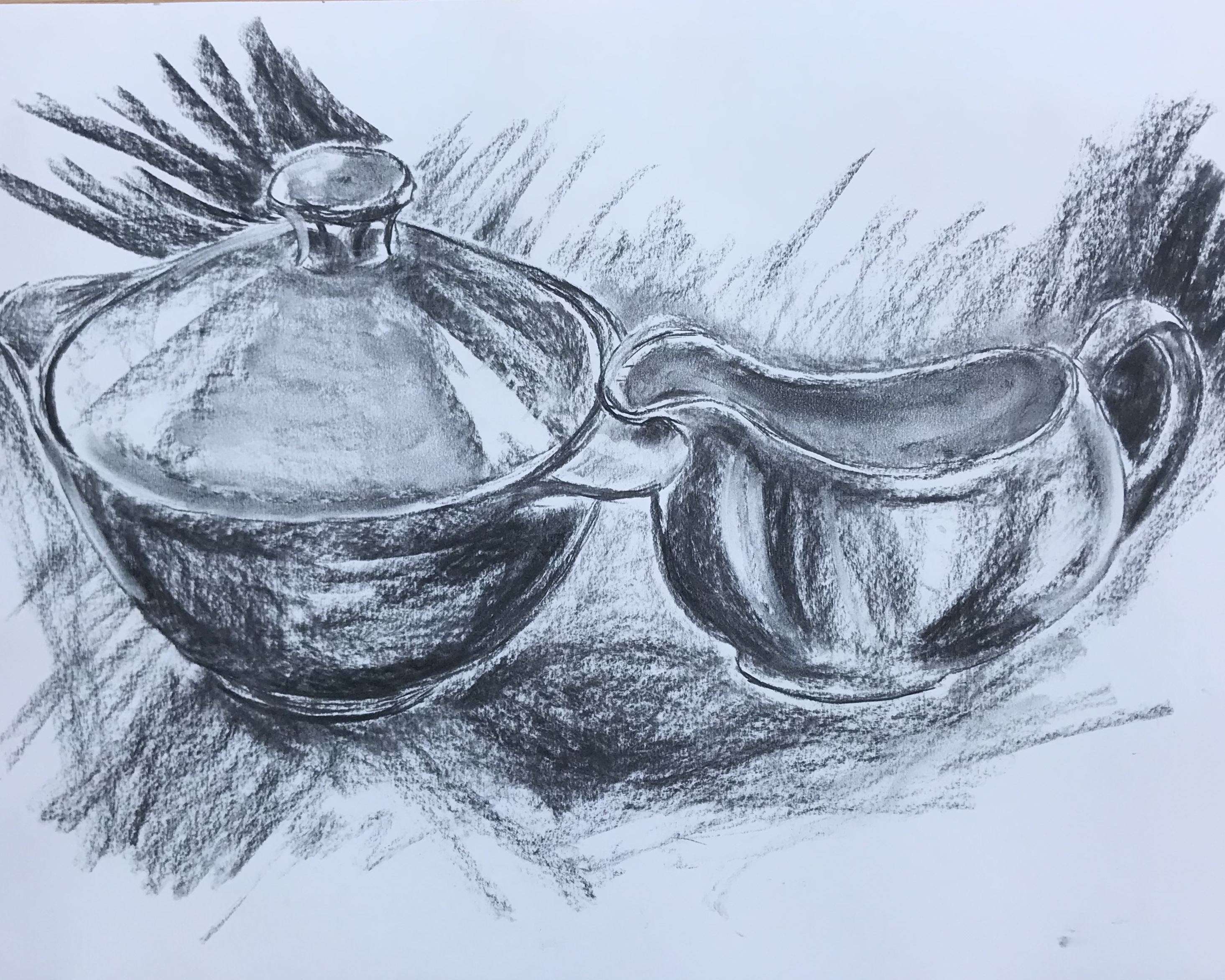
I have hitherto denoted shadow by shading, usually working on smaller sheets of paper, but I am really growing to enjoy working on large sheets of paper with crayon or charcoal, and so I approached this exercise with a degree of expectation. After a couple of sketches in my A3 sketchbook playing around with the arrangement of my objects (a lidded serving bowl and a gravy boat) I chose the one I preferred (basically where the gravy boat looked the least weird – unless you looked at it exactly side-on, its sweeping curves did notgo where you would have thought they were going to!), I chose to work in charcoal on A2 paper.

            I worked in natural light on a bright day in our north-facing garden room, where the objects were lit from two sides, which made for a lot of unexpected shadow and reflected light. The objects were sitting on a small table of a similar colour, with occasional startling contrasts from the darker terracotta floor. Having chosen two very rounded objects, many of the shadows were also curved, but with some almost-straight lines where the objects reflected the windows. Many quite dark areas had a light sliver right at the edge where light was coming from behind them, and there were several interesting little light areas, eg under the handle of the serving dish.

            The tone of the background was close to that of the objects in several places; in others it was startlingly different. The cast shadows on the table were quite complex with the two light sources (three if you count the skylight above), which added to the interest of the piece.

            I feel my finished drawing shows clear contrast between lights and darks and is quite a strong lively rendering (which of course might not be appropriate to all situations); I think a little more practice in looking at transition through the midtones would be of benefit.

Drawing 1 Part 1 Project 2: Basic shapes and fundamental form Exercise 1: Groups of objects

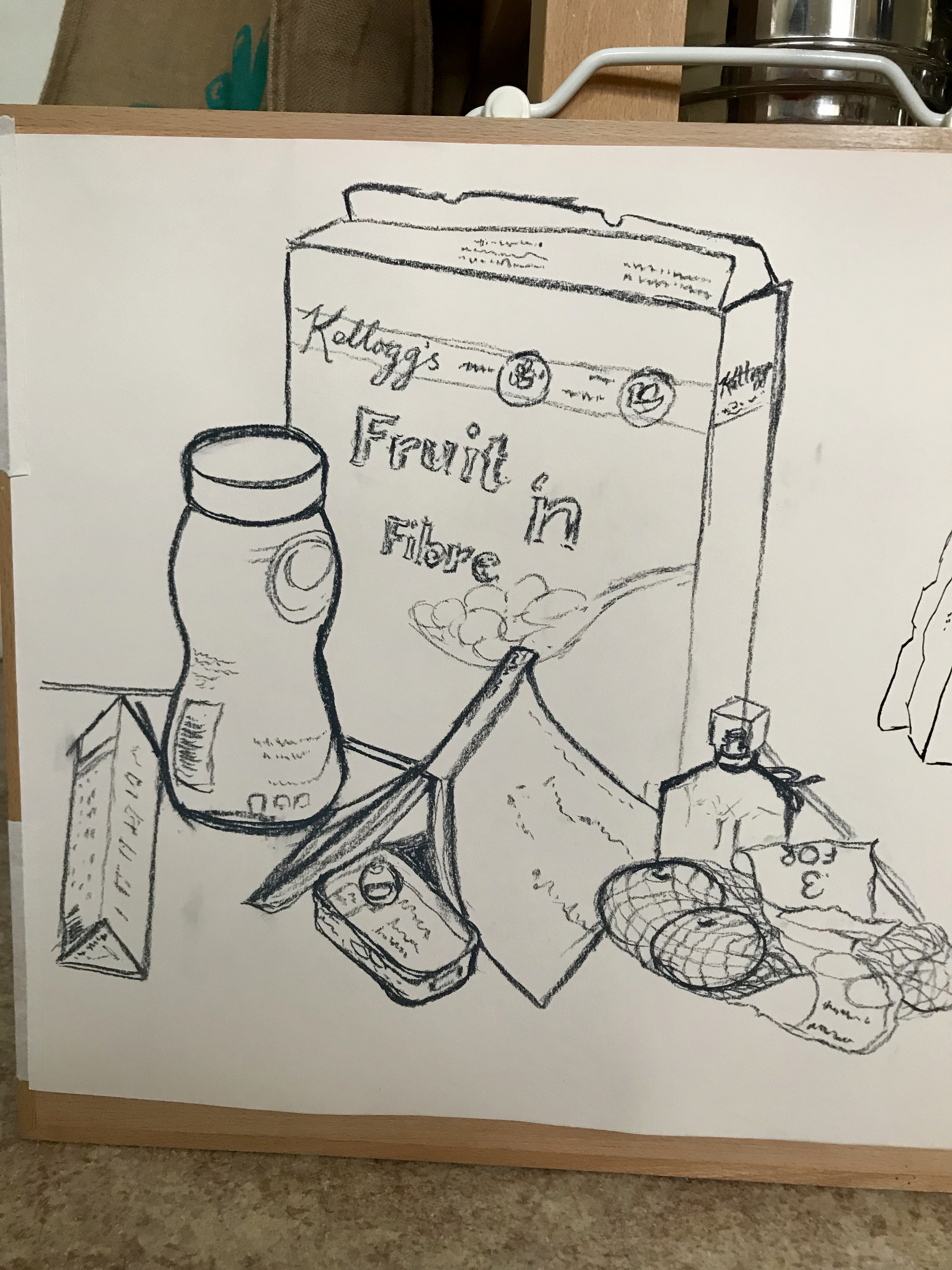
My initial approach to this was on A2 off-white paper using a Conte crayon. The paper felt big to me but I tried to use bold clear lines, without removing errors but just drawing over them. It was very tempting to do a quick light outline first in pencil to be “safe’, but I resisted it; I wanted to try to be bold and just go for it. These crayons are lovely to draw with, gliding across the page and allowing thick and thinner lines and grades of dark depending on the pressure you use, and I was soon immersed in the exercise. I tried to work top-left to bottom right to minimise smudging. I became aware part-way through the exercise, however, that the junctions between one item and the other were not falling in quite the right place; I tried to rectify this as I went along, but it has left one or two of the items looking a little misshapen.

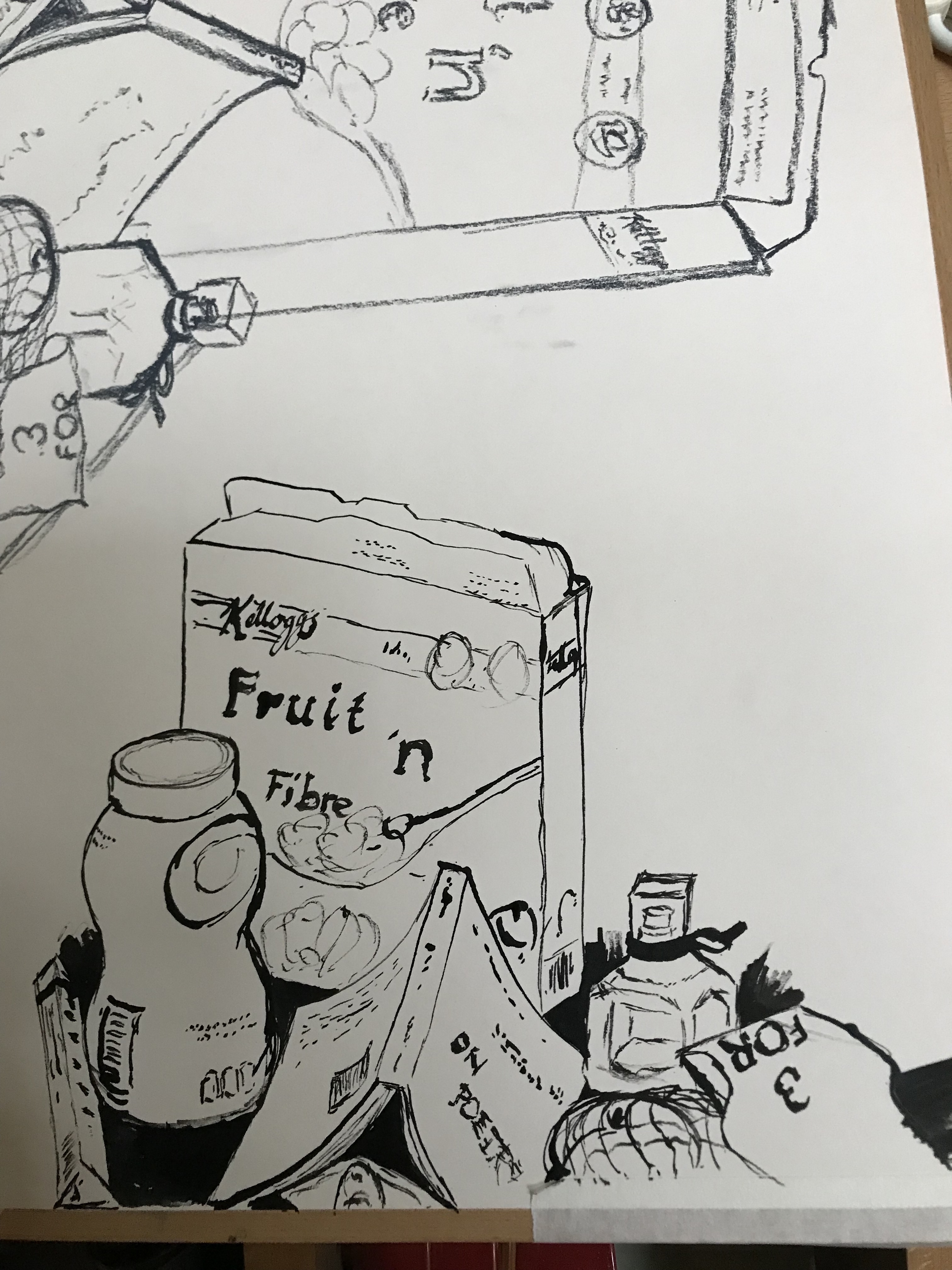
I decided to have another go with the same layout (the angle was fractionally different due to my change of position) using the medium I had most enjoyed in the previous exercise, namely a stick and ink; this time, however, my stick was the bevelled end of a pencil, which allowed for both broad and very fine lines, whilst still retaining the randomness of the strength of line depending on when the ink ran out. I felt a bit more confident with this. I also tried to look more carefully at the negative shapes around and between objects, which helped me to be a little more accurate. When I’d finished I filled in the negative shapes with ink so I could see them clearly and compared them with the real thing – not perfect, but much closer to it; even though I misjudged the space a little and went off the edge, I was more pleased with this latter effort.

I have been reflecting on the drawing styles I have admired so far in my research, and find that they are actually very contradictory – the smooth, clear, minimalist lines of Nuno DaCosta (see Proj 1 Ex 1)versus the busy, scrappy lines of Susan Kemenyffy (see notes on Downs et al – Drawing Now).Signs of schizophrenia? I decided to experiment a bit more, so I tried this exercise again with each style.

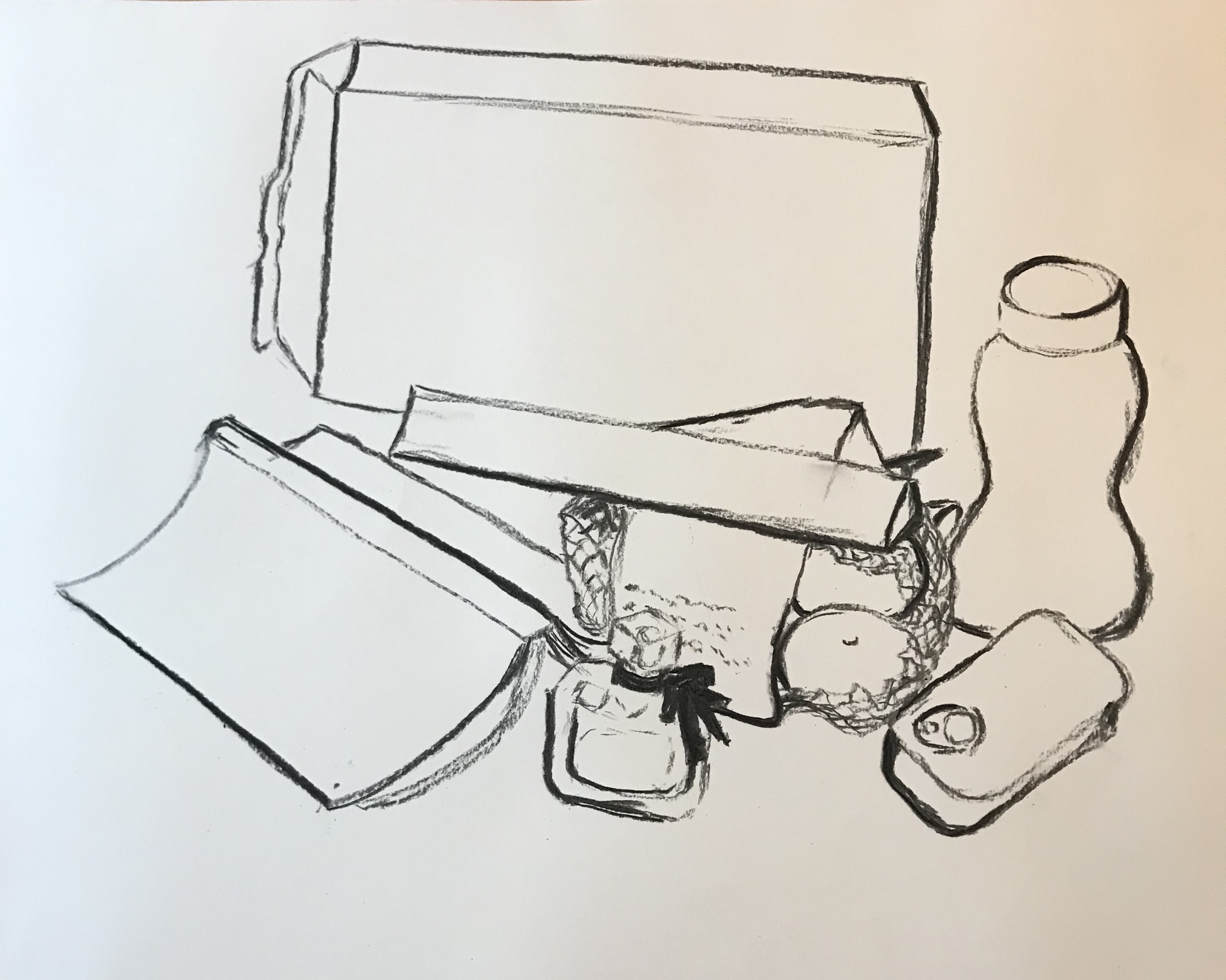
First, I had a go at the Da Costa style using charcoal so that I could get the dark/light contrast:

Deciding which should be light and which dark was made trickier by the fact that I had rather perversely set my still life up under an electric light but also in front of a window – note to self to think better about light sources when setting up next time.  I was reasonably pleased with the effect (although less so with the shape of the sardine tin!), but think that it would have been even better using my ink-and-stick to get really sharp lines.

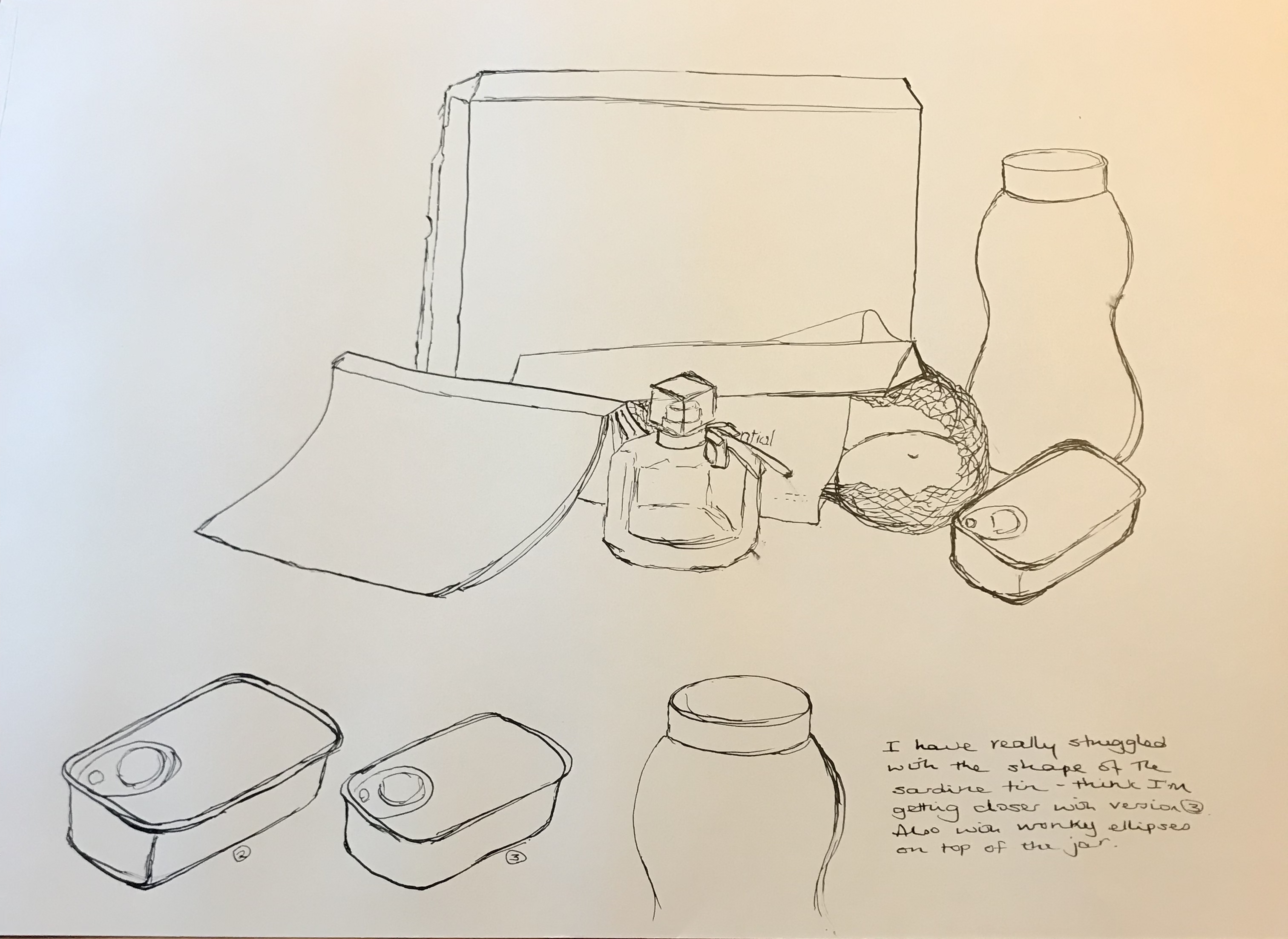
Next I tried the Kemenyffy style using a dip pen and ink:

The drawing was ok except for the blessed sardine tin, although I haven’t achieved the busy effect that she does, I don’t think – but part of her effect comes from the hatching and shading, which I haven’t tried yet, so will continue to experiment. I feel that, drawing large like this, the scrappy style is more my thing at the moment, but this could just be because I haven’t done much drawing large with solid lines, and practice might improve and change this opinion.

Looking back over all four drawings, I think the one that actually has the most energy and “zing” is the second ink-and-stick one, even though not quite the most accurate. It seems odd that the medium I first thought of as a bit of a laugh has turned out to be the one I enjoy the most! I do however see in this medium a way of uniting the two styles (Da Costa and Kemenyffy), partly because of its unpredictability, which almost enforces a mixture of clear bold lines and broken lines within the same drawing.

Drawing 1 Part 1 Project 1 Exercise 2 – Experimenting with texture

I went about this exercise backwards rather, in that I started playing about with frottage first. My initial sortie wasn’t always successful as the paper in my sketchbook was too thick and the pencil I randomly chose was too hard (HB). With a bit of trial and error I found I got much better results with a thinner paper (actually a scrap of packing paper from an Amazon parcel) and a 6B pencil – I got slightly carried away then and even ended up in the shower doing a rubbing of the hose! – see A5 sketchbook. Once I started looking around the house there were myriad different textures everywhere – even my husband started spotting them and directed my attention to the glass in our windows and doors (we live in an old early Edwardian house and have most of the original patterned glass). By this time I had remembered some uber-thin paper I bought for Chinese brush painting which is great for rubbings (with care) and adds interest from its own slightly uneven texture.

I wanted to include some of the rubbings in my other work on texture and have done so although the thinness of the Chinese paper is a bit limiting in terms of the robustness of strokes and marks which can be made.

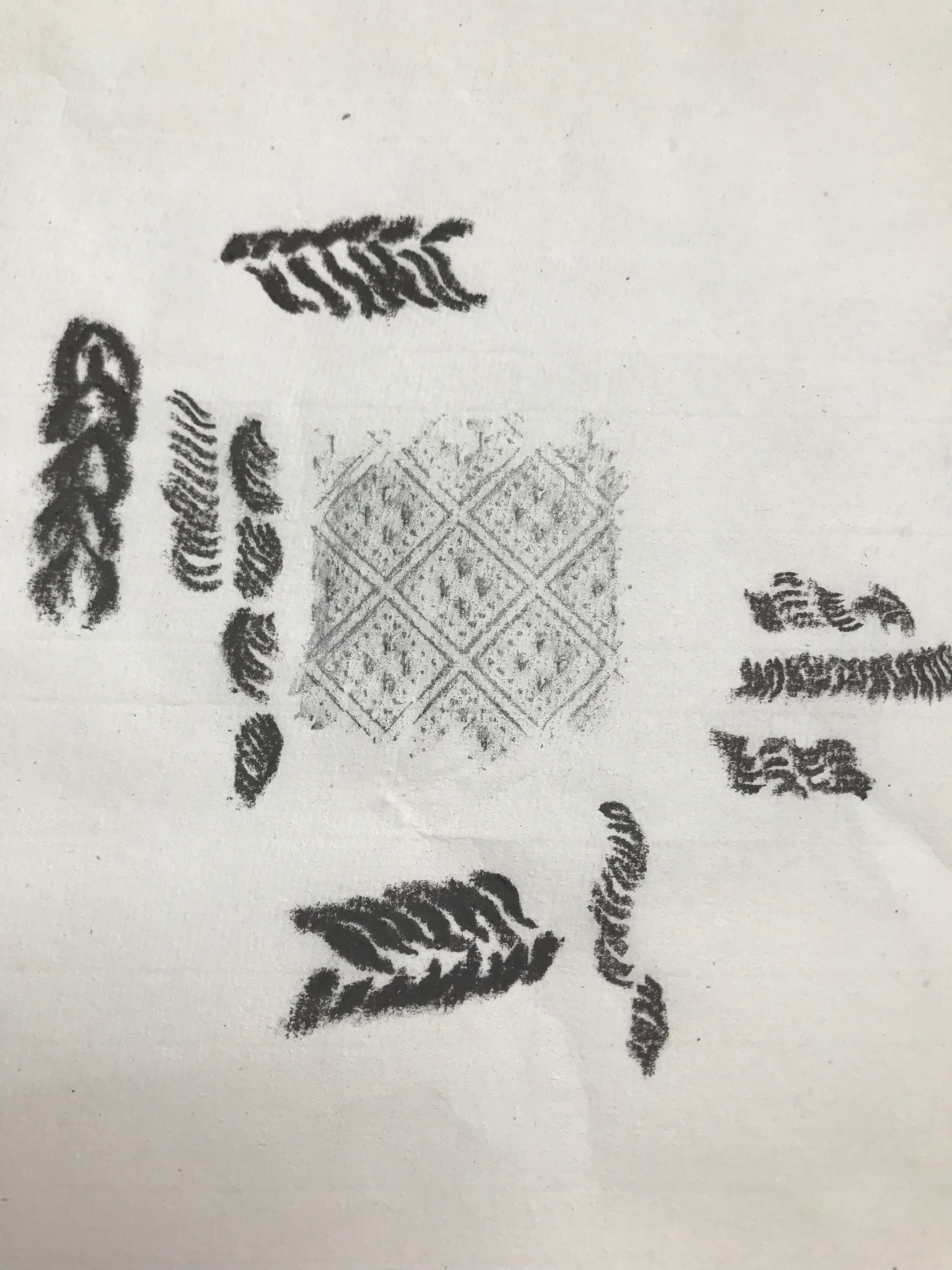
I tried to capture the texture of a piece of knitwear using a Conte crayon; the thickness of it could denote whole individual stitches, and the sharp edges were used to catch the plies of an individual stitch. The rubbing in the centre does not mirror the knitted pattern exactly, but on the other hand I felt it did represent the regular spacing characteristic of a lot of knitted fabric.

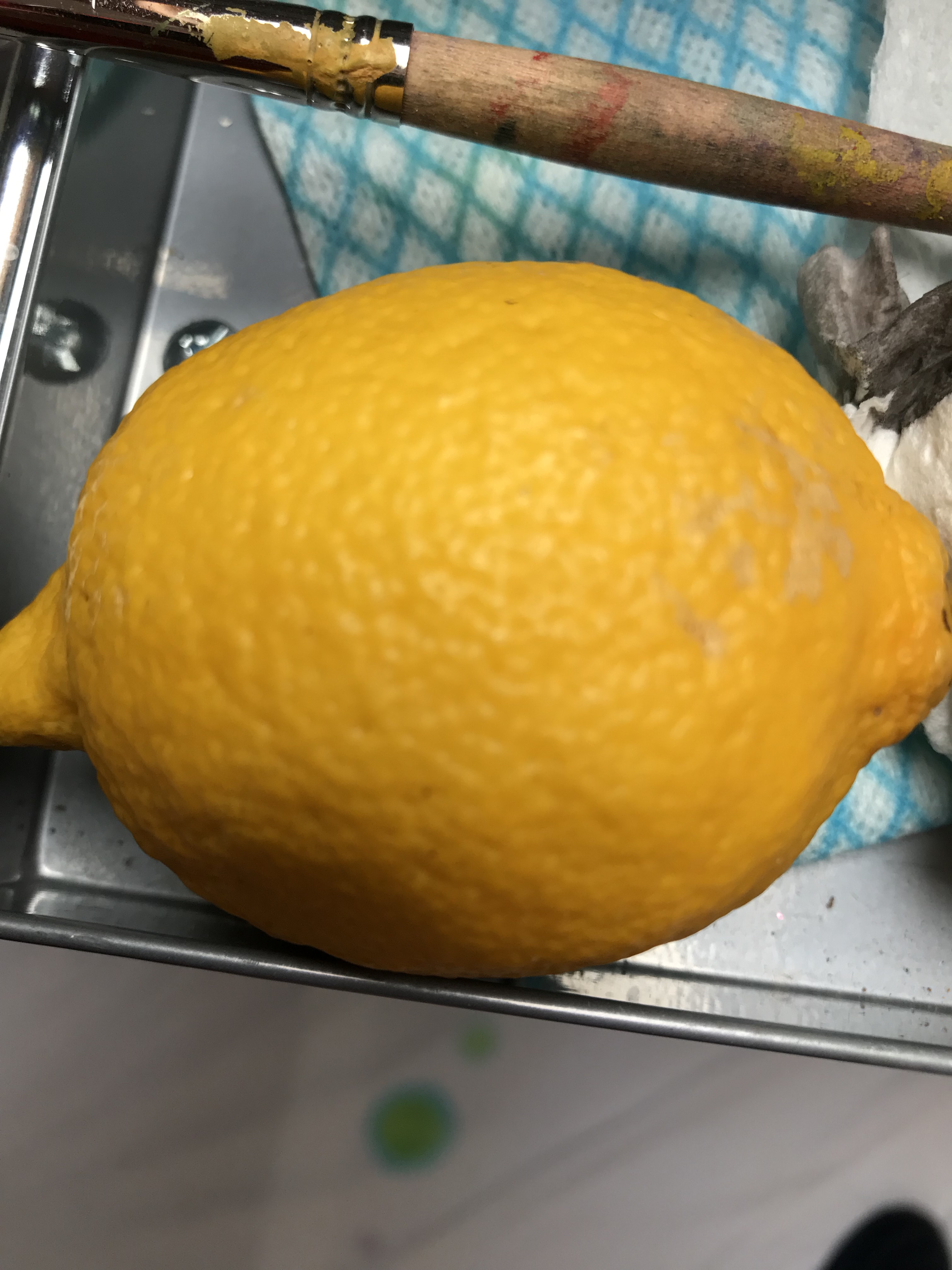
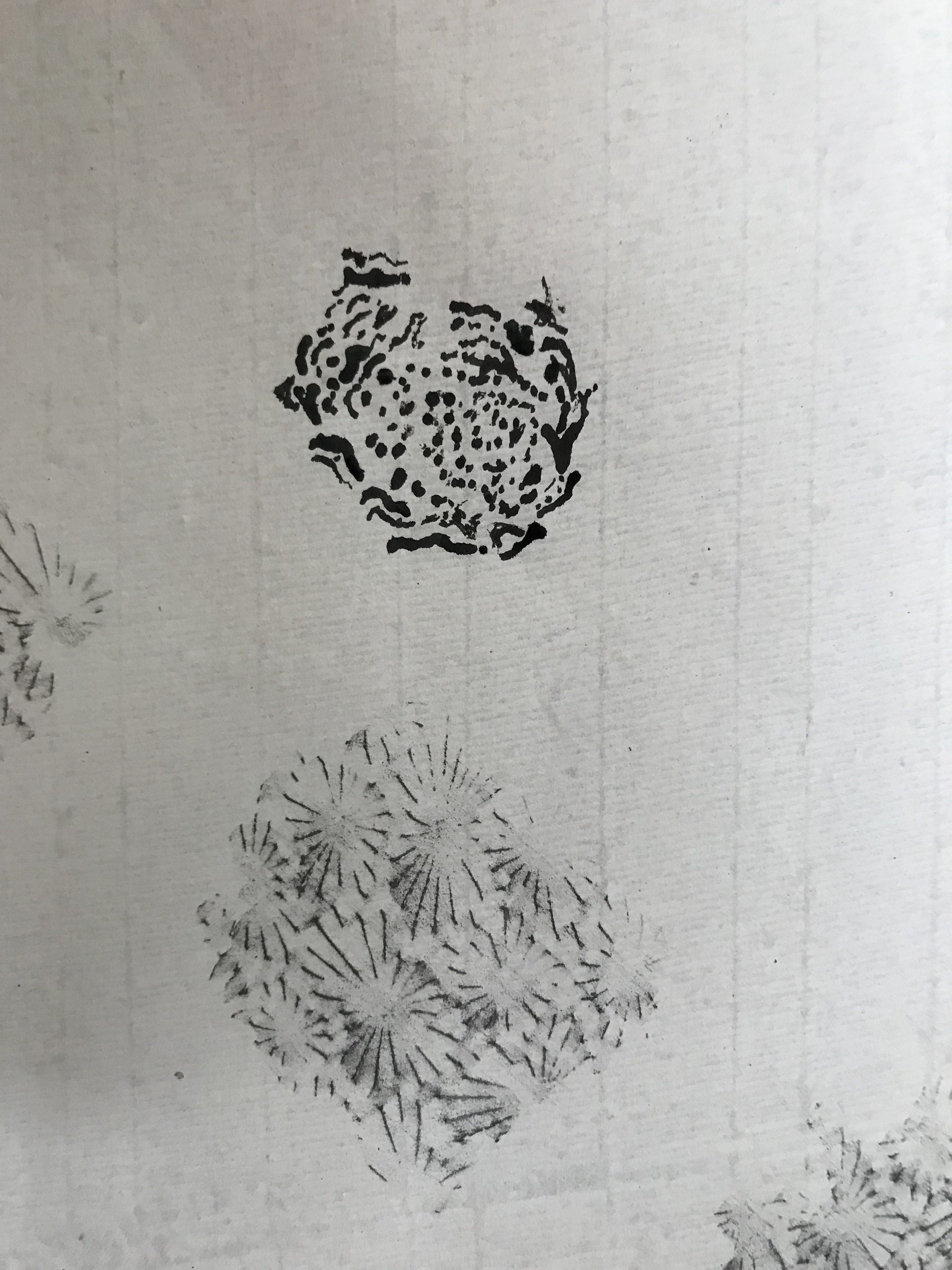
            I approached the depiction of the skin of a (slightly dried-up) lemon using my favourite medium from Exercise 1 – the stick and ink. On close inspection of the lemon, the indentations formed themselves into lines and whorls and the pattern was very complex, and I had to play about with the relation between the size of individual dots and the size of “runs” of dots with this medium – not sure I have it entirely right, might need another go. I did this on a sheet of rubbings from a piece of glass – the rubbing pattern again is not exactly the same, although it does indicate to my eye a surface of hills and depressions; but I included it mainly because I felt it depicted that burst of tangy taste in your mouth when you bite on a lemon.

            The bark on a log was fun to try – I used watered ink and made the patches by pressing the paintbrush head flat; the dark shadows at the edges of each patch were drawn in using a thick black marker pen, and I finally found a perfect use of the dreaded black oil pastel, which was perfect for the scumbly areas in-between the bark flakes. Again, I chose to do this on a sheet including a rubbing which gave the impression of a wavy surface, which you get from looking at the bark with half-closed eyes.

            For a smooth and shiny soapstone statuette I wanted to try applying sweeps of ink with a palette knife, so reverted to a sketch book page as a more robust support. This method has the potential to represent planes of light and dark well and to enable clear edges between light and dark (although I think I need more practice in using it accurately). Great fun to do, though!

Finally, I had a go at depicting the surface of a piece of natural sponge – this proved quite a challenge, and again I opted for sketchbook paper. I wetted the paper over an area the rough shape of the sponge, dropped in some ink, and then tried to scrape into it using the end of a paintbrush. I can’t claim this was an overwhelming success; interestingly, it all dried more quickly than I expected, and the scraping soon became rather difficult. I think the overall effect looks more like a negative photograph of a sponge than the sponge itself. 

            It has been helpful to be pushed into experimenting with a wider range of methods of showing texture than I have tried hitherto; some of my experiments have met with some success (particularly the bark and the soapstone), whilst others have been less so. I am aware I have still only basically used ink with a few forays into pastel, crayon and pen – clearly this aspect of drawing is very much the tip of the iceberg as far as I am concerned, and is an area which I shall need to work on a lot more over the coming weeks and months.

Drawing 1 Part 1 – Form and Gesture; Project 1 – Feeling and expression; Exercise 1

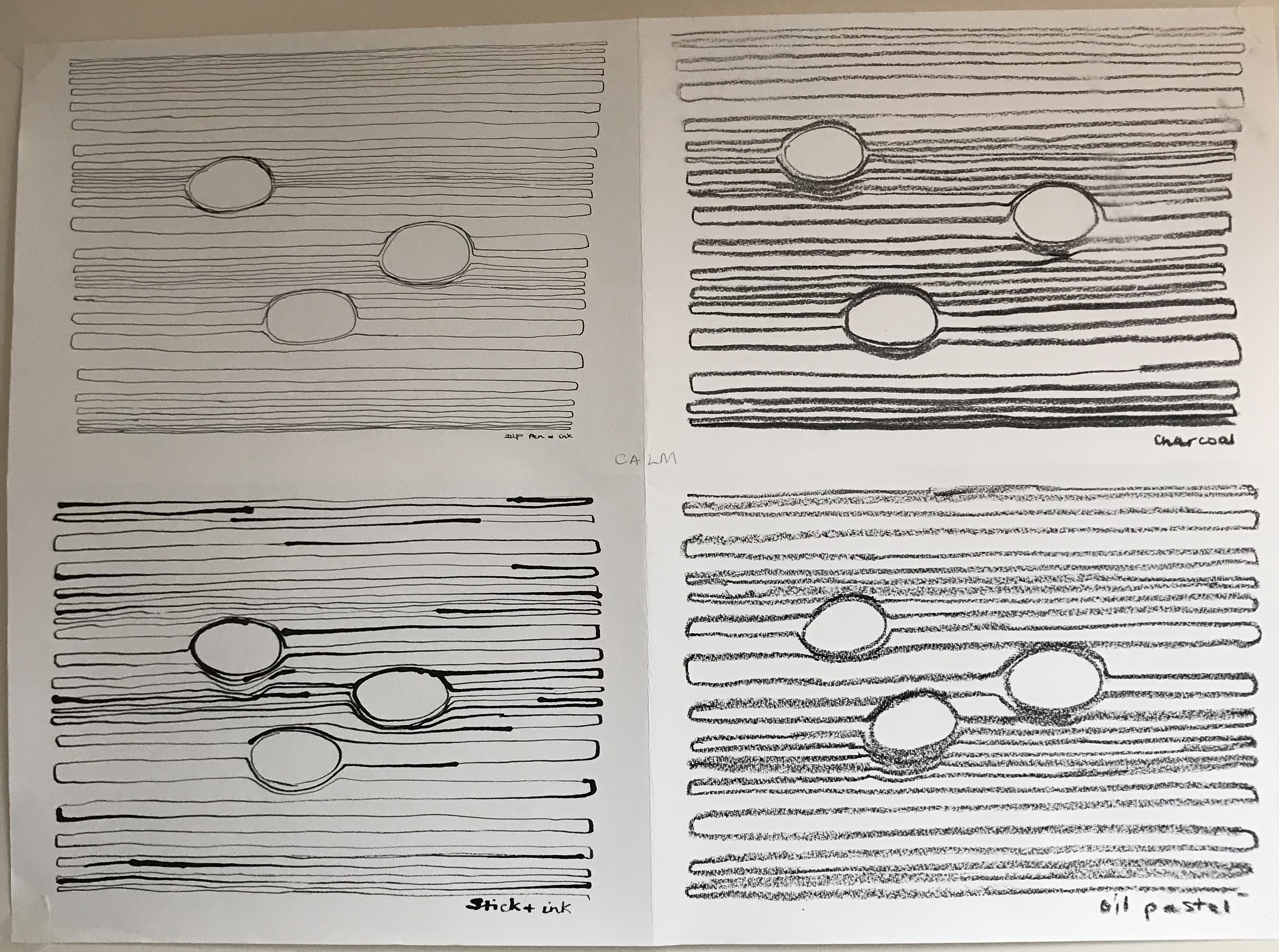
“Calm”

  • Most effective as I envisaged it with pen and ink (I wanted to use a continuous line throughout, and imagined it as one of those Zen gardens with the swept sand and boulders)  
  • Charcoal and oil pastel turned out looking quite similar, although you can make better gradations light-to-dark with charcoal
  • I enjoyed doing this – actually did it during an art group session – it was very absorbing (whilst allowing me to listen in to random discussions about squirrels and barn owls in a serene and detached manner)
  • The stick and ink was a bit of a surprise – it was hard to control, but felt the most “fun”
  • It turns out I’m better and drawing lines left-to-right than right-to-left
  • Comments from art group members passing by:
    • “Oh dear, what’s that?”
    • “Yes, I can see it’s calm”
    • “Think I’d need a drink first!” (when asked to guess which emotion)
    • “Looks like the grain of wood with knots in”
    • “Oceans of tranquility”
    • “I thought you were going to write music”
    • “Looks like spoons”
    • “Like coracles spinning in water”

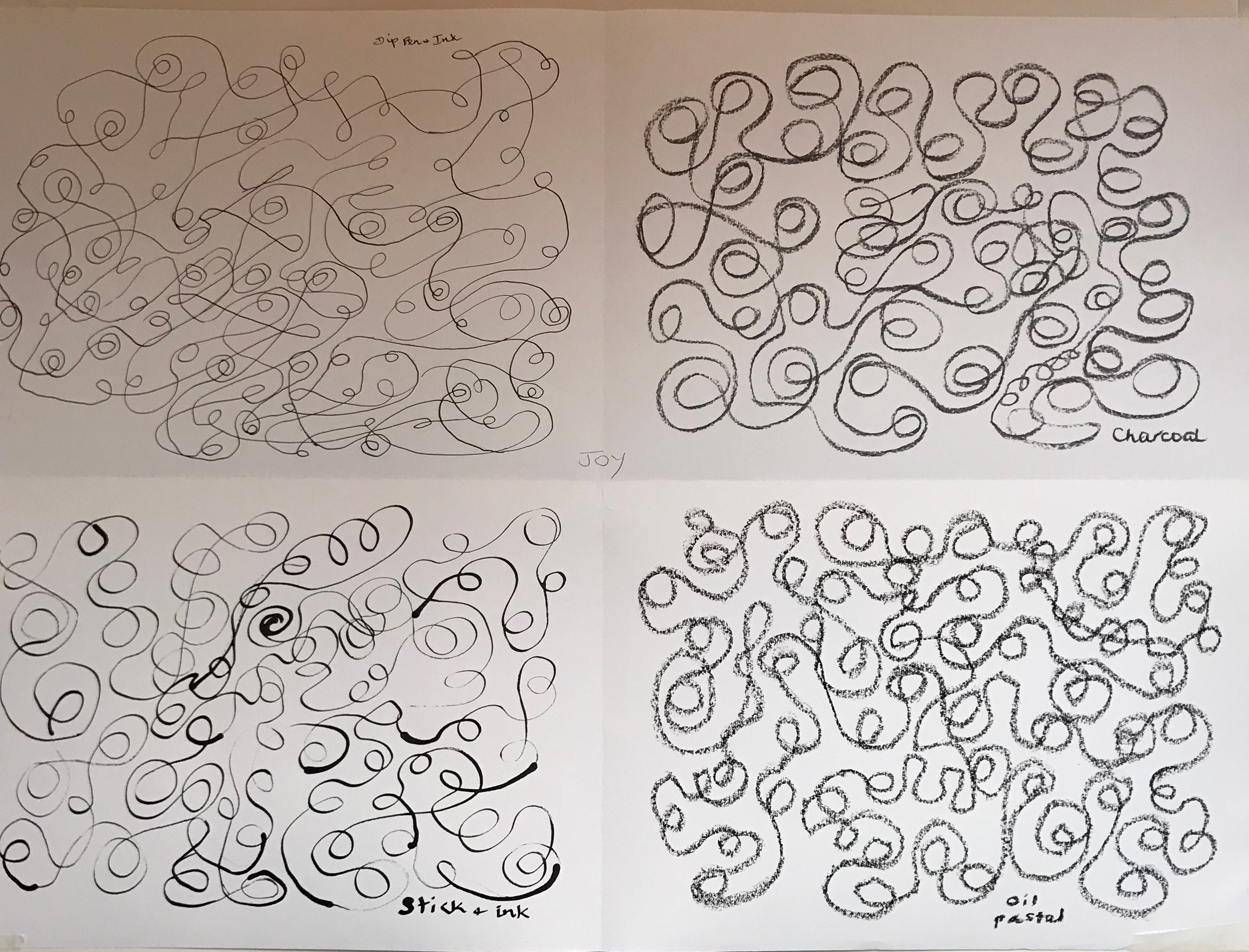
 “Joy”

  • I felt quite stilted as I started making loopy lines in the centre of the pen and ink drawing, but managed to relax a bit and let go, and the loops gradually developed a life of their own, until they felt like children tumbling head-over-heels in the park
  • The charcoal felt like a dream with this sort of mark, much more so than with the straight lines of “Calm” – it ran so smoothly, feeling almost creamy, and the loops and swirls became much curvier as a result
  • Again, the stick and ink gave me the permission to be free and mess about and, of the four, I think this is the most appealing image with its unpredictable conjunction of thick and thin lines
  • The oil pastel was again my least favourite to use – you feel as if you are having to push it the whole time – but the image turned out better than the straight lines, I think – very round loops with caterpillar-track texture, bit like a drunken earthworm

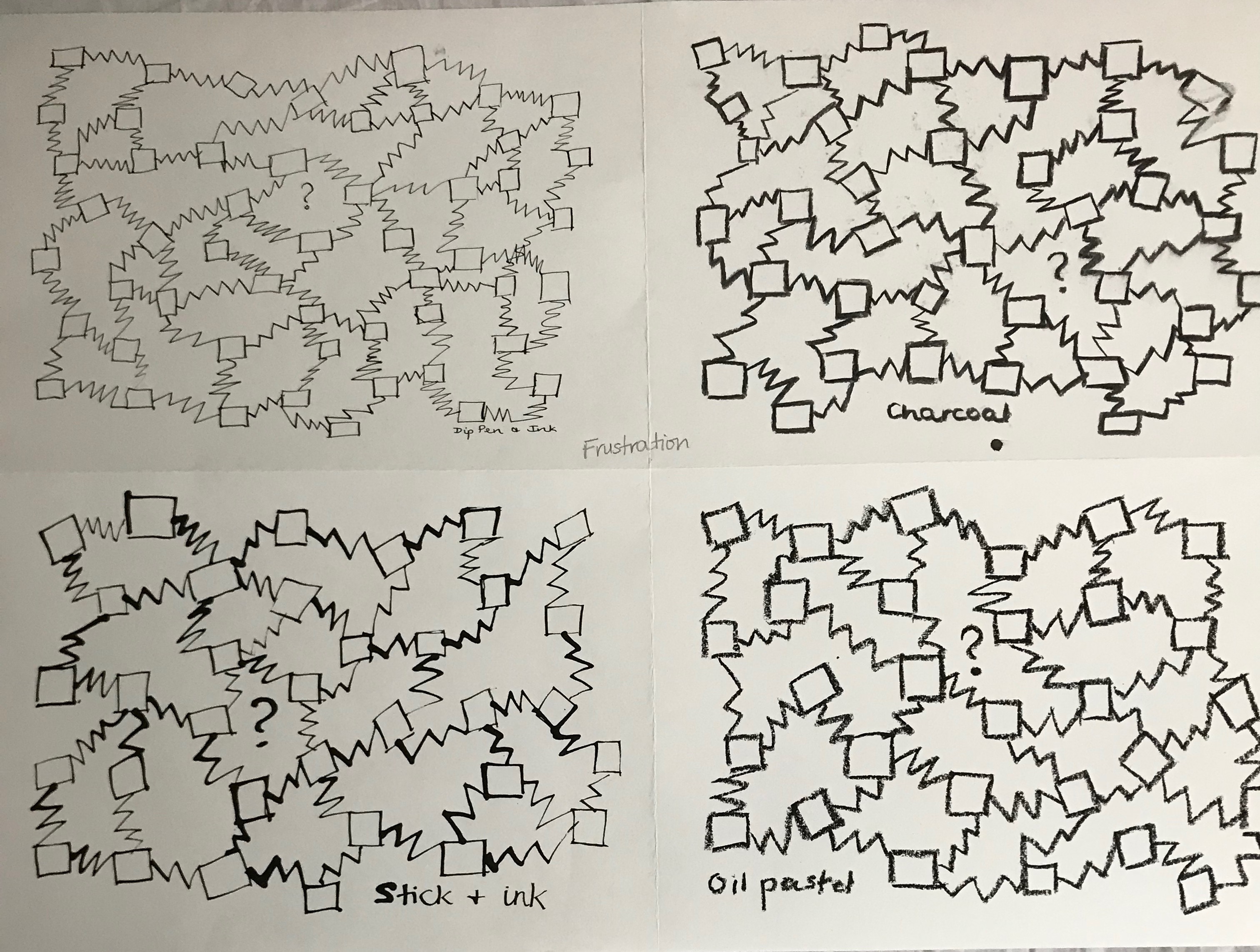
“Frustration”  

  • Inspired by my attempts to get to grips with WordPress!
  • Worked this much quicker -”Calm” was very calm and leisurely by comparison – and the design came to me very rapidly
  • The charcoal felt the easiest to express the emotion – could zig-zag at speed!

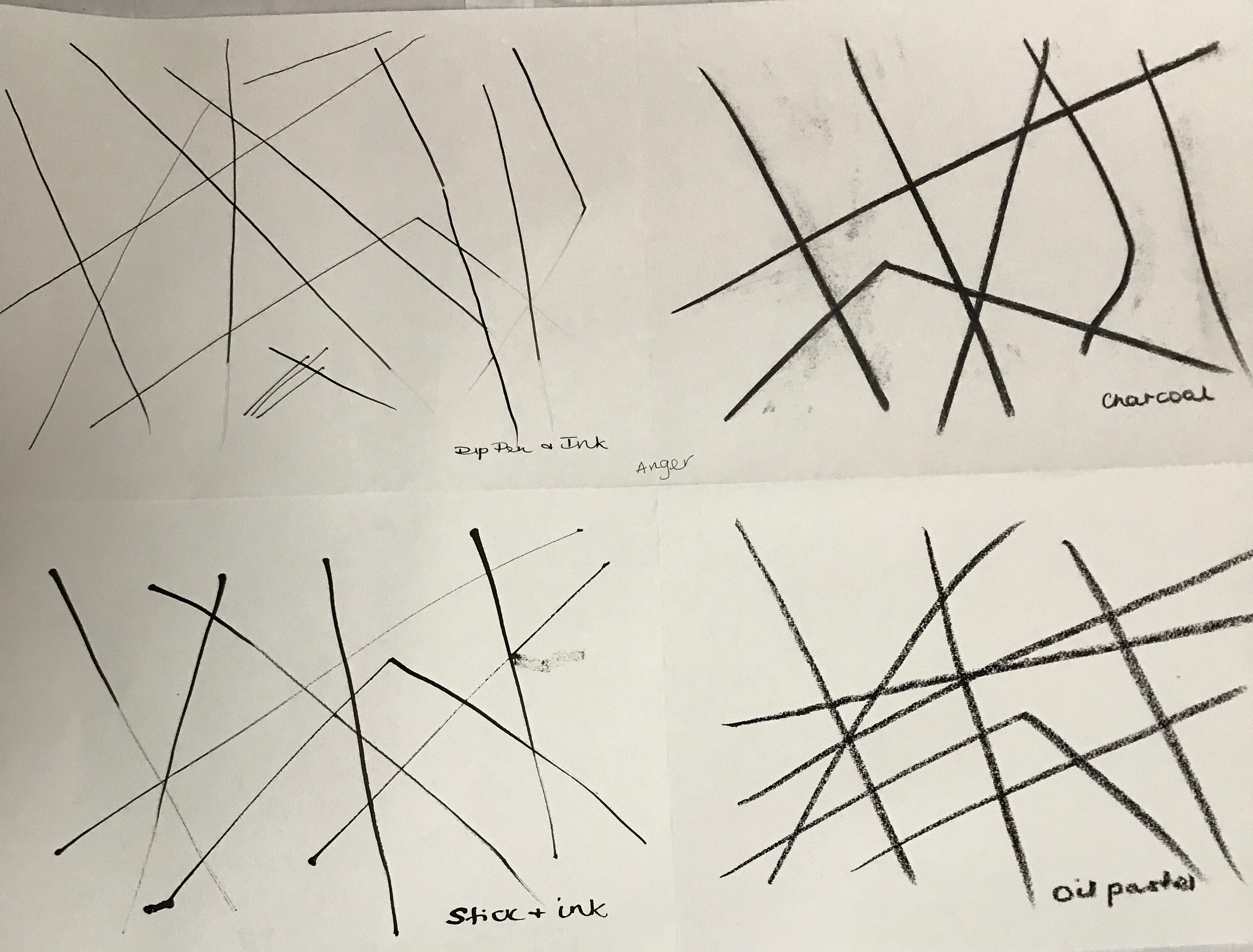
“Anger”              

  • I chose to interpret this as real anger, rather than just annoyance, and so I had put it off till last as I am not a very angry person and I had to draw deep on memories to get me in the mood (and maintain it)
  • The oil pastel feels the only medium where the emotion is not really reflected in the quality of the line

GENERAL REFLECTIONS ON THE EXERCISE

Drawing 1, Part 1 warm-up

Temporary drawings

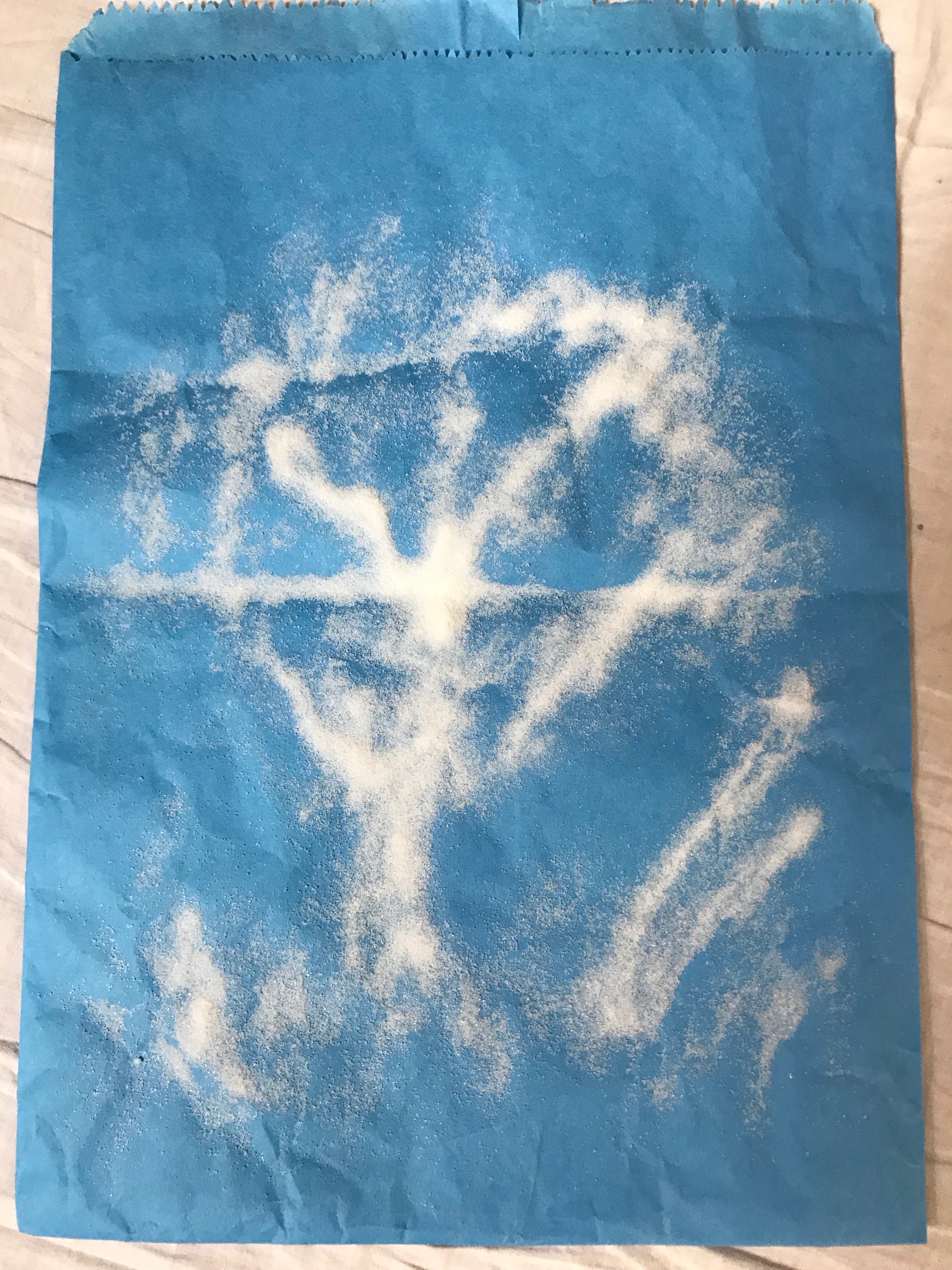
I had a go at drawing a tree with free-flowing salt onto a blue paper bag background.

Thought I was being clever by putting a fold in the bag so I could pour the salt off into a jar afterwards, but this seriously affected the way the salt lay on the paper. I tried making thick and thin lines by varying my salt flow, but it was tricky to control, and I’m not sure anyone would recognise it as a tree unless I gave them a hint!

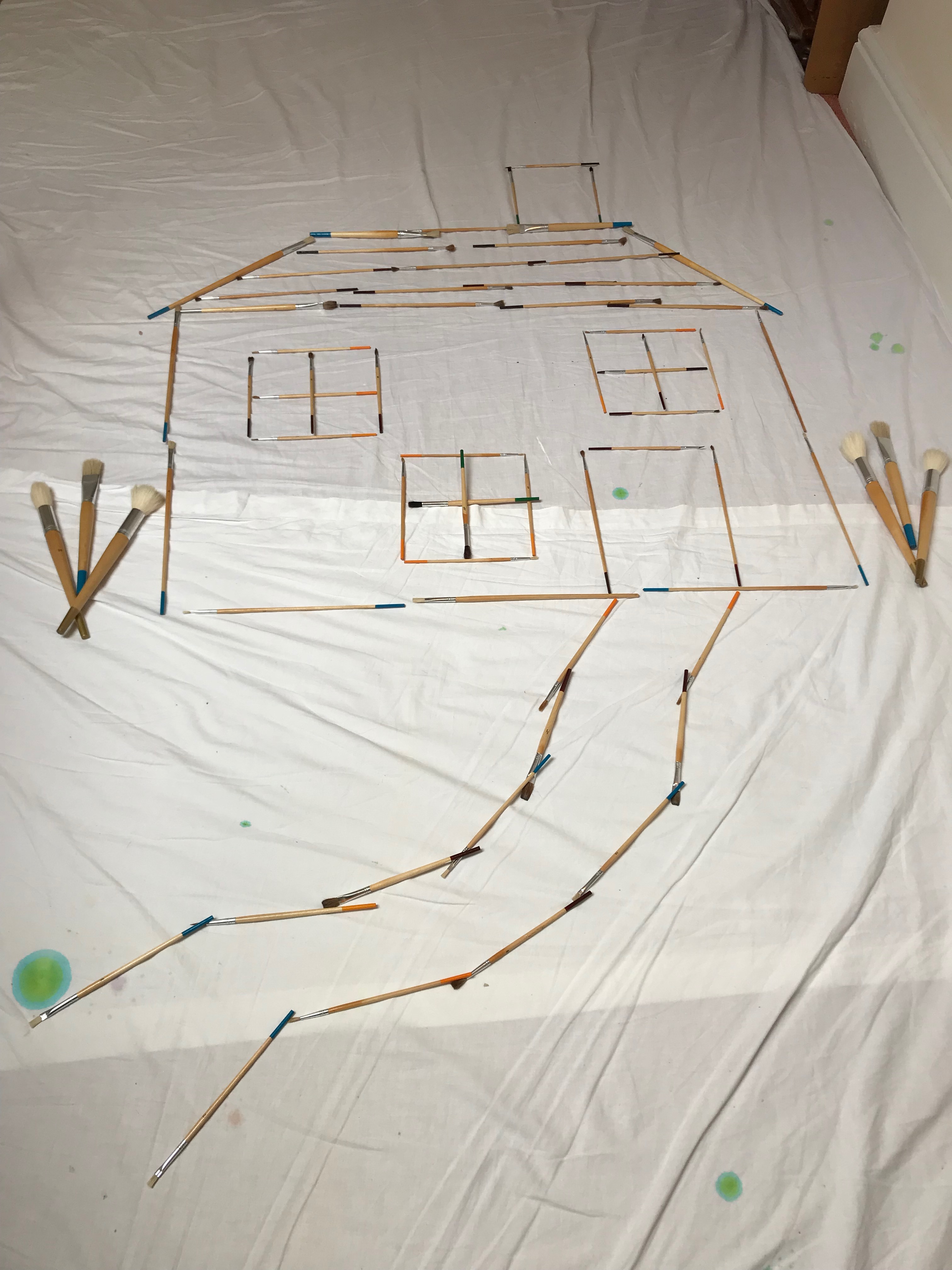
Next I tried making a stereotypical child-like drawing of a house using a tub of cheap (but very varied) paintbrushes. I was able to play about more with this, as it appealed to my organising instincts, and much fun was had comparing lengths of brush for matching sets to make windows etc. The thick bushy brushes made good garden shrubs, and I experimented with making curved lines from straight sticks to construct the path.

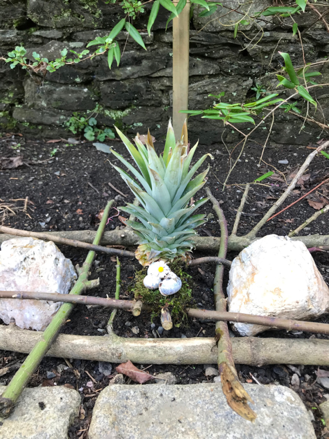
There was no-one around to photograph me crawling around on the floor of my art-room making either of these, but I would like to try another out in the garden at some stage; I can remember looking at Andy Goldsworthy’s work with the children at school (I was a primary teacher) many moons ago, when we created our works of art down on the foreshore of the River Tavy. The children at that time seemed unconcerned that their masterpieces would be washed away downriver with the next downpour of rain – to them, the making of it was the thing (especially since they knew I had taken photos), and I feel the same – if you accept from the start that the artwork is not meant to last, you are freer just to go for it and enjoy yourself.

There was no-one around to photograph me crawling around on the floor of my art-room making either of these, but I would like to try another out in the garden at some stage; I can remember looking at Andy Goldsworthy’s work with the children at school (I was a primary teacher) many moons ago, when we created our works of art down on the foreshore of the River Tavy. The children at that time seemed unconcerned that their masterpieces would be washed away downriver with the next downpour of rain – to them, the making of it was the thing (especially since they knew I had taken photos), and I feel the same – if you accept from the start that the artwork is not meant to last, you are freer just to go for it and enjoy yourself.