We went on our annual culture fest to London 6-10 January this year, trying to walk the tightrope of visiting as many exhibitions as possible without getting brain freeze.
Tate Britain – William Blake
This is quite brain freezing by the time you get even halfway round – I noticed several people pausing and looking around, taking a deep breath and clearly thinking Oh my goodness – there’s more!?
I don’t think I’ve ever seen a body of work quite like this. It spans Blake’s life, and he was prolific, meticulous, talented……and yet his art didn’t seem to me to develop and grow. His figures, whether drawn or painted or printed, are all in the same mould – tall, highly muscled, thick-necked, either nude or diaphanously clad, with straight Roman noses and pointed chins, staring dark eyes and often dark open mouths. Females and angelic types have hugely long thighs; heroic looking men have thick, muscular thighs. His favourite of all appears to be the man with the flowing beard, who at some stage in each series (he painted loads of series telling stories, some intelligible, others less so) is bound to feature sitting staring out of the picture full face with his knees tucked up under his chin. Gestures are sweeping, bodies are either oddly contorted or else gracefully flowing. He often drew or painted to illustrate a text, which is meticulously written, often tiny.
The only sets of pictures where individuals seem to depart from his “standard” faces are (a) the Chaucer series, where one can easily pick out particular characters, and (b) his late pictures of his visions, such as The Flea.
It was all so, so strange – one felt compelled to get to the end and give it all one’s full attention, and yet there was a feeling of drowning in it and disappearing into his, obviously brilliant, yet surely disturbed, psyche. But his influence on artists to follow, whether consciously or unconsciously, is there for those who look – surely Byrne Jones was attracted by the tall, sweeping ladies with the slightly bowed heads; Ronnie Mackintosh by the symmetrical angels in The angels hovering over the body of Christ in the sepulchre, c.1805, ink, watercolour on paper; Gaudier Brzeska in his more twisted forms?
Royal Academy – Lucian Freud self portraits
Inspiration!
The progression here was so startling – from line to paint, sort-of-good-ok to wonderful.
The drawings at first were average art student standard but grew in confidence as he started to experiment with composition, often having himself peering into drawings rather than being the obvious subject, and his use of varied mark making became an object lesson. An oddity was his facial proportion; his eyes were often set way above halfway up, making the top of his head seem artificially flattened or squashed – surely not a mis-seeing as his seeing becomes his superpower?
As soon as he jumps to painting, the oddity of proportion disappears. His experiments with watercolour are interesting as he does achieve lights and darks and gradations of colour, but the oils are what blows you away. The “seeing superpower” is highlighted by the way he works – a quick scrappy charcoal sketch, and then straight in with the painting which appears to grow out fully formed from the centre – the complete opposite of the advice I’ve always been given about working all parts of the image at once for harmony and continuity. Uncanny. Sheer brilliance. Unusually though, he never puts highlights in the eyes, making them seem like wells of dark, which all adds to the compelling quality of the images.
Royal Academy – Laura Knight
This was just a one-room exhibition, but was of great interest to me as it featured many of her drawings and sketchbooks from her interest in life drawings of circus performers, dancers etc – hence very relevant to my current work on Drawing 1 Part 4. At first it seemed to me as if she had two styles of sketching which was a little confusing – but I think it’s because, when she has a moderately static scene in front of her, she has time to put in shading (which she often does quite heavily – see e.g. Figures by the pool, c 1959, black biro in a sketchbook, Royal Academy of Arts, London), whereas when the subject is highly mobile, she focuses a lot of information into clean single lines (e.g. Drawing of ballet dancers, c. 1930s, pen and ink on paper, Royal Academy, London – about which she says: “..found the value of what I call rhythm, repetition of line, accented beat and cross rhythm, as in music”.) Lots of useful similar examples to be found in Valentine & Wickham, 2019, Laura Knight, A working life. Royal Academy of Arts, London.
National Gallery – Paul Gaugin – Portraits
When this exhibition was first reviewed in the national press, it seemed as though the gallery was very anti Gaugin’s attitudes and morals on the basis that he had taken advantage of young girls in Tahiti – and so I went with a positive mindset, determined to form my own opinions. I have never been completely sure about Gaugin anyway, he has always been in my mind the less talented half of the short-lived partnership with Van Gogh. The way the exhibition notes were written harped on rather about how frankly self-obsessed Gaugin was, how he was forever depressed about his lack of commercial success, etc, which did little to bolster my opinion of him – it felt they were showing his works almost in spite of themselves.
So, what of his actual work? Bright colours abound, and nearly every painting had a main pair of colours which were complementaries; blue and orange dominated, but there was also much red and green, and only a smattering of purple and yellow, although this was the dominant pairing on one of my favourites, Woman of the Mango, 1892, oil on canvas, Baltimore Museum of Art. He is a capable draughtsman, although there was not too much simple drawing to go on; my favourite was of a sketch of a face, or parts thereof, which he executes in very clear bold lines, and in which he was practising a nose which I could then identify about three paintings along – so he obviously did use drawing to work through tricky bits. His drawings of his erstwhile friend, Meijir de Haan (1889-90) and L’Arlesienne, Madame Ginoux, 1888, depict strong characters with a few bold confident lines. In his early days his paintings shimmered and had the short dabbed directional brushstrokes of Van Gogh, and I preferred those – for example, Interior with Aline, 1881, oil on canvas, private collection; and his still lifes are very Cezanne-like, e.g. Still Life with Profile of Laval, 1886, oil on canvas, Indianapolis Museum of Art. I suppose the later paintings feel as if they lack life because they look very flat, being painted apparently in thin washes; it seems that he disapproved of Van Gogh’s habit of applying paint thickly. And yet, by far my favourite painting in the whole exhibition is the last one, rendered shortly before his death; it is a self-portrait (Self portrait, 1903, oil on canvas, Kunstmuseum, Basel), looking directly out, no side, no weird objects in the background, no assumption of a character, no artifice, no bright colours (although he returned in a muted way to his apparent favourites, orange and blue) and I thought – here is the man – shame he didn’t do loads more of this.
National Portrait Gallery – Pre-Raphaelite Sisters
This was a spur of the moment afternoon visit after the Gaugin in the morning – we wondered if we had the brainspace and concentration to do it justice, but it was as a well constructed exhibition with (good from my point of view) several excellent portrait drawings which have illustrated to me only too plainly just what can be achieved with graphite, charcoal and chalk. Back to the drawing board, then….

A couple which blew me away by the way of illustration are both by Dante Gabriel Rossetti;
Fanny Cornforth, 1874, coloured chalks on paper, Birmingham Museums and Art Gallery

Christina Rossetti, 1866, coloured chalk on paper, private collection.
British Museum – inspired by the East
This exhibition looked at the effects of Islamic art from about 1500 upon us in the West. It explores the fascination we had with the Ottoman (Turkey etc) and Sarafid (Iran) empires (and indeed their gradually growing interest in us) and how this was fed by artists who went out and drew and painted somewhat idealised scenes, and of course, other artists who never left their studio but drew from a jumbled mismatched set of objects acquired from dealers. Some great drawings from life by Delacroix, but slightly disappointed by Ingres who totally invented harem odalisque drawings as Westerners were not allowed access and they therefore used their imaginations and used this as a bit of an excuse for female nude life drawings (in fairness, he was by no means alone in this, but I had thought better of him). Interestingly, the image on the publicity material which had drawn me in in the first place, a beautiful turquoise ceramic decorated vase, turned out to be 1800s European and based on the revival of ceramic, enamelling and glassware skills inspired by the Oriental Islamic craze. Stand out object by far for me was a set of 4 decorated tiles from 1500 – all the Western replicas and offshoots were around, but couldn’t match it for brilliance and sheer joyousness.
British Museum – Kathe Kollwitz
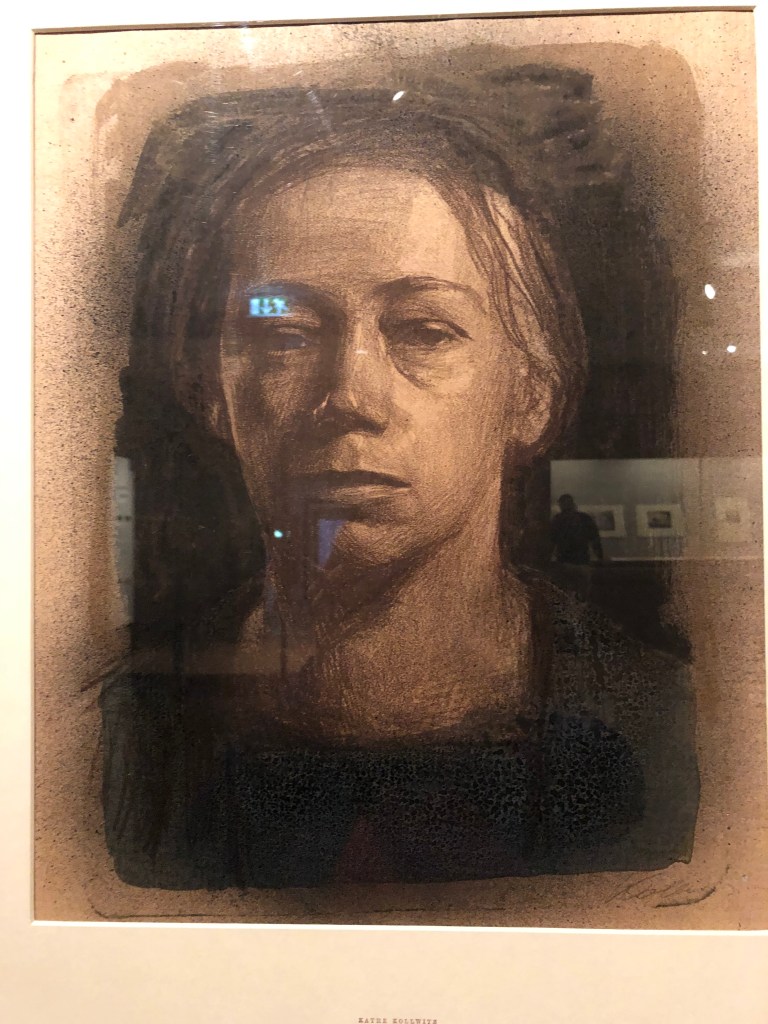
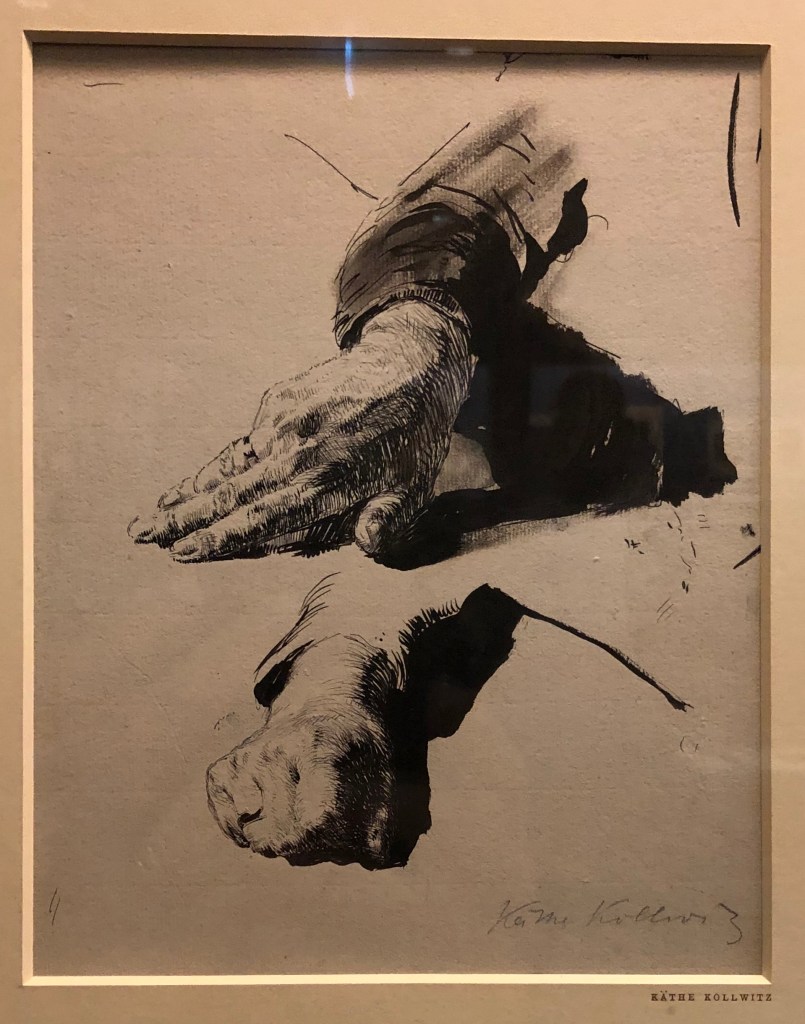
Unexpected and only open for two more days! I hadn’t known that this German artist of prints and etchings. Much of her work on show related to the First World War and was rather harrowing, as was her work on the death of a child (she had lost her son Peter) and, very self-indulgently, I wasn’t feeling in the mood for being harrowed. But there were a few excellent life drawings and portraits which drew my attention – specifically……
Self portrait in full face, 1904, crayon and brush lithograph in three colours overworked with black wash, British Museum
Studies of the artist’s left hand (or her right hand drawn as a mirror reflection) 1891, pen, black ink and wash, British Museum.
British Museum – Pushing Paper
I had already purchased the book accompanying this small exhibition (Seligman, Isabel (ed.)(2019), Pushing Paper, Contemporary drawing from 1970 to now, Thames and Hudson Ltd, London) so had an idea of what to expect, although art is almost invariably much more striking in real life, and that proved to be the case here.
Several pieces one ‘gets the hang of’ better, for example: David Nash’s Wooden Boulder, 1981, black-and-white photograph with graphite, charcoal and gouache on cream card – in the book I hadn’t appreciated the map-like quality of the drawings, which stand out much more in the (much larger) original – maps in drawings always appeal to me for some reason, think I must try them out for myself… My favourite after looking round though was still the image they have chosen for the back cover – Minjung Kim’s Mountain, 2009, ink on hanji paper – a demonstration of how knowledge and experience of materials and supports can make or break a drawing.






 Sue J's blog